Medium MCAT Endocrine System Practice Questions
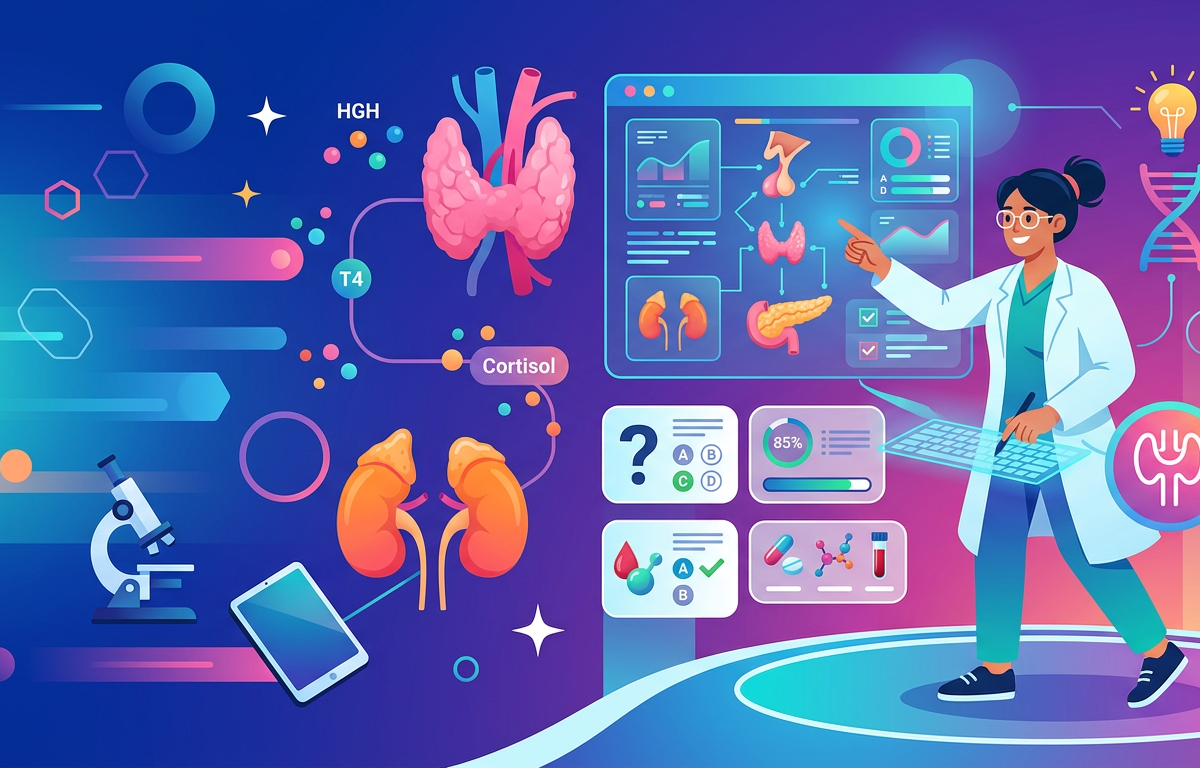
Medium MCAT Endocrine System Practice Questions
Mastering the endocrine system is essential for success on the Biological and Biochemical Foundations of Living Systems section of the MCAT. This high-yield topic requires more than just memorizing a list of glands; you must understand the feedback loops, chemical classifications, and physiological impacts of various hormones. These Medium MCAT Endocrine System Practice Questions are designed to bridge the gap between basic memorization and the complex application required on exam day.
If you are looking to broaden your review, check out our MCAT Biology Practice Questions with Answers for a comprehensive overview of other biological systems. Utilizing retrieval practice is one of the most effective ways to ensure this information sticks long-term.
Concept Explanation
The endocrine system is a network of glands and organs that produce and secrete hormones directly into the circulatory system to regulate distant target organs and maintain homeostasis. Unlike the nervous system, which uses electrical impulses for rapid, localized communication, the endocrine system utilizes chemical messengers for slower, more sustained, and widespread effects. Hormones are generally classified into three categories: peptides, steroids, and amino acid derivatives.
Hormone Classifications
- Peptide Hormones: Composed of amino acids, these are polar and cannot cross the plasma membrane. They bind to extracellular receptors and trigger second messenger cascades (e.g., cAMP, ). Examples include insulin and ADH.
- Steroid Hormones: Derived from cholesterol, these are nonpolar and can diffuse through the lipid bilayer. They bind to intracellular or intranuclear receptors to alter gene transcription. Examples include cortisol and testosterone.
- Amino Acid Derivatives: Derived from one or two amino acids (usually tyrosine or tryptophan). Their behavior varies; catecholamines like epinephrine act like peptides, while thyroid hormones act like steroids.
The Hypothalamic-Pituitary Axis
The hypothalamus serves as the bridge between the nervous and endocrine systems. It controls the anterior pituitary through the hypophyseal portal system using releasing hormones (e.g., GnRH, TRH). The posterior pituitary, however, does not synthesize hormones; it stores and releases oxytocin and ADH produced by the hypothalamus. Most endocrine pathways are regulated by negative feedback, where the final product of a pathway inhibits the hormones or enzymes earlier in the sequence to maintain a set point.
Solved Examples
- Question: A patient presents with high serum calcium levels. Which hormone is likely being overproduced, and what is its mechanism?
Solution:- Identify the hormone responsible for increasing blood calcium: Parathyroid Hormone (PTH).
- Determine the source: Parathyroid glands.
- Analyze the mechanism: PTH increases bone resorption (breakdown) by osteoclasts, increases calcium reabsorption in the kidneys, and stimulates the activation of Vitamin D to increase intestinal calcium absorption.
- Conclusion: Overproduction of PTH (hyperparathyroidism) leads to hypercalcemia.
- Question: How does the mechanism of action differ between Vasopressin (ADH) and Aldosterone regarding osmolarity?
Solution:- ADH (peptide) increases water permeability in the collecting duct via aquaporins. This increases water reabsorption alone, which decreases blood osmolarity.
- Aldosterone (steroid) increases pump activity in the distal tubule. Since water follows the salt osmotically, the net gain is isotonic. Therefore, blood osmolarity remains the same.
- Conclusion: ADH changes osmolarity; Aldosterone changes blood volume without changing osmolarity.
- Question: Predict the effect of a tumor that hypersecretes ACTH on the levels of CRH and Cortisol.
Solution:- ACTH stimulates the adrenal cortex to release Cortisol. Therefore, Cortisol levels will be high.
- Cortisol exerts negative feedback on both the anterior pituitary and the hypothalamus.
- High Cortisol will inhibit the hypothalamus from releasing Corticotropin-releasing hormone (CRH).
- Conclusion: High ACTH leads to high Cortisol and low CRH.
Practice Questions
- Which of the following hormones is most likely to require a protein carrier for transport in the bloodstream?
A. Insulin
B. Epinephrine
C. Aldosterone
D. Oxytocin - A researcher discovers a hormone that binds to a G protein-coupled receptor (GPCR). This hormone is most likely synthesized in the:
A. Rough Endoplasmic Reticulum
B. Smooth Endoplasmic Reticulum
C. Mitochondria
D. Cytosol - If a patient has a deficiency in iodine, which of the following physiological changes would be expected?
A. Increased metabolic rate
B. Decreased levels of TSH
C. Hypertrophy of the thyroid gland
D. Weight loss
Need more MCAT practice questions?
Generate unlimited MCAT-style questions with instant explanations and adaptive practice powered by Bevinzey AI.
Generate Questions Free- Which of the following correctly pairs a hormone with its direct effect on the nephron?
A. ANP: Increases sodium reabsorption in the distal convoluted tubule.
B. ADH: Increases water urea recycling in the loop of Henle.
C. Aldosterone: Increases potassium secretion in the collecting duct.
D. PTH: Decreases calcium reabsorption in the proximal tubule. - A patient is unable to produce sufficient amounts of Guanylate Cyclase. Which hormone's signaling pathway would be most directly compromised?
A. Atrial Natriuretic Peptide (ANP)
B. Glucagon
C. Cortisol
D. Growth Hormone - During periods of prolonged starvation, which of the following hormone profiles is most likely?
A. High Insulin, High Glucagon, Low Cortisol
B. Low Insulin, High Glucagon, High Cortisol
C. High Insulin, Low Glucagon, High Epinephrine
D. Low Insulin, Low Glucagon, Low Cortisol - Which of the following is a key difference between the anterior and posterior pituitary?
A. The anterior pituitary is connected to the hypothalamus via neurons.
B. The posterior pituitary produces its own hormones, while the anterior does not.
C. The anterior pituitary receives hypothalamic hormones via a portal system.
D. The posterior pituitary is regulated by negative feedback, while the anterior is not. - Somatostatin is known to inhibit the release of which two hormones?
A. Insulin and Glucagon
B. GH and Prolactin
C. TSH and ACTH
D. Epinephrine and Norepinephrine
Answers & Explanations
- Answer: C. Aldosterone is a steroid hormone. Because steroid hormones are lipophilic (nonpolar), they are not soluble in the aqueous environment of the blood and require carrier proteins (like albumin or specific globulins) for transport. Insulin, Epinephrine, and Oxytocin are polar and can travel freely in the plasma.
- Answer: A. GPCRs are extracellular receptors, meaning the signaling molecule is likely a peptide hormone. Peptide hormones are proteins synthesized on ribosomes bound to the Rough Endoplasmic Reticulum (RER). Steroid hormones, conversely, are synthesized in the Smooth ER.
- Answer: C. Iodine is necessary for the synthesis of and . Without it, thyroid hormone levels drop, removing the negative feedback on the anterior pituitary. This causes an increase in TSH, which overstimulates the thyroid gland, leading to a goiter (hypertrophy).
- Answer: C. Aldosterone acts on the distal convoluted tubule and collecting duct to increase the activity of the ATPase, resulting in sodium reabsorption and potassium secretion. ANP actually decreases sodium reabsorption.
- Answer: A. ANP uses a cGMP-dependent signaling pathway, which involves the enzyme Guanylate Cyclase. Glucagon uses the cAMP pathway (Adenylate Cyclase). Cortisol is a steroid and acts as a transcription factor.
- Answer: B. Starvation is a catabolic state. To maintain blood glucose, insulin (an anabolic hormone) will be low, while "counter-regulatory" hormones like glucagon, cortisol, and epinephrine will be high to promote gluconeogenesis and lipolysis.
- Answer: C. The anterior pituitary is glandular tissue that receives releasing/inhibiting hormones from the hypothalamus via the hypophyseal portal system. The posterior pituitary is neural tissue that stores hormones made in the hypothalamus.
- Answer: A. Somatostatin, also known as growth hormone-inhibiting hormone, is produced by delta cells of the pancreas and the hypothalamus. In the pancreas, its primary role is to inhibit the secretion of both insulin and glucagon.
For more practice with complex physiological systems, review our MCAT Physiology Practice Questions or dive into MCAT Nervous System Practice Questions to see how these systems integrate.
1. Which hormone is derived from cholesterol?
Frequently Asked Questions
What is the difference between direct and tropic hormones?
Direct hormones act immediately on target tissues to cause a physiological change, such as growth hormone affecting bone growth. Tropic hormones act on other endocrine glands to trigger the release of a second hormone, such as TSH stimulating the thyroid.
How do peptide and steroid hormones differ in their speed of action?
Peptide hormones generally have a rapid but short-lived effect because they utilize second messenger cascades that amplify signals quickly. Steroid hormones have a slower onset but longer-lasting effects because they must alter gene expression at the level of DNA transcription.
Why is the hypothalamus called the "master gland" regulator?
The hypothalamus integrates signals from the central nervous system and translates them into endocrine signals. By controlling the pituitary gland via the hypophyseal portal system and direct neuronal connections, it regulates almost every major hormonal axis in the body.
What is the role of the hypophyseal portal system?
The hypophyseal portal system is a specialized capillary bed that allows hypothalamic hormones to travel directly to the anterior pituitary without entering systemic circulation. This ensures high concentrations of releasing hormones reach their target cells efficiently.
How does negative feedback maintain homeostasis in the endocrine system?
Negative feedback occurs when the end product of a pathway inhibits the upstream hormones that stimulated its production. This prevents the over-accumulation of hormones and ensures that physiological variables, like blood glucose or calcium, remain within a narrow, healthy range.
What are the primary hormones involved in the "fight or flight" response?
The primary hormones are epinephrine and norepinephrine, which are catecholamines released from the adrenal medulla. They act rapidly to increase heart rate, dilate bronchioles, and shunt blood flow toward skeletal muscles during acute stress.
Need more MCAT practice questions?
Generate unlimited MCAT-style questions with instant explanations and adaptive practice powered by Bevinzey AI.
Generate Questions FreeReviewed by
Michael Danquah, MS, PhD
Dr. Michael Danquah is a professor of pharmaceutical sciences and founder of several educational technology platforms focused on improving student learning and performance.
Enjoyed this article?
Share it with others who might find it helpful.
Related Articles
Hard MCAT Endocrine System Practice Questions
Hard MCAT Endocrine System Practice Questions
May 9, 2026

Hard MCAT Immune System Practice Questions
Master the complexities of the immune system with these hard MCAT practice questions covering MHC restriction, clonal selection, and the complement system.
May 9, 2026
Hard MCAT Philosophy Passage Practice Questions
Master Hard MCAT Philosophy Passage Practice Questions with our comprehensive guide featuring solved examples, practice questions, and expert explanations.
May 17, 2026

Hard MCAT Humanities Passage Practice Questions
Master Hard MCAT Humanities Passage Practice Questions with our comprehensive guide featuring solved examples, practice questions, and expert strategies.
May 17, 2026

Hard MCAT Critical Analysis Practice Questions
Hard MCAT Critical Analysis Practice Questions
May 17, 2026
Hard MCAT Reading Comprehension Practice Questions
Hard MCAT Reading Comprehension Practice Questions
May 17, 2026
Hard MCAT CARS Passage Practice Questions
Master high-difficulty MCAT CARS passages with our expert guide featuring solved examples, practice questions, and detailed logical analysis.
May 17, 2026

Hard MCAT CARS Practice Questions
Master Hard MCAT CARS Practice Questions with our comprehensive guide featuring solved examples, practice passages, and expert reasoning strategies.
May 17, 2026