Medium MCAT Biology Exam Practice Questions
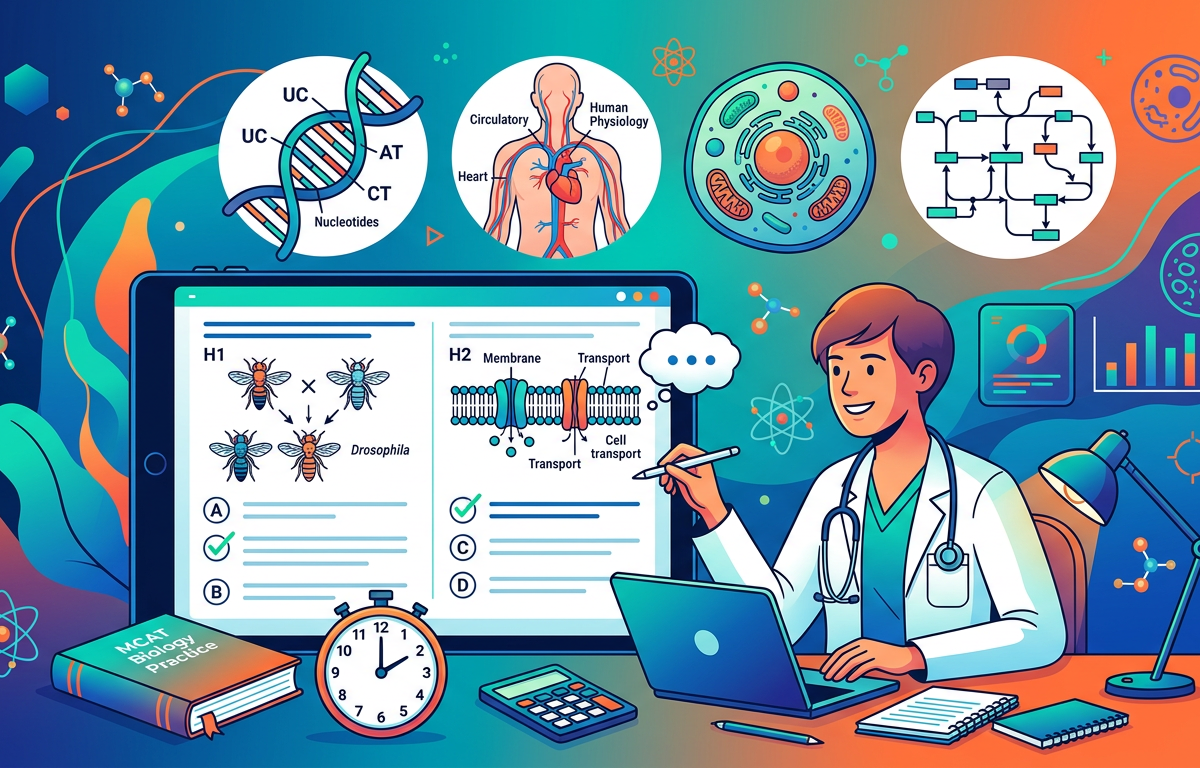
Medium MCAT Biology Exam Practice Questions
Preparing for the MCAT requires more than just memorizing facts; it demands a deep understanding of how biological systems interact and the ability to apply that knowledge to complex scenarios. These Medium MCAT Biology Exam Practice Questions focus on high-yield topics such as genetics, metabolic pathways, and organ system physiology to help you bridge the gap between basic recall and advanced application.
Concept Explanation
MCAT Biology focuses on the "living systems" aspect of the exam, testing your knowledge of how organisms maintain homeostasis, reproduce, and process energy. At the medium difficulty level, questions often require you to integrate multiple concepts—for example, understanding how a change in the endocrine system might affect renal filtration or how a specific mutation in genetics influences protein folding and enzyme kinetics. Success on this section involves mastering the central dogma of molecular biology, the mechanics of cell division, and the intricate feedback loops that govern human physiology. By using retrieval practice, you can strengthen the neural pathways required to recall these complex mechanisms under the time pressure of the actual exam.
Solved Examples
Reviewing these solved examples will help you understand the logic required to tackle multi-step biology problems.
- Example: Enzyme Inhibition
A researcher identifies a molecule that binds to an enzyme only when the substrate is already bound to the active site. What happens to the and of the reaction?- Identify the type of inhibition: Binding only to the enzyme-substrate (ES) complex is the hallmark of uncompetitive inhibition.
- Recall the effects: Uncompetitive inhibitors prevent the substrate from leaving the active site, effectively increasing the affinity (decreasing ) and reducing the maximum velocity because the ES complex is being removed from the productive pathway.
- Conclusion: Both and decrease.
- Example: Genetics and Probability
In a cross between two individuals with the genotype , what is the probability of producing an offspring that is phenotypically dominant for both traits, assuming independent assortment?- Break down the cross by trait: For trait A (), the probability of a dominant phenotype ( or ) is .
- Apply the same logic to trait B: The probability of a dominant phenotype for B is also .
- Use the multiplication rule: .
- Conclusion: The probability is .
- Example: Hemoglobin Dissociation
How does a decrease in blood pH (acidosis) affect the oxygen-hemoglobin dissociation curve?- Relate pH to the Bohr Effect: A lower pH means a higher concentration of ions.
- Determine the shift: Increased and concentrations stabilize the T-state (tense state) of hemoglobin, which has a lower affinity for oxygen.
- Analyze the graphical change: A lower affinity results in a rightward shift of the curve, meaning oxygen is more easily unloaded to the tissues.
- Conclusion: The curve shifts to the right.
Practice Questions
Test your knowledge with these practice questions designed to mimic the difficulty of the MCAT Biology section.
1. A patient presents with a mutation that prevents the formation of the tight junctions in the intestinal epithelium. Which of the following is the most likely physiological consequence?
2. During the contraction of a skeletal muscle fiber, which of the following regions of the sarcomere does NOT shorten in length?
3. If a segment of double-stranded DNA contains 20% Guanine, what is the percentage of Thymine in the same segment?
Need more MCAT practice questions?
Generate unlimited MCAT-style questions with instant explanations and adaptive practice powered by Bevinzey AI.
Generate Questions Free4. Which of the following hormonal changes occurs in response to a significant decrease in blood pressure?
5. In the citric acid cycle, which enzyme catalyzes the conversion of succinate to fumarate while reducing FAD to ?
6. A researcher discovers a drug that specifically inhibits the function of the nucleolus. Which cellular process will be most directly inhibited?
7. During oogenesis, at which stage is the secondary oocyte arrested before fertilization occurs?
8. Which of the following best describes the role of the proximal convoluted tubule (PCT) in the nephron?
Answers & Explanations
- Answer: Increased paracellular transport of solutes. Tight junctions serve as a seal between adjacent epithelial cells to prevent the uncontrolled passage of molecules. If they are defective, substances can leak between cells (paracellularly) rather than being processed through regulated transcellular pathways.
- Answer: The A-band. The A-band represents the entire length of the thick filaments (myosin). While the I-band and H-zone shorten as actin and myosin slide past each other, the A-band remains constant. This is a fundamental concept in the Sliding Filament Theory.
- Answer: 30%. According to Chargaff's rules, and . If , then . Together, . The remaining 60% must be split equally between A and T, so .
- Answer: Increased secretion of aldosterone and ADH. Low blood pressure triggers the Renin-Angiotensin-Aldosterone System (RAAS). Aldosterone increases sodium reabsorption, while Antidiuretic Hormone (ADH) increases water reabsorption in the collecting duct to expand blood volume.
- Answer: Succinate dehydrogenase. This is a unique enzyme in the Krebs cycle because it is also part of the electron transport chain (Complex II), located in the inner mitochondrial membrane.
- Answer: Ribosome biogenesis. The nucleolus is the site of ribosomal RNA (rRNA) synthesis and the assembly of ribosomal subunits. Inhibiting it would stop the production of ribosomes, eventually halting protein synthesis.
- Answer: Metaphase II. As explained in our guide on MCAT reproduction, primary oocytes are arrested in Prophase I until puberty, and secondary oocytes are arrested in Metaphase II until fertilization by a sperm cell.
- Answer: Bulk reabsorption of glucose, amino acids, and salts. The PCT is responsible for reabsorbing approximately 65-70% of the filtered load, including nearly all glucose and amino acids via secondary active transport.
1. Which of the following is a characteristic of a competitive inhibitor?
Frequently Asked Questions
What makes a biology question "medium" difficulty on the MCAT?
Medium difficulty questions typically require a two-step reasoning process, such as identifying a biological structure and then predicting how a specific change or drug would affect its function. They move beyond simple definitions to test your ability to apply concepts to new data or experimental results.
How important is enzyme kinetics for the MCAT?
Enzyme kinetics is a high-yield topic that appears frequently in both the Biology and Biochemistry sections. You must understand how different types of inhibitors change and and be able to interpret Lineweaver-Burk plots accurately.
Do I need to memorize every step of the Krebs cycle?
While you should know the main substrates and products, it is more important to understand the regulatory steps, the total yield of ATP/NADH/FADH2, and how the cycle integrates with the electron transport chain. For more on this, visit Khan Academy's Citric Acid Cycle guide.
What is the best way to study for MCAT Biology?
The most effective strategy is to combine content review with active retrieval practice. Instead of just reading, use practice questions to force your brain to recall information, which strengthens long-term memory and improves exam performance.
How is the endocrine system tested on the MCAT?
The exam focuses on the "axis" systems (like the HPA axis), the chemical nature of hormones (peptide vs. steroid), and the physiological feedback loops that maintain homeostasis. You should be able to predict how a deficiency in one hormone affects the levels of others in the pathway.
Need more MCAT practice questions?
Generate unlimited MCAT-style questions with instant explanations and adaptive practice powered by Bevinzey AI.
Generate Questions FreeReviewed by
Michael Danquah, MS, PhD
Dr. Michael Danquah is a professor of pharmaceutical sciences and founder of several educational technology platforms focused on improving student learning and performance.
Enjoyed this article?
Share it with others who might find it helpful.
Related Articles
Hard MCAT Biology Exam Practice Questions
Hard MCAT Biology Exam Practice Questions
May 9, 2026

Applying Coulomb’s Law and Potential to MCAT Biological Systems
MCAT Electrostatics Practice Questions with Answers
May 14, 2026
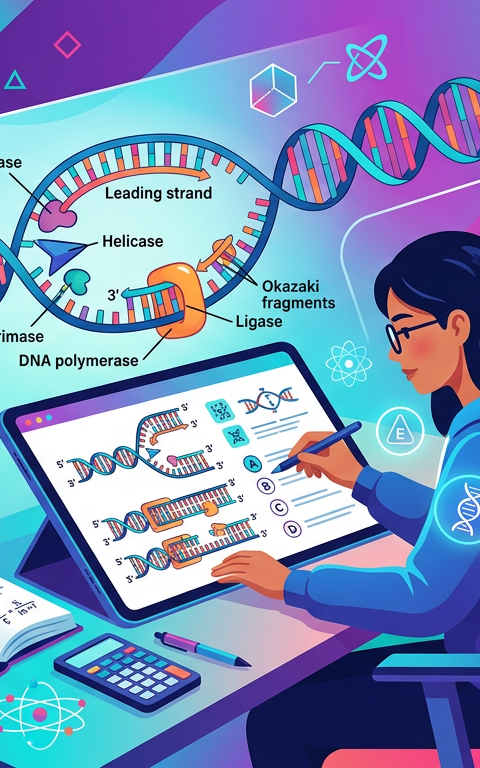
Hard MCAT DNA Replication Practice Questions
Master high-level DNA replication concepts with these hard MCAT practice questions covering enzymes, directionality, and telomeres.
May 14, 2026
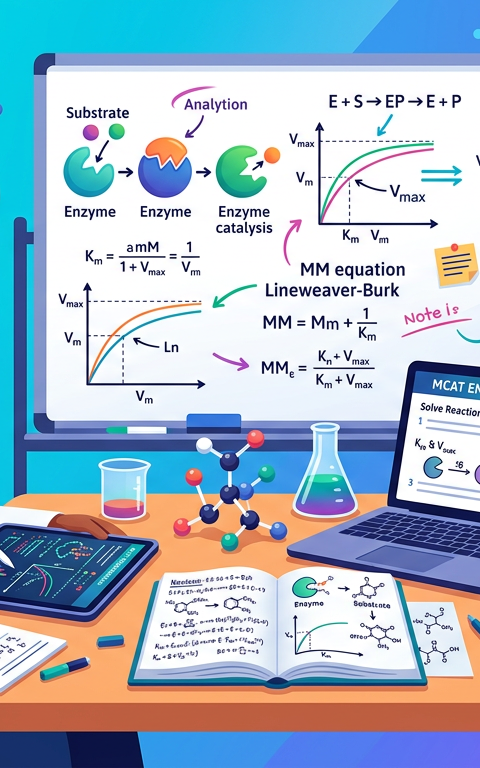
Hard MCAT Enzyme Practice Questions
Hard MCAT Enzyme Practice Questions
May 14, 2026

Medium MCAT DNA Replication Practice Questions
Medium MCAT DNA Replication Practice Questions
May 14, 2026

Medium MCAT Enzyme Practice Questions
Medium MCAT Enzyme Practice Questions
May 14, 2026

Easy MCAT DNA Replication Practice Questions
Master DNA replication with these easy MCAT practice questions. Learn about helicase, polymerase, and semi-conservative replication with detailed explanations.
May 14, 2026

MCAT Enzyme Kinetics: Solving KM and Vmax Without a Calculator
Easy MCAT Enzyme Practice Questions
May 14, 2026