Medium Homeostasis Questions Practice Questions
1. Concept Explanation
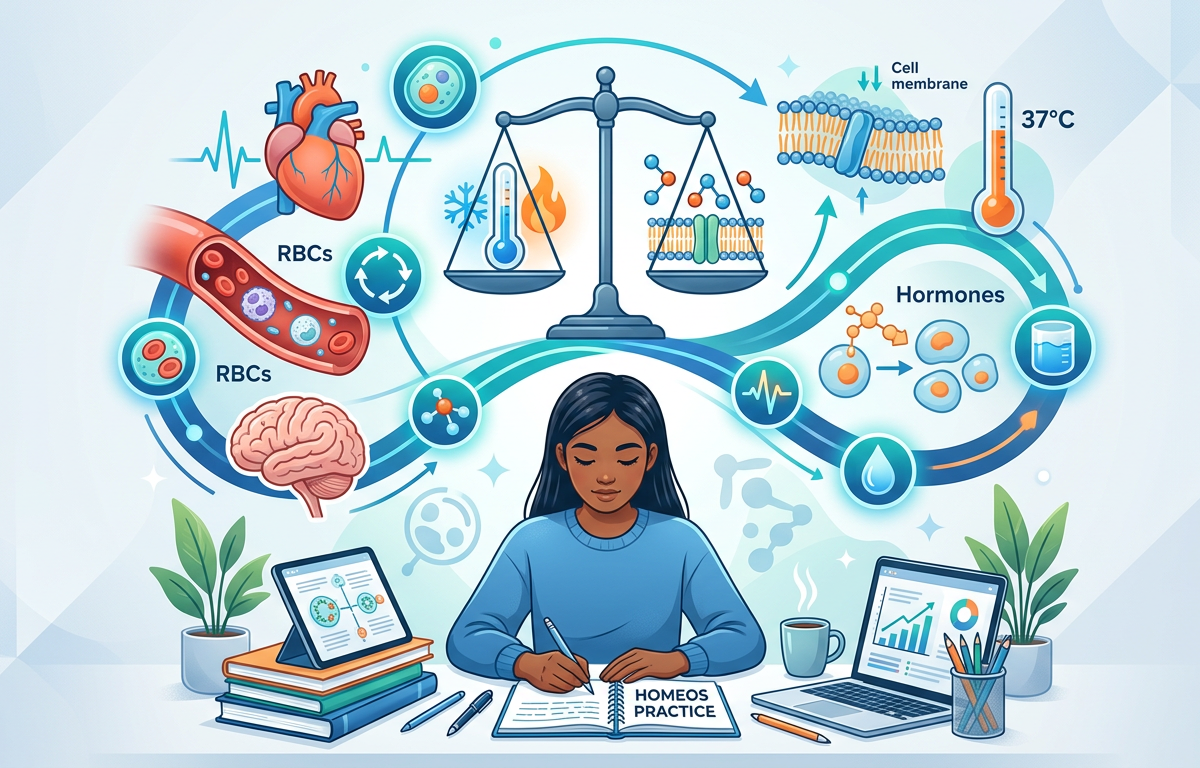
Homeostasis is the ability of an organism to maintain a stable internal environment despite changes in external conditions. This dynamic equilibrium is crucial for the optimal functioning of cells, tissues, and organs, ensuring survival and proper metabolic processes. It involves a complex interplay of regulatory mechanisms, primarily negative feedback loops, though positive feedback also plays a role in specific situations. Key components of a homeostatic control system include a stimulus (a change in the internal environment), a receptor (detects the change), a control center (processes information and determines a response), and an effector (carries out the response to counteract or amplify the change).
For example, regulating body temperature, blood glucose levels, blood pressure, and pH are all vital homeostatic processes. When the body temperature rises, thermoreceptors in the skin and hypothalamus detect the change. The hypothalamus, acting as the control center, then sends signals to effectors like sweat glands (to produce sweat for cooling) and blood vessels (to dilate for heat dissipation). This response helps bring the body temperature back to its set point. Similarly, the regulation of blood glucose by insulin and glucagon is a classic example of a negative feedback loop ensuring metabolic stability. Understanding these intricate systems is fundamental to comprehending how living organisms adapt and survive. For more about how different body systems work together, you might find our Organ System Questions Practice Questions useful.
2. Solved Examples
Example 1: Blood Glucose Regulation
A person consumes a large meal, leading to a significant increase in blood glucose levels. Explain the homeostatic mechanism that brings blood glucose back to normal.
- Stimulus: Increased blood glucose levels after a meal.
- Receptor: Beta cells in the pancreatic islets of Langerhans detect the high blood glucose.
- Control Center: The beta cells themselves act as both receptor and control center, releasing insulin.
- Effector: Insulin acts on target cells (muscle, liver, adipose tissue) to increase glucose uptake from the blood and convert it into glycogen for storage (in liver and muscle) or fat (in adipose tissue).
- Response: Blood glucose levels decrease, returning to the normal range. This is a negative feedback loop as the response counteracts the initial stimulus.
Example 2: Body Temperature Regulation (Cooling)
During strenuous exercise, an individual's body temperature begins to rise above the normal set point. Describe the homeostatic response to lower body temperature.
- Stimulus: Increase in body temperature above the set point (e.g., 37°C).
- Receptor: Thermoreceptors in the skin and hypothalamus detect the rise in temperature.
- Control Center: The hypothalamus processes the information.
- Effector: The hypothalamus sends signals to:
- Sweat glands: Stimulates sweat production, which evaporates from the skin, causing cooling.
- Blood vessels in the skin: Causes vasodilation, increasing blood flow to the surface of the body, allowing heat to radiate away.
- Response: Body temperature decreases, returning to the normal range. This is a negative feedback loop.
Example 3: Blood Pressure Regulation (Increase)
A person stands up quickly, causing a sudden drop in blood pressure. Explain how the body uses homeostatic mechanisms to quickly raise blood pressure back to normal.
- Stimulus: Decrease in blood pressure.
- Receptor: Baroreceptors (pressure receptors) located in the carotid arteries and aortic arch detect the drop in blood pressure.
- Control Center: The cardiovascular center in the medulla oblongata of the brain receives signals from the baroreceptors.
- Effector: The cardiovascular center sends signals via the autonomic nervous system to:
- Heart: Increases heart rate and contractility, leading to increased cardiac output.
- Blood vessels: Causes vasoconstriction, especially of arterioles, increasing peripheral resistance.
- Response: Increased cardiac output and peripheral resistance elevate blood pressure, bringing it back to the normal range. This exemplifies a negative feedback loop. For more on how the heart and blood vessels work, check out our Cardiovascular System Questions Practice Questions.
3. Practice Questions
1. Describe the key difference between negative feedback and positive feedback in the context of homeostatic regulation, providing a specific biological example for each.
2. A patient is diagnosed with Type 1 Diabetes Mellitus. Explain how the absence of insulin production in this condition disrupts the homeostatic regulation of blood glucose, and what immediate physiological consequences might arise.
3. Explain why the regulation of blood pH is critical for enzyme function and overall cellular metabolism, and briefly describe one homeostatic mechanism involved in maintaining blood pH within a narrow range.
4. During a cold winter day, a person experiences a significant drop in core body temperature. Outline the complete homeostatic feedback loop that would be activated to restore normal body temperature, identifying the stimulus, receptor, control center, and effectors.
5. How does the kidney contribute to the homeostatic regulation of water balance and electrolyte concentration in the body? Pick one specific hormone and explain its role.
6. Explain the concept of a 'set point' in homeostatic regulation. Can this set point change, and if so, provide an example?
7. Why is maintaining a stable internal environment (homeostasis) considered more challenging for endothermic animals compared to ectothermic animals in fluctuating external temperatures?
8. A person experiences severe dehydration. Describe the homeostatic mechanisms that would be initiated to conserve water and restore fluid balance. Include the role of osmoreceptors and ADH.
9. Discuss the role of the nervous system and endocrine system in coordinating homeostatic responses. Provide an example where both systems are involved.
10. Explain how fever, despite being a deviation from the normal body temperature set point, can be considered an adaptive homeostatic response.
4. Answers & Explanations
1. Negative feedback systems work to counteract or reverse the initial stimulus, bringing the variable back towards its set point. They are the most common type of homeostatic regulation. Example: Regulation of blood glucose levels by insulin and glucagon. When blood glucose rises, insulin is released to lower it; when it falls, glucagon is released to raise it. Positive feedback systems, on the other hand, amplify or intensify the initial stimulus, moving the variable further away from the set point. They are less common in general homeostasis but crucial for specific processes. Example: Childbirth. Uterine contractions stimulate the release of oxytocin, which in turn increases the strength and frequency of contractions until the baby is born.
2. In Type 1 Diabetes Mellitus, the pancreatic beta cells are destroyed, leading to an absolute deficiency of insulin production. Without insulin, glucose cannot be efficiently taken up by most body cells (muscle, adipose tissue) or stored as glycogen in the liver. This disruption causes chronically elevated blood glucose levels (hyperglycemia). Immediate physiological consequences include increased urination (polyuria) as the kidneys try to excrete excess glucose, increased thirst (polydipsia) due to water loss, and increased hunger (polyphagia) as cells cannot access glucose for energy, leading to the breakdown of fats and proteins for fuel, potentially resulting in ketoacidosis.
3. The regulation of blood pH is critical because enzymes, which catalyze nearly all biochemical reactions in the body, are highly sensitive to pH changes. Deviations from the optimal pH range (typically 7.35-7.45 in blood) can alter enzyme structure (denaturation), reducing or eliminating their catalytic activity, thereby disrupting metabolism. One homeostatic mechanism involves the bicarbonate buffer system, which can absorb excess hydrogen ions (H+) when pH drops (becoming more acidic) or release H+ when pH rises (becoming more alkaline), thus maintaining pH stability. The respiratory system (adjusting CO2 exhalation) and renal system (excreting/reabsorbing H+ and bicarbonate) also play crucial roles.
4. Stimulus: Decrease in core body temperature below the set point (e.g., 37°C). Receptor: Thermoreceptors in the skin and hypothalamus detect the drop in temperature. Control Center: The hypothalamus processes this information. Effectors: The hypothalamus sends signals to:
- Skeletal muscles: Initiates shivering, which generates heat through muscle contractions.
- Blood vessels in the skin: Causes vasoconstriction, reducing blood flow to the surface to minimize heat loss.
- Adrenal glands: Releases hormones like adrenaline, which can increase metabolic rate and heat production.
5. The kidneys are central to the homeostatic regulation of water balance and electrolyte concentration by filtering blood, reabsorbing essential substances, and excreting waste. They precisely control how much water is reabsorbed or excreted, and similarly regulate the levels of electrolytes like sodium, potassium, and chloride. Antidiuretic Hormone (ADH), also known as vasopressin, plays a key role. When the body is dehydrated or blood osmolarity increases, osmoreceptors stimulate the release of ADH from the posterior pituitary. ADH then acts on the collecting ducts of the kidneys, increasing their permeability to water, leading to more water reabsorption and the production of a more concentrated urine, thus conserving water. This exemplifies how the Organ System Questions Practice Questions can be further explored.
6. A 'set point' is the physiological value around which a homeostatic variable (like body temperature or blood glucose) is maintained. It represents the optimal or desired level for that variable. Yes, the set point can change. An example is fever, where the body's thermoregulatory set point is temporarily raised in response to infection, allowing the body temperature to increase. Another example is acclimatization to altitude, where the set point for red blood cell production might increase to enhance oxygen carrying capacity.
7. Maintaining a stable internal environment is more challenging for endothermic animals because they generate their own heat internally and have a higher metabolic rate, requiring precise regulation of body temperature across a wide range of external temperatures. Ectothermic animals, in contrast, rely on external heat sources and their internal temperature often fluctuates with the environment, requiring behavioral adaptations for thermoregulation rather than complex physiological ones. Endotherms expend significant energy to maintain their set point, especially in extreme conditions.
8. In severe dehydration, the body initiates several homeostatic mechanisms to conserve water and restore fluid balance. Stimulus: Increased blood osmolarity (due to less water) and decreased blood volume/pressure. Receptor: Osmoreceptors in the hypothalamus detect increased osmolarity; baroreceptors detect decreased blood volume/pressure. Control Center: The hypothalamus processes these signals. Effectors/Responses:
- ADH release: Hypothalamus stimulates the posterior pituitary to release Antidiuretic Hormone (ADH). ADH increases water reabsorption in the kidneys, leading to less urine production and more concentrated urine.
- Thirst sensation: Hypothalamus also triggers the sensation of thirst, encouraging water intake.
- Renin-Angiotensin-Aldosterone System (RAAS): Decreased blood volume/pressure triggers renin release from the kidneys, initiating RAAS, which ultimately leads to aldosterone release. Aldosterone promotes sodium and thus water reabsorption in the kidneys.
9. The nervous system and endocrine system are the two main regulatory systems that coordinate homeostatic responses, often working in concert. The nervous system provides rapid, short-term responses through electrical signals (nerve impulses) and neurotransmitters, ideal for quick adjustments like reflex actions (e.g., withdrawing hand from heat) or immediate blood pressure changes. The endocrine system provides slower, longer-lasting responses through hormones transported in the blood, suitable for sustained regulation like growth, metabolism, and fluid balance. An example involving both is the 'fight or flight' response: The nervous system (sympathetic division) rapidly alerts the adrenal medulla to release adrenaline (epinephrine) and noradrenaline (norepinephrine) (endocrine component), which then cause widespread physiological changes like increased heart rate, blood pressure, and glucose mobilization to prepare the body for immediate action. This interaction highlights the complex regulatory networks that maintain homeostasis, similar to how the Nervous System Questions Practice Questions delve into neural control.
10. Fever is considered an adaptive homeostatic response because it represents a controlled elevation of the body's temperature set point by the hypothalamus, often in response to pyrogens released during infection. While it deviates from the normal 37°C, the body maintains this higher temperature within a new, elevated range. This elevated temperature can enhance immune cell activity, inhibit the growth of certain pathogens, and speed up metabolic reactions involved in fighting infection, thereby aiding in recovery rather than harming the organism. It's a temporary re-setting of the thermostat, not a failure of regulation.
1. Which of the following is the primary mechanism by which the body maintains most homeostatic variables?
6. Frequently Asked Questions
What is the definition of homeostasis?
Homeostasis is the process by which living organisms maintain a relatively stable internal environment, such as constant temperature, pH, and fluid balance, despite fluctuations in the external environment. This dynamic equilibrium is essential for optimal cellular function and survival.
Why is homeostasis important for living organisms?
Homeostasis is crucial because biochemical reactions, enzyme activity, and cellular processes are highly sensitive to changes in internal conditions. Maintaining a stable environment ensures that these processes can occur efficiently, supporting growth, reproduction, and overall organism health.
What are the main components of a homeostatic control system?
A typical homeostatic control system includes a stimulus (the change), a receptor (detects the change), a control center (processes information and determines the response), and an effector (carries out the response). These components work together, primarily through feedback loops, to maintain stability.
Can homeostatic set points change?
Yes, homeostatic set points can be temporarily or permanently altered. For example, during fever, the body's temperature set point is raised, and during acclimatization to high altitudes, the set point for red blood cell production increases to adapt to lower oxygen levels.
What is the difference between negative and positive feedback?
Negative feedback counteracts the initial stimulus to bring a variable back to its set point, like blood glucose regulation. Positive feedback amplifies the initial stimulus, pushing the variable further from the set point, as seen in processes like childbirth or blood clotting.
How do the nervous and endocrine systems contribute to homeostasis?
The nervous system provides rapid, short-term responses to maintain homeostasis through electrical signals and neurotransmitters. The endocrine system offers slower, longer-lasting regulation via hormones. Both systems often work together to coordinate complex homeostatic adjustments, such as the stress response or blood pressure control.
Enjoyed this article?
Share it with others who might find it helpful.
Related Articles
Hard Le Chatelier’s Principle Practice Questions
Master Hard Le Chatelier’s Principle Practice Questions with our comprehensive guide featuring solved examples, practice problems, and detailed explanations.
Mar 30, 2026
Hard Reaction Quotient (Q) Practice Questions
Hard Reaction Quotient (Q) Practice Questions
Mar 30, 2026
Grams to Moles Practice Questions with Answers
Master grams to moles conversions with our comprehensive guide. Includes step-by-step examples, practice questions, and detailed answers for chemistry students.
Mar 26, 2026
Avogadro’s Number Practice Questions with Answers
Master the mole concept with our Avogadro’s Number practice questions. Includes step-by-step solved examples, a quick quiz, and detailed explanations.
Mar 26, 2026
Empirical Formulas: Solving Ratios from Mass and Percent Data
Master empirical formula calculations with 10 practice questions, worked answers, and a free step-by-step calculator for mass, percentage, and combustion problems.
Mar 26, 2026