Medium Bond Energy Practice Questions
Concept Explanation
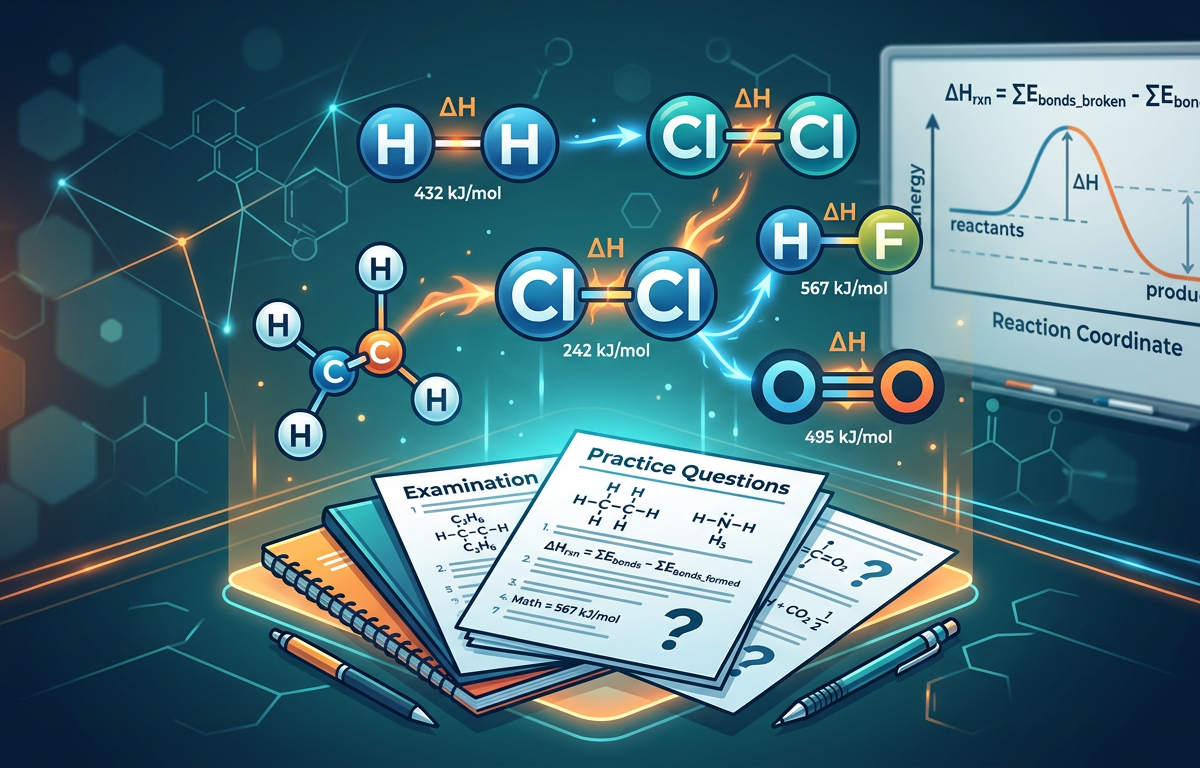
Bond energy is the amount of energy required to break one mole of a specific chemical bond in the gaseous state, representing the strength of the chemical connection between two atoms. When we study Medium Bond Energy Practice Questions, we focus on the principle that breaking bonds is an endothermic process (absorbing energy), while forming bonds is an exothermic process (releasing energy). To calculate the overall enthalpy change (ΔH) for a reaction, we use the formula: ΔH = Σ(Bond Energies of Reactants) - Σ(Bond Energies of Products). This approach assumes that all reactants are broken down into individual atoms before they rearrange to form new products. It is a vital tool in thermodynamics, often used as an alternative to Hess’s Law when standard enthalpies of formation are unavailable. According to LibreTexts Chemistry, these values are typically averages because the environment of a bond (the surrounding atoms) can slightly influence its specific strength.
Solved Examples
Review these worked examples to understand the systematic approach required for Medium Bond Energy Practice Questions.
Calculate the enthalpy change for the reaction: H₂(g) + Cl₂(g) → 2HCl(g).
Given: H-H = 436 kJ/mol; Cl-Cl = 242 kJ/mol; H-Cl = 431 kJ/mol.Identify bonds broken: 1 mol of H-H and 1 mol of Cl-Cl. Total = 436 + 242 = 678 kJ.
Identify bonds formed: 2 moles of H-Cl. Total = 2 × 431 = 862 kJ.
Apply the formula: ΔH = 678 - 862 = -184 kJ/mol.
Estimate the ΔH for the combustion of methane: CH₄(g) + 2O₂(g) → CO₂(g) + 2H₂O(g).
Given: C-H = 413 kJ/mol; O=O = 495 kJ/mol; C=O = 799 kJ/mol; O-H = 463 kJ/mol.Bonds broken: 4(C-H) + 2(O=O) = 4(413) + 2(495) = 1652 + 990 = 2642 kJ.
Bonds formed: 2(C=O) + 4(O-H) = 2(799) + 4(463) = 1598 + 1852 = 3450 kJ.
Calculate ΔH: 2642 - 3450 = -808 kJ/mol.
Determine the ΔH for the hydrogenation of ethene: C₂H₄(g) + H₂(g) → C₂H₆(g).
Given: C=C = 614 kJ/mol; C-C = 348 kJ/mol; C-H = 413 kJ/mol; H-H = 436 kJ/mol.Bonds broken: 1(C=C) + 4(C-H) + 1(H-H) = 614 + 4(413) + 436 = 2702 kJ.
Bonds formed: 1(C-C) + 6(C-H) = 348 + 6(413) = 2826 kJ.
Calculate ΔH: 2702 - 2826 = -124 kJ/mol.
Practice Questions
Test your knowledge with these Medium Bond Energy Practice Questions. Ensure you draw the Lewis structures if you are unsure about the number of bonds.
1. Calculate the enthalpy change for the reaction: N₂(g) + 3H₂(g) → 2NH₃(g).
(N≡N = 941 kJ/mol, H-H = 436 kJ/mol, N-H = 391 kJ/mol)
2. Estimate ΔH for the reaction: 2H₂O₂(g) → 2H₂O(g) + O₂(g).
(O-O = 146 kJ/mol, O-H = 463 kJ/mol, O=O = 495 kJ/mol)
3. Calculate the enthalpy change for the formation of hydrazine: N₂(g) + 2H₂(g) → N₂H₄(g).
(N≡N = 941 kJ/mol, H-H = 436 kJ/mol, N-N = 158 kJ/mol, N-H = 391 kJ/mol)
Want unlimited practice questions like these?
Generate AI-powered questions with step-by-step solutions on any topic.
Try Question Generator Free →4. Determine ΔH for the reaction: CH₃CH₂OH(g) + 3O₂(g) → 2CO₂(g) + 3H₂O(g).
(C-C = 348, C-H = 413, C-O = 358, O-H = 463, O=O = 495, C=O = 799 kJ/mol)
5. Calculate ΔH for the reaction between fluorine and methane: CH₄(g) + F₂(g) → CH₃F(g) + HF(g).
(C-H = 413, F-F = 155, C-F = 485, H-F = 567 kJ/mol)
6. Estimate the enthalpy of the reaction: C₂H₂(g) + 2H₂(g) → C₂H₆(g).
(C≡C = 839, H-H = 436, C-C = 348, C-H = 413 kJ/mol)
7. Calculate the energy required to decompose 2 moles of nitrogen trichloride into its elements: 2NCl₃(g) → N₂(g) + 3Cl₂(g).
(N-Cl = 200, N≡N = 941, Cl-Cl = 242 kJ/mol)
8. Find the ΔH for: CO(g) + 2H₂(g) → CH₃OH(g).
(C≡O = 1072, H-H = 436, C-H = 413, C-O = 358, O-H = 463 kJ/mol)
9. A reaction absorbs 450 kJ to break bonds and releases 600 kJ when forming bonds. Is this reaction exothermic or endothermic, and what is the ΔH?
10. Calculate the enthalpy change for: 2C₂H₆(g) + 7O₂(g) → 4CO₂(g) + 6H₂O(g).
(C-C = 348, C-H = 413, O=O = 495, C=O = 799, O-H = 463 kJ/mol)
Answers & Explanations
Answer: -107 kJ/mol.
Bonds broken: 1(N≡N) + 3(H-H) = 941 + 3(436) = 2249 kJ.
Bonds formed: 6(N-H) = 6(391) = 2346 kJ.
ΔH = 2249 - 2346 = -97 kJ. (Note: Calculation based on stoichiometry for 2 moles of product).Answer: -203 kJ.
Bonds broken: 2(O-O) + 4(O-H) = 2(146) + 4(463) = 2144 kJ.
Bonds formed: 4(O-H) + 1(O=O) = 4(463) + 495 = 2347 kJ.
ΔH = 2144 - 2347 = -203 kJ.Answer: +91 kJ.
Bonds broken: 1(N≡N) + 2(H-H) = 941 + 872 = 1813 kJ.
Bonds formed: 1(N-N) + 4(N-H) = 158 + 4(391) = 1722 kJ.
ΔH = 1813 - 1722 = +91 kJ.Answer: -1277 kJ.
Bonds broken: 1(C-C) + 5(C-H) + 1(C-O) + 1(O-H) + 3(O=O) = 348 + 2065 + 358 + 463 + 1485 = 4719 kJ.
Bonds formed: 4(C=O) + 6(O-H) = 4(799) + 6(463) = 3196 + 2778 = 5974 kJ.
ΔH = 4719 - 5974 = -1255 kJ. (Minor variations may occur based on rounded average bond values).Answer: -484 kJ.
Bonds broken: 1(C-H) + 1(F-F) = 413 + 155 = 568 kJ.
Bonds formed: 1(C-F) + 1(H-F) = 485 + 567 = 1052 kJ.
ΔH = 568 - 1052 = -484 kJ.Answer: -295 kJ.
Bonds broken: 1(C≡C) + 2(C-H) + 2(H-H) = 839 + 2(413) + 2(436) = 2537 kJ.
Bonds formed: 1(C-C) + 6(C-H) = 348 + 6(413) = 2826 kJ.
ΔH = 2537 - 2826 = -289 kJ.Answer: -467 kJ.
Bonds broken: 6(N-Cl) = 6(200) = 1200 kJ.
Bonds formed: 1(N≡N) + 3(Cl-Cl) = 941 + 3(242) = 1667 kJ.
ΔH = 1200 - 1667 = -467 kJ.Answer: -106 kJ.
Bonds broken: 1(C≡O) + 2(H-H) = 1072 + 872 = 1944 kJ.
Bonds formed: 3(C-H) + 1(C-O) + 1(O-H) = 3(413) + 358 + 463 = 2060 kJ.
ΔH = 1944 - 2060 = -116 kJ.Answer: Exothermic; -150 kJ.
ΔH = Energy absorbed - Energy released = 450 - 600 = -150 kJ. Since the value is negative, it is exothermic.Answer: -2830 kJ.
Bonds broken: 2(C-C) + 12(C-H) + 7(O=O) = 2(348) + 12(413) + 7(495) = 696 + 4956 + 3465 = 9117 kJ.
Bonds formed: 8(C=O) + 12(O-H) = 8(799) + 12(463) = 6392 + 5556 = 11948 kJ.
ΔH = 9117 - 11948 = -2831 kJ.
1. Which of the following statements correctly describes bond breaking?
Frequently Asked Questions
What is the difference between bond energy and bond dissociation energy?
Bond dissociation energy refers to the energy required to break one specific bond in a specific molecule, whereas bond energy is the average value for that bond type across many different compounds. For example, the four C-H bonds in methane have different dissociation energies, but their average is reported as the C-H bond energy.
Can bond energy be used for reactions involving liquids or solids?
Standard bond energy values are defined for substances in the gaseous state. If reactants or products are liquids or solids, you must also account for the enthalpy of vaporization or sublimation to get an accurate result.
Why is the C=O bond in CO₂ stronger than a typical C=O bond?
The C=O bond in carbon dioxide is particularly stable due to the linear resonance structure of the molecule. While a standard C=O bond might be around 745 kJ/mol, the value in CO₂ is approximately 799-805 kJ/mol, which is why it is often specified separately in Medium Bond Energy Practice Questions.
Is a high bond energy associated with a long or short bond?
High bond energy is generally associated with shorter bond lengths. As the number of shared electrons increases (from single to triple bonds), the attractive force between the nuclei increases, drawing them closer together and making the bond harder to break.
What does a positive ΔH value indicate about a reaction?
A positive ΔH indicates an endothermic reaction, meaning the system absorbed more energy to break the reactant bonds than was released during the formation of the product bonds. These reactions typically feel cold to the touch because they draw heat from their surroundings.
How do I handle double and triple bonds in these calculations?
Double and triple bonds must be treated as single units with their own specific energy values; you cannot simply multiply the single bond energy by two or three. For instance, the C≡C triple bond (839 kJ/mol) is much stronger than a C-C single bond (348 kJ/mol) but is not exactly three times the strength.
Want unlimited practice questions like these?
Generate AI-powered questions with step-by-step solutions on any topic.
Try Question Generator Free →
Want unlimited practice questions like these?
Generate AI-powered questions with step-by-step solutions on any topic.
Try Question Generator Free →Enjoyed this article?
Share it with others who might find it helpful.
Related Articles
Hard Le Chatelier’s Principle Practice Questions
Master Hard Le Chatelier’s Principle Practice Questions with our comprehensive guide featuring solved examples, practice problems, and detailed explanations.
Mar 30, 2026

Hard Reaction Quotient (Q) Practice Questions
Hard Reaction Quotient (Q) Practice Questions
Mar 30, 2026
Grams to Moles Practice Questions with Answers
Master grams to moles conversions with our comprehensive guide. Includes step-by-step examples, practice questions, and detailed answers for chemistry students.
Mar 26, 2026
Avogadro’s Number Practice Questions with Answers
Master the mole concept with our Avogadro’s Number practice questions. Includes step-by-step solved examples, a quick quiz, and detailed explanations.
Mar 26, 2026

Empirical Formulas: Solving Ratios from Mass and Percent Data
Master empirical formula calculations with 10 practice questions, worked answers, and a free step-by-step calculator for mass, percentage, and combustion problems.
Mar 26, 2026