Medium Arrhenius Equation Practice Questions
Concept Explanation
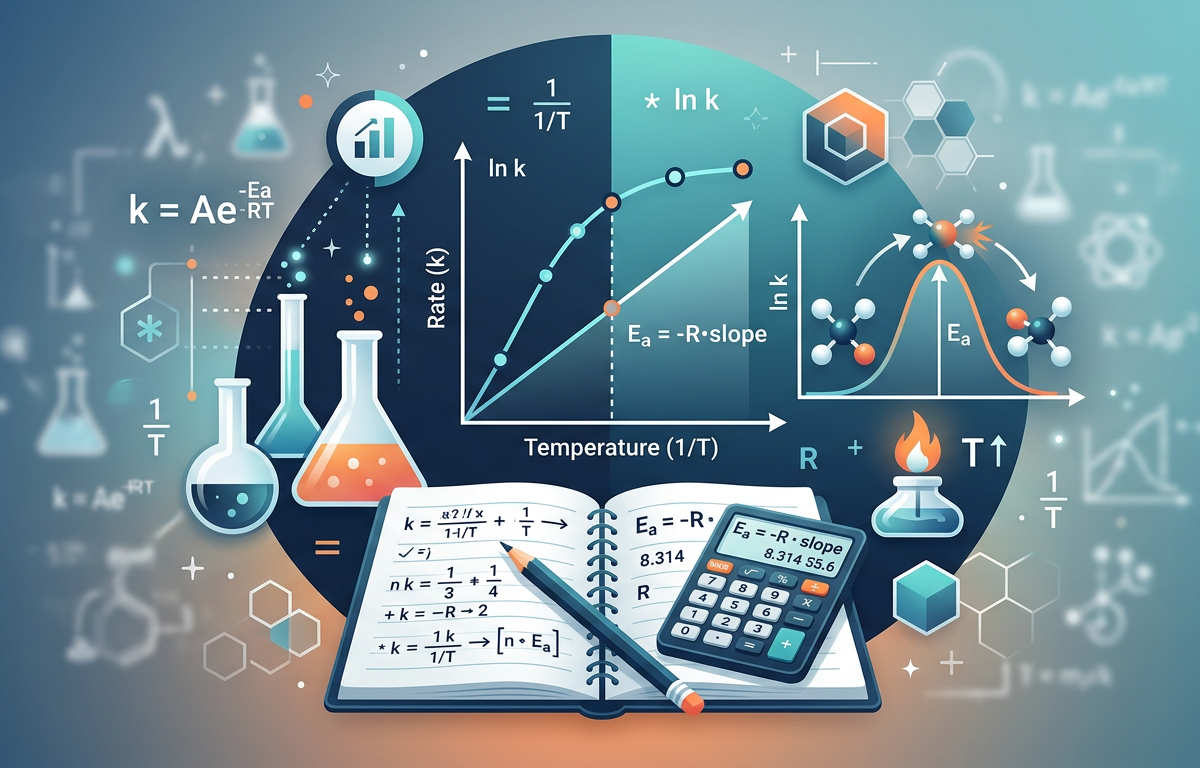
The Arrhenius equation is a mathematical expression that describes how the rate constant of a chemical reaction depends on temperature and activation energy. It provides the quantitative basis for the relationship between temperature and reaction rates, showing that as temperature increases, the kinetic energy of molecules increases, leading to more frequent and energetic collisions. This relationship is essential for understanding chemical kinetics, a field thoroughly explored in resources like Khan Academy's kinetics module.
The standard form of the Arrhenius equation is written as:
k = Ae-Ea/RT
Where:
k is the rate constant.
A is the pre-exponential factor (frequency factor), representing the frequency of collisions with the correct orientation.
Ea is the activation energy (usually in Joules per mole, J/mol).
R is the universal gas constant (8.314 J/mol·K).
T is the absolute temperature in Kelvin (K).
For most Medium Arrhenius Equation Practice Questions, you will use the logarithmic form, which allows for the comparison of rate constants at two different temperatures:
ln(k₂/k₁) = (Ea / R) * (1/T₁ - 1/T₂)
This "two-point" form is a powerful tool for calculating the activation energy of a reaction if the rate constants at two temperatures are known. Understanding this is as fundamental to chemistry as mastering reaction order practice questions. It highlights that even a small increase in temperature can lead to a significant increase in the rate constant because the temperature is part of an exponential term.
Solved Examples
Reviewing worked examples is one of the most effective ways to learn how to study for exams efficiently under pressure. Here are three detailed solutions to common medium-level problems.
Example 1: Calculating Activation Energy
A reaction has a rate constant of 1.2 x 10⁻³ s⁻¹ at 300 K and 4.5 x 10⁻³ s⁻¹ at 320 K. Calculate the activation energy (Ea) in kJ/mol.
Identify the knowns: k₁ = 1.2 x 10⁻³, T₁ = 300 K, k₂ = 4.5 x 10⁻³, T₂ = 320 K, R = 8.314 J/mol·K.
Use the formula: ln(k₂/k₁) = (Ea / R) * (1/T₁ - 1/T₂).
Substitute the values: ln(4.5 x 10⁻³ / 1.2 x 10⁻³) = (Ea / 8.314) * (1/300 - 1/320).
Calculate the left side: ln(3.75) ≈ 1.3217.
Calculate the temperature difference: (0.003333 - 0.003125) = 0.0002083.
Solve for Ea: 1.3217 = (Ea / 8.314) * 0.0002083 → Ea = (1.3217 * 8.314) / 0.0002083 ≈ 52,750 J/mol.
Convert to kJ/mol: 52.75 kJ/mol.
Example 2: Finding a New Rate Constant
The activation energy for a reaction is 75 kJ/mol. If the rate constant is 0.050 M⁻¹s⁻¹ at 298 K, what is the rate constant at 350 K?
Identify the knowns: Ea = 75,000 J/mol, k₁ = 0.050, T₁ = 298 K, T₂ = 350 K.
Set up the equation: ln(k₂/0.050) = (75,000 / 8.314) * (1/298 - 1/350).
Calculate the temperature term: (0.003356 - 0.002857) = 0.000499.
Calculate the right side: (9020.9) * 0.000499 ≈ 4.50.
Apply the exponential: k₂/0.050 = e⁴·⁵⁰ ≈ 90.01.
Solve for k₂: k₂ = 90.01 * 0.050 = 4.50 M⁻¹s⁻¹.
Example 3: Determining Temperature for a Specific Rate
A reaction with an activation energy of 40 kJ/mol has a rate constant of 0.10 s⁻¹ at 300 K. At what temperature will the rate constant triple?
Identify the knowns: Ea = 40,000 J/mol, k₁ = 0.10, k₂ = 0.30, T₁ = 300 K.
Set up the equation: ln(0.30/0.10) = (40,000 / 8.314) * (1/300 - 1/T₂).
Calculate the left side: ln(3) ≈ 1.0986.
Rearrange to solve for 1/T₂: 1.0986 / 4811.16 = 0.003333 - 1/T₂.
0.0002283 = 0.003333 - 1/T₂ → 1/T₂ = 0.003105.
Calculate T₂: T₂ = 1 / 0.003105 ≈ 322 K.
Practice Questions
Test your knowledge with these Medium Arrhenius Equation Practice Questions. Ensure you convert energy to Joules and temperature to Kelvin before calculating.
1. A reaction has an activation energy of 65 kJ/mol. If the rate constant is 1.5 x 10⁻² s⁻¹ at 25°C, what is the rate constant at 50°C?
2. For a certain first-order reaction, the rate constant doubles when the temperature is increased from 20°C to 30°C. Calculate the activation energy (Ea) in kJ/mol.
3. The frequency factor (A) for a reaction is 4.0 x 10¹³ s⁻¹ and the activation energy is 100 kJ/mol. What is the rate constant at 500 K?
Start Learning Smarter Today
Join thousands of students using AI-powered study tools to achieve better results.
Get Started Free4. A reaction is found to have Ea = 80 kJ/mol. If the rate constant is 2.0 x 10⁻⁴ s⁻¹ at 400 K, at what temperature will the rate constant be 1.0 x 10⁻³ s⁻¹?
5. If the activation energy of a reaction is 0 kJ/mol, how does the rate constant change when the temperature is increased from 300 K to 600 K?
6. The decomposition of N₂O₅ has a rate constant of 3.46 x 10⁻⁵ s⁻¹ at 25°C and 4.87 x 10⁻³ s⁻¹ at 65°C. Determine the activation energy for this reaction.
7. A chemist observes that a reaction rate increases by a factor of 10 when the temperature is raised from 298 K to 308 K. Calculate the activation energy.
8. Calculate the ratio of rate constants (k₂/k₁) for a reaction with Ea = 50 kJ/mol when the temperature is raised from 300 K to 310 K.
9. A reaction has A = 8.5 x 10¹¹ M⁻¹s⁻¹ and Ea = 70 kJ/mol. At what temperature is the rate constant equal to 1.2 x 10⁻² M⁻¹s⁻¹?
10. The rate constant for a reaction is 0.020 s⁻¹ at 273 K. If the activation energy is 35 kJ/mol, calculate the rate constant at 298 K.
Answers & Explanations
1. Answer: 1.2 x 10⁻¹ s⁻¹. First, convert temperatures to Kelvin: T₁ = 298 K, T₂ = 323 K. Convert Ea to 65,000 J/mol. Use ln(k₂/k₁) = (65,000/8.314) * (1/298 - 1/323). ln(k₂/1.5e-2) = 7818.1 * 0.0002596 = 2.029. k₂ = 1.5e-2 * e^(2.029) ≈ 0.114 s⁻¹.
2. Answer: 51.2 kJ/mol. Given k₂/k₁ = 2, T₁ = 293 K, T₂ = 303 K. ln(2) = (Ea/8.314) * (1/293 - 1/303). 0.693 = (Ea/8.314) * (0.0001126). Ea = (0.693 * 8.314) / 0.0001126 = 51,165 J/mol.
3. Answer: 1.4 x 10³ s⁻¹. Use k = Ae^(-Ea/RT). k = (4.0 x 10¹³) * e^(-100,000 / (8.314 * 500)). k = 4.0 x 10¹³ * e^(-24.05) = 4.0 x 10¹³ * 3.58 x 10⁻¹¹ ≈ 1432 s⁻¹.
4. Answer: 434 K. ln(1.0e-3 / 2.0e-4) = (80,000/8.314) * (1/400 - 1/T₂). 1.609 = 9622.3 * (0.0025 - 1/T₂). 0.000167 = 0.0025 - 1/T₂. 1/T₂ = 0.002333. T₂ = 428.6 K.
5. Answer: It does not change. If Ea = 0, the term e^(-Ea/RT) becomes e⁰ = 1. Thus, k = A, and the rate constant becomes independent of temperature. This is rare but theoretically possible for some radical recombinations.
6. Answer: 103 kJ/mol. T₁ = 298 K, T₂ = 338 K. ln(4.87e-3 / 3.46e-5) = (Ea/8.314) * (1/298 - 1/338). ln(140.75) = (Ea/8.314) * (0.000397). 4.947 = (Ea/8.314) * 0.000397. Ea = 103,600 J/mol.
7. Answer: 175 kJ/mol. ln(10) = (Ea/8.314) * (1/298 - 1/308). 2.303 = (Ea/8.314) * 0.000109. Ea = (2.303 * 8.314) / 0.000109 ≈ 175,600 J/mol.
8. Answer: 1.9. ln(k₂/k₁) = (50,000/8.314) * (1/300 - 1/310). ln(ratio) = 6013.9 * 0.0001075 = 0.6465. Ratio = e^(0.6465) ≈ 1.91.
9. Answer: 266 K. ln(k/A) = -Ea/RT. ln(1.2e-2 / 8.5e11) = -70,000 / (8.314 * T). -32.19 = -8419.5 / T. T = 8419.5 / 32.19 ≈ 261.5 K. (Recalculating with precision: ln(1.4e-14) = -31.89. T = 8419.5/31.89 = 264 K).
10. Answer: 0.067 s⁻¹. ln(k₂/0.020) = (35,000/8.314) * (1/273 - 1/298). ln(k₂/0.020) = 4209.8 * 0.000307 = 1.292. k₂ = 0.020 * e^(1.292) = 0.072 s⁻¹.
1. What happens to the rate constant (k) as the activation energy (Ea) increases at a constant temperature?
Frequently Asked Questions
What is the physical meaning of activation energy?
Activation energy is the minimum amount of energy required for reactants to collide and successfully undergo a chemical transformation. It represents the energy barrier that must be overcome to reach the transition state.
Can the activation energy of a reaction be negative?
While extremely rare in elementary steps, some complex reactions or barrierless reactions (like certain radical recombinations) can exhibit a negative effective activation energy where the rate decreases as temperature increases. However, for most standard chemistry problems and Arrhenius equation practice questions, Ea is positive.
How do catalysts affect the Arrhenius equation?
Catalysts provide an alternative reaction pathway with a lower activation energy (Ea). By decreasing the value of Ea in the Arrhenius equation, the exponential term becomes less negative, which significantly increases the rate constant (k).
What is the difference between A and k?
The frequency factor (A) is a constant that represents the total number of collisions with the correct orientation, while the rate constant (k) is the actual frequency of successful collisions that result in a reaction at a specific temperature. A is the theoretical maximum for k if the activation energy were zero.
Why must temperature always be in Kelvin?
The Arrhenius equation is derived from thermodynamic and kinetic principles where zero energy corresponds to absolute zero. Using Celsius or Fahrenheit would result in incorrect ratios and could lead to division by zero or negative results, which are physically impossible in this context.
Is the frequency factor (A) truly constant?
In reality, the frequency factor A can vary slightly with temperature because molecular speeds change, but for the purpose of most calculations and chemistry exams, it is treated as a constant over a reasonable temperature range.
Start Learning Smarter Today
Join thousands of students using AI-powered study tools to achieve better results.
Get Started FreeEnjoyed this article?
Share it with others who might find it helpful.
Related Articles

Easy Arrhenius Equation Practice Questions
Master the Arrhenius Equation with these easy practice questions. Learn to calculate rate constants, activation energy, and temperature effects on reactions.
Apr 2, 2026
Arrhenius Equation Practice Questions with Answers
Master the Arrhenius equation with our comprehensive guide featuring solved examples, practice questions, and detailed explanations for chemistry students.
Apr 2, 2026

Absolute Value Equation Practice Questions with Answers
Master the absolute value equation with our comprehensive guide. Includes step-by-step solved examples, practice questions, and detailed explanations.
Apr 6, 2026
Hard Nernst Equation Practice Questions
Master the Nernst equation with these hard practice questions. Learn to calculate cell potentials under non-standard conditions with step-by-step solutions.
Apr 4, 2026
Medium Nernst Equation Practice Questions
Master the Nernst equation with these medium-level practice questions and detailed solutions. Perfect for chemistry students tackling non-standard cell potentials.
Apr 4, 2026
Easy Nernst Equation Practice Questions
Master the Nernst Equation with these easy practice questions and step-by-step solutions. Learn to calculate cell potentials under non-standard conditions.
Apr 4, 2026

Predicting Voltage: Solving Nernst Equation Problems at Non-Standard State
Master the Nernst equation with our comprehensive practice guide. Includes solved examples, step-by-step calculations, and a quick quiz to test your knowledge.
Apr 3, 2026
Mastering E°cell: Identifying Anodes and Using the Nernst Equation
Master cell potential calculations with our guide. Includes solved examples, Nernst equation practice, and 10 detailed questions with answers.
Apr 3, 2026