MCAT Metabolism Practice Questions with Answers
1. Concept Explanation
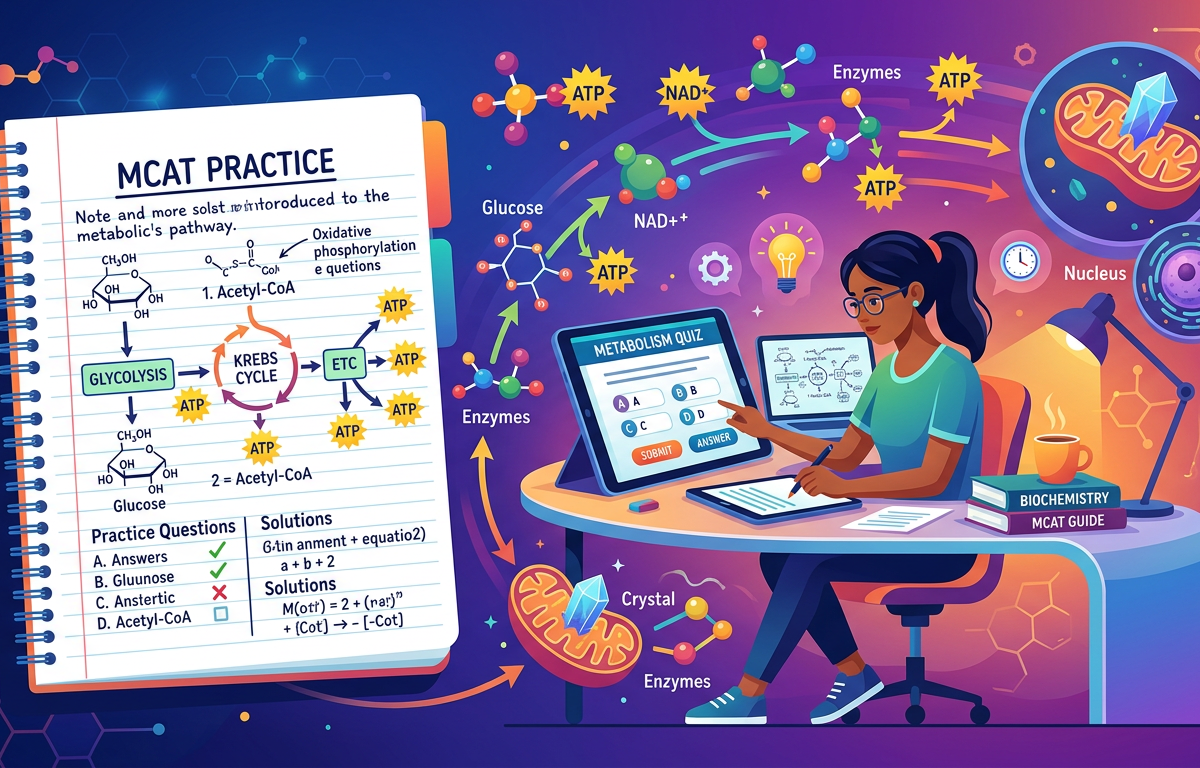
MCAT metabolism encompasses the biochemical processes by which living organisms convert nutrients into energy and build cellular components. This field focuses on the catabolic pathways that break down molecules like glucose, fatty acids, and amino acids to produce adenosine triphosphate (ATP), as well as the anabolic pathways used for biosynthesis. Key concepts include glycolysis, the citric acid cycle (Krebs cycle), the electron transport chain, oxidative phosphorylation, and the hormonal regulation of these pathways by insulin and glucagon. Understanding the redox reactions involved in these pathways is essential, as the movement of electrons—often carried by NADH and FADH2—drives the synthesis of ATP. According to Khan Academy, cellular respiration is the central hub of metabolism, and mastering its stoichiometry and energetics is a high-yield requirement for the MCAT.
2. Solved Examples
Example 1: Glycolysis Net Yield
Calculate the net yield of ATP and NADH from the conversion of one molecule of glucose to two molecules of pyruvate during glycolysis.
- Identify the investment phase: 2 ATP molecules are consumed to phosphorylate glucose and fructose-6-phosphate.
- Identify the payoff phase: 4 ATP molecules are produced via substrate-level phosphorylation (2 per G3P molecule).
- Identify electron carriers: 2 NADH are produced during the oxidation of glyceraldehyde 3-phosphate.
- Calculate net: .
- Final Result: 2 ATP and 2 NADH.
Example 2: Citric Acid Cycle Stoichiometry
For every one turn of the Citric Acid Cycle (starting from Acetyl-CoA), how many CO2, NADH, FADH2, and GTP are produced?
- Isocitrate to -ketoglutarate: Produces 1 NADH and 1 CO2.
- -ketoglutarate to Succinyl-CoA: Produces 1 NADH and 1 CO2.
- Succinyl-CoA to Succinate: Produces 1 GTP.
- Succinate to Fumarate: Produces 1 FADH2.
- Malate to Oxaloacetate: Produces 1 NADH.
- Final Count: 2 CO2, 3 NADH, 1 FADH2, 1 GTP.
Example 3: Beta-Oxidation Rounds
How many rounds of beta-oxidation are required to fully break down a 16-carbon saturated fatty acid (Palmitic acid), and what are the products?
- Calculate rounds: , where is the number of carbons. rounds.
- Calculate Acetyl-CoA: Acetyl-CoA molecules.
- Calculate carriers: Each round produces 1 NADH and 1 FADH2. Total = 7 NADH and 7 FADH2.
- Final Result: 7 rounds, producing 8 Acetyl-CoA, 7 NADH, and 7 FADH2.
3. Practice Questions
1. Which enzyme serves as the primary rate-limiting step of glycolysis and is allosterically inhibited by high levels of ATP and citrate?
2. A patient with a deficiency in the enzyme glucose-6-phosphatase would most likely struggle with which metabolic process in the liver?
3. During the electron transport chain, which complex does NOT contribute to the proton gradient across the inner mitochondrial membrane?
Your MCAT prep should adapt to you.
Bevinzey analyzes your performance and helps you focus on the concepts you need most.
Try Adaptive Practice4. In the presence of cyanide, which inhibits Cytochrome c oxidase (Complex IV), what is the expected status of the mitochondrial pH gradient and the NADH/NAD+ ratio?
5. Which metabolic state is characterized by high levels of Ketone bodies, and which precursor molecule is used to synthesize them?
6. Compare the ATP yield of one molecule of glucose undergoing aerobic respiration versus anaerobic fermentation in muscle cells.
7. How many mol of ATP are generated from the complete oxidation of one mol of Acetyl-CoA, assuming 2.5 ATP per NADH and 1.5 ATP per FADH2?
8. Which hormonal signal triggers the activation of glycogen phosphorylase in the liver, and what is the resulting product released into the blood?
9. Identify the three irreversible steps of glycolysis and the corresponding enzymes that bypass them in gluconeogenesis.
10. An individual with a Carnitine Palmitoyltransferase I (CPT1) deficiency would have the most difficulty utilizing which fuel source during exercise?
4. Answers & Explanations
- Phosphofructokinase-1 (PFK-1): This is the committed step of glycolysis. It is inhibited by ATP and Citrate (signals of high energy) and activated by AMP and Fructose-2,6-bisphosphate (signals of low energy).
- Gluconeogenesis and Glycogenolysis: Glucose-6-phosphatase is the final enzyme that removes the phosphate group from Glucose-6-phosphate, allowing free glucose to be released into the bloodstream. Without it, the liver cannot maintain blood glucose levels during fasting.
- Complex II (Succinate Dehydrogenase): Unlike Complexes I, III, and IV, Complex II does not pump protons into the intermembrane space; it merely transfers electrons from FADH2 to Coenzyme Q.
- Decreased pH gradient; increased NADH/NAD+ ratio: Inhibiting Complex IV stops the pumping of protons, causing the gradient to dissipate. Since the ETC stops, NADH cannot be oxidized back to NAD+, leading to an accumulation of NADH.
- Post-absorptive/Starvation state; Acetyl-CoA: When oxaloacetate is depleted for gluconeogenesis, excess Acetyl-CoA from beta-oxidation is diverted to ketogenesis.
- 30-32 ATP vs 2 ATP: Aerobic respiration yields significantly more energy because it utilizes the Citric Acid Cycle and Oxidative Phosphorylation, whereas fermentation only yields the 2 ATP from glycolysis.
- 10 ATP: One Acetyl-CoA produces 3 NADH (), 1 FADH2 (), and 1 GTP (). Total: .
- Glucagon; Glucose: Glucagon stimulates glycogen breakdown (glycogenolysis) in the liver to increase blood glucose levels.
- Steps 1, 3, and 10: Hexokinase is bypassed by Glucose-6-phosphatase; PFK-1 is bypassed by Fructose-1,6-bisphosphatase; Pyruvate Kinase is bypassed by Pyruvate Carboxylase and PEP Carboxykinase.
- Long-chain fatty acids: CPT1 is the rate-limiting enzyme for the carnitine shuttle, which transports long-chain fatty acids into the mitochondria for beta-oxidation.
1. Which molecule acts as a potent allosteric activator of PFK-1 and an inhibitor of Fructose-1,6-bisphosphatase?
6. Frequently Asked Questions
What is the difference between NADH and NADPH in metabolism?
NADH is primarily used in catabolic reactions to carry electrons to the electron transport chain for ATP production. In contrast, NADPH is used in anabolic reactions, such as fatty acid synthesis, and serves as a reducing agent to neutralize reactive oxygen species via glutathione.
Why is the Citric Acid Cycle considered amphibolic?
The Citric Acid Cycle is amphibolic because it functions in both catabolism (breaking down Acetyl-CoA for energy) and anabolism. Many of its intermediates, like -ketoglutarate and oxaloacetate, serve as precursors for the synthesis of amino acids and other biomolecules.
How does the body maintain blood glucose during a long-term fast?
Initially, the liver performs glycogenolysis to release stored glucose. As glycogen stores deplete (usually within 24 hours), the liver shifts primarily to gluconeogenesis, synthesizing glucose from non-carbohydrate precursors like lactate, glycerol, and glucogenic amino acids.
What is the role of Uncoupling Proteins (UCPs) in mitochondria?
Uncoupling proteins like thermogenin allow protons to leak back into the mitochondrial matrix without passing through ATP synthase. This process bypasses ATP production and instead dissipates the energy of the proton gradient as heat, which is vital for thermogenesis in brown adipose tissue.
How is the PDH complex regulated?
The Pyruvate Dehydrogenase (PDH) complex is inhibited by its products (Acetyl-CoA and NADH) and by high ATP levels through phosphorylation by PDH kinase. It is activated by pyruvate, NAD+, and ADP, which stimulate PDH phosphatase to dephosphorylate and activate the enzyme.
For more review on related chemical principles, check out our kinetics practice questions or explore general chemistry topics to strengthen your foundational knowledge for the MCAT.
Your MCAT prep should adapt to you.
Bevinzey analyzes your performance and helps you focus on the concepts you need most.
Try Adaptive PracticeReviewed by
Michael Danquah, MS, PhD
Dr. Michael Danquah is a professor of pharmaceutical sciences and founder of several educational technology platforms focused on improving student learning and performance.
Enjoyed this article?
Share it with others who might find it helpful.
Related Articles

Medium MCAT Metabolism Practice Questions
Master MCAT metabolism with our medium-level practice questions and detailed explanations. Explore glycolysis, the TCA cycle, and oxidative phosphorylation.
May 14, 2026
Easy MCAT Metabolism Practice Questions
Master foundational metabolic pathways with our Easy MCAT Metabolism Practice Questions, covering glycolysis, the TCA cycle, and ATP production.
May 14, 2026

Hard MCAT Metabolism Practice Questions
Hard MCAT Metabolism Practice Questions
May 14, 2026

Hard MCAT Philosophy Passage Practice Questions
Master Hard MCAT Philosophy Passage Practice Questions with our comprehensive guide featuring solved examples, practice questions, and expert explanations.
May 17, 2026

Hard MCAT Humanities Passage Practice Questions
Master Hard MCAT Humanities Passage Practice Questions with our comprehensive guide featuring solved examples, practice questions, and expert strategies.
May 17, 2026

Hard MCAT Critical Analysis Practice Questions
Hard MCAT Critical Analysis Practice Questions
May 17, 2026

Hard MCAT Reading Comprehension Practice Questions
Hard MCAT Reading Comprehension Practice Questions
May 17, 2026

Hard MCAT CARS Passage Practice Questions
Master high-difficulty MCAT CARS passages with our expert guide featuring solved examples, practice questions, and detailed logical analysis.
May 17, 2026