MCAT Carbonyl Practice Questions with Answers
MCAT Carbonyl Practice Questions with Answers
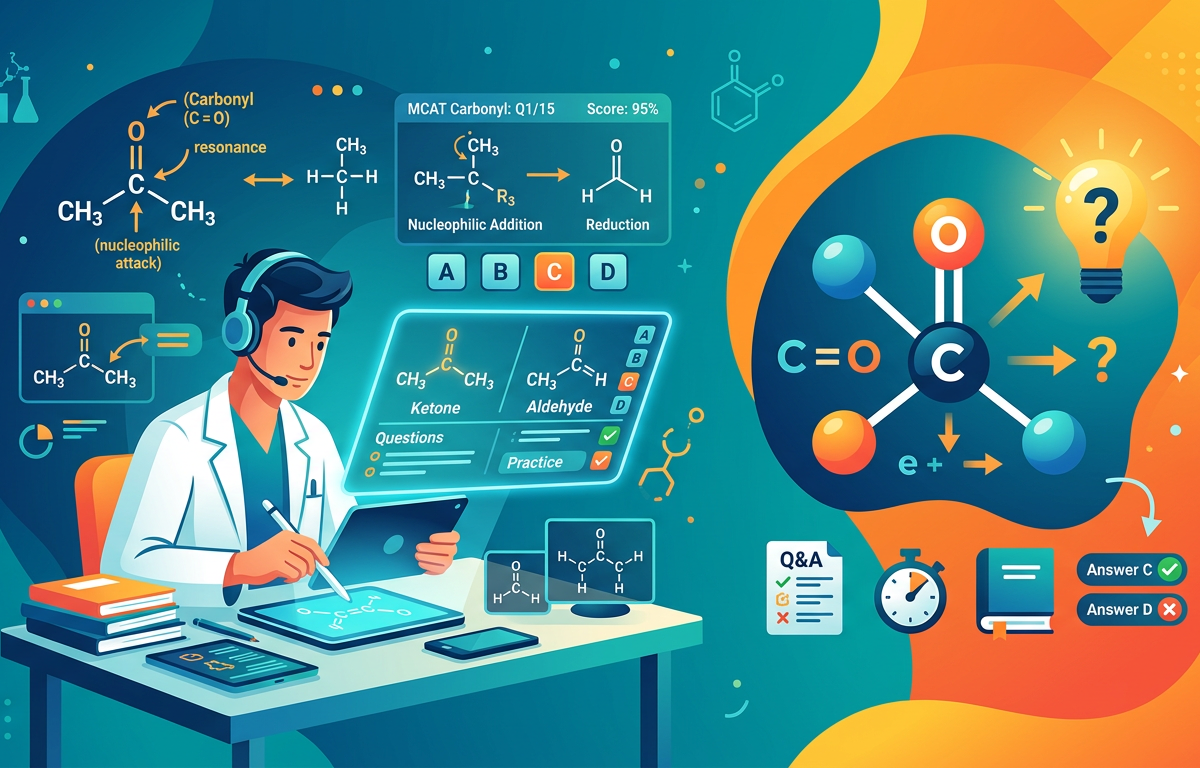
Mastering the reactivity of the carbonyl group is a cornerstone of organic chemistry and a vital component of the Chemical and Physical Foundations of Biological Systems section of the MCAT. This guide provides comprehensive MCAT Carbonyl practice questions and detailed explanations to help you understand nucleophilic addition, oxidation-reduction, and alpha-substitution reactions.
Concept Explanation
A carbonyl group is a functional group characterized by a carbon atom double-bonded to an oxygen atom , which creates a highly polarized bond due to the significant difference in electronegativity between the two atoms. This polarization results in a partial positive charge on the carbon (electrophilic) and a partial negative charge on the oxygen (nucleophilic). In the context of the MCAT, carbonyl chemistry is divided into two main categories: reactions of aldehydes and ketones, and reactions of carboxylic acid derivatives. Aldehydes and ketones typically undergo nucleophilic addition because they lack a good leaving group. In contrast, carboxylic acid derivatives (esters, amides, anhydrides, and acyl halides) undergo nucleophilic acyl substitution, where a nucleophile replaces a leaving group attached to the carbonyl carbon. Understanding the electronic properties of the carbonyl group is essential for predicting reaction mechanisms and products. Furthermore, the acidity of the alpha-hydrogen—the hydrogen attached to the carbon adjacent to the carbonyl—allows for the formation of enolates, which are critical intermediates in C-C bond-forming reactions like the Aldol condensation.
Solved Examples
- Predict the product of the reaction between Acetone and Methylmagnesium Bromide followed by an acid workup.
- Identify the reactants: Acetone (a ketone) and Methylmagnesium Bromide (a Grignard reagent, a strong nucleophile).
- Mechanism: The nucleophilic methyl group attacks the electrophilic carbonyl carbon.
- Intermediate: This forms an alkoxide intermediate where the oxygen carries a negative charge.
- Workup: The addition of protonates the alkoxide.
- Final Product: The result is 2-methyl-2-propanol (tert-butanol), a tertiary alcohol.
- Rank the following in order of increasing reactivity toward nucleophilic attack: Ethyl acetate, Acetamide, Acetic anhydride, Acetyl chloride.
- Reactivity is determined by the electron-withdrawing or donating ability of the leaving group and its stability after departure.
- Amides (Acetamide) are the least reactive because the nitrogen lone pair highly stabilizes the carbonyl through resonance.
- Esters (Ethyl acetate) are more reactive than amides but less than anhydrides.
- Anhydrides (Acetic anhydride) have two carbonyls competing for electrons, making them quite reactive.
- Acyl halides (Acetyl chloride) are the most reactive due to the strong inductive effect of the chlorine atom.
- Order: Acetamide < Ethyl acetate < Acetic anhydride < Acetyl chloride.
- Determine the product of the reaction between Butanal and , followed by water.
- Identify the reagent: is a strong reducing agent that provides hydride ions .
- Action: The hydride ion attacks the carbonyl carbon of the aldehyde (Butanal).
- Intermediate: An alkoxide is formed.
- Final Product: Protonation yields 1-butanol, a primary alcohol.
Practice Questions
1. Which of the following compounds will react most rapidly with in the presence of an acid catalyst to form an acetal or ketal?
2. An unknown compound reacts with Tollens' reagent to produce a silver mirror. Which functional group is most likely present?
3. What is the major product formed when propanone reacts with followed by hydrolysis in aqueous acid?
Don’t just reread. Train for recall.
Use Bevinzey’s active recall and retrieval practice tools to improve long-term memory and MCAT performance.
Try Active Recall Free4. Arrange the following in order of increasing acidity of their alpha-hydrogens: Propanal, Ethyl acetate, Diethyl malonate.
5. A nucleophile attacks the carbonyl carbon of an ester. During the formation of the tetrahedral intermediate, what happens to the hybridization of the carbonyl carbon?
6. Which reagent would effectively convert a carboxylic acid directly into a primary alcohol?
7. In the Aldol condensation of acetaldehyde, what is the role of the base (e.g., )?
8. Which of the following will NOT undergo an entry-level nucleophilic addition-elimination reaction?
9. What is the product of the reaction between Cyclohexanone and in the presence of an acid catalyst?
10. Explain why aldehydes are generally more reactive than ketones toward nucleophilic addition.
Answers & Explanations
- Answer: Formaldehyde. Aldehydes are more reactive than ketones due to less steric hindrance and less inductive stabilization of the partial positive charge on the carbonyl carbon. Among aldehydes, formaldehyde is the most reactive because it has no alkyl groups. Using retrieval practice for medical education can help you remember these reactivity trends more effectively.
- Answer: Aldehyde. Tollens' reagent is a mild oxidizing agent that oxidizes aldehydes to carboxylic acids while reducing silver ions to metallic silver. Ketones do not react with Tollens' reagent because they cannot be easily oxidized without breaking C-C bonds.
- Answer: 2-hydroxy-2-methylpropanoic acid. First, attacks propanone (acetone) to form a cyanohydrin. Subsequent hydrolysis of the nitrile group in aqueous acid converts it into a carboxylic acid .
- Answer: Ethyl acetate < Propanal < Diethyl malonate. Propanal is more acidic than ethyl acetate because the ester oxygen donates electron density into the carbonyl, destabilizing the resulting enolate. Diethyl malonate is the most acidic because its alpha-hydrogens are flanked by two carbonyl groups, allowing for resonance stabilization across both.
- Answer: to . The carbonyl carbon starts as hybridized (trigonal planar). When the nucleophile attacks, the pi bond breaks, and the carbon forms four sigma bonds, becoming hybridized (tetrahedral).
- Answer: . While is strong enough to reduce aldehydes and ketones, only (Lithium Aluminum Hydride) is powerful enough to reduce carboxylic acids and esters to primary alcohols.
- Answer: To deprotonate the alpha-carbon to form a nucleophilic enolate. The base removes a relatively acidic alpha-hydrogen, creating a resonance-stabilized enolate ion that then attacks another molecule of acetaldehyde.
- Answer: Acetone. Acetone is a ketone. Ketones and aldehydes undergo nucleophilic addition. Carboxylic acid derivatives like esters or anhydrides undergo nucleophilic addition-elimination (acyl substitution) because they possess a leaving group.
- Answer: An Imine. The reaction between a ketone and a primary amine results in the formation of an imine with the loss of water.
- Answer: Steric and Electronic factors. Ketones have two bulky alkyl groups that hinder the approach of a nucleophile (sterics). Electronically, alkyl groups are electron-donating, which reduces the partial positive charge (electrophilicity) on the carbonyl carbon compared to aldehydes.
1. Which of the following is the most reactive carboxylic acid derivative?
Frequently Asked Questions
Why is the carbonyl carbon electrophilic?
The carbonyl carbon is electrophilic because the oxygen atom is more electronegative, pulling electron density away from the carbon and creating a partial positive charge. This makes the carbon susceptible to attack by electron-rich nucleophiles.
What is the difference between nucleophilic addition and nucleophilic acyl substitution?
Nucleophilic addition occurs in aldehydes and ketones where the nucleophile adds to the carbon and the pi bond breaks without a leaving group departing. Nucleophilic acyl substitution occurs in carboxylic acid derivatives where a nucleophile replaces a leaving group attached to the carbonyl carbon.
How does steric hindrance affect carbonyl reactivity?
Steric hindrance involves the physical bulk of groups surrounding the carbonyl carbon; larger groups block the path of incoming nucleophiles, thereby decreasing the reaction rate. This is why aldehydes, which have at least one small hydrogen atom, are typically more reactive than ketones.
What are the common reducing agents for MCAT carbonyl chemistry?
The two primary reducing agents are Sodium Borohydride , which reduces aldehydes and ketones, and Lithium Aluminum Hydride , which is stronger and can reduce carboxylic acids, esters, and amides. To master these differences, consider using retrieval practice during your review sessions.
What is an enolate and why is it important?
An enolate is an anion formed by the deprotonation of the alpha-carbon of a carbonyl compound, stabilized by resonance with the carbonyl oxygen. It is a powerful nucleophile used in many synthetic reactions, including the Aldol and Claisen condensations, to form new carbon-carbon bonds.
Can a ketone be oxidized by PCC?
No, ketones cannot be oxidized by Pyridinium Chlorochromate (PCC) or other common oxidizing agents because they lack a hydrogen atom on the carbonyl carbon. PCC is generally used to oxidize primary alcohols to aldehydes and secondary alcohols to ketones as noted in Chemistry LibreTexts.
Don’t just reread. Train for recall.
Use Bevinzey’s active recall and retrieval practice tools to improve long-term memory and MCAT performance.
Try Active Recall FreeReviewed by
Michael Danquah, MS, PhD
Dr. Michael Danquah is a professor of pharmaceutical sciences and founder of several educational technology platforms focused on improving student learning and performance.
Enjoyed this article?
Share it with others who might find it helpful.
Related Articles

Hard MCAT Carbonyl Practice Questions
Master high-yield MCAT carbonyl chemistry with our hard practice questions, detailed explanations, and expert strategies for nucleophilic reactions.
May 11, 2026
Medium MCAT Carbonyl Practice Questions
Medium MCAT Carbonyl Practice Questions
May 11, 2026
Easy MCAT Carbonyl Practice Questions
Master the basics of carbonyl chemistry with our easy MCAT carbonyl practice questions, solved examples, and clear explanations for pre-med students.
May 11, 2026

Hard MCAT Philosophy Passage Practice Questions
Master Hard MCAT Philosophy Passage Practice Questions with our comprehensive guide featuring solved examples, practice questions, and expert explanations.
May 17, 2026

Hard MCAT Humanities Passage Practice Questions
Master Hard MCAT Humanities Passage Practice Questions with our comprehensive guide featuring solved examples, practice questions, and expert strategies.
May 17, 2026

Hard MCAT Critical Analysis Practice Questions
Hard MCAT Critical Analysis Practice Questions
May 17, 2026

Hard MCAT Reading Comprehension Practice Questions
Hard MCAT Reading Comprehension Practice Questions
May 17, 2026

Hard MCAT CARS Passage Practice Questions
Master high-difficulty MCAT CARS passages with our expert guide featuring solved examples, practice questions, and detailed logical analysis.
May 17, 2026