Medium MCAT Carbonyl Practice Questions

Concept Explanation
Carbonyl compounds are organic molecules containing a carbon-oxygen double bond (), characterized by a strong dipole where the carbon is electrophilic and the oxygen is nucleophilic. This functional group is the cornerstone of organic chemistry on the MCAT, appearing in aldehydes, ketones, carboxylic acids, and their derivatives like esters and amides. The reactivity of the carbonyl group is primarily driven by the hybridization of the carbon atom and the significant electronegativity difference between carbon () and oxygen (). Because the oxygen pulls electron density away from the carbon, the carbon atom becomes a prime target for nucleophilic attack. Understanding these mechanisms is essential for mastering medical science prerequisites and performing well on the Chemical and Physical Foundations of Biological Systems section. Key reactions include nucleophilic addition (for aldehydes and ketones) and nucleophilic acyl substitution (for carboxylic acid derivatives). Additionally, the acidity of the -hydrogen—the hydrogen attached to the carbon adjacent to the carbonyl—allows for the formation of enolates, which are critical intermediates in aldol condensations and other carbon-carbon bond-forming reactions.
For more detailed information on the chemical properties of carbonyls, you can explore resources from LibreTexts Chemistry or the Khan Academy Organic Chemistry modules.
Solved Examples
- Predicting Reactivity: Rank the following in order of increasing reactivity toward nucleophilic attack: Acetone, Acetaldehyde, and Formaldehyde.
- Identify the structures: Formaldehyde (), Acetaldehyde (), and Acetone ().
- Consider steric hindrance: Formaldehyde has two small hydrogens; Acetaldehyde has one methyl group; Acetone has two methyl groups. Less steric hindrance increases reactivity.
- Consider electronic effects: Alkyl groups are electron-donating via induction, which stabilizes the partial positive charge on the carbonyl carbon, making it less electrophilic.
- Conclusion: Acetone < Acetaldehyde < Formaldehyde.
- Acetal Formation: What is the product when benzaldehyde reacts with two equivalents of methanol in the presence of an acid catalyst?
- The carbonyl oxygen is protonated by the acid catalyst to increase the electrophilicity of the carbon.
- The first equivalent of methanol () attacks the carbonyl carbon, forming a hemiacetal.
- The hydroxyl group of the hemiacetal is protonated and leaves as water, creating a resonance-stabilized carbocation.
- The second equivalent of methanol attacks, resulting in a dimethyl acetal: .
- Aldol Condensation: Determine the product of the self-condensation of ethanal (acetaldehyde) in basic conditions followed by heating.
- Base () removes an -hydrogen from one ethanal molecule to form an enolate.
- The enolate nucleophile attacks the carbonyl carbon of a second neutral ethanal molecule.
- Protonation of the resulting alkoxide yields 3-hydroxybutanal (an aldol).
- Heating causes dehydration (loss of ) to form the -unsaturated aldehyde: but-2-enal.
Practice Questions
1. Which of the following compounds will most readily undergo nucleophilic addition with a Grignard reagent?
2. An unknown compound reacts with to produce a primary alcohol. Which functional group was likely present in the starting material?
3. Explain why the -hydrogens of a ketone are more acidic than the hydrogens of a standard alkane.
Study smarter for the MCAT.
Turn practice into performance with AI-powered MCAT tools designed to help students retain more and score higher.
Start Learning Free4. Predict the product of the reaction between propanone and at physiological pH.
5. Which reagent would effectively oxidize a primary alcohol to an aldehyde without further oxidation to a carboxylic acid?
6. Compare the boiling points of propanal and propan-1-ol. Which is higher and why?
7. In an aqueous solution of glucose, the molecule exists in an equilibrium between its open-chain and cyclic forms. What is the name of the functional group formed during cyclization?
8. What is the major product when ethyl acetate is treated with excess followed by an acid workup?
9. Rank the following by their rate of hydrolysis in basic conditions: Acetamide, Ethyl acetate, and Acetyl chloride.
10. A keto-enol tautomerization is catalyzed by both acids and bases. Which form is typically more stable for simple ketones like acetone?
Answers & Explanations
- Answer: Aldehydes (specifically smaller ones like formaldehyde). Aldehydes are more reactive than ketones due to less steric hindrance and fewer electron-donating alkyl groups that would otherwise stabilize the electrophilic carbon.
- Answer: Aldehyde, Carboxylic Acid, or Ester. While all three can be reduced to a primary alcohol, carboxylic acids and esters must be reduced with a strong agent like , whereas aldehydes can be reduced by both and .
- Answer: Resonance stabilization. When an -hydrogen is removed, the resulting carbanion (enolate) is resonance-stabilized by the adjacent carbonyl oxygen, which is highly electronegative and can carry the negative charge.
- Answer: Propanone cyanohydrin. The cyanide ion () acts as a nucleophile, attacking the carbonyl carbon of propanone, followed by protonation of the oxygen to form .
- Answer: Pyridinium chlorochromate (PCC). PCC is a mild oxidizing agent that stops at the aldehyde stage. Stronger agents like or would continue the oxidation to a carboxylic acid.
- Answer: Propan-1-ol has a higher boiling point. Propan-1-ol can engage in intermolecular hydrogen bonding, whereas propanal only experiences dipole-dipole interactions. Effective study habits like retrieval practice can help you remember these physical property trends.
- Answer: Hemiacetal. The intramolecular reaction between the hydroxyl group on C5 and the aldehyde on C1 of glucose creates a hemiacetal linkage.
- Answer: 2-methylpropan-2-ol. Grignard reagents react with esters twice. The first addition forms a ketone (after the ethoxide leaves), and the second addition converts the ketone into a tertiary alcohol.
- Answer: Acetyl chloride > Ethyl acetate > Acetamide. Reactivity depends on the leaving group ability. is a very weak base and an excellent leaving group, while is a very strong base and a poor leaving group.
- Answer: The keto form. For most simple ketones, the bond is significantly stronger than the bond found in the enol form, making the keto form thermodynamically favored.
1. Which of the following best describes the carbon atom in a carbonyl group?
Frequently Asked Questions
What is the difference between nucleophilic addition and nucleophilic substitution in carbonyls?
Nucleophilic addition occurs in aldehydes and ketones because they lack a good leaving group, resulting in the saturation of the double bond. Nucleophilic substitution occurs in carboxylic acid derivatives where a nucleophile replaces a leaving group, reforming the carbonyl double bond.
Why are aldehydes generally more reactive than ketones?
Aldehydes have less steric hindrance around the carbonyl carbon and fewer electron-donating alkyl groups to stabilize the partial positive charge. This makes the carbonyl carbon more accessible and more electrophilic compared to ketones.
What is the purpose of using a protecting group like an acetal?
Acetals are used to protect aldehydes and ketones from basic or nucleophilic reagents during a multi-step synthesis. They are stable in basic conditions but can be easily converted back to the carbonyl group using aqueous acid.
How does the Wolff-Kishner reduction differ from the Clemmensen reduction?
The Wolff-Kishner reduction uses hydrazine and strong base to reduce a carbonyl to an alkane, making it ideal for acid-sensitive molecules. The Clemmensen reduction uses zinc-mercury amalgam and hydrochloric acid, making it suitable for base-sensitive molecules.
What makes the alpha-hydrogen of a carbonyl acidic?
The acidity arises from the induction effect of the electronegative oxygen and the resonance stabilization of the resulting enolate anion. This allows the negative charge to be delocalized onto the oxygen atom, significantly lowering the pKa of the hydrogen.
Study smarter for the MCAT.
Turn practice into performance with AI-powered MCAT tools designed to help students retain more and score higher.
Start Learning FreeReviewed by
Michael Danquah, MS, PhD
Dr. Michael Danquah is a professor of pharmaceutical sciences and founder of several educational technology platforms focused on improving student learning and performance.
Enjoyed this article?
Share it with others who might find it helpful.
Related Articles

Hard MCAT Carbonyl Practice Questions
Master high-yield MCAT carbonyl chemistry with our hard practice questions, detailed explanations, and expert strategies for nucleophilic reactions.
May 11, 2026
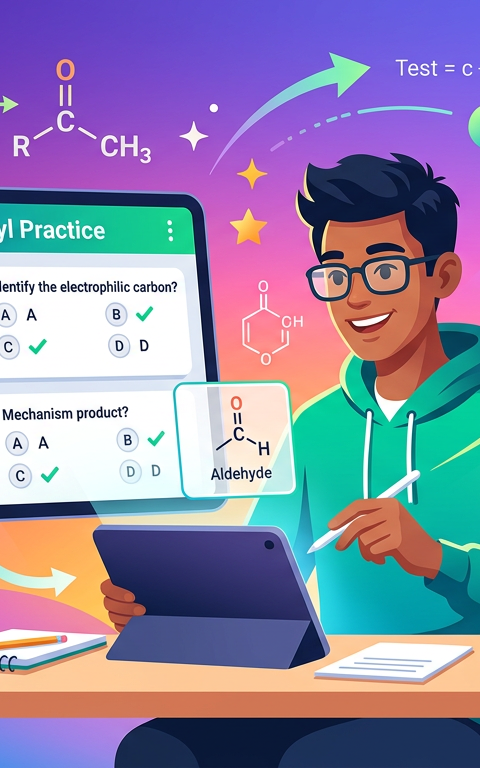
Easy MCAT Carbonyl Practice Questions
Master the basics of carbonyl chemistry with our easy MCAT carbonyl practice questions, solved examples, and clear explanations for pre-med students.
May 11, 2026
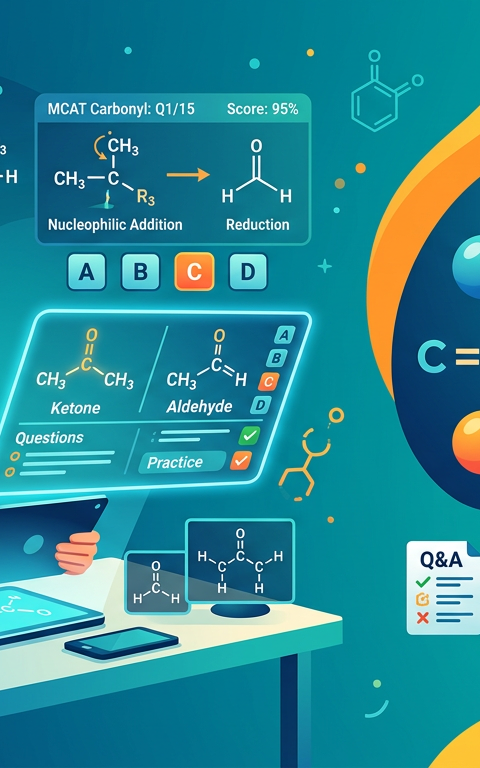
MCAT Carbonyl Practice Questions with Answers
MCAT Carbonyl Practice Questions with Answers
May 10, 2026

Hard MCAT Philosophy Passage Practice Questions
Master Hard MCAT Philosophy Passage Practice Questions with our comprehensive guide featuring solved examples, practice questions, and expert explanations.
May 17, 2026

Hard MCAT Humanities Passage Practice Questions
Master Hard MCAT Humanities Passage Practice Questions with our comprehensive guide featuring solved examples, practice questions, and expert strategies.
May 17, 2026

Hard MCAT Critical Analysis Practice Questions
Hard MCAT Critical Analysis Practice Questions
May 17, 2026

Hard MCAT Reading Comprehension Practice Questions
Hard MCAT Reading Comprehension Practice Questions
May 17, 2026

Hard MCAT CARS Passage Practice Questions
Master high-difficulty MCAT CARS passages with our expert guide featuring solved examples, practice questions, and detailed logical analysis.
May 17, 2026