Homeostasis Questions Practice Questions with Answers
Concept Explanation
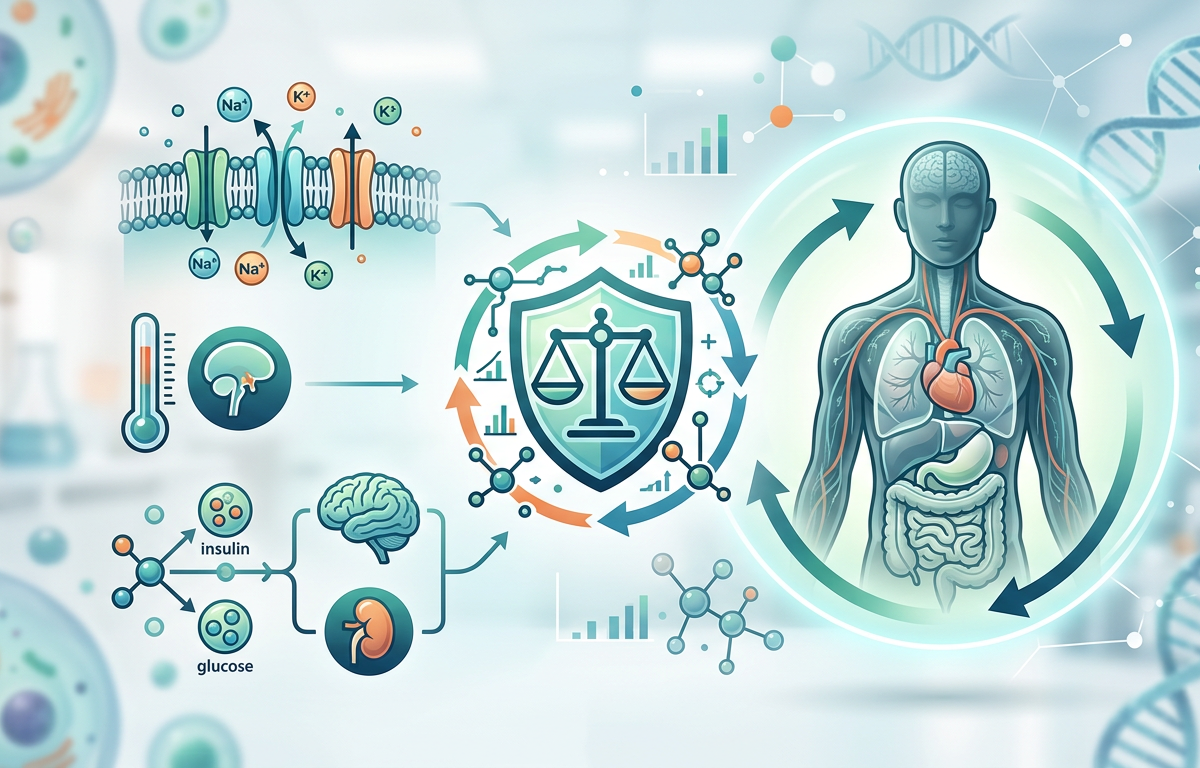
Homeostasis is the ability of an organism to maintain stable internal conditions despite changes in its external environment. This dynamic equilibrium is crucial for the optimal functioning of cells, tissues, and organs, ensuring survival. It involves a complex network of regulatory mechanisms, primarily negative feedback loops, that detect deviations from a set point and initiate responses to restore balance. Key components of a homeostatic system include a stimulus (a change in the internal environment), a receptor (detects the change), a control center (processes information and determines a response), and an effector (carries out the response).
Solved Examples
Example 1: Regulation of Body Temperature
- Stimulus: Body temperature rises above the set point (e.g., during exercise).
- Receptor: Thermoreceptors in the skin and hypothalamus detect the increase.
- Control Center: The hypothalamus in the brain processes this information.
- Effector: The hypothalamus sends signals to sweat glands to increase sweat production and to blood vessels in the skin to dilate (vasodilation).
- Response: Evaporation of sweat cools the body, and increased blood flow to the skin allows more heat to dissipate, lowering body temperature back to the set point.
Example 2: Blood Glucose Regulation
- Stimulus: Blood glucose levels rise after a meal.
- Receptor: Beta cells in the pancreatic islets detect the high glucose.
- Control Center: The beta cells themselves act as the control center, signaling the pancreas.
- Effector: The pancreas releases insulin into the bloodstream.
- Response: Insulin promotes the uptake of glucose by body cells (especially muscle and liver cells) and its conversion to glycogen for storage, thus lowering blood glucose back to the set point.
Example 3: Regulation of Blood Pressure
- Stimulus: Blood pressure falls below the set point (e.g., due to dehydration or standing up quickly).
- Receptor: Baroreceptors in the carotid arteries and aorta detect the decrease.
- Control Center: The medulla oblongata in the brainstem receives signals from the baroreceptors.
- Effector: The medulla oblongata sends signals to the heart to increase heart rate and contractility, and to blood vessels to constrict (vasoconstriction).
- Response: Increased cardiac output and peripheral resistance raise blood pressure back to the set point. This is a vital process for maintaining proper cardiovascular system function.
Practice Questions
1. Which component of a homeostatic control system detects changes in the internal environment?
2. Explain the difference between negative feedback and positive feedback in the context of homeostasis.
3. Describe the role of the kidneys in maintaining water balance within the body.
4. A person experiences a sudden drop in blood pressure. Outline the homeostatic response that would occur to restore normal blood pressure, identifying the key components involved.
5. Why is maintaining a stable internal temperature (thermoregulation) critical for enzyme function?
6. Consider a situation where blood calcium levels are too low. Describe the homeostatic mechanism involving parathyroid hormone (PTH) that would act to raise calcium levels.
7. What would happen if a crucial receptor in a negative feedback loop stopped functioning correctly?
8. How does the body regulate blood pH to maintain it within a narrow, healthy range?
9. Discuss the role of the nervous system and endocrine system in coordinating homeostatic responses.
10. Explain how shivering helps to maintain body temperature when exposed to cold environments.
Answers & Explanations
1. Receptor. Receptors are specialized structures or cells that monitor changes in a controlled condition (stimulus) and send input to a control center.
2. Negative feedback is the primary mechanism of homeostatic regulation, where the response reverses the original stimulus, bringing the variable back to its set point. For example, if body temperature rises, negative feedback mechanisms work to lower it. Positive feedback, in contrast, intensifies or amplifies the original stimulus, moving the variable further away from the set point. It is less common in homeostasis and is typically involved in processes that require a rapid, self-amplifying change, such as childbirth contractions or blood clotting.
3. The kidneys play a vital role in maintaining water balance by regulating the volume and concentration of urine. When the body is dehydrated, the kidneys reabsorb more water, producing concentrated urine. Conversely, when there is excess water, they excrete more water, producing dilute urine. This process is largely controlled by hormones like Antidiuretic Hormone (ADH).
4. When blood pressure drops:
- Stimulus: Decreased blood pressure.
- Receptors: Baroreceptors in the carotid arteries and aorta detect the drop.
- Control Center: The cardiovascular center in the medulla oblongata receives input from the baroreceptors.
- Effectors: The control center sends signals via the autonomic nervous system to the heart (increasing heart rate and contractility) and blood vessels (causing vasoconstriction).
- Response: Increased cardiac output and peripheral resistance elevate blood pressure back to the normal range.
5. Maintaining a stable internal temperature is critical for enzyme function because enzymes are proteins with specific three-dimensional structures that are essential for their catalytic activity. Extreme temperatures (either too high or too low) can alter or denature these structures, reducing or eliminating their ability to function. Optimal temperature ensures enzymes operate at their peak efficiency, which is vital for metabolic reactions.
6. If blood calcium levels are too low:
- Stimulus: Low blood calcium (hypocalcemia).
- Receptors/Control Center: Parathyroid glands detect the low calcium levels.
- Effector: Parathyroid glands release parathyroid hormone (PTH).
- Response: PTH acts on bones (stimulating osteoclasts to release calcium), kidneys (increasing calcium reabsorption and activating Vitamin D), and intestines (increasing calcium absorption indirectly via Vitamin D) to raise blood calcium levels back to the set point.
7. If a crucial receptor in a negative feedback loop stopped functioning correctly, the body would lose its ability to detect deviations from the set point for that particular variable. This would lead to a failure in initiating the appropriate corrective response, causing the variable to continue moving away from the normal range. For example, if thermoreceptors failed, the body might not detect a rise in temperature, leading to hyperthermia.
8. The body regulates blood pH primarily through three main mechanisms: buffer systems, respiratory regulation, and renal regulation. Buffer systems (like the bicarbonate buffer system) quickly bind to excess hydrogen ions or release them to resist changes in pH. The respiratory system adjusts the rate of carbon dioxide (an acid-forming gas) excretion through breathing. The renal system (kidneys) excretes excess acids or bases and reabsorbs bicarbonate ions, a slower but very powerful long-term regulator of pH. Understanding how organ systems work together is key here.
9. The nervous system and endocrine system are the two main coordinating systems for homeostatic responses. The nervous system provides rapid, short-term responses, using nerve impulses to transmit signals quickly to specific effectors (e.g., muscle contractions for shivering, changes in heart rate). The endocrine system provides slower, longer-lasting responses, using hormones transported through the bloodstream to target cells throughout the body (e.g., insulin for blood glucose regulation, ADH for water balance).
10. Shivering helps to maintain body temperature by generating heat through involuntary muscle contractions. When the body's internal temperature drops below the set point, the hypothalamus triggers skeletal muscles to contract rhythmically. This muscular activity requires energy and releases heat as a byproduct, effectively increasing the body's heat production and helping to raise the core temperature back to normal.
1. What is the primary mechanism by which homeostasis is maintained in the body?
Frequently Asked Questions
What is the set point in homeostasis?
The set point is the ideal or optimal value at which a physiological variable is maintained. Homeostatic mechanisms work to keep internal conditions within a narrow range around this set point, rather than at a fixed, absolute value.
Why is homeostasis important for living organisms?
Homeostasis is vital because it ensures that internal conditions, such as temperature, pH, and nutrient levels, remain stable within a range that supports optimal cellular function. Without it, enzymes would denature, metabolic processes would fail, and cells would die, leading to the organism's demise.
What is the difference between intrinsic and extrinsic regulation?
Intrinsic regulation (or autoregulation) occurs when the organs themselves adjust their activity without input from the nervous or endocrine systems. Extrinsic regulation involves coordination by the nervous or endocrine systems, which control multiple organs simultaneously to maintain homeostasis across the entire body.
Can homeostasis fail?
Yes, homeostasis can fail. When homeostatic mechanisms are overwhelmed or compromised, the body's internal environment can deviate significantly from the set point, leading to illness or disease. For example, diabetes is a condition where blood glucose homeostasis fails.
How do positive feedback loops differ from negative feedback loops in their outcome?
Negative feedback loops reverse the initial change, bringing the system back to its set point, thus maintaining stability. Positive feedback loops amplify the initial change, pushing the system further away from the set point, often to achieve a specific, rapid outcome like blood clotting or childbirth.
Enjoyed this article?
Share it with others who might find it helpful.
Related Articles
Hard Le Chatelier’s Principle Practice Questions
Master Hard Le Chatelier’s Principle Practice Questions with our comprehensive guide featuring solved examples, practice problems, and detailed explanations.
Mar 30, 2026
Hard Reaction Quotient (Q) Practice Questions
Hard Reaction Quotient (Q) Practice Questions
Mar 30, 2026
Grams to Moles Practice Questions with Answers
Master grams to moles conversions with our comprehensive guide. Includes step-by-step examples, practice questions, and detailed answers for chemistry students.
Mar 26, 2026
Avogadro’s Number Practice Questions with Answers
Master the mole concept with our Avogadro’s Number practice questions. Includes step-by-step solved examples, a quick quiz, and detailed explanations.
Mar 26, 2026
Empirical Formulas: Solving Ratios from Mass and Percent Data
Master empirical formula calculations with 10 practice questions, worked answers, and a free step-by-step calculator for mass, percentage, and combustion problems.
Mar 26, 2026