Hard Reaction Mechanism Practice Questions
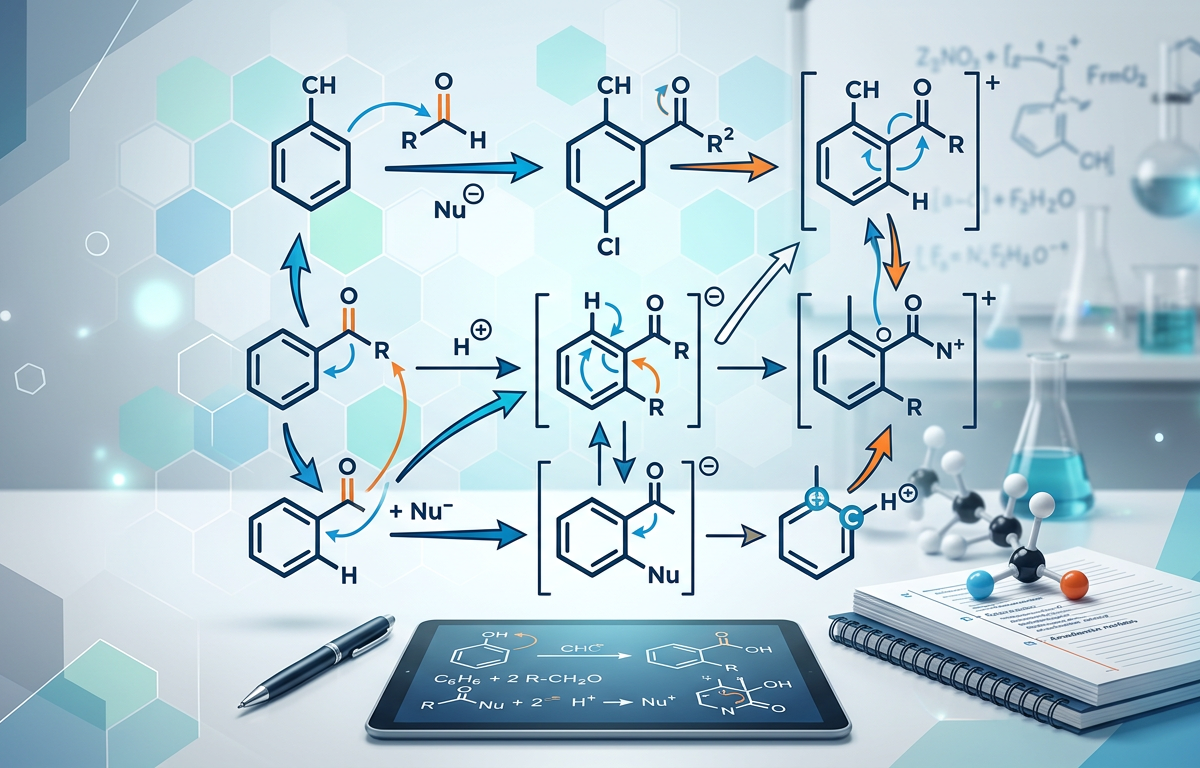
Concept Explanation
A reaction mechanism is a step-by-step description of the path by which reactants are converted into products, detailing the movement of electrons and the formation of short-lived intermediates. Understanding a Hard Reaction Mechanism requires more than just memorizing reagents; it demands an intuitive grasp of electron density, molecular orbital theory, and steric hindrance. In organic chemistry, we use "curved arrows" to represent the flow of electron pairs, starting from a nucleophile (electron donor) and pointing toward an electrophile (electron acceptor). High-level mechanisms often involve complex rearrangements, such as Wagner-Meerwein shifts, or multi-step sequences like the Robinson Annulation. Mastery of this topic is essential for predicting the outcome of synthetic pathways and understanding the kinetic and thermodynamic control of chemical processes. By analyzing these steps, chemists can determine the rate-determining step, which is the slowest part of the reaction that dictates the overall speed.
Solved Examples
These examples demonstrate the logical progression required to solve advanced problems in organic chemistry.
Example 1: Pinacol Rearrangement
Predict the product of the reaction of 2,3-dimethyl-2,3-butanediol with concentrated sulfuric acid.
The reaction begins with the protonation of one of the hydroxyl groups by H₂SO₄, creating a good leaving group (-OH₂⁺).
Loss of water occurs, generating a tertiary carbocation at the C2 position.
A 1,2-methyl shift occurs from C3 to C2. This is driven by the formation of a more stable resonance-stabilized oxocarbocation.
Deprotonation of the carbonyl oxygen yields the final product: pinacolone (3,3-dimethyl-2-butanone).
Example 2: Electrophilic Aromatic Substitution (EAS) with Rearrangement
Determine the major product when benzene reacts with 1-chloro-2,2-dimethylpropane in the presence of AlCl₃.
The alkyl halide reacts with the Lewis acid AlCl₃ to form a complex.
Because a primary carbocation is unstable, a simultaneous 1,2-methyl shift occurs as the leaving group departs, forming a tertiary carbocation (2-methyl-2-butyl cation).
The benzene ring acts as a nucleophile, attacking the tertiary carbocation.
The sigma complex (arenium ion) is deprotonated by AlCl₄⁻ to restore aromaticity, yielding (2-methylbutan-2-yl)benzene.
Example 3: Epoxide Opening in Acidic vs. Basic Conditions
Explain why 1,2-epoxypropane reacts with methanol/H⁺ to give 2-methoxy-1-propanol, but with NaOCH₃/CH₃OH to give 1-methoxy-2-propanol.
Under acidic conditions, the oxygen is protonated. The C-O bond to the more substituted carbon (C2) weakens due to its ability to better stabilize a partial positive charge. The nucleophile (methanol) attacks the more substituted C2 position.
Under basic conditions, the methoxide ion is a strong nucleophile and attacks the least sterically hindered carbon (C1) via an SN2 mechanism.
This demonstrates how regioselectivity changes based on the reaction environment.
Practice Questions
Test your advanced knowledge with these Hard Reaction Mechanism Practice Questions. If you find these challenging, you might want to review our Reaction Mechanism Practice Questions with Answers for foundational concepts.
Predict the mechanism and major product for the reaction of (R)-3-methyl-2-pentanol with PBr₃.
Draw the step-by-step mechanism for the acid-catalyzed formation of an acetal from benzaldehyde and ethylene glycol.
Propose a mechanism for the Baeyer-Villiger oxidation of cyclohexanone using mCPBA.
Want unlimited practice questions like these?
Generate AI-powered questions with step-by-step solutions on any topic.
Try Question Generator Free →Identify the intermediate and final product when 1-methylcyclohexene reacts with NBS in aqueous DMSO.
Provide the mechanism for the Cannizzaro reaction of formaldehyde in concentrated NaOH.
Describe the mechanism for the Robinson Annulation between methyl vinyl ketone and 2-methylcyclohexane-1,3-dione.
Predict the outcome and mechanism when neopentyl alcohol is treated with concentrated HBr.
Draw the mechanism for the Hofmann Rearrangement of butanamide using Br₂ and NaOH.
Explain the mechanism of the Diels-Alder reaction between 1,3-butadiene and maleic anhydride, including the endo-product rationale.
Analyze the mechanism for the hydroboration-oxidation of 1-methylcyclopentene, focusing on stereochemistry.
Answers & Explanations
Answer: (S)-2-bromo-3-methylpentane. The reaction involves the formation of a bromophosphite intermediate, followed by an SN2 back-side attack by bromide ion, leading to an inversion of configuration at the chiral center.
Answer: Cyclic Acetal. The mechanism involves: 1) Protonation of the carbonyl oxygen. 2) Nucleophilic attack by one OH of the glycol. 3) Proton transfer. 4) Loss of water to form an oxonium ion. 5) Intramolecular attack by the second OH group. 6) Final deprotonation.
Answer: Ɛ-caprolactone. The peroxyacid attacks the carbonyl carbon. A C-C bond migrates to the peroxy oxygen (the more substituted carbon migrates faster), followed by the departure of the carboxylate leaving group.
Answer: Bromohydrin (2-bromo-1-methylcyclohexanol). NBS provides a bromonium ion intermediate. Water then attacks the more substituted carbon from the opposite face (anti-addition) to give the trans-bromohydrin.
Answer: Methanol and Sodium Formate. OH⁻ attacks one formaldehyde molecule to form a tetrahedral intermediate. A hydride shift (H⁻) occurs from this intermediate to a second formaldehyde molecule. This redox disproportionation yields the alcohol and the carboxylate.
Answer: A fused bicyclic enone. This consists of a Michael addition followed by an intramolecular Aldol condensation and dehydration. It is a classic method for building six-membered rings. For more on ring structures, see our Isomer Identification Practice Questions.
Answer: 2-bromo-2-methylbutane. Protonation of the alcohol and loss of water would yield a primary carbocation, but a 1,2-methyl shift occurs simultaneously to form a stable tertiary carbocation, which is then attacked by Br⁻.
Answer: Propylamine. The amide is deprotonated, reacts with Br₂ to form an N-bromoamide, is deprotonated again, and then undergoes an alkyl shift to the nitrogen as bromide leaves, forming an isocyanate which hydrolyzes to the amine.
Answer: Cis-cyclohexene dicarboxylic anhydride. This is a concerted [4+2] cycloaddition. The endo-product is favored due to secondary orbital interactions between the pi-systems of the diene and the dienophile substituents.
Answer: trans-2-methylcyclopentanol. Borane adds in a syn-addition to the alkene (H and BH₂ on the same side). Oxidation with H₂O₂/NaOH replaces BH₂ with OH with retention of configuration, resulting in the H and OH being trans to the methyl group.
1. Which of the following is the rate-determining step in an SN1 reaction?
Frequently Asked Questions
What is the difference between a transition state and an intermediate?
A transition state is a high-energy, fleeting arrangement of atoms at a potential energy maximum that cannot be isolated, while an intermediate is a chemical species with a finite lifetime located at a potential energy minimum between steps.
How do you identify the nucleophile in a mechanism?
A nucleophile is an electron-rich species, often possessing a lone pair or a pi bond, that seeks out electron-deficient centers (electrophiles) to form a new chemical bond. For help with molecular properties, check our Hard Polarity Determination Practice Questions.
Why are carbocation rearrangements common in SN1 but not SN2?
SN1 reactions proceed through a distinct carbocation intermediate that has time to rearrange to a more stable form, whereas SN2 reactions are concerted, meaning bond-breaking and bond-forming happen simultaneously without an intermediate.
What role does a catalyst play in a reaction mechanism?
A catalyst provides an alternative reaction pathway with a lower activation energy, increasing the reaction rate without being consumed in the overall process. According to the Khan Academy, catalysts often change the nature of the transition state to speed up the process.
What is regioselectivity in a chemical reaction?
Regioselectivity refers to the preference of a chemical reaction to occur at one specific atom or direction over others, such as Markovnikov addition in alkenes. This is often dictated by the stability of the intermediates formed during the mechanism.
How does solvent polarity affect reaction mechanisms?
Polar protic solvents stabilize ions through hydrogen bonding, favoring SN1 mechanisms, while polar aprotic solvents do not solvate nucleophiles strongly, thereby increasing their reactivity in SN2 mechanisms.
Want unlimited practice questions like these?
Generate AI-powered questions with step-by-step solutions on any topic.
Try Question Generator Free →
Want unlimited practice questions like these?
Generate AI-powered questions with step-by-step solutions on any topic.
Try Question Generator Free →Enjoyed this article?
Share it with others who might find it helpful.
Related Articles
Hard Le Chatelier’s Principle Practice Questions
Master Hard Le Chatelier’s Principle Practice Questions with our comprehensive guide featuring solved examples, practice problems, and detailed explanations.
Mar 30, 2026

Hard Reaction Quotient (Q) Practice Questions
Hard Reaction Quotient (Q) Practice Questions
Mar 30, 2026
Grams to Moles Practice Questions with Answers
Master grams to moles conversions with our comprehensive guide. Includes step-by-step examples, practice questions, and detailed answers for chemistry students.
Mar 26, 2026
Avogadro’s Number Practice Questions with Answers
Master the mole concept with our Avogadro’s Number practice questions. Includes step-by-step solved examples, a quick quiz, and detailed explanations.
Mar 26, 2026

Empirical Formulas: Solving Ratios from Mass and Percent Data
Master empirical formula calculations with 10 practice questions, worked answers, and a free step-by-step calculator for mass, percentage, and combustion problems.
Mar 26, 2026