Hard Balancing Redox Practice Questions
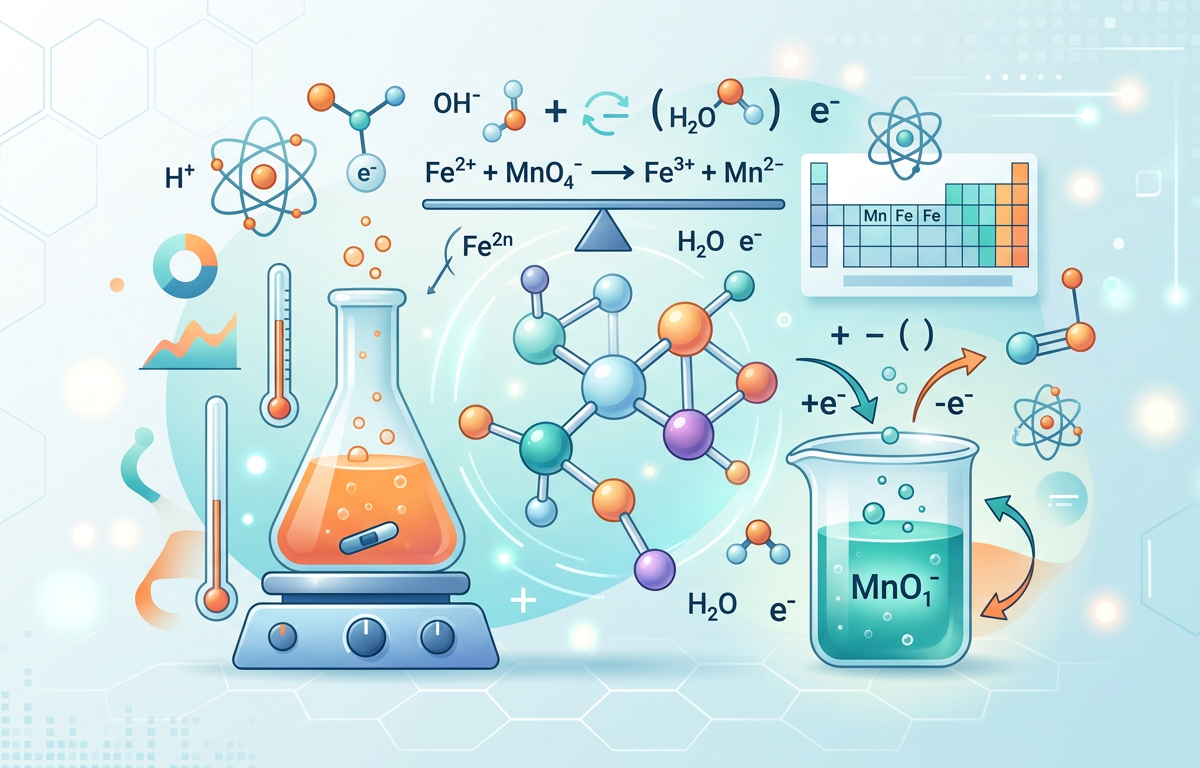
Concept Explanation
Hard balancing redox involves using the half-reaction method or the oxidation number method to equate the total number of electrons lost in oxidation with the total number of electrons gained in reduction within complex chemical equations. These reactions often occur in acidic or basic solutions, requiring the addition of H+, OH-, and H2O to balance charge and mass. Unlike simple chemical equations, balancing redox practice questions at a hard level typically involve polyatomic ions, multiple elements changing oxidation states, or disproportionation reactions where a single species is both oxidized and reduced. Mastering this requires a strict adherence to the law of conservation of mass and charge, ensuring that the net charge on the reactant side perfectly matches the net charge on the product side. For a broader overview of these principles, you might explore the Wikipedia page on Redox reactions.
The Half-Reaction Method in Acidic Solution
Identify the oxidation and reduction half-reactions by calculating oxidation states.
Balance all elements except Oxygen and Hydrogen.
Balance Oxygen atoms by adding H2O molecules to the side that needs oxygen.
Balance Hydrogen atoms by adding H+ ions to the side that needs hydrogen.
Balance the charge by adding electrons (e-) to the more positive side.
Multiply the half-reactions by integers so the number of electrons lost equals the number of electrons gained.
Add the half-reactions and cancel out species appearing on both sides.
The Half-Reaction Method in Basic Solution
Follow the acidic steps above, then add an amount of OH- ions equal to the amount of H+ ions to both sides of the final equation. Combine the H+ and OH- to form water, and simplify the water molecules on both sides. This process is essential for calculating cell potential calculations in alkaline batteries.
Solved Examples
Example 1: Acidic Solution
Balance the reaction: MnO4⁻ + Fe²⁺ → Mn²⁺ + Fe³⁺ (Acidic)
Separate half-reactions: (Red) MnO4⁻ → Mn²⁺ | (Ox) Fe²⁺ → Fe³⁺.
Balance Mn and Fe: Already balanced.
Balance O in MnO4⁻: MnO4⁻ → Mn²⁺ + 4H2O.
Balance H: MnO4⁻ + 8H⁺ → Mn²⁺ + 4H2O.
Balance charge: MnO4⁻ + 8H⁺ + 5e⁻ → Mn²⁺ + 4H2O | Fe²⁺ → Fe³⁺ + 1e⁻.
Equalize electrons: Multiply iron reaction by 5.
Combine: MnO4⁻ + 8H⁺ + 5Fe²⁺ → Mn²⁺ + 4H2O + 5Fe³⁺.
Example 2: Basic Solution
Balance the reaction: Cl2 → Cl⁻ + ClO3⁻ (Basic)
Separate half-reactions: (Red) Cl2 → Cl⁻ | (Ox) Cl2 → ClO3⁻.
Balance Cl: Cl2 → 2Cl⁻ | Cl2 → 2ClO3⁻.
Balance O and H (Acidic first): Cl2 + 6H2O → 2ClO3⁻ + 12H⁺.
Balance charge: Cl2 + 2e⁻ → 2Cl⁻ | Cl2 + 6H2O → 2ClO3⁻ + 12H⁺ + 10e⁻.
Equalize: Multiply reduction by 5. 5Cl2 + 10e⁻ → 10Cl⁻.
Combine: 6Cl2 + 6H2O → 10Cl⁻ + 2ClO3⁻ + 12H⁺. Simplify: 3Cl2 + 3H2O → 5Cl⁻ + ClO3⁻ + 6H⁺.
Convert to basic: Add 6OH⁻ to both sides. 3Cl2 + 3H2O + 6OH⁻ → 5Cl⁻ + ClO3⁻ + 6H2O.
Final: 3Cl2 + 6OH⁻ → 5Cl⁻ + ClO3⁻ + 3H2O.
Example 3: Complex Polyatomic Ion
Balance: Cr2O7²⁻ + C2O4²⁻ → Cr³⁺ + CO2 (Acidic)
Red: Cr2O7²⁻ + 14H⁺ + 6e⁻ → 2Cr³⁺ + 7H2O.
Ox: C2O4²⁻ → 2CO2 + 2e⁻.
Equalize: Multiply oxidation by 3. 3C2O4²⁻ → 6CO2 + 6e⁻.
Combine: Cr2O7²⁻ + 14H⁺ + 3C2O4²⁻ → 2Cr³⁺ + 7H2O + 6CO2.
Practice Questions
1. Balance the following disproportionation reaction in a basic solution: P4 → PH3 + HPO3²⁻.
2. Balance the following reaction in an acidic solution: As2O3 + NO3⁻ → H3AsO4 + NO.
3. Balance the following reaction occurring in a basic medium: CN⁻ + MnO4⁻ → CNO⁻ + MnO2.
Want unlimited practice questions like these?
Generate AI-powered questions with step-by-step solutions on any topic.
Try Question Generator Free →4. Balance the reaction of ethanol oxidation by dichromate in acidic solution: CH3CH2OH + Cr2O7²⁻ → CH3COOH + Cr³⁺.
5. Balance the following complex redox reaction in acidic solution: S2O3²⁻ + IO3⁻ + Cl⁻ → SO4²⁻ + ICl2⁻.
6. Balance the reaction in a basic solution: Al + NO2⁻ → Al(OH)4⁻ + NH3.
7. Balance the reaction: XeF4 + H2O → Xe + XeO3 + HF + O2 (Note: This is a complex disproportionation; balance atoms first).
8. Balance the following reaction in acidic solution: PbO2 + Cl⁻ → Pb²⁺ + Cl2.
9. Balance the reaction in basic solution: Zn + NO3⁻ → Zn²⁺ + NH3.
10. Balance the following reaction in acidic solution: BrO3⁻ + N2H4 → Br⁻ + N2.
Answers & Explanations
1. P4 + 4OH⁻ + 2H2O → 2PH3 + 2HPO3²⁻
Phosphorus is both oxidized and reduced. The reduction half-reaction is P4 + 12H⁺ + 12e⁻ → 4PH3. The oxidation half-reaction is P4 + 12H2O → 4HPO3²⁻ + 20H⁺ + 12e⁻. Combining and converting to basic medium yields the final balanced equation.
2. 3As2O3 + 4NO3⁻ + 7H2O + 4H⁺ → 6H3AsO4 + 4NO
As in As2O3 goes from +3 to +5 (oxidation). Nitrogen in NO3⁻ goes from +5 to +2 (reduction). Balance electrons (4 for As2O3, 3 for NO3⁻) by using coefficients 3 and 4 respectively. If you find these steps difficult, review our guide on studying when you struggle to focus to improve your concentration on complex steps.
3. 3CN⁻ + 2MnO4⁻ + H2O → 3CNO⁻ + 2MnO2 + 2OH⁻
In basic solution, CN⁻ is oxidized to CNO⁻ (2e⁻ change) and MnO4⁻ is reduced to MnO2 (3e⁻ change). We multiply the cyanide reaction by 3 and the permanganate reaction by 2 to balance the 6 electrons exchanged.
4. 3CH3CH2OH + 2Cr2O7²⁻ + 16H⁺ → 3CH3COOH + 4Cr³⁺ + 11H2O
The oxidation of ethanol to acetic acid involves a 4-electron change. The reduction of dichromate involves a 6-electron change. The least common multiple is 12, requiring a 3:2 ratio of reactants.
5. 3S2O3²⁻ + 4IO3⁻ + 8Cl⁻ + 6H⁺ → 6SO4²⁻ + 4ICl2⁻ + 3H2O
This involves balancing multiple anions. Sulfur is oxidized from +2 to +6 (8 electrons per S2O3²⁻). Iodine is reduced from +5 to +1 (4 electrons per IO3⁻). Balancing the electron flow is the primary challenge here.
6. 2Al + NO2⁻ + OH⁻ + 5H2O → 2Al(OH)4⁻ + NH3
Aluminum is oxidized (3e⁻) and Nitrogen is reduced from +3 to -3 (6e⁻). We need 2 Al for every 1 NO2⁻. This is a classic example of basic solution balancing often found in the LibreTexts Chemistry database.
7. 3XeF4 + 6H2O → 2Xe + XeO3 + 12HF + 1.5O2 (or 6:12:4:2:24:3)
Xe is reduced from +4 to 0 and oxidized from +4 to +6. Oxygen is oxidized from -2 to 0. This requires careful tracking of three different oxidation state changes simultaneously.
8. PbO2 + 4H⁺ + 2Cl⁻ → Pb²⁺ + Cl2 + 2H2O
Lead is reduced from +4 to +2. Chlorine is oxidized from -1 to 0. The charge is balanced by the 4 H+ ions on the reactant side.
9. 4Zn + NO3⁻ + 7OH⁻ + 6H2O → 4Zn(OH)4²⁻ + NH3
Zinc is oxidized to the zincate ion (or Zn²⁺ depending on pH) and Nitrate is reduced to Ammonia. This requires 8 electrons total, provided by 4 Zinc atoms.
10. 2BrO3⁻ + 3N2H4 → 2Br⁻ + 3N2 + 6H2O
Bromate is reduced (6e⁻ per Br) and Hydrazine is oxidized (4e⁻ per N2H4). The lowest common multiple is 12, leading to the 2:3 ratio of the reactants.
1. In the reaction MnO4⁻ + 5Fe²⁺ + 8H⁺ → Mn²⁺ + 5Fe³⁺ + 4H2O, which species is the reducing agent?
Frequently Asked Questions
What makes a redox reaction "hard" to balance?
Hard redox reactions often involve multiple species undergoing oxidation/reduction simultaneously or include complex polyatomic ions where oxidation states are not immediately obvious. They frequently require balancing in basic media, which adds an extra layer of stoichiometric steps compared to acidic solutions.
Why do we add water when balancing redox reactions?
Water is added to balance Oxygen atoms because most redox reactions occur in aqueous solutions where H2O is the solvent and readily available. This ensures the conservation of mass for oxygen without introducing unrelated chemical species.
Can I balance redox reactions using the inspection method?
While simple reactions can be balanced by inspection, complex redox reactions involve electron transfers that are difficult to track visually. The half-reaction method is much more reliable for ensuring both mass and charge are perfectly balanced.
What is the difference between an oxidizing agent and a reducing agent?
An oxidizing agent gains electrons and is reduced, while a reducing agent loses electrons and is oxidized. In a balanced equation, the substance that undergoes a decrease in oxidation number is the oxidizing agent.
How do I know if a reaction is in an acidic or basic solution?
The problem statement will usually specify the medium, or it will be implied by the presence of H+ (acidic) or OH- (basic) in the skeleton equation. If neither is present, you should check the typical reaction conditions for those specific reagents on sites like Khan Academy.
Want unlimited practice questions like these?
Generate AI-powered questions with step-by-step solutions on any topic.
Try Question Generator Free →
Want unlimited practice questions like these?
Generate AI-powered questions with step-by-step solutions on any topic.
Try Question Generator Free →Enjoyed this article?
Share it with others who might find it helpful.
Related Articles
Medium Balancing Redox Practice Questions
Master medium-level redox balancing with our comprehensive guide featuring solved examples, step-by-step methods for acidic/basic solutions, and practice questions.
Apr 4, 2026
Balancing Redox Practice Questions with Answers
Master balancing redox reactions with our comprehensive guide featuring step-by-step solved examples, practice questions in acidic and basic solutions, and a quick quiz.
Apr 3, 2026
Hard Redox Reaction Practice Questions
Master complex chemistry with our Hard Redox Reaction Practice Questions. Learn to balance equations in acidic/basic media and calculate cell potentials.
Apr 4, 2026
Medium Redox Reaction Practice Questions
Master medium-level redox reaction problems with our comprehensive guide featuring solved examples, balancing tips, and practice questions for students.
Apr 4, 2026
Stop Guessing: How to Balance Redox Charges Without Losing Electrons
Master the basics of oxidation-reduction with these easy balancing redox practice questions and step-by-step solutions for students.
Apr 4, 2026
Easy Redox Reaction Practice Questions
Master the basics of electron transfer with these easy redox reaction practice questions, featuring step-by-step solutions and clear explanations.
Apr 4, 2026
Redox Reaction Practice Questions with Answers
Master redox reactions with these practice questions and answers. Learn to identify oxidation, reduction, and balancing techniques for your chemistry exams.
Apr 3, 2026
Calculating High-Stakes Meds: BSA Mosteller Formula Practice
Master hard body surface area-based dosage calculations with our comprehensive guide, solved examples, and practice questions for healthcare students.
May 17, 2026