Easy Quantum Number Practice Questions
Concept Explanation
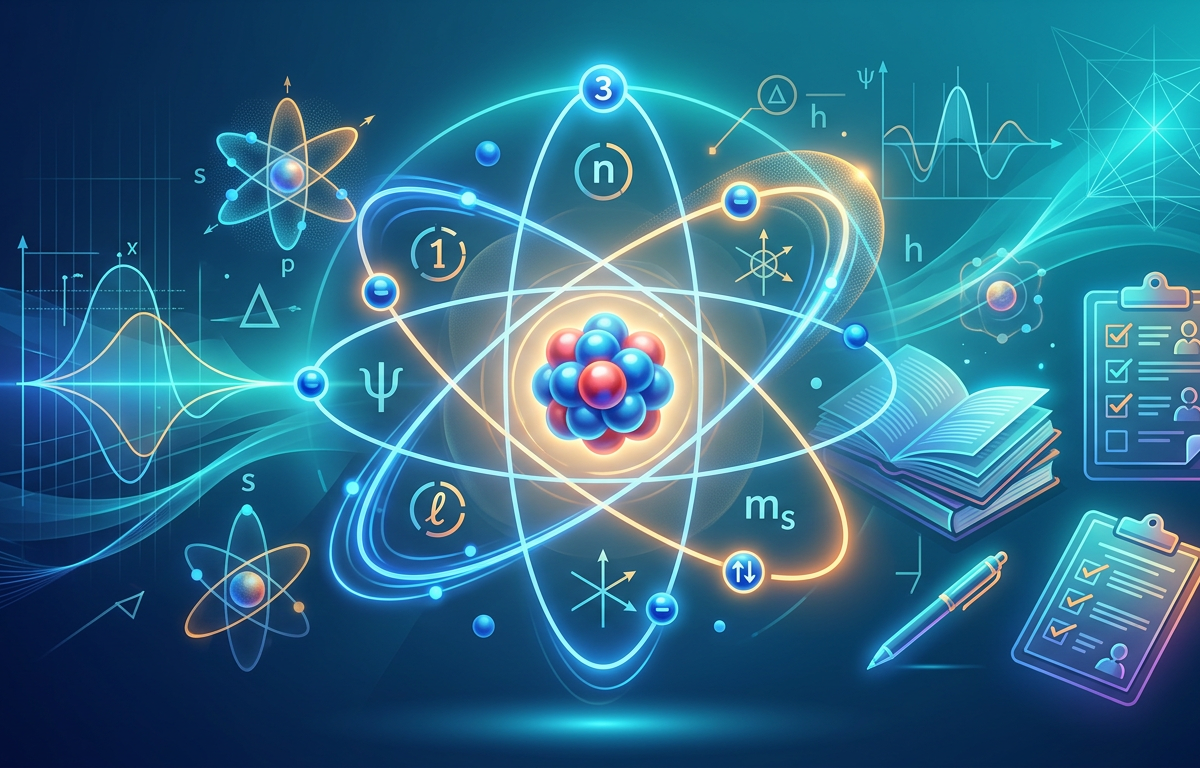
Quantum numbers are a set of four numerical values that describe the unique location, energy, and orientation of an electron within an atom. Think of these numbers as the "postal address" for every electron, ensuring that no two electrons in the same atom share the exact same state, a principle known as the Pauli Exclusion Principle. Understanding these values is essential for mastering electron configuration practice questions and predicting how atoms will interact chemically. According to Wikipedia, these numbers arise from the solutions to the Schrödinger wave equation.
The Four Quantum Numbers
Principal Quantum Number (n): Describes the main energy level or shell. It can be any positive integer (1, 2, 3...). As n increases, the electron is further from the nucleus.
Angular Momentum Quantum Number (l): Defines the shape of the orbital (subshell). Its value ranges from 0 to (n - 1).
l = 0: s orbital (spherical)
l = 1: p orbital (dumbbell)
l = 2: d orbital
l = 3: f orbital
Magnetic Quantum Number (ml): Specifies the orientation of the orbital in space. Its values range from -l to +l, including zero.
Spin Quantum Number (ms): Describes the direction of the electron's spin. It can only be +1/2 or -1/2.
Mastering these basics allows students to move on to more complex topics like VSEPR geometry practice questions, where orbital shapes dictate molecular structure.
Solved Examples
These solved examples demonstrate how to identify valid sets of quantum numbers and determine the number of orbitals available in a specific shell.
Determine the possible values of l if n = 3.
Identify the rule: The angular momentum quantum number l ranges from 0 to (n - 1).
Substitute the value: Since n = 3, the maximum value for l is 3 - 1 = 2.
List the values: l can be 0, 1, or 2. This corresponds to the 3s, 3p, and 3d subshells.
Identify the subshell label for the quantum numbers n = 4 and l = 1.
Identify the principal shell: n = 4.
Identify the subshell type: When l = 1, the orbital is a "p" orbital.
Combine the values: The subshell is 4p.
Is the set (n=2, l=2, ml=0, ms=+1/2) allowed?
Check the l constraint: l must be less than n.
Compare values: Here, n = 2 and l = 2. Since l is not less than n, this is impossible.
Conclusion: This set is invalid because a 2d orbital does not exist.
Practice Questions
Test your knowledge with these easy quantum number practice questions designed to reinforce the rules of atomic structure.
1. What is the maximum value of l for an electron in the n = 2 energy level?
2. How many possible values of ml exist for a d-orbital (l = 2)?
3. Name the subshell designated by the quantum numbers n = 3 and l = 0.
Want unlimited practice questions like these?
Generate AI-powered questions with step-by-step solutions on any topic.
Try Question Generator Free →4. Which quantum number determines the orientation of an orbital in space?
5. If l = 3, what are the possible values for the magnetic quantum number ml?
6. Can an electron have a spin quantum number (ms) of 0?
7. What is the total number of orbitals in the n = 3 principal shell?
8. Which quantum number defines the size and energy of the orbital?
9. Identify the error in this set of quantum numbers: (n=1, l=0, ml=1, ms=-1/2).
10. How many electrons can fit into a single orbital?
Answers & Explanations
Answer: 1. The rule for l is 0 to (n - 1). If n = 2, then l can be 0 or 1. The maximum is 1.
Answer: 5. For l = 2, the ml values are -2, -1, 0, +1, +2. There are five orientations.
Answer: 3s. The 3 comes from n = 3, and l = 0 corresponds to the "s" orbital shape.
Answer: Magnetic Quantum Number (ml). While l defines the shape, ml defines how that shape is oriented along the x, y, and z axes.
Answer: -3, -2, -1, 0, 1, 2, 3. The range is always -l to +l.
Answer: No. An electron can only have a spin of +1/2 (spin up) or -1/2 (spin down).
Answer: 9. The total number of orbitals in a shell is n². Since 3² = 9. These consist of one 3s, three 3p, and five 3d orbitals.
Answer: Principal Quantum Number (n). This number correlates with the distance from the nucleus; higher n values mean larger, higher-energy orbitals.
Answer: ml=1 is invalid. If l = 0, the only possible value for ml is 0. The magnetic quantum number cannot exceed the angular momentum quantum number.
Answer: 2. According to the Pauli Exclusion Principle, an orbital can hold a maximum of two electrons, and they must have opposite spins. This concept is fundamental when studying periodic trends practice questions.
1. Which quantum number is represented by the letter 'l'?
Frequently Asked Questions
What is the Pauli Exclusion Principle?
The Pauli Exclusion Principle states that no two electrons in an atom can have the same four quantum numbers. This means an orbital can hold a maximum of two electrons, and they must have opposite spins.
How do you find the number of orbitals in a subshell?
The number of orbitals in a subshell is calculated using the formula (2l + 1). For example, a p-subshell (l=1) has 2(1) + 1 = 3 orbitals.
Why can't the principal quantum number be zero?
The principal quantum number represents the energy shell of an electron; a value of zero would imply the electron has no energy and is located at the nucleus, which is physically impossible according to quantum mechanics. You can learn more about atomic energy at Khan Academy.
What is the difference between a shell and a subshell?
A shell is defined by the principal quantum number (n) and represents a general energy level, while a subshell is a division of a shell defined by the angular momentum quantum number (l), representing specific orbital shapes. Understanding this is key to solving ionization energy practice questions.
What does the spin quantum number signify?
The spin quantum number (ms) indicates the intrinsic angular momentum of an electron, which can be visualized as the electron spinning on its axis either clockwise or counter-clockwise. This property is crucial for the magnetic characteristics of elements as explained by LibreTexts Chemistry.
Want unlimited practice questions like these?
Generate AI-powered questions with step-by-step solutions on any topic.
Try Question Generator Free →
Want unlimited practice questions like these?
Generate AI-powered questions with step-by-step solutions on any topic.
Try Question Generator Free →Enjoyed this article?
Share it with others who might find it helpful.
Related Articles

Hard Le Chatelier’s Principle Practice Questions
Master Hard Le Chatelier’s Principle Practice Questions with our comprehensive guide featuring solved examples, practice problems, and detailed explanations.
Mar 30, 2026

Hard Reaction Quotient (Q) Practice Questions
Hard Reaction Quotient (Q) Practice Questions
Mar 30, 2026

Grams to Moles Practice Questions with Answers
Master grams to moles conversions with our comprehensive guide. Includes step-by-step examples, practice questions, and detailed answers for chemistry students.
Mar 26, 2026

Avogadro’s Number Practice Questions with Answers
Master the mole concept with our Avogadro’s Number practice questions. Includes step-by-step solved examples, a quick quiz, and detailed explanations.
Mar 26, 2026

Empirical Formulas: Solving Ratios from Mass and Percent Data
Master empirical formula calculations with 10 practice questions, worked answers, and a free step-by-step calculator for mass, percentage, and combustion problems.
Mar 26, 2026