Easy pKa and pKb Practice Questions
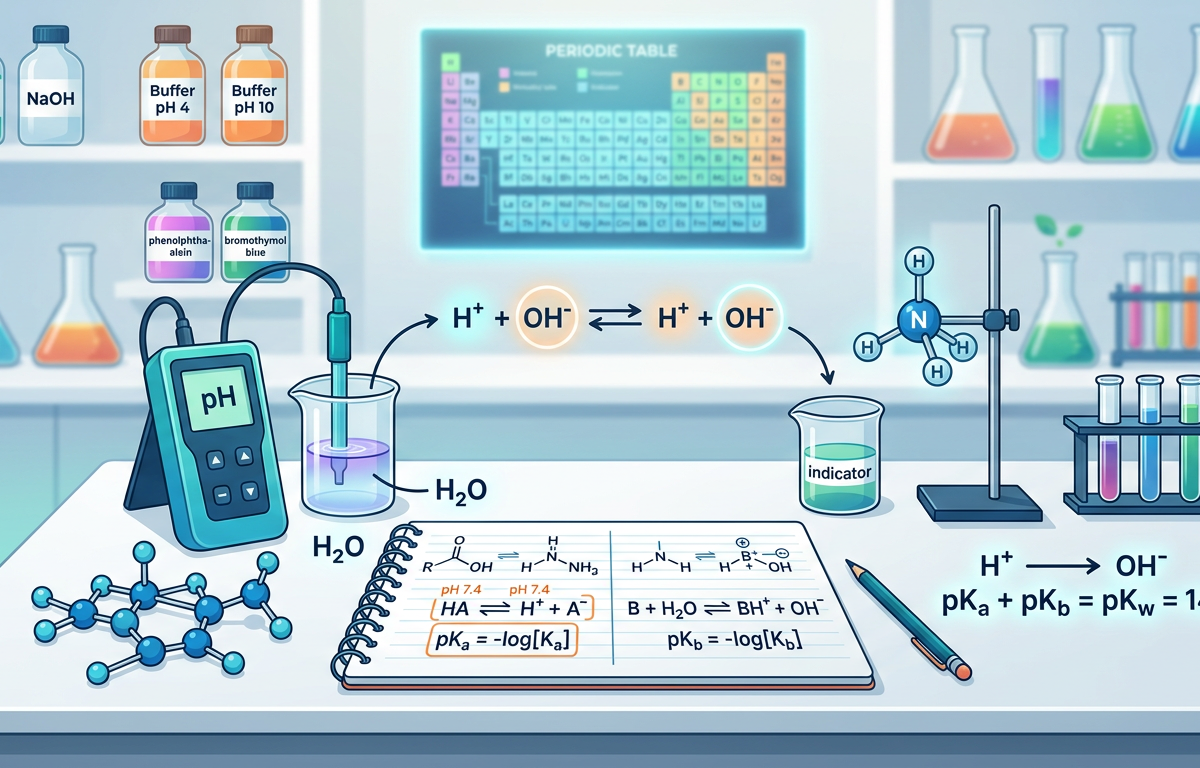
Concept Explanation
pKa and pKb are logarithmic scales used to represent the strength of acids and bases, respectively, with lower values indicating stronger substances. These values are derived from the acid dissociation constant (Ka) and the base dissociation constant (Kb). Because Ka and Kb values often involve very small numbers (like 1.8 × 10⁻⁵), the negative logarithm is used to convert them into a more manageable scale, similar to how pH calculations simplify hydrogen ion concentrations.
Understanding these values is fundamental in acid-base chemistry. The mathematical relationship is defined by the following formulas:
pKa = -log[Ka]
pKb = -log[Kb]
Ka = 10^(-pKa)
Kb = 10^(-pKb)
A crucial relationship exists for conjugate acid-base pairs in water at 25°C: the sum of pKa and pKb always equals 14.00 (pKw). This means if you know the strength of an acid, you can immediately determine the strength of its conjugate base. In practical chemistry, this relationship is vital for understanding buffer solutions and titration curves. Generally, a pKa less than 0 indicates a strong acid, while a pKa between 0 and 14 indicates a weak acid. The same logic applies to pKb for bases.
Solved Examples
Calculating pKa from Ka: An unknown acid has a Ka of 4.5 × 10⁻⁴. Calculate its pKa.
Identify the formula: pKa = -log(Ka).
Substitute the value: pKa = -log(4.5 × 10⁻⁴).
Calculate the logarithm: log(4.5) ≈ 0.65; log(10⁻⁴) = -4.
Combine: - (0.65 - 4) = 3.35.
The pKa is 3.35.
Calculating Kb from pKb: Ammonia has a pKb of 4.75. What is its Kb value?
Identify the formula: Kb = 10^(-pKb).
Substitute the value: Kb = 10^(-4.75).
Calculate the exponent: 10^(-4.75) ≈ 1.78 × 10⁻⁵.
The Kb of ammonia is 1.78 × 10⁻⁵.
Finding the Conjugate Pair: If Hydrocyanic acid (HCN) has a pKa of 9.21, what is the pKb of its conjugate base, the cyanide ion (CN⁻)?
Use the relationship: pKa + pKb = 14.00.
Rearrange for pKb: pKb = 14.00 - pKa.
Substitute the value: pKb = 14.00 - 9.21.
The pKb of CN⁻ is 4.79.
Practice Questions
Test your knowledge with these easy to moderate pKa and pKb practice questions.
Calculate the pKa of Acetic acid if its Ka is 1.8 × 10⁻⁵.
A weak base has a Kb of 1.2 × 10⁻⁶. What is its pKb?
If an acid has a pKa of 3.20, what is the pKb of its conjugate base?
Convert a pKa of 10.5 into its corresponding Ka value.
A solution of Methylamine has a pKb of 3.36. Calculate its Kb.
Which is a stronger acid: Acid A with pKa = 2.5 or Acid B with pKa = 4.8?
Calculate the pKb of the conjugate base of Nitrous acid (HNO₂), which has a Ka of 4.0 × 10⁻⁴.
If the pKb of a base is 9.0, what is its Kb?
Determine the pKa of the conjugate acid of a base that has a pKb of 5.25.
Given Ka = 6.3 × 10⁻⁸, find the pKa.
Answers & Explanations
pKa = 4.74. Calculation: -log(1.8 × 10⁻⁵) = 4.74. This is a classic value for acetic acid commonly seen in chemistry labs.
pKb = 5.92. Calculation: -log(1.2 × 10⁻⁶) = 5.92.
pKb = 10.80. Calculation: 14.00 - 3.20 = 10.80. This uses the constant relationship between conjugate pairs.
Ka = 3.16 × 10⁻¹¹. Calculation: 10^(-10.5) = 3.16 × 10⁻¹¹.
Kb = 4.37 × 10⁻⁴. Calculation: 10^(-3.36) = 4.37 × 10⁻⁴.
Acid A. Lower pKa values correspond to higher Ka values, meaning Acid A (2.5) is stronger than Acid B (4.8).
pKb = 10.60. First, find pKa: -log(4.0 × 10⁻⁴) = 3.40. Then, pKb = 14.00 - 3.40 = 10.60.
Kb = 1.0 × 10⁻⁹. Calculation: 10^(-9.0) = 1.0 × 10⁻⁹.
pKa = 8.75. Calculation: 14.00 - 5.25 = 8.75.
pKa = 7.20. Calculation: -log(6.3 × 10⁻⁸) = 7.20.
1. Which of the following pKa values represents the strongest acid?
Frequently Asked Questions
What is the difference between Ka and pKa?
Ka is the acid dissociation constant that measures the actual equilibrium concentration ratio, while pKa is the negative logarithm of that value. The pKa scale is used to make it easier to compare acid strengths without using scientific notation.
Can pKa values be negative?
Yes, very strong acids like Hydrochloric acid (HCl) have pKa values less than zero. A negative pKa indicates that the acid almost completely dissociates in water, according to Khan Academy's chemistry resources.
How does temperature affect pKa and pKb?
Since dissociation is an equilibrium process, pKa and pKb values are temperature-dependent. Most standard tables provide these values at 25°C, but they will shift if the temperature of the solution changes.
Why is the sum of pKa and pKb always 14?
This sum is derived from the autoionization constant of water (Kw), which is 1.0 × 10⁻¹⁴ at 25°C. Taking the negative log of Kw gives pKw, which equals 14, establishing the link between Ka and Kb calculations.
Is a high pKb value good for a base?
No, a high pKb value indicates a weak base. Strength in bases is indicated by a high Kb value or a low pKb value, just as strong acids have low pKa values.
Want unlimited practice questions like these?
Generate AI-powered questions with step-by-step solutions on any topic.
Try Question Generator Free →Enjoyed this article?
Share it with others who might find it helpful.
Related Articles
Hard pKa and pKb Practice Questions
Master advanced acid-base chemistry with our hard pKa and pKb practice questions. Includes step-by-step solutions, theory, and a quick quiz to test your knowledge.
Mar 29, 2026
Medium pKa and pKb Practice Questions
Medium pKa and pKb Practice Questions
Mar 29, 2026

Calculating High-Stakes Meds: BSA Mosteller Formula Practice
Master hard body surface area-based dosage calculations with our comprehensive guide, solved examples, and practice questions for healthcare students.
May 17, 2026

Solving High-Stakes IV Titrations and Weight-Based Infusions
Master advanced IV flow rate calculations with these hard practice questions. Covers weight-based dosing, titrations, and dimensional analysis for nurses.
May 17, 2026

Solving Weight-Based Dosing: The 2.2 Conversion and Rounding Logic
Weight-Based Dosage Calculations Practice Questions with Answers
May 17, 2026
Predicting Periodic Anomalies: Beyond Basic Trend Rules
Hard Periodic Trends Practice Questions
Apr 4, 2026
Hard Electron Configuration Practice Questions
Hard Electron Configuration Practice Questions
Apr 4, 2026
Medium Electron Configuration Practice Questions
Master medium-level electron configuration with our comprehensive guide, including solved examples, stability exceptions, and practice questions with answers.
Apr 4, 2026