Easy MCAT Glycolysis Practice Questions
Concept Explanation
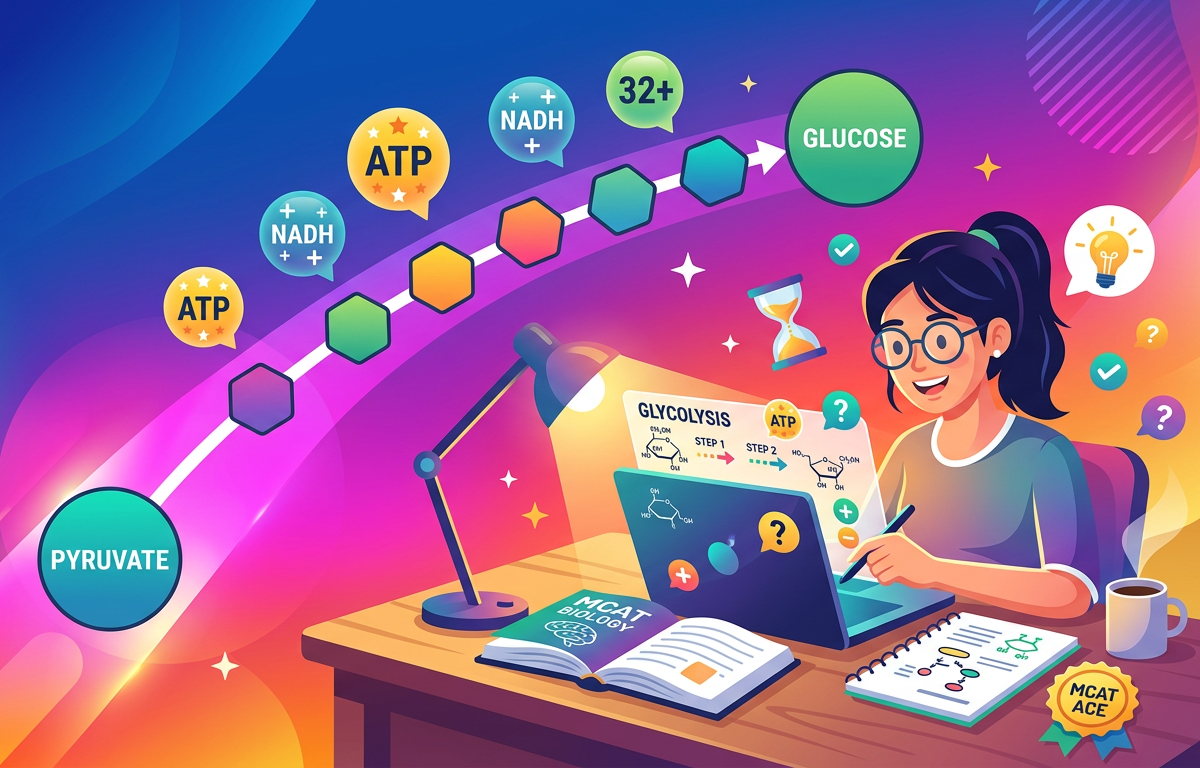
Glycolysis is a universal metabolic pathway occurring in the cytoplasm that breaks down one molecule of glucose into two molecules of pyruvate while producing a net gain of 2 ATP and 2 NADH. This ten-step process is the first stage of both aerobic and anaerobic respiration. It is divided into two main phases: the energy investment phase, where 2 ATP are consumed to phosphorylate glucose, and the energy payoff phase, where 4 ATP and 2 NADH are generated. According to Khan Academy, glycolysis is unique because it does not require oxygen to proceed, making it essential for cells under anaerobic conditions.
For the MCAT, you must focus on the three irreversible steps, as these are the primary sites of regulation. These steps are catalyzed by Hexokinase (or Glucokinase in the liver), Phosphofructokinase-1 (PFK-1), and Pyruvate Kinase. PFK-1 is widely considered the rate-limiting enzyme of the pathway. Understanding how these enzymes are regulated by molecules like ATP, AMP, and Fructose-2,6-bisphosphate is crucial for scoring well on the biological sciences section. If you are also reviewing general chemistry concepts, you might find our Easy MCAT Kinetics Practice Questions helpful for understanding how these enzymes speed up metabolic reactions.
The net reaction of glycolysis can be summarized as:
Solved Examples
Calculating Net ATP: If a cell processes 5 molecules of glucose through glycolysis, what is the net yield of ATP molecules produced in the cytoplasm?
Recall that one molecule of glucose yields a net of 2 ATP.
Multiply the number of glucose molecules by the net yield: .
The net yield is 10 ATP.
Identifying the Rate-Limiting Step: Which enzyme catalyzes the conversion of Fructose-6-phosphate to Fructose-1,6-bisphosphate, and why is this step significant?
The enzyme is Phosphofructokinase-1 (PFK-1).
This is the rate-limiting step of glycolysis.
It is heavily regulated by the energy status of the cell (inhibited by ATP and citrate, activated by AMP).
NADH Production: Which specific enzyme in glycolysis is responsible for the reduction of to NADH?
Identify the step where oxidation occurs: the conversion of Glyceraldehyde-3-phosphate to 1,3-bisphosphoglycerate.
The enzyme responsible is Glyceraldehyde-3-phosphate dehydrogenase.
This step is vital because the resulting NADH carries high-energy electrons to the electron transport chain in aerobic conditions.
Practice Questions
Where in the eukaryotic cell do all the enzymes of glycolysis reside?
Hexokinase catalyzes the first step of glycolysis. What is the primary purpose of phosphorylating glucose to glucose-6-phosphate?
During the energy investment phase, how many total ATP molecules are consumed per molecule of glucose?
[CTA_BLOCK_0]
Which enzyme is responsible for the "cleavage" of a 6-carbon sugar into two 3-carbon sugars (DHAP and GAP)?
In the absence of oxygen, what is the primary purpose of converting pyruvate to lactate in muscle cells?
Which molecule acts as a potent allosteric activator of PFK-1 in the liver, overriding inhibition by ATP?
What is the net molecular product of glycolysis besides ATP and NADH?
Which enzyme catalyzes the final step of glycolysis, producing ATP via substrate-level phosphorylation?
Arsenate is a toxic metalloid that can substitute for inorganic phosphate in the Glyceraldehyde-3-phosphate dehydrogenase reaction. How would this affect the net ATP yield of glycolysis?
Is the conversion of phosphoenolpyruvate (PEP) to pyruvate reversible or irreversible under physiological conditions?
Answers & Explanations
Cytosol (Cytoplasm): All ten enzymes of glycolysis are located in the soluble portion of the cytoplasm. This allows the pathway to function independently of mitochondria, which is necessary for cells like mature red blood cells that lack organelles.
To trap glucose inside the cell: Glucose-6-phosphate is polar and charged, meaning it cannot leak back across the hydrophobic plasma membrane via GLUT transporters. This maintains the concentration gradient for glucose uptake.
2 ATP: One ATP is used by Hexokinase/Glucokinase, and a second ATP is used by PFK-1. Understanding these energy costs is as fundamental as knowing your functional groups for organic chemistry.
Aldolase: This enzyme splits Fructose-1,6-bisphosphate into Dihydroxyacetone phosphate (DHAP) and Glyceraldehyde-3-phosphate (GAP).
To regenerate : Glycolysis requires a constant supply of to continue. Under anaerobic conditions, lactate dehydrogenase reduces pyruvate to lactate so that NADH can be oxidized back to .
Fructose-2,6-bisphosphate: Produced by PFK-2, this molecule signals high glucose levels and strongly activates PFK-1, ensuring glycolysis continues even when ATP levels are relatively high.
Pyruvate: Specifically, two molecules of pyruvate are produced for every one molecule of glucose.
Pyruvate Kinase: This enzyme transfers a phosphate group from PEP to ADP, forming ATP and pyruvate. This is an example of substrate-level phosphorylation.
It would decrease the net ATP to zero: Arsenate allows the pathway to bypass the step that generates 1,3-BPG. Since the subsequent ATP-generating step relies on 1,3-BPG, the 2 ATP normally gained in that step are lost, cancelling out the 2 ATP gained at the end, resulting in a net yield of 0 ATP.
Irreversible: The reaction catalyzed by Pyruvate Kinase has a large negative Gibbs free energy change, making it one of the three regulated, irreversible "bottlenecks" of the pathway.
1. Which of the following enzymes is the primary rate-limiting step of glycolysis?
Frequently Asked Questions
What is the difference between Hexokinase and Glucokinase?
Hexokinase is found in most tissues, has a low Km (high affinity for glucose), and is inhibited by its product, Glucose-6-phosphate. Glucokinase is found in the liver and pancreatic beta-cells, has a high Km, and is not inhibited by Glucose-6-phosphate, allowing the liver to buffer high blood glucose levels.
Why is glycolysis considered an anaerobic process?
Glycolysis is considered anaerobic because none of its ten steps require molecular oxygen () as a reactant. It can provide energy in the form of ATP even when oxygen levels are depleted, such as in heavily exercising muscle or in organisms like yeast.
What happens to pyruvate after glycolysis?
In the presence of oxygen, pyruvate is transported into the mitochondria to be converted into Acetyl-CoA for the Citric Acid Cycle. In the absence of oxygen, pyruvate undergoes fermentation to become either lactate (in animals) or ethanol and (in yeast).
How does insulin affect glycolysis?
Insulin generally stimulates glycolysis by upregulating the transcription of key enzymes like Glucokinase, PFK-1, and Pyruvate Kinase. It also promotes the synthesis of Fructose-2,6-bisphosphate, which allosterically activates PFK-1.
What is substrate-level phosphorylation?
Substrate-level phosphorylation is the direct transfer of a phosphate group from a high-energy metabolic intermediate (like PEP or 1,3-BPG) to ADP to form ATP. This is distinct from oxidative phosphorylation, which uses an electrochemical gradient in the mitochondria.
Feel more confident on exam day.
Practice with realistic MCAT-style questions and strengthen your understanding before test day arrives.
Practice Free NowReviewed by
Michael Danquah, MS, PhD
Dr. Michael Danquah is a professor of pharmaceutical sciences and founder of several educational technology platforms focused on improving student learning and performance.
Enjoyed this article?
Share it with others who might find it helpful.
Related Articles
Hard MCAT Glycolysis Practice Questions
Hard MCAT Glycolysis Practice Questions
May 14, 2026
Medium MCAT Glycolysis Practice Questions
Medium MCAT Glycolysis Practice Questions
May 14, 2026
MCAT Glycolysis Practice Questions with Answers
MCAT Glycolysis Practice Questions with Answers
May 14, 2026

Hard MCAT Philosophy Passage Practice Questions
Master Hard MCAT Philosophy Passage Practice Questions with our comprehensive guide featuring solved examples, practice questions, and expert explanations.
May 17, 2026

Hard MCAT Humanities Passage Practice Questions
Master Hard MCAT Humanities Passage Practice Questions with our comprehensive guide featuring solved examples, practice questions, and expert strategies.
May 17, 2026

Hard MCAT Critical Analysis Practice Questions
Hard MCAT Critical Analysis Practice Questions
May 17, 2026

Hard MCAT Reading Comprehension Practice Questions
Hard MCAT Reading Comprehension Practice Questions
May 17, 2026

Hard MCAT CARS Passage Practice Questions
Master high-difficulty MCAT CARS passages with our expert guide featuring solved examples, practice questions, and detailed logical analysis.
May 17, 2026