Easy MCAT Endocrine System Practice Questions
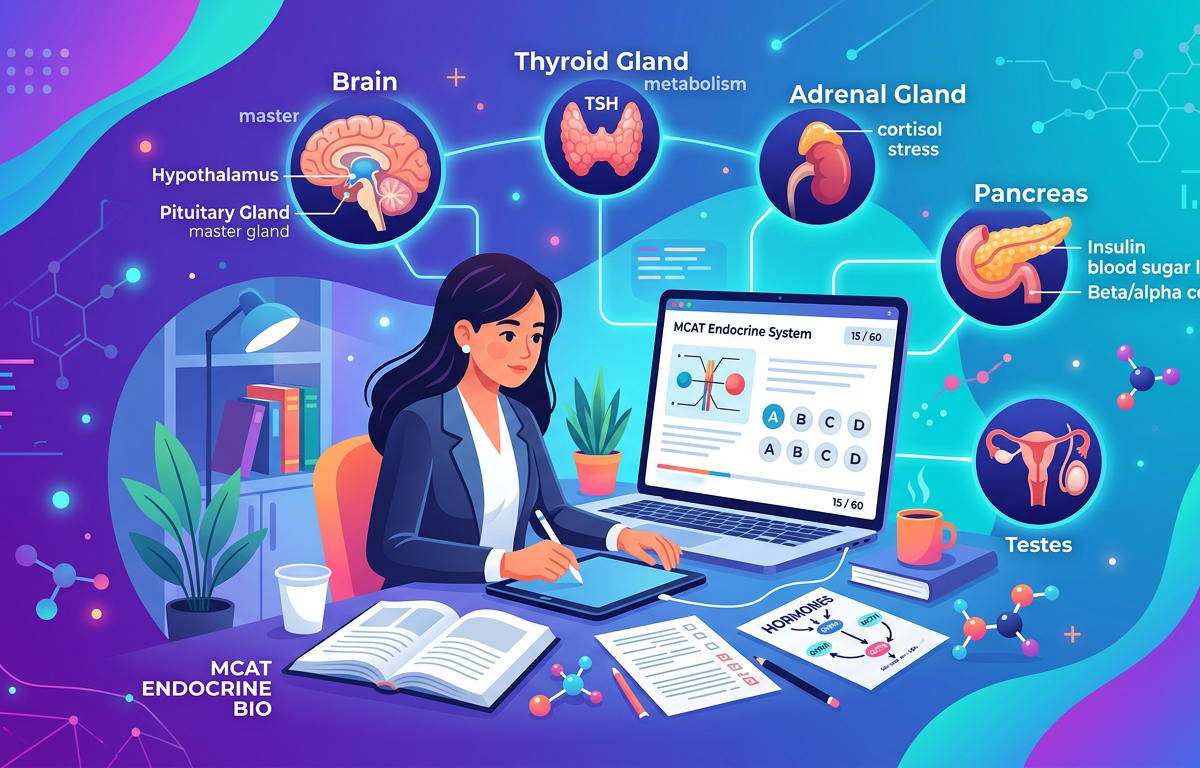
Concept Explanation
The endocrine system is a network of glands and organs that produce and secrete hormones directly into the circulatory system to regulate distant target organs. Unlike the exocrine system, which uses ducts, endocrine glands are ductless and rely on the blood to transport chemical messengers. These messengers, or hormones, fall into three primary chemical categories: peptides, steroids, and amino acid derivatives. Peptides are water-soluble and bind to extracellular receptors, while steroids are lipid-derived and typically bind to intracellular or nuclear receptors. Mastering these fundamentals is a key part of your MCAT biology practice questions preparation, as the exam frequently tests the mechanism of action and the physiological effects of specific hormones such as insulin, glucagon, and cortisol.
Hormonal regulation is largely governed by negative feedback loops, where the product of a pathway inhibits its own further production to maintain homeostasis. For example, the hypothalamus releases Thyrotropin-Releasing Hormone (TRH), which stimulates the anterior pituitary to release Thyroid-Stimulating Hormone (TSH), which in turn prompts the thyroid to release thyroxine. High levels of thyroxine then inhibit both the hypothalamus and the pituitary. Understanding these axes is vital for success on the MCAT physiology practice questions you will encounter on test day.
Solved Examples
To help you master the material, here are three solved examples demonstrating how to approach endocrine system problems.
- Problem: A patient presents with chronically high blood glucose levels. If the issue is endocrine in nature, which hormone is likely deficient or ineffective?
Solution:- Identify the primary hormone responsible for lowering blood glucose: Insulin.
- Recall that insulin is produced by the beta cells of the pancreas.
- Determine the mechanism: Insulin facilitates the uptake of glucose into cells and promotes glycogenesis.
- Conclusion: A deficiency in insulin (Type 1 Diabetes) or resistance to insulin (Type 2 Diabetes) results in hyperglycemia.
- Problem: How does the mechanism of action differ between testosterone and epinephrine?
Solution:- Classify the hormones: Testosterone is a steroid; epinephrine is an amino acid derivative (behaving like a peptide).
- Identify solubility: Testosterone is lipid-soluble; epinephrine is water-soluble.
- Determine receptor location: Testosterone crosses the cell membrane to bind to cytosolic or nuclear receptors to alter gene expression. Epinephrine binds to G-protein coupled receptors on the cell surface to trigger a secondary messenger cascade (like cAMP).
- Problem: If a person is severely dehydrated, which hormone from the posterior pituitary will be released to conserve water?
Solution:- Identify the physiological need: Water retention.
- Recall the hormones secreted by the posterior pituitary: Oxytocin and Antidiuretic Hormone (ADH/Vasopressin).
- Match the function: ADH increases the permeability of the collecting duct in the kidney to water.
- Conclusion: ADH is released to increase water reabsorption.
Practice Questions
Test your knowledge with these Easy MCAT Endocrine System Practice Questions. Be sure to use retrieval practice techniques to reinforce your memory as you work through them.
- Which of the following glands is often referred to as the "master gland" because it regulates many other endocrine glands?
- Which hormone is responsible for the "fight or flight" response and is secreted by the adrenal medulla?
- A hormone that travels through the blood and binds to a receptor inside the nucleus is most likely derived from which precursor?
Need more MCAT practice questions?
Generate unlimited MCAT-style questions with instant explanations and adaptive practice powered by Bevinzey AI.
Generate Questions Free- Which hormone, produced by the thyroid gland, functions to lower blood calcium levels?
- Which organ contains both endocrine and exocrine structures?
- What is the primary effect of parathyroid hormone (PTH) on the skeletal system?
- Oxytocin and Antidiuretic Hormone (ADH) are synthesized in which structure?
- Which hormone is released by the anterior pituitary in response to Corticotropin-Releasing Hormone (CRH) from the hypothalamus?
- A scientist discovers a new hormone that is highly polar and cannot cross the plasma membrane. This hormone most likely uses what type of signaling?
- Which hormone is primarily responsible for maintaining the uterine lining during the luteal phase of the menstrual cycle?
Answers & Explanations
- Anterior Pituitary: Often called the master gland, it releases hormones like TSH, ACTH, FSH, and LH that control other glands. (Note: The hypothalamus actually controls the pituitary).
- Epinephrine (Adrenaline): Secreted by the adrenal medulla, it increases heart rate and blood glucose during stress.
- Cholesterol: Hormones that bind to nuclear receptors are typically steroid hormones, which are synthesized from cholesterol.
- Calcitonin: Produced by the parafollicular cells of the thyroid, it "tones down" blood calcium by promoting bone deposition and renal excretion.
- Pancreas: It has an exocrine function (digestive enzymes) and an endocrine function (islets of Langerhans secreting insulin and glucagon).
- Bone Resorption: PTH stimulates osteoclasts to break down bone, which releases calcium into the bloodstream to increase serum calcium levels.
- Hypothalamus: While secreted by the posterior pituitary, ADH and oxytocin are actually produced by neuronal cell bodies in the hypothalamus.
- Adrenocorticotropic Hormone (ACTH): CRH stimulates the anterior pituitary to release ACTH, which then acts on the adrenal cortex to release cortisol.
- Secondary Messenger System: Polar hormones (peptides) bind to extracellular receptors and typically trigger a cascade involving molecules like cAMP or .
- Progesterone: It is the primary hormone secreted by the corpus luteum to support the endometrium for potential implantation. You can find more details on this in our MCAT reproduction practice questions.
1. Which of the following is a peptide hormone?
Frequently Asked Questions
What is the difference between endocrine and exocrine glands?
Endocrine glands secrete hormones directly into the blood without using ducts, whereas exocrine glands secrete products like sweat or enzymes through ducts onto epithelial surfaces. Common examples of exocrine secretions include saliva and digestive juices.
How do steroid hormones cross the cell membrane?
Steroid hormones are lipophilic (lipid-soluble) molecules derived from cholesterol, allowing them to diffuse directly through the lipid bilayer of the plasma membrane. Once inside, they typically bind to receptors that act as transcription factors to modify gene expression.
What is a negative feedback loop in the endocrine system?
A negative feedback loop is a regulatory mechanism where the final product of a pathway inhibits the upstream signals that triggered its production. This ensures that hormone levels remain within a narrow, healthy physiological range to maintain homeostasis.
Which hormones are produced by the adrenal cortex?
The adrenal cortex produces corticosteroids, which include glucocorticoids like cortisol, mineralocorticoids like aldosterone, and cortical sex hormones like androgens. These are distinct from the catecholamines produced by the adrenal medulla.
What is the role of the hypothalamus in the endocrine system?
The hypothalamus acts as the bridge between the nervous and endocrine systems, controlling the pituitary gland through releasing and inhibiting hormones. It maintains homeostasis by monitoring factors like blood pressure, temperature, and osmolarity.
Where can I find more resources for MCAT biology?
Authoritative sources like Khan Academy and the AAMC provide detailed content outlines. Additionally, peer-reviewed journals such as Nature Endocrinology offer deep dives into hormonal research.
Need more MCAT practice questions?
Generate unlimited MCAT-style questions with instant explanations and adaptive practice powered by Bevinzey AI.
Generate Questions FreeReviewed by
Michael Danquah, MS, PhD
Dr. Michael Danquah is a professor of pharmaceutical sciences and founder of several educational technology platforms focused on improving student learning and performance.
Enjoyed this article?
Share it with others who might find it helpful.
Related Articles
Hard MCAT Endocrine System Practice Questions
Hard MCAT Endocrine System Practice Questions
May 9, 2026

Hard MCAT Immune System Practice Questions
Master the complexities of the immune system with these hard MCAT practice questions covering MHC restriction, clonal selection, and the complement system.
May 9, 2026

Hard MCAT Philosophy Passage Practice Questions
Master Hard MCAT Philosophy Passage Practice Questions with our comprehensive guide featuring solved examples, practice questions, and expert explanations.
May 17, 2026

Hard MCAT Humanities Passage Practice Questions
Master Hard MCAT Humanities Passage Practice Questions with our comprehensive guide featuring solved examples, practice questions, and expert strategies.
May 17, 2026

Hard MCAT Critical Analysis Practice Questions
Hard MCAT Critical Analysis Practice Questions
May 17, 2026

Hard MCAT Reading Comprehension Practice Questions
Hard MCAT Reading Comprehension Practice Questions
May 17, 2026

Hard MCAT CARS Passage Practice Questions
Master high-difficulty MCAT CARS passages with our expert guide featuring solved examples, practice questions, and detailed logical analysis.
May 17, 2026

Hard MCAT CARS Practice Questions
Master Hard MCAT CARS Practice Questions with our comprehensive guide featuring solved examples, practice passages, and expert reasoning strategies.
May 17, 2026