Easy Genetics Practice Questions Practice Questions
Concept Explanation
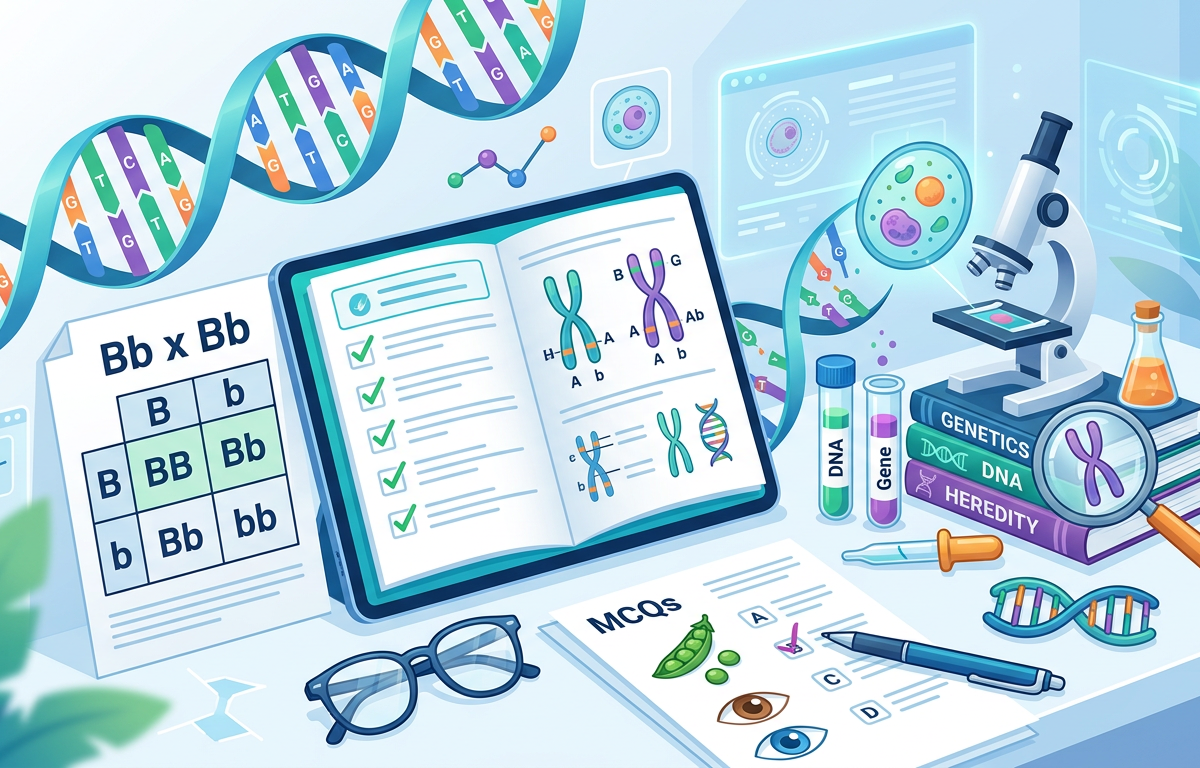
Genetics is the branch of biology that studies how traits are passed from parents to offspring through genes, which are segments of DNA located on chromosomes. Understanding Easy Genetics Practice Questions Practice Questions requires a grasp of fundamental terms like alleles, genotype, and phenotype. An allele is a variant form of a gene; for example, a gene for flower color might have a red allele and a white allele. When an individual has two of the same alleles (e.g., BB or bb), they are homozygous, while having two different alleles (e.g., Bb) makes them heterozygous. Dominant alleles mask the expression of recessive alleles, meaning a dominant trait will appear even if only one copy is present. These principles were first documented by Gregor Mendel, often called the father of genetics. To master these basics, students often start with Punnett Square Problems Practice Questions to visualize how alleles segregate and recombine during reproduction.
Solved Examples
Reviewing worked solutions is the most effective way to learn how to apply genetic principles to real-world scenarios.
- Example 1: Identifying Phenotypes
In pea plants, purple flowers (P) are dominant over white flowers (p). If a plant has the genotype Pp, what is its phenotype?- Identify the alleles: P is dominant (purple), p is recessive (white).
- Determine dominance: Since P is present, it masks the recessive p.
- Conclusion: The phenotype is purple flowers.
- Example 2: Homozygous vs. Heterozygous
A guinea pig has the genotype bb for hair color, where B is black and b is brown. Is this guinea pig homozygous or heterozygous, and what color is it?- Analyze the alleles: Both alleles are the same (bb), which means it is homozygous recessive.
- Determine the trait: Since there is no dominant B allele, the recessive trait is expressed.
- Conclusion: The guinea pig is homozygous and has brown hair.
- Example 3: Simple Monohybrid Cross
Cross a homozygous dominant tall plant (TT) with a homozygous recessive short plant (tt). What percentage of offspring will be tall?- Set up the Punnett square: Place T, T on the top and t, t on the side.
- Fill the boxes: Every box results in the genotype Tt.
- Interpret results: 100% of the offspring have the T allele.
- Conclusion: 100% of the offspring will be tall.
Practice Questions
Test your knowledge with these easy genetics practice questions. These problems focus on vocabulary and basic inheritance patterns.
- A segment of DNA that codes for a specific protein or trait is known as a what?
- If a person has the genotype Aa, are they considered homozygous or heterozygous?
- In humans, brown eyes (B) are dominant to blue eyes (b). If a child has blue eyes, what must their genotype be?
- Which term describes the physical appearance of an organism resulting from its genetic makeup?
- A cross between two heterozygous plants (Gg x Gg) for seed color (G=Green, g=yellow) will produce what ratio of phenotypes?
- How many chromosomes do human somatic (body) cells typically contain?
- If a trait only appears when two copies of the allele are present, is that trait dominant or recessive?
- True or False: A phenotype of "Tall" always means the genotype is TT.
- Which scientist is famous for studying inheritance patterns in pea plants?
- If you cross a homozygous dominant (RR) individual with a heterozygous (Rr) individual, what percentage of the offspring will show the dominant trait?
Answers & Explanations
- Gene: A gene is the basic physical and functional unit of heredity made up of DNA. For more on how this DNA is copied, see our guide on DNA Replication Questions Practice Questions.
- Heterozygous: The prefix "hetero-" means different. Since the alleles (A and a) are different, the organism is heterozygous.
- bb: Blue eyes are a recessive trait. Recessive traits only appear in the phenotype if the individual is homozygous recessive.
- Phenotype: The phenotype is the observable physical or biochemical characteristics of an organism, as determined by both genetic makeup and environmental influences.
- 3:1 (Green to Yellow): In a Gg x Gg cross, the genotypes are GG, Gg, Gg, and gg. The first three result in a green phenotype, while the last results in yellow.
- 46: Human cells contain 23 pairs of chromosomes, totaling 46. You can learn more about how these traits are passed down in Inheritance Questions Practice Questions.
- Recessive: Recessive alleles are masked by dominant ones and only express themselves when paired with another recessive allele.
- False: A "Tall" phenotype can be produced by either a TT (homozygous dominant) or Tt (heterozygous) genotype.
- Gregor Mendel: Mendel's work in the mid-19th century established the laws of Mendelian inheritance.
- 100%: All offspring will receive at least one dominant R allele (genotypes will be RR or Rr), so all will display the dominant phenotype.
1. Which of the following represents a homozygous recessive genotype?
Frequently Asked Questions
What is the difference between genotype and phenotype?
The genotype refers to the specific genetic makeup or set of alleles an organism carries (like Bb), while the phenotype is the observable physical characteristic or trait (like brown eyes) produced by those genes. Phenotype is often influenced by both the genotype and the environment.
Why are some traits called dominant?
A trait is called dominant because its associated allele will express the phenotype even if only one copy is present in the pair. It effectively masks the expression of a recessive allele when they are paired together in a heterozygous individual.
What is a Punnett square used for?
A Punnett square is a graphical tool used by geneticists to predict the probability of an offspring having a particular genotype or phenotype based on the alleles of the parents. It helps visualize all possible combinations of egg and sperm during fertilization.
How many alleles does an individual have for each gene?
In diploid organisms like humans, each individual carries two alleles for every gene—one inherited from the mother and one from the father. These alleles are located at the same position on homologous chromosomes.
What does it mean to be a carrier of a genetic trait?
A carrier is an individual who is heterozygous for a recessive trait, meaning they carry one recessive allele but do not display the trait in their phenotype. They can, however, pass that recessive allele to their offspring.
Enjoyed this article?
Share it with others who might find it helpful.
Related Articles

Hard Genetics Practice Questions Practice Questions
Master advanced genetics with our hard practice questions covering gene linkage, epistasis, and recombination frequency calculations with detailed answers.
Apr 25, 2026

Medium Genetics Practice Questions Practice Questions
Master genetics with our medium-level practice questions covering Punnett squares, X-linked traits, and Mendelian ratios with detailed step-by-step solutions.
Apr 25, 2026

Hard Microbiology Practice Questions Practice Questions
Hard Microbiology Practice Questions Practice Questions
Apr 26, 2026

Medium Microbiology Practice Questions Practice Questions
Master microbiology with our medium-level practice questions covering bacterial growth, genetics, and metabolism. Includes solved examples and a quick quiz.
Apr 26, 2026

Easy Microbiology Practice Questions Practice Questions
Easy Microbiology Practice Questions Practice Questions
Apr 26, 2026

Hard Enzyme Questions Practice Questions
Master complex biochemistry with these hard enzyme questions. Cover Michaelis-Menten kinetics, inhibition types, and Lineweaver-Burk plots with solved examples.
Apr 26, 2026

Medium Enzyme Questions Practice Questions
Master enzyme kinetics and regulation with our Medium Enzyme Questions Practice Questions. Includes solved examples, detailed explanations, and a quick quiz.
Apr 26, 2026
Enzyme Questions Practice Questions with Answers
Master enzyme kinetics and function with our comprehensive guide. Includes solved examples, practice questions, and detailed answers on biological catalysts.
Apr 26, 2026