Solve DNA Replication Problems: Leading, Lagging, and Base Pairing
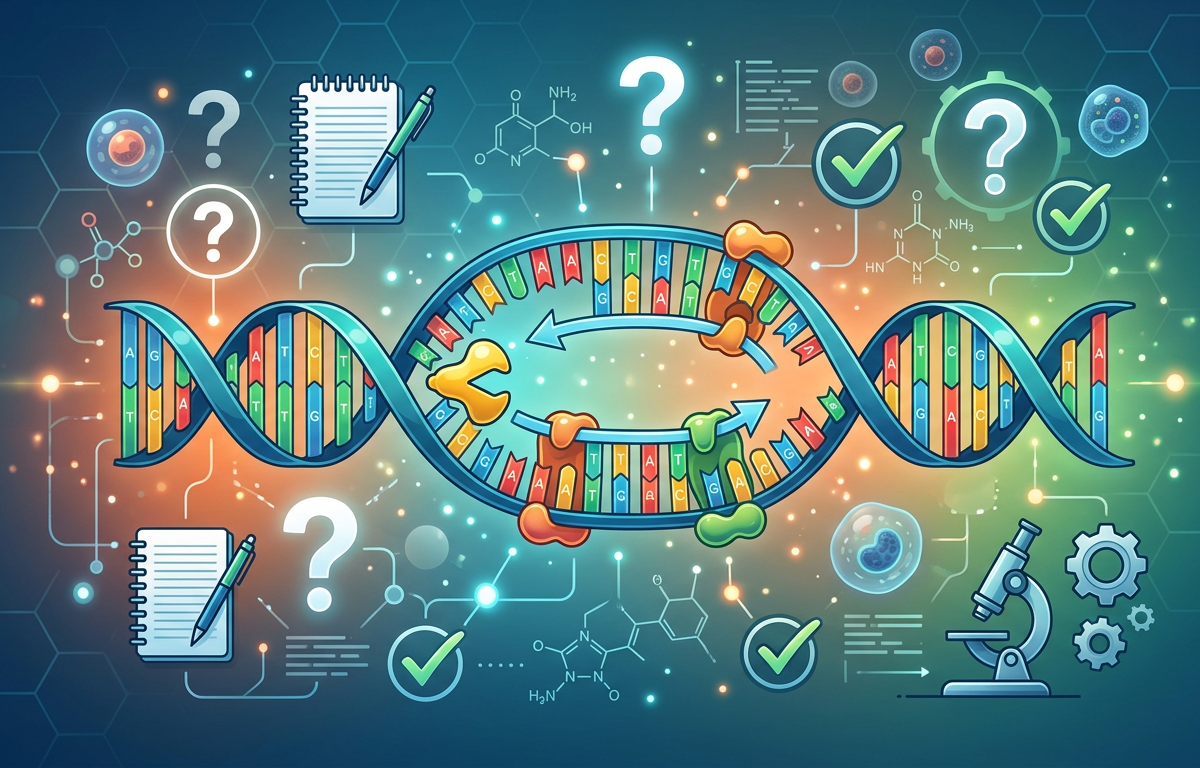
When students look at a template strand like 3'-TACGGCATA-5', the most frequent error isn't forgetting that Adenine pairs with Thymine. The mistake happens in the antiparallel orientation. Many learners correctly identify the complementary bases but fail to flip the directionality, resulting in a sequence that would physically impossible for DNA Polymerase III to synthesize. Because this enzyme only works in the 5' to 3' direction, mastering replication requires you to visualize the molecular machinery moving in opposite directions on the leading and lagging strands simultaneously.
This guide moves beyond simple definitions to focus on the mechanical logic of the replication fork. You will practice identifying why Single-Strand Binding Proteins are the only thing stopping a replication bubble from snapping shut and how to calculate the exact number of RNA primers needed for a lagging strand of a specific nucleotide length. By working through these scenarios, you will develop the ability to predict how mutations in enzymes like Ligase or Topoisomerase directly halt the cell cycle during S-phase.
1. Concept Explanation
DNA replication is the biological process by which a cell creates an identical copy of its genome before cell division, ensuring that each daughter cell receives a complete set of genetic information. This high-fidelity mechanism occurs during the S-phase of the cell cycle and is fundamental to heredity and biological continuity. DNA replication is described as semi-conservative because each of the two resulting double-stranded DNA molecules contains one original (parental) strand and one newly synthesized (daughter) strand, a model first proven by the Meselson-Stahl experiment.
The process involves several key enzymes and structural components within the organelles of eukaryotic cells, specifically the nucleus. The major steps include:
- Initiation: Helicase unwinds the double helix at specific sequences called origins of replication, creating a replication fork.
- Elongation: DNA Polymerase III adds nucleotides in the 5' to 3' direction. Because the strands are antiparallel, the leading strand is synthesized continuously, while the lagging strand is synthesized in short fragments called Okazaki fragments.
- Termination: RNA primers are removed by DNA Polymerase I and replaced with DNA. DNA Ligase then seals the nicks between fragments.
Understanding the molecular machinery, such as Topoisomerase (which prevents over-winding) and Single-Strand Binding Proteins (which stabilize open strands), is essential for mastering DNA replication questions. For more on how cells manage internal environments during these processes, see our guide on medium cell transport problems.
2. Solved Examples
Review these step-by-step solutions to understand the logic behind common DNA replication problems.
- Example 1: Complementary Strand Synthesis
If a template DNA strand has the sequence 3'-TACGGCATA-5', what is the sequence of the newly synthesized daughter strand?
- Identify the base-pairing rules: Adenine (A) pairs with Thymine (T), and Cytosine (C) pairs with Guanine (G).
- Determine the orientation: DNA is antiparallel, so the new strand will run 5' to 3'.
- Match the bases: T pairs with A, A with T, C with G, G with C, G with C, C with G, A with T, T with A, A with T.
- Final Answer: 5'-ATGCCGTAT-3'.
- Example 2: Calculating Okazaki Fragments
A lagging strand is 3,000 nucleotides long. If each Okazaki fragment is approximately 150 nucleotides long, how many RNA primers were required for its synthesis?
- Divide the total length of the lagging strand by the length of one fragment: 3,000 / 150 = 20 fragments.
- Recall that each Okazaki fragment requires exactly one RNA primer to begin synthesis.
- Final Answer: 20 RNA primers.
- Example 3: Enzyme Function Identification
During a laboratory observation, a researcher notices that DNA strands are unwinding, but they immediately snap back together before replication can occur. Which protein is likely missing or non-functional?
- Identify the stage: This occurs at the start of the replication fork.
- Analyze the roles: Helicase unwinds the DNA, but it does not keep it open.
- Recall the stabilizer: Single-Strand Binding Proteins (SSBs) bind to the exposed bases to prevent re-annealing.
- Final Answer: Single-Strand Binding Proteins (SSBs).
3. Practice Questions
Test your knowledge with these DNA replication questions ranging from basic mechanics to complex enzymatic interactions.
- Which enzyme is responsible for relieving torsional strain and preventing supercoiling ahead of the replication fork?
- In which direction does DNA Polymerase III always synthesize a new DNA strand?
- What is the function of the enzyme Primase in the replication process?
- Why is the lagging strand synthesized in fragments (Okazaki fragments) rather than continuously?
- Which enzyme replaces RNA primers with DNA nucleotides?
- What is the role of DNA Ligase in the final stages of replication?
- If a cell has a mutation that prevents DNA Polymerase III from proofreading, what is the most likely biological consequence?
- Compare the replication origins in prokaryotes versus eukaryotes. How many are typically found in each?
- Define "semi-conservative replication" and explain how it differs from "conservative replication."
- What role do telomeres play in the replication of eukaryotic linear chromosomes?
4. Answers & Explanations
- Topoisomerase (or DNA Gyrase): This enzyme travels ahead of the replication fork and cuts then reseals the DNA backbone to relieve the physical tension caused by unwinding.
- 5' to 3' direction: DNA Polymerase can only add new nucleotides to the free 3'-hydroxyl (-OH) group of an existing nucleotide chain.
- Synthesizing RNA primers: Primase creates a short RNA sequence (about 10 nucleotides) that provides the necessary 3'-OH end for DNA Polymerase to begin elongation.
- Antiparallel orientation: DNA Polymerase only works 5' to 3'. Since the lagging strand template runs 5' to 3' relative to the fork's movement, the polymerase must move away from the fork, restart, and move away again as more DNA is exposed.
- DNA Polymerase I: This enzyme has 5' to 3' exonuclease activity, allowing it to remove the RNA primer and fill the gap with DNA nucleotides.
- Sealing nicks: DNA Ligase catalyzes the formation of a phosphodiester bond between the 3'-OH end of one fragment and the 5'-phosphate end of the next, creating a continuous sugar-phosphate backbone.
- Increased mutation rate: Proofreading allows the polymerase to remove mismatched bases immediately. Without it, errors would be incorporated into the genome, potentially leading to cancer or genetic disorders.
- Prokaryotes vs. Eukaryotes: Prokaryotes (like E. coli) typically have a single origin of replication (oriC) on their circular chromosome. Eukaryotes have hundreds or thousands of origins to allow for the timely replication of much larger linear genomes.
- Semi-conservative: Each new DNA molecule consists of one old strand and one new strand. In conservative replication, the original double helix would remain intact, and a completely new double helix would be formed.
- Protecting ends: Because DNA polymerase cannot replicate the very end of a linear lagging strand, telomeres (repetitive non-coding sequences) act as a buffer to prevent the loss of vital genetic information during successive divisions.
1. Which of the following enzymes is responsible for unwinding the DNA double helix?
6. Frequently Asked Questions
What is the main difference between the leading and lagging strands?
The leading strand is synthesized continuously in the same direction as the replication fork movement, while the lagging strand is synthesized discontinuously in short segments called Okazaki fragments in the opposite direction. This occurs because DNA polymerase can only add nucleotides in a 5' to 3' direction.
Why is DNA replication called semi-conservative?
It is called semi-conservative because each of the two resulting DNA molecules contains one original template strand from the parent molecule and one newly synthesized strand. This ensures that the genetic code is accurately preserved across generations of cells. To see how these cells maintain structure, check out our easy cell structure practice questions.
Which enzyme fixes errors during DNA replication?
DNA Polymerase III performs the primary proofreading function by checking each added nucleotide against its template; if an error is found, it uses 3' to 5' exonuclease activity to remove the wrong base. Later, mismatch repair enzymes scan the DNA to fix any errors that the polymerase missed.
What are the requirements for DNA Polymerase to start working?
DNA Polymerase requires a template strand to copy and a free 3'-hydroxyl (-OH) group to attach the first nucleotide. Because it cannot start a chain from scratch, an RNA primer must first be laid down by the enzyme Primase.
What happens if Telomerase is inactive in a cell?
If Telomerase is inactive, the protective telomeres at the ends of linear chromosomes will shorten with every round of cell division. Eventually, the cell will reach the Hayflick limit and stop dividing (senescence) or lose essential genetic data, which is a key factor in biological aging.
Enjoyed this article?
Share it with others who might find it helpful.
Related Articles

Hard DNA Replication Questions Practice Questions
Challenge yourself with hard DNA replication questions. Explore enzymatic mechanisms, Okazaki fragments, and telomeres with solved examples and a quiz.
Apr 25, 2026
Medium DNA Replication Questions Practice Questions
Master medium-level DNA replication concepts with solved examples, detailed explanations, and a practice quiz to boost your biology exam scores.
Apr 25, 2026
Easy DNA Replication Questions Practice Questions
Master the basics of DNA replication with our easy practice questions, solved examples, and clear explanations of enzymes like helicase and polymerase.
Apr 25, 2026
Hard Microbiology Practice Questions Practice Questions
Hard Microbiology Practice Questions Practice Questions
Apr 26, 2026

Medium Microbiology Practice Questions Practice Questions
Master microbiology with our medium-level practice questions covering bacterial growth, genetics, and metabolism. Includes solved examples and a quick quiz.
Apr 26, 2026

Easy Microbiology Practice Questions Practice Questions
Easy Microbiology Practice Questions Practice Questions
Apr 26, 2026

Hard Enzyme Questions Practice Questions
Master complex biochemistry with these hard enzyme questions. Cover Michaelis-Menten kinetics, inhibition types, and Lineweaver-Burk plots with solved examples.
Apr 26, 2026

Medium Enzyme Questions Practice Questions
Master enzyme kinetics and regulation with our Medium Enzyme Questions Practice Questions. Includes solved examples, detailed explanations, and a quick quiz.
Apr 26, 2026