Predicting Genetic Traits: Solving Punnett Square Ratios and Crosses
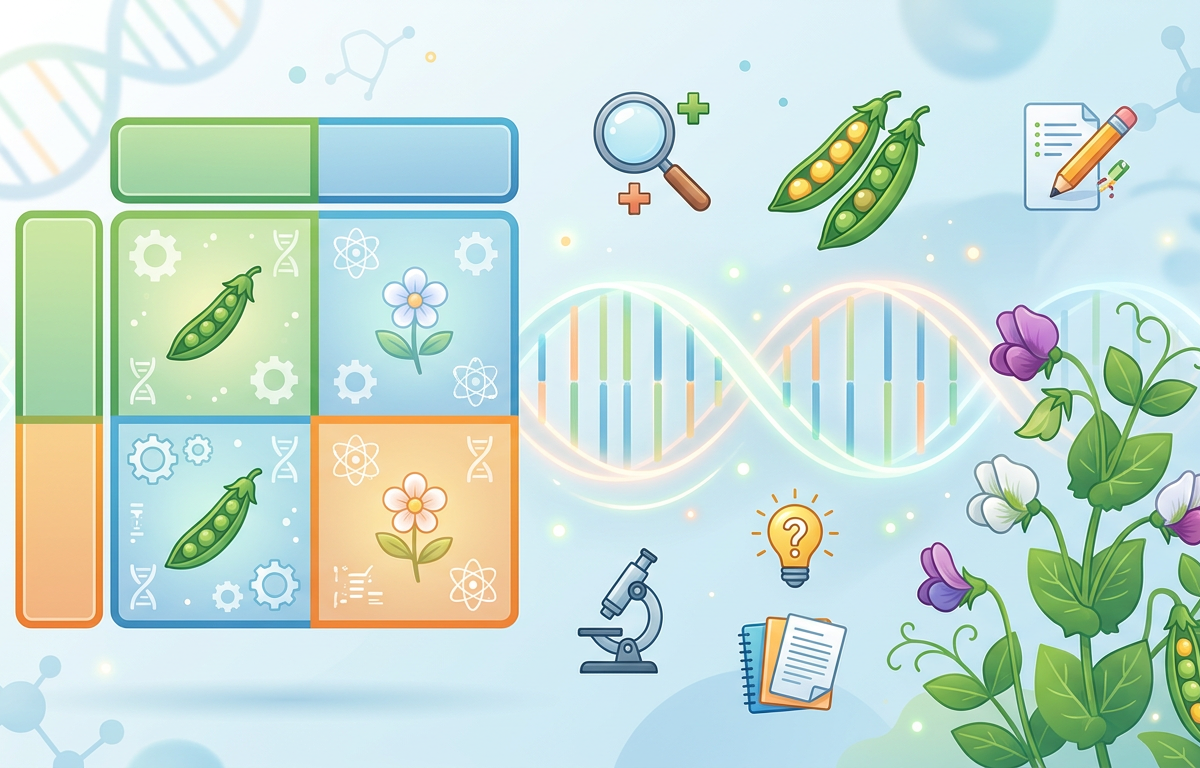
When a purple-flowered pea plant (Pp) crosses with another of the same genotype, three-quarters of the offspring appear purple, yet only one-third of those purple plants are genetically identical to their parents. This discrepancy between phenotype and genotype is where most students stumble. It is not enough to simply count the boxes in a four-square grid; you must distinguish between the physical trait expressed and the hidden recessive alleles that may reappear in the next generation. If you have ever confused a 3:1 phenotypic ratio with a 1:2:1 genotypic ratio, you are likely overlooking the way alleles segregate during gamete formation.
Success in genetics requires treating the Punnett square as a probability map rather than a simple checklist. Many learners fail to correctly assign letters for codominance or sex-linked traits, often forgetting that the X and Y chromosomes carry different information. By working through the specific crosses below, you will practice placing parental alleles on the correct axes and calculating the exact percentage of offspring likely to inherit specific conditions like hemophilia or roan coat colors. Focus on the logic of allele separation to avoid common mistakes in dihybrid setups.
1. Concept Explanation
Punnett Square problems are graphical representations used in genetics to determine the probability of an offspring having a particular genotype and phenotype based on the genetic makeup of the parents. This tool, named after the British geneticist Reginald Punnett, allows scientists and students to predict how alleles—alternative forms of a gene—will segregate and recombine during fertilization. To solve these problems, one must understand the difference between a genotype (the genetic code, such as Bb) and a phenotype (the physical trait, such as brown eyes). Concepts of dominance and recessiveness are central; a dominant allele (represented by a capital letter) masks the expression of a recessive allele (lowercase letter). Just as understanding Easy Probability Practice Questions helps in statistics, Punnett squares apply probability to biological inheritance. Whether you are dealing with a monohybrid cross involving one trait or a dihybrid cross involving two, the square provides a visual ratio of expected outcomes. Modern genetics also expands these rules to include incomplete dominance, codominance, and sex-linked traits, making the Punnett square a foundational tool for understanding complex life processes within the cell structure.
2. Solved Examples
Review these step-by-step solutions to understand how to set up and solve basic genetic crosses.
- Monohybrid Cross (Homozygous Dominant x Homozygous Recessive): In pea plants, purple flowers (P) are dominant over white flowers (p). Cross a homozygous purple plant (PP) with a white plant (pp).
- Write the parental genotypes: PP and pp.
- Place the alleles of one parent on the top and the other on the side of a 2x2 grid.
- Fill in the boxes: All four boxes result in the genotype "Pp".
- Result: 100% of the offspring are heterozygous (Pp) and 100% have the purple phenotype.
- Heterozygous Cross (F2 Generation): Cross two heterozygous purple plants (Pp x Pp).
- The alleles for both parents are P and p.
- Filling the grid results in: PP, Pp, Pp, and pp.
- Calculate ratios: Genotypic ratio is 1 PP : 2 Pp : 1 pp. Phenotypic ratio is 3 purple : 1 white.
- Result: There is a 75% chance of purple offspring and a 25% chance of white offspring.
- Incomplete Dominance: In snapdragons, red (R) and white (W) alleles show incomplete dominance, resulting in pink (RW) offspring. Cross a red plant (RR) with a pink plant (RW).
- Parental genotypes: RR and RW.
- The grid yields: RR, RW, RR, RW.
- Result: 50% chance of red flowers (RR) and 50% chance of pink flowers (RW). No white flowers are possible.
3. Practice Questions
Test your knowledge with these Punnett Square problems ranging from basic mendelian genetics to more complex inheritance patterns.
1. In humans, brown eyes (B) are dominant over blue eyes (b). If a heterozygous brown-eyed man marries a blue-eyed woman, what is the probability they will have a blue-eyed child?
2. A tall pea plant (TT) is crossed with a short pea plant (tt). What percentage of the F1 generation will be short?
3. In cattle, the allele for a red coat (R) and a white coat (W) are codominant. Heterozygous cattle (RW) have a roan coat (spotted red and white). If two roan cattle mate, what are the possible phenotypes of the offspring?
4. Hemophilia is a sex-linked recessive disorder (Xh). A woman who is a carrier (XHXh) marries a man with normal blood clotting (XHY). What is the probability that their sons will have hemophilia?
5. In rabbits, black fur (B) is dominant to white fur (b). If two heterozygous rabbits mate and produce 12 offspring, approximately how many would you expect to have white fur?
6. Perform a dihybrid cross: In guinea pigs, black hair (B) is dominant to brown (b), and short hair (S) is dominant to long (s). Cross a homozygous black, short-haired guinea pig (BBSS) with a brown, long-haired guinea pig (bbss). What is the genotype of the F1 generation?
7. If you cross two F1 individuals from Question 6 (BbSs x BbSs), what is the phenotypic ratio of the F2 generation?
8. A man with Type AB blood marries a woman with Type O blood. What are the possible blood types of their children? (Hint: Use IA, IB, and i notation).
9. In certain chickens, feather color is controlled by codominance. Black (B) and white (W) result in "erminitte" (speckled). If an erminitte rooster mates with a white hen, what is the probability of getting a black chick?
10. Huntington’s disease is caused by a dominant allele (H). If one parent is heterozygous for the disease (Hh) and the other is unaffected (hh), what is the chance their child will inherit the disease?
4. Answers & Explanations
1. 50%. The man is Bb and the woman is bb. The cross results in 2 Bb (brown) and 2 bb (blue) offspring. Therefore, there is a 1/2 or 50% chance for a blue-eyed child.
2. 0%. All offspring in the F1 generation will have the genotype Tt. Since tall is dominant, 100% will be tall and 0% will be short.
3. 25% Red, 50% Roan, 25% White. The cross RW x RW yields 1 RR, 2 RW, and 1 WW. This is a classic 1:2:1 ratio for codominance.
4. 50%. Focus only on the male offspring. The Y chromosome comes from the father. The mother can pass either XH (normal) or Xh (hemophilia). Thus, half of the sons will be XhY.
5. 3 offspring. A heterozygous cross (Bb x Bb) results in a 1:4 (25%) probability of the recessive phenotype (bb). 25% of 12 is 3.
6. BbSs. Every gamete from the first parent is BS, and every gamete from the second is bs. Combining them always results in the dihybrid BbSs.
7. 9:3:3:1. This is the standard Mendelian ratio for a dihybrid cross: 9 Black/Short, 3 Black/Long, 3 Brown/Short, and 1 Brown/Long.
8. Type A and Type B. The cross is IAIB x ii. The children will be either IAi (Type A) or IBi (Type B). Type AB and Type O are impossible.
9. 0%. The cross is BW (erminitte) x WW (white). The offspring can only be BW or WW. To get a black chick (BB), both parents must contribute a B allele.
10. 50%. The cross Hh x hh results in 50% Hh (affected) and 50% hh (unaffected). Since the disease is dominant, having just one H results in the condition.
1. Which term describes an organism that has two different alleles for a specific trait?
6. Frequently Asked Questions
What is the difference between genotype and phenotype?
Genotype refers to the actual genetic makeup or set of alleles an organism carries (like BB or Bb), while phenotype refers to the observable physical characteristics or traits (like brown eyes) resulting from those genes. Phenotype is influenced by both the genotype and environmental factors.
How do you set up a dihybrid cross?
To set up a dihybrid cross, you must first determine the possible gamete combinations for each parent using the FOIL method (First, Outer, Inner, Last). For a parent with genotype AaBb, the gametes would be AB, Ab, aB, and ab, which are then placed along the top and side of a 16-square grid.
What is incomplete dominance?
Incomplete dominance occurs when the phenotype of a heterozygous individual is an intermediate blend between the two homozygous phenotypes, such as a red flower and a white flower producing pink offspring. Neither allele is completely dominant over the other.
What are sex-linked traits?
Sex-linked traits are characteristics associated with genes located on the sex chromosomes, usually the X chromosome. Because males have only one X chromosome, they are more likely to express recessive sex-linked disorders, as they do not have a second X chromosome to mask the recessive allele.
Can a Punnett square predict the exact number of offspring?
No, a Punnett square predicts the probability or statistical likelihood of offspring having certain traits, not the exact number. Similar to flipping a coin, each fertilization event is independent, though large sample sizes typically reflect the predicted Mendelian ratios.
Enjoyed this article?
Share it with others who might find it helpful.
Related Articles
Solving Mendelian Ratios and Punnett Squares Without the Guesswork
Master genetics with our comprehensive guide featuring solved examples, practice questions, and detailed explanations on Mendelian and modern inheritance.
Apr 25, 2026

Hard Microbiology Practice Questions Practice Questions
Hard Microbiology Practice Questions Practice Questions
Apr 26, 2026

Medium Microbiology Practice Questions Practice Questions
Master microbiology with our medium-level practice questions covering bacterial growth, genetics, and metabolism. Includes solved examples and a quick quiz.
Apr 26, 2026

Easy Microbiology Practice Questions Practice Questions
Easy Microbiology Practice Questions Practice Questions
Apr 26, 2026

Hard Enzyme Questions Practice Questions
Master complex biochemistry with these hard enzyme questions. Cover Michaelis-Menten kinetics, inhibition types, and Lineweaver-Burk plots with solved examples.
Apr 26, 2026

Medium Enzyme Questions Practice Questions
Master enzyme kinetics and regulation with our Medium Enzyme Questions Practice Questions. Includes solved examples, detailed explanations, and a quick quiz.
Apr 26, 2026
Enzyme Questions Practice Questions with Answers
Master enzyme kinetics and function with our comprehensive guide. Includes solved examples, practice questions, and detailed answers on biological catalysts.
Apr 26, 2026

Microbiology Practice Questions Practice Questions with Answers
Master microbiology with our comprehensive guide featuring concept explanations, solved examples, and practice questions with detailed answers.
Apr 26, 2026