Easy Functional Group Identification Practice Questions
Concept Explanation
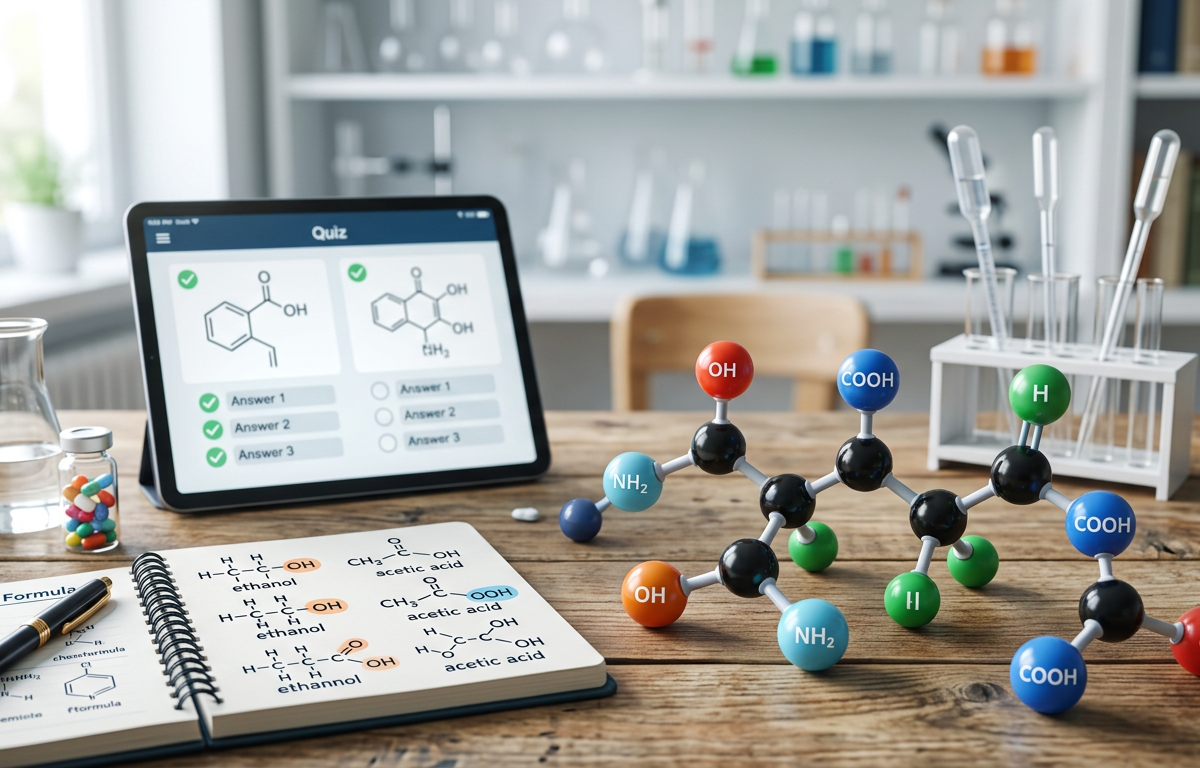
Functional groups are specific arrangements of atoms within molecules that possess characteristic chemical properties and dictate how the molecule reacts regardless of the size of the rest of the carbon chain.
In organic chemistry, identifying these groups is the first step toward understanding molecular behavior, solubility, and reactivity. For instance, the presence of a hydroxyl group (-OH) indicates an alcohol, while a carbonyl group (C=O) is the hallmark of aldehydes and ketones. These groups are the active sites of a molecule. While the carbon backbone provides the structural framework, the functional groups are where the "action" happens during a chemical reaction. According to the IUPAC definition, a functional group is an atom or group of atoms that replaces hydrogen in an organic compound.
To master Easy Functional Group Identification Practice Questions, you must recognize the structural patterns of the most common groups:
Hydroxyl (-OH): Found in alcohols.
Carbonyl (C=O): Found in aldehydes (at the end of a chain) and ketones (in the middle of a chain).
Carboxyl (-COOH): Found in carboxylic acids.
Amino (-NH2): Found in amines.
Halide (-X): Found in alkyl halides (F, Cl, Br, I).
Understanding these groups is essential before moving on to more complex topics like naming organic compounds or performing IR spectroscopy interpretation, as each group has a distinct signal in the infrared spectrum.
Solved Examples
Study these solved examples to understand the logic behind identifying organic structures.
Identify the functional group in CH3-CH2-OH.
Locate the atom that is not carbon or hydrogen: the oxygen atom.
Observe the bonding: The oxygen is bonded to a hydrogen and a carbon atom.
Match the pattern: The -OH group is a hydroxyl group.
Conclusion: This molecule is an alcohol (ethanol).
What functional group is present in CH3-CO-CH3?
Identify the central feature: A carbon double-bonded to an oxygen (C=O).
Check the neighbors: The carbonyl carbon is attached to two other carbon atoms.
Match the pattern: A C=O group flanked by carbons is a ketone.
Conclusion: The functional group is a ketone (propanone).
Identify the group in CH3-NH2.
Locate the heteroatom: Nitrogen.
Observe the bonding: Nitrogen is bonded to two hydrogens and one alkyl group.
Match the pattern: An -NH2 group attached to a carbon is an amine.
Conclusion: The functional group is an amine (methylamine).
Practice Questions
Test your knowledge with these Easy Functional Group Identification Practice Questions. Try to identify the group based on the molecular formula or structural description provided.
Identify the functional group in CH3-CH2-Cl.
What is the name of the functional group represented by -COOH?
Which functional group is characterized by a carbon double-bonded to an oxygen and single-bonded to a hydrogen (R-CHO)?
Want unlimited practice questions like these?
Generate AI-powered questions with step-by-step solutions on any topic.
Try Question Generator Free →Identify the functional group in CH3-O-CH3.
What group is present in CH3-COOCH3?
Identify the group in CH3-CH2-NH-CH3.
Which functional group contains a C=C double bond?
Identify the group in CH3-CONH2.
What is the functional group in a molecule of propan-2-ol?
Identify the functional group in CH3-C≡N.
Answers & Explanations
Alkyl Halide (Chloride): The presence of a chlorine atom (Cl) bonded to a saturated carbon chain identifies this as an alkyl halide. Chlorine is part of the halogen group on the periodic table.
Carboxyl Group: The -COOH group consists of both a carbonyl (C=O) and a hydroxyl (-OH) group on the same carbon, defining a carboxylic acid.
Aldehyde: The R-CHO structure indicates a carbonyl group located at the terminal end of a carbon chain, which is the definition of an aldehyde.
Ether: The structure R-O-R (an oxygen atom single-bonded to two carbon groups) is an ether. In this case, it is dimethyl ether.
Ester: The -COO- linkage (a carbonyl group adjacent to an ether-like oxygen) identifies this as an ester.
Amine (Secondary): The nitrogen atom is bonded to two carbon groups and one hydrogen, making it a secondary amine.
Alkene: The carbon-carbon double bond (C=C) is the defining functional group for alkenes.
Amide: The combination of a carbonyl group (C=O) directly bonded to a nitrogen atom (-NH2) forms an amide.
Hydroxyl (Alcohol): The "-ol" suffix and the structural position of the oxygen indicate a hydroxyl group attached to the second carbon.
Nitrile: The carbon-nitrogen triple bond (C≡N) is known as a cyano or nitrile group.
1. Which of the following functional groups contains a nitrogen atom?
Frequently Asked Questions
What is the difference between an aldehyde and a ketone?
An aldehyde has the carbonyl group (C=O) at the end of the carbon chain attached to at least one hydrogen, while a ketone has the carbonyl group in the middle of the chain attached to two carbon atoms.
How can I tell the difference between an alcohol and an ether?
Alcohols contain an oxygen bonded to a hydrogen (-OH), whereas ethers contain an oxygen atom bonded to two separate carbon atoms (C-O-C). You can further explore this by looking at Functional Group Identification Practice Questions with Answers.
Is an alkene considered a functional group?
Yes, the carbon-carbon double bond is a functional group because it is a site of high electron density that undergoes specific chemical reactions, such as addition reactions. For more on double bonds, check out Easy Hybridization Practice Questions.
What atoms are found in an amide group?
An amide group consists of a carbon atom double-bonded to an oxygen atom (carbonyl) and single-bonded to a nitrogen atom. This is a common linkage in protein structures.
Why is identifying functional groups important?
Identifying functional groups allows chemists to predict a molecule's boiling point, solubility in water, and how it will react with other chemicals in a laboratory setting.
Want unlimited practice questions like these?
Generate AI-powered questions with step-by-step solutions on any topic.
Try Question Generator Free →
Want unlimited practice questions like these?
Generate AI-powered questions with step-by-step solutions on any topic.
Try Question Generator Free →Enjoyed this article?
Share it with others who might find it helpful.
Related Articles
Hard Le Chatelier’s Principle Practice Questions
Master Hard Le Chatelier’s Principle Practice Questions with our comprehensive guide featuring solved examples, practice problems, and detailed explanations.
Mar 30, 2026
Hard Reaction Quotient (Q) Practice Questions
Hard Reaction Quotient (Q) Practice Questions
Mar 30, 2026
Grams to Moles Practice Questions with Answers
Master grams to moles conversions with our comprehensive guide. Includes step-by-step examples, practice questions, and detailed answers for chemistry students.
Mar 26, 2026
Avogadro’s Number Practice Questions with Answers
Master the mole concept with our Avogadro’s Number practice questions. Includes step-by-step solved examples, a quick quiz, and detailed explanations.
Mar 26, 2026
Empirical Formulas: Solving Ratios from Mass and Percent Data
Master empirical formula calculations with 10 practice questions, worked answers, and a free step-by-step calculator for mass, percentage, and combustion problems.
Mar 26, 2026