Easy Conditional Probability Practice Questions
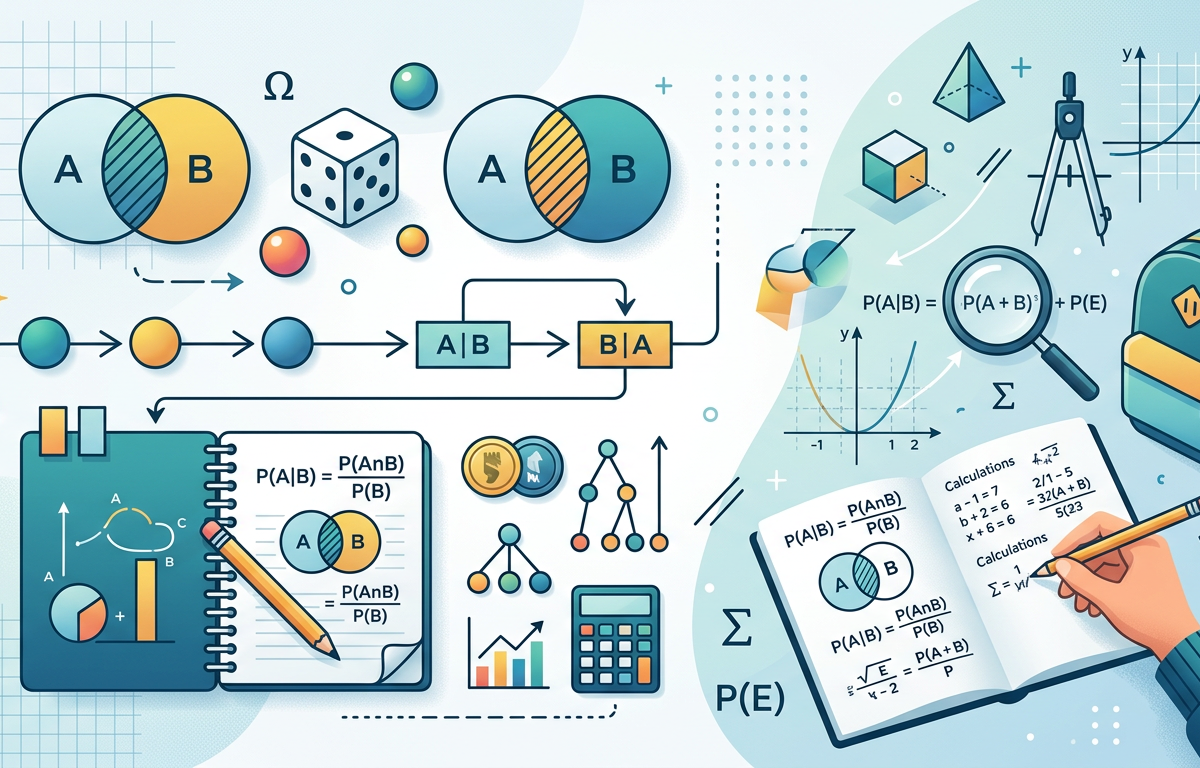
Easy Conditional Probability Practice Questions
Understanding how events influence each other is a fundamental skill in statistics and everyday decision-making. Conditional probability is the tool that allows us to quantify this influence, helping us make more informed predictions based on new information. Whether you're analyzing medical test results, predicting stock market movements, or just trying to win a board game, grasping the basics of conditional probability is essential. This guide provides clear explanations, worked examples, and practice problems to build your confidence with this key concept.
Concept Explanation
Conditional probability is the likelihood of an event occurring, given that another event has already happened. In other words, it's the probability of event A happening under the condition that event B has occurred. This is denoted as P(A|B) and is read as "the probability of A given B." The core idea is that the occurrence of event B can change the probability of event A. The new information (that B happened) effectively reduces our sample space, or the total set of possible outcomes, to only those outcomes where B is true.
The formula for calculating conditional probability is:
P(A|B) = P(A and B) / P(B)
Let's break down the components:
P(A|B): The conditional probability of event A occurring, given that event B has occurred.
P(A and B): The probability of both event A and event B occurring together. This is also known as the joint probability.
P(B): The probability of event B occurring. It's crucial that P(B) is greater than zero, as we cannot condition on an impossible event.
For example, imagine drawing a card from a standard 52-card deck. The probability of drawing a Queen is 4/52. However, if we know that the card drawn is a face card (Jack, Queen, or King), the probability of it being a Queen changes. This is a classic case for applying conditional probability. For a deeper mathematical foundation, you can explore resources like Khan Academy's detailed lessons on the topic. If you need to brush up on the fundamentals first, our general probability practice questions are a great place to start.
Solved Examples of Conditional Probability
Working through solved examples is the best way to understand how to apply the conditional probability formula. Below are several common scenarios with step-by-step solutions.
Example 1: Rolling Two Dice
Question: You roll two standard six-sided dice. What is the probability that the sum of the dice is 7, given that the first die shows a 4?
Define the Events:
Event A: The sum of the dice is 7.
Event B: The first die shows a 4.Identify the Sample Space: When rolling two dice, there are 6 x 6 = 36 possible outcomes.
Find the Probability of Event B, P(B):
The outcomes where the first die is a 4 are: (4,1), (4,2), (4,3), (4,4), (4,5), (4,6).
There are 6 such outcomes. So, P(B) = 6/36 = 1/6.Find the Probability of A and B, P(A and B):
We need the outcome where the first die is a 4 AND the sum is 7. The only outcome that satisfies both conditions is (4,3).
So, P(A and B) = 1/36.Apply the Conditional Probability Formula:
P(A|B) = P(A and B) / P(B)
P(A|B) = (1/36) / (6/36)
P(A|B) = 1/6
Answer: The probability that the sum is 7, given the first die was a 4, is 1/6.
Example 2: Drawing Cards
Question: You draw two cards from a standard 52-card deck without replacement. What is the probability that the second card is a King, given that the first card was a Queen?
Define the Events:
Event A: The second card is a King.
Event B: The first card is a Queen.Think about the Reduced Sample Space: After the first card (a Queen) is drawn and not replaced, the situation changes. There are now 51 cards left in the deck.
Count the Favorable Outcomes for A: The number of Kings in the deck has not changed. There are still 4 Kings.
Calculate the Probability: The probability of drawing a King as the second card, given a Queen was drawn first, is the number of Kings remaining divided by the total number of cards remaining.
P(A|B) = (Number of Kings) / (Total cards remaining)
P(A|B) = 4 / 51
Answer: The probability is 4/51. Note that for this type of problem, it's often easier to reason through the reduced sample space than to formally use the P(A and B) / P(B) formula.
Example 3: Survey Data (Contingency Table)
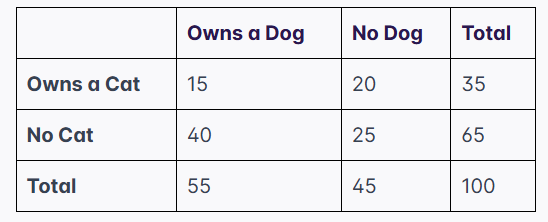
Question: A survey of 100 people asked if they own a cat or a dog. The results are in the table below. Given that a randomly selected person owns a dog, what is the probability they also own a cat?
Define the Events:
Event A: The person owns a cat.
Event B: The person owns a dog.Find the Probability of Event B, P(B):
From the table, the total number of people who own a dog is 55. The total number of people surveyed is 100.
P(B) = 55/100.Find the Probability of A and B, P(A and B):
From the table, the number of people who own both a cat AND a dog is 15.
P(A and B) = 15/100.Apply the Conditional Probability Formula:
P(A|B) = P(A and B) / P(B)
P(A|B) = (15/100) / (55/100)
P(A|B) = 15/55 = 3/11
Answer: The probability that a person owns a cat given they own a dog is 3/11, or approximately 27.3%.
Practice Questions
Now it's your turn to solve some problems. Use the concepts and formulas discussed above to find the answers to these easy conditional probability questions.
1. A bag contains 5 red marbles and 3 blue marbles. You draw one marble, and then another, without replacement. If the first marble you draw is red, what is the probability that the second marble is blue?
2. You flip two fair coins. What is the probability that you get two heads, given that the first flip was a head?
3. In a class of 30 students, 18 students have brown hair, 10 have blue eyes, and 6 have both brown hair and blue eyes. What is the probability that a student has blue eyes, given that they have brown hair?
Want unlimited practice questions like these?
Generate AI-powered questions with step-by-step solutions on any topic.
Try Question Generator Free →4. You draw a single card from a standard 52-card deck. What is the probability that the card is a Jack, given that it is a face card (Jack, Queen, or King)?
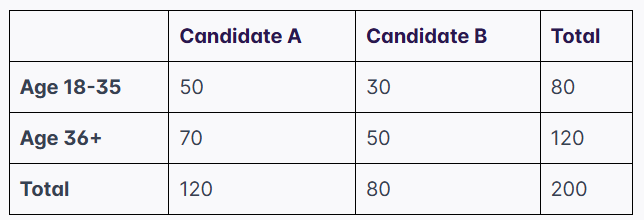
5. The table below shows the results of a poll asking 200 voters their preferred candidate and their age group. What is the probability that a randomly selected voter is in the 18-35 age group, given that they prefer Candidate B?
6. A weather forecast predicts a 40% chance of rain for the day. It also predicts a 20% chance of both rain and strong winds. What is the probability that there will be strong winds, given that it is raining?
7. You roll a single fair six-sided die. What is the probability that the number is greater than 3, given that the number is odd?
8. At a high school, 25% of students take chemistry and 40% of students take biology. Of the students who take chemistry, 60% also take biology. What is the probability that a randomly selected student takes both chemistry and biology?
9. Two cards are drawn from a deck without replacement. What is the probability that both cards are hearts?
10. An electronics factory produces two models of phones, Model X and Model Y. 70% of the phones produced are Model X. 5% of all phones produced are defective. 3% of all phones produced are defective Model X phones. What is the probability that a phone is defective, given that it is a Model Y?
Answers & Explanations
Here you will find the detailed solutions for each of the practice questions, allowing you to check your work and understand the reasoning behind each answer.
1. A bag contains 5 red marbles and 3 blue marbles. You draw one marble, and then another, without replacement. If the first marble you draw is red, what is the probability that the second marble is blue?
Explanation: This is a classic reduced sample space problem.
Initial state: 8 marbles total (5 red, 3 blue).
Condition: The first marble drawn is red.
After drawing one red marble, there are 7 marbles left in the bag. The number of red marbles is now 4, and the number of blue marbles is still 3.
The probability of the second marble being blue is the number of blue marbles divided by the new total number of marbles.
P(Second is Blue | First is Red) = 3 / 7.
2. You flip two fair coins. What is the probability that you get two heads, given that the first flip was a head?
Explanation:
Let A = getting two heads (HH).
Let B = the first flip is a head. The possible outcomes for B are (HH, HT).
We are looking for P(A|B).
The sample space is {HH, HT, TH, TT}.
P(B) = The probability of the first flip being a head is 2/4 = 1/2.
P(A and B) = The probability of getting two heads AND the first being a head is just the probability of getting two heads (HH), which is 1/4.
Using the formula: P(A|B) = P(A and B) / P(B) = (1/4) / (1/2) = 1/2.
Alternatively, since coin flips are independent, the result of the first flip does not affect the second. The probability of the second flip being a head is simply 1/2.
3. In a class of 30 students, 18 students have brown hair, 10 have blue eyes, and 6 have both brown hair and blue eyes. What is the probability that a student has blue eyes, given that they have brown hair?
Explanation:
Let A = student has blue eyes.
Let B = student has brown hair.
We want to find P(A|B).
Total students = 30.
P(B) = Probability of having brown hair = 18/30.
P(A and B) = Probability of having both blue eyes and brown hair = 6/30.
Using the formula: P(A|B) = P(A and B) / P(B) = (6/30) / (18/30) = 6/18 = 1/3.
4. You draw a single card from a standard 52-card deck. What is the probability that the card is a Jack, given that it is a face card (Jack, Queen, or King)?
Explanation:
Let A = the card is a Jack.
Let B = the card is a face card.
Our sample space is reduced to only the face cards. There are 3 face cards in each of the 4 suits, so there are 3 * 4 = 12 face cards in total. P(B) = 12/52.
Within this group of 12 face cards, there are 4 Jacks. So, the event 'A and B' (a Jack that is also a face card) has 4 outcomes. P(A and B) = 4/52.
Using the formula: P(A|B) = P(A and B) / P(B) = (4/52) / (12/52) = 4/12 = 1/3.
Intuitively: If you know the card is a face card, there are 12 possibilities (4 Jacks, 4 Queens, 4 Kings). The probability of it being a Jack is 4 out of these 12, which is 1/3.
5. Using the voter table, what is the probability that a randomly selected voter is in the 18-35 age group, given that they prefer Candidate B?
Explanation:
Let A = voter is in the 18-35 age group.
Let B = voter prefers Candidate B.
We are looking for P(A|B).
From the table, the total number of voters who prefer Candidate B is 80. This is our new sample space. P(B) = 80/200.
The number of voters who are in the 18-35 age group AND prefer Candidate B is 30. P(A and B) = 30/200.
Using the formula: P(A|B) = P(A and B) / P(B) = (30/200) / (80/200) = 30/80 = 3/8.
6. A weather forecast predicts a 40% chance of rain for the day. It also predicts a 20% chance of both rain and strong winds. What is the probability that there will be strong winds, given that it is raining?
Explanation:
Let A = there will be strong winds.
Let B = it will rain.
We are given: P(B) = 0.40 and P(A and B) = 0.20.
We need to find P(A|B).
Using the formula: P(A|B) = P(A and B) / P(B) = 0.20 / 0.40 = 1/2 or 0.50.
So, there is a 50% chance of strong winds if it is raining.
7. You roll a single fair six-sided die. What is the probability that the number is greater than 3, given that the number is odd?
Explanation:
Let A = the number is greater than 3 {4, 5, 6}.
Let B = the number is odd {1, 3, 5}.
We need to find P(A|B).
The condition that the number is odd reduces our sample space to {1, 3, 5}. There are 3 possible outcomes.
Within this new sample space, we look for the numbers that are also greater than 3. The only number that fits is 5. There is 1 such outcome.
Therefore, the probability is 1/3. For students interested in foundational statistics, our guide on mean, median, mode practice questions can be helpful.
8. At a high school, 25% of students take chemistry and 40% of students take biology. Of the students who take chemistry, 60% also take biology. What is the probability that a randomly selected student takes both chemistry and biology?
Explanation: This question asks for a joint probability, P(Chem and Bio), but gives us a conditional probability. We can rearrange the formula to solve it.
Let C = student takes chemistry. Let B = student takes biology.
We are given: P(C) = 0.25, P(B) = 0.40.
The statement "Of the students who take chemistry, 60% also take biology" is a conditional probability: P(B|C) = 0.60.
The formula is P(B|C) = P(B and C) / P(C).
Rearranging to solve for P(B and C): P(B and C) = P(B|C) * P(C).
P(B and C) = 0.60 * 0.25 = 0.15.
The probability that a student takes both is 15%.
9. Two cards are drawn from a deck without replacement. What is the probability that both cards are hearts?
Explanation: This can be solved using conditional probability. We want P(1st is Heart AND 2nd is Heart).
P(1st is Heart and 2nd is Heart) = P(1st is Heart) * P(2nd is Heart | 1st is Heart).
P(1st is Heart) = There are 13 hearts in a 52-card deck, so the probability is 13/52 = 1/4.
P(2nd is Heart | 1st is Heart) = After drawing one heart, there are 12 hearts left and 51 total cards. So, this probability is 12/51.
Now, multiply them: (13/52) * (12/51) = (1/4) * (12/51) = 12/204 = 1/17.
The probability of drawing two hearts is 1/17.
10. An electronics factory produces two models of phones, Model X and Model Y. 70% of the phones produced are Model X. 5% of all phones produced are defective. 3% of all phones produced are defective Model X phones. What is the probability that a phone is defective, given that it is a Model Y?
Explanation: This problem requires careful breakdown.
Let D = phone is defective. Let X = phone is Model X. Let Y = phone is Model Y.
We are given: P(X) = 0.70, P(D) = 0.05, P(D and X) = 0.03.
We need to find P(D|Y).
First, let's find the probabilities related to Model Y. Since there are only two models, P(Y) = 1 - P(X) = 1 - 0.70 = 0.30.
We know that P(D) = P(D and X) + P(D and Y), because a defective phone must be either model X or model Y.
0.05 = 0.03 + P(D and Y).
Solving for P(D and Y), we get P(D and Y) = 0.05 - 0.03 = 0.02.
Now we can use the conditional probability formula: P(D|Y) = P(D and Y) / P(Y).
P(D|Y) = 0.02 / 0.30 = 2/30 = 1/15.
The probability that a phone is defective, given it is a Model Y, is 1/15 or approximately 6.67%.
1. Test your understanding with this quick quiz. Each question focuses on the core ideas of conditional probability covered in this article.1. What does P(A|B) represent?
Frequently Asked Questions
Here are answers to some common questions that arise when learning about easy conditional probability for the first time.
What's the difference between conditional and unconditional probability?
Unconditional probability (or marginal probability) is the likelihood of a single event occurring without any other information, like P(A). Conditional probability, P(A|B), is the likelihood of an event occurring after we know that another event, B, has already happened. The key difference is the presence of a condition that alters the sample space.
How is the formula for conditional probability written?
The formula is written as P(A|B) = P(A and B) / P(B). It states that the probability of A given B is equal to the probability of both A and B happening, divided by the probability of B happening. A helpful way to remember it is that the event you are conditioning on (B) is the one that goes in the denominator.
What does P(A|B) mean in words?
P(A|B) is read as "the probability of A given B." It asks you to calculate the probability of event A under the assumption or knowledge that event B is true. For example, "What is the probability a student gets an 'A' on the final, given they had perfect attendance?"
Can P(A|B) be greater than P(A)?
Yes, absolutely. This happens when event B makes event A more likely. For example, the probability of a street being wet, P(Wet), is low on a sunny day. But the probability of the street being wet *given* that it is raining, P(Wet|Raining), is very high. In this case, P(Wet|Raining) > P(Wet).
Are conditional probability and independent events related?
Yes, they are fundamentally connected. Two events, A and B, are considered independent if the occurrence of one does not affect the probability of the other. In terms of conditional probability, this means P(A|B) = P(A). Knowing that B happened provides no new information about the likelihood of A. The concept of independence is a core part of statistics, which often builds on concepts like the normal distribution.
Where is conditional probability used in real life?
Conditional probability is used everywhere. Doctors use it to determine the likelihood of a disease given certain symptoms (e.g., P(Disease|Symptom)). Insurance companies use it to set premiums based on risk factors (e.g., P(Accident|Age Group)). It's also the mathematical basis for machine learning algorithms, spam filters, and recommendation engines. For a more academic overview, the Wikipedia article on Conditional Probability provides extensive detail.
Want unlimited practice questions like these?
Generate AI-powered questions with step-by-step solutions on any topic.
Try Question Generator Free →
Want unlimited practice questions like these?
Generate AI-powered questions with step-by-step solutions on any topic.
Try Question Generator Free →Enjoyed this article?
Share it with others who might find it helpful.
Related Articles

Conditional Probability Practice Questions with Answers
Master conditional probability with our comprehensive guide featuring solved examples, formula explanations, and 10+ practice questions with detailed answers.
Apr 5, 2026

Easy Probability Practice Questions
Master the basics of probability with our easy-to-follow guide. Includes solved examples, practice questions with answers, and a quick quiz to test your skills.
Apr 5, 2026

Probability Practice Questions with Answers
Master probability with our guide featuring solved examples, practice questions, and detailed explanations for students and exam prep.
Apr 5, 2026
Hard Confidence Interval Practice Questions
Challenge your statistical skills with hard confidence interval practice questions. This guide covers complex scenarios like two-sample tests and sample size determination.
Apr 5, 2026
Medium Sampling Distribution Practice Questions
Master the sampling distribution with clear explanations, worked examples, and medium-difficulty practice questions on the Central Limit Theorem and standard error.
Apr 5, 2026

Medium Hypothesis Testing Practice Questions
Master hypothesis testing with our comprehensive guide. This page includes solved examples, practice questions with detailed answers, a quiz, and FAQs.
Apr 5, 2026

Medium Confidence Interval Practice Questions
Master the art of estimating population parameters with our comprehensive guide. This page features medium-level confidence interval practice questions with full solutions.
Apr 5, 2026

Medium Standard Deviation Practice Questions
Master standard deviation with our comprehensive guide. Features clear explanations, solved examples, and medium-difficulty practice questions with detailed answers.
Apr 5, 2026