Easy Charles’s Law Practice Questions
Concept Explanation
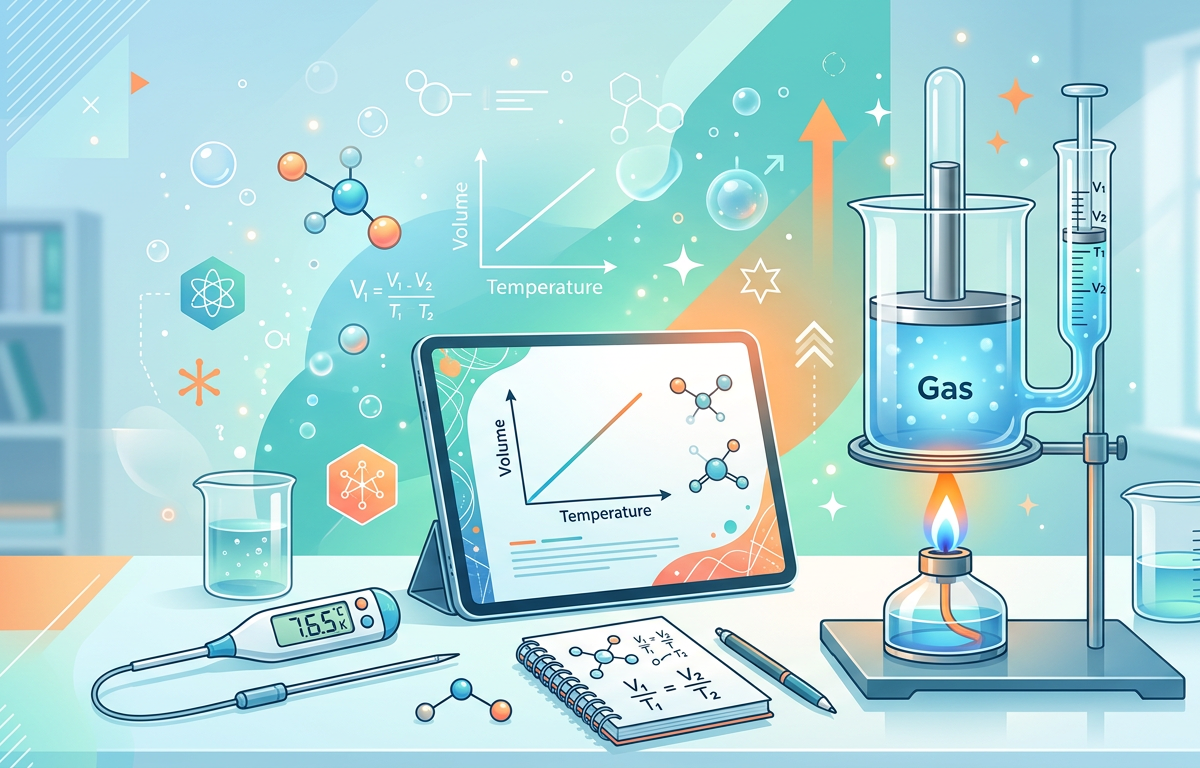
Charles’s Law states that the volume of a given mass of gas is directly proportional to its absolute temperature, provided the pressure remains constant. This fundamental principle of chemistry and physics means that as the temperature of a gas increases, its volume increases, and as the temperature decreases, its volume decreases. To apply this law accurately, you must always measure temperature in Kelvins (K), which is the absolute temperature scale used in the International System of Units (SI).
The mathematical expression for Charles’s Law is:
V₁ / T₁ = V₂ / T₂
Where:
- V₁ is the initial volume.
- T₁ is the initial absolute temperature (in Kelvin).
- V₂ is the final volume.
- T₂ is the final absolute temperature (in Kelvin).
In a laboratory setting, this relationship is often demonstrated using a balloon. If you place a balloon in a freezer, it shrinks; if you move it to a hot sunny spot, it expands. This happens because the gas molecules move faster and push outward more forcefully when heated, requiring more space to maintain constant pressure. Understanding this concept is a vital stepping stone before moving on to more complex topics like the Combined Gas Law or the Ideal Gas Law.
To convert Celsius to Kelvin, simply add 273.15 to the Celsius temperature. For most Easy Charles’s Law Practice Questions, using 273 is sufficient for calculation. Failing to convert to Kelvin is the most common mistake students make when solving gas law problems.
Solved Examples
Reviewing these solved examples will help you master the step-by-step process required for gas law calculations.
Example 1: Finding Final Volume
A sample of nitrogen gas occupies a volume of 2.0 L at 300 K. What will the volume be if the temperature is increased to 600 K at constant pressure?
- Identify the knowns: V₁ = 2.0 L, T₁ = 300 K, T₂ = 600 K.
- Identify the unknown: V₂.
- Set up the equation: V₁ / T₁ = V₂ / T₂.
- Plug in the values: 2.0 / 300 = V₂ / 600.
- Solve for V₂: V₂ = (2.0 × 600) / 300 = 1200 / 300 = 4.0 L.
Example 2: Temperature Conversion Required
A balloon has a volume of 5.0 L at 25°C. If the balloon is heated to 50°C, what is the new volume?
- Convert Celsius to Kelvin: T₁ = 25 + 273 = 298 K; T₂ = 50 + 273 = 323 K.
- Identify knowns: V₁ = 5.0 L.
- Set up the equation: 5.0 / 298 = V₂ / 323.
- Solve for V₂: V₂ = (5.0 × 323) / 298.
- Final Answer: V₂ ≈ 5.42 L.
Example 3: Finding Initial Temperature
A gas occupies 10.0 L at an unknown temperature. When cooled to 200 K, the volume becomes 5.0 L. What was the starting temperature?
- Identify knowns: V₁ = 10.0 L, V₂ = 5.0 L, T₂ = 200 K.
- Set up the equation: 10.0 / T₁ = 5.0 / 200.
- Cross-multiply: 10.0 × 200 = 5.0 × T₁.
- Divide to isolate T₁: 2000 / 5.0 = T₁.
- Final Answer: T₁ = 400 K.
Practice Questions
Test your knowledge with these Easy Charles’s Law Practice Questions. Remember to always convert your temperatures to Kelvin!
1. A container of oxygen gas has a volume of 3.5 L at 280 K. If the temperature is raised to 560 K, what is the new volume?
2. A balloon filled with helium has a volume of 1.2 L at 20°C. What volume will it occupy at 40°C?
3. If a gas occupies 15.0 L at 300 K, at what temperature will the volume be 30.0 L?
Want unlimited practice questions like these?
Generate AI-powered questions with step-by-step solutions on any topic.
Try Question Generator Free →4. A sample of neon gas at 250 K occupies 5.0 L. If the volume decreases to 2.5 L, what is the new temperature in Kelvin?
5. A flexible container holds 8.0 L of gas at 100°C. What is the volume if the temperature drops to 0°C?
6. At 273 K, a gas sample has a volume of 22.4 L. What will the volume be at 546 K?
7. A gas occupies 500 mL at 350 K. What is the volume at 700 K?
8. A piston contains 2.0 L of gas at 300 K. To what temperature must the gas be cooled to reduce the volume to 1.5 L?
9. A sample of argon gas is at 10°C and has a volume of 4.0 L. If the volume increases to 6.0 L, what is the new temperature in Celsius?
10. A weather balloon contains 100 L of hydrogen at 290 K. As it rises, the temperature drops to 250 K. What is the new volume?
Answers & Explanations
- 7.0 L: Using V₁/T₁ = V₂/T₂, we get 3.5/280 = V₂/560. Since the temperature doubled, the volume also doubles.
- 1.28 L: Convert to Kelvin (293 K and 313 K). 1.2 / 293 = V₂ / 313. V₂ = (1.2 × 313) / 293 = 1.28 L.
- 600 K: 15.0 / 300 = 30.0 / T₂. Since the volume doubled, the absolute temperature must also double.
- 125 K: 5.0 / 250 = 2.5 / T₂. The volume was halved, so the temperature is halved.
- 5.85 L: Convert to Kelvin (373 K and 273 K). 8.0 / 373 = V₂ / 273. V₂ = (8.0 × 273) / 373 = 5.85 L.
- 44.8 L: 22.4 / 273 = V₂ / 546. The temperature doubled (from 273 to 546 K), so the volume doubles.
- 1000 mL (or 1.0 L): 500 / 350 = V₂ / 700. Doubling the temperature doubles the volume.
- 225 K: 2.0 / 300 = 1.5 / T₂. T₂ = (1.5 × 300) / 2.0 = 225 K.
- 151.6°C: Convert initial T to 283 K. 4.0 / 283 = 6.0 / T₂. T₂ = 424.5 K. Convert back to Celsius: 424.5 - 273 = 151.5°C.
- 86.2 L: 100 / 290 = V₂ / 250. V₂ = (100 × 250) / 290 = 86.2 L.
1. Which variable must remain constant for Charles’s Law to apply?
Frequently Asked Questions
What is the main formula for Charles’s Law?
The main formula is V₁/T₁ = V₂/T₂, which shows that volume and absolute temperature are directly proportional. This formula allows you to calculate a change in one variable when the other is modified, assuming pressure and the amount of gas stay the same.
Can I use Celsius in Charles’s Law problems?
No, you cannot use Celsius because it is not an absolute scale and can contain zero or negative values, which would lead to mathematically impossible volumes. Always convert Celsius to Kelvin by adding 273 to the Celsius value.
What happens to gas molecules when temperature increases?
When temperature increases, gas molecules gain kinetic energy and move faster, colliding with the walls of their container more frequently and with greater force. To keep pressure constant, the container must expand, increasing the volume.
Is Charles’s Law applicable to liquids?
Charles’s Law specifically describes the behavior of gases, which have much greater compressibility and thermal expansion than liquids. While liquids do expand when heated, they do not follow the simple direct proportionality defined by this law.
Who discovered Charles’s Law?
The law is named after Jacques Charles, a French scientist who formulated it in the 1780s, although it was first published by Joseph Louis Gay-Lussac. Their work was instrumental in the development of early aviation and hot air balloons.
Mastering these Easy Charles’s Law Practice Questions is a great way to build confidence. If you're looking for more ways to improve your study habits, check out our guide on how to study for exams efficiently under pressure.
Enjoyed this article?
Share it with others who might find it helpful.
Related Articles
Hard Le Chatelier’s Principle Practice Questions
Master Hard Le Chatelier’s Principle Practice Questions with our comprehensive guide featuring solved examples, practice problems, and detailed explanations.
Mar 30, 2026

Hard Reaction Quotient (Q) Practice Questions
Hard Reaction Quotient (Q) Practice Questions
Mar 30, 2026
Grams to Moles Practice Questions with Answers
Master grams to moles conversions with our comprehensive guide. Includes step-by-step examples, practice questions, and detailed answers for chemistry students.
Mar 26, 2026
Avogadro’s Number Practice Questions with Answers
Master the mole concept with our Avogadro’s Number practice questions. Includes step-by-step solved examples, a quick quiz, and detailed explanations.
Mar 26, 2026

Empirical Formulas: Solving Ratios from Mass and Percent Data
Master empirical formula calculations with 10 practice questions, worked answers, and a free step-by-step calculator for mass, percentage, and combustion problems.
Mar 26, 2026