Easy Cell Structure Practice Questions Practice Questions
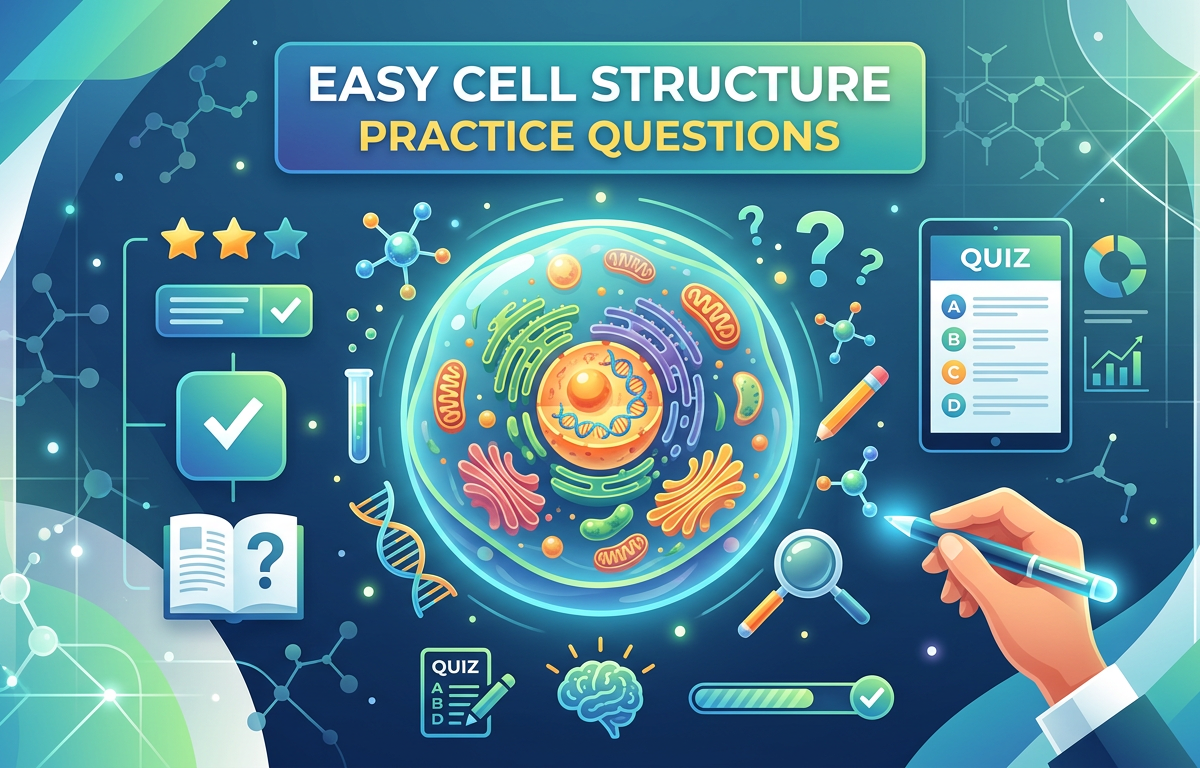
Easy Cell Structure Practice Questions
Understanding the fundamental components of life is key to mastering biology. The cell is the basic building block, and grasping its structure is the first step. This guide provides a clear explanation of cell components, worked examples, and a series of easy cell structure practice questions to test your knowledge. Whether you're studying for an introductory biology course or just curious about how life works, these exercises will help solidify your understanding.
Concept Explanation
Cell structure refers to the arrangement and function of the different components, or organelles, within a cell. All living organisms are made of cells, which can be broadly categorized into two types: prokaryotic and eukaryotic. Eukaryotic cells, found in plants, animals, fungi, and protists, have a membrane-bound nucleus and other specialized organelles. Prokaryotic cells, like bacteria, are simpler and lack a nucleus. The main components of a typical eukaryotic cell include the nucleus, which contains the genetic material; the cytoplasm, a jelly-like substance filling the cell; and the cell membrane, which encloses the cell and controls what enters and exits. Other vital organelles have specific roles, such as mitochondria for energy production and ribosomes for protein synthesis. Plant cells have additional structures not found in animal cells, including a rigid cell wall for support, chloroplasts for photosynthesis, and a large central vacuole for water storage. For a deeper dive into cell theory, you can explore the comprehensive overview on Nature Education's Scitable.
Solved Examples of Cell Structure Questions
The best way to understand cell structure is to apply the concepts. Here are a few solved examples that break down common questions about cell components and their functions.
Example 1: Identifying an Organelle by Function
Question: An organelle is responsible for synthesizing proteins by translating the information encoded in messenger RNA. Which organelle is this?
Solution:
- Analyze the function: The key function described is "synthesizing proteins."
- Recall organelle functions: Think about the roles of major organelles. The nucleus holds DNA, mitochondria produce energy, and chloroplasts perform photosynthesis.
- Identify the correct organelle: Ribosomes are the cellular machinery responsible for protein synthesis. They can be found floating freely in the cytoplasm or attached to the endoplasmic reticulum.
- Final Answer: The organelle is the ribosome.
Example 2: Differentiating Cell Types
Question: A student observes a slide of a cell under a microscope. They note the presence of a cell wall, a cell membrane, and a nucleus, but they do not see any chloroplasts. Is this cell from a plant or an animal? Or could it be something else?
Solution:
- List the observed structures: Cell wall, cell membrane, nucleus.
- List the absent structure: Chloroplasts.
- Evaluate against an animal cell: Animal cells have a cell membrane and a nucleus, but they do NOT have a cell wall. Therefore, it cannot be an animal cell.
- Evaluate against a plant cell: Plant cells have a cell wall, cell membrane, and nucleus. Most photosynthetic plant cells (like in leaves) also have chloroplasts. However, not all plant cells do (e.g., root cells). So it could be a non-photosynthetic plant cell.
- Consider other possibilities: Fungi cells also have a cell wall (made of chitin, not cellulose) and a nucleus, but they do not have chloroplasts.
- Final Answer: The cell is not an animal cell because it has a cell wall. It could be a plant cell from a non-photosynthetic part of the plant (like a root) or a fungal cell.
Example 3: Classifying a Cell as Prokaryotic or Eukaryotic
Question: A microbiologist discovers a new single-celled organism. It has a cell membrane, ribosomes, and a circular loop of DNA floating in the cytoplasm, but it lacks a distinct nucleus. How should this organism be classified?
Solution:
- Identify the key feature: The most critical piece of information is the lack of a distinct nucleus. The genetic material (DNA) is floating in the cytoplasm.
- Define prokaryote and eukaryote: Eukaryotic cells have a true nucleus that encloses their DNA. Prokaryotic cells do not have a nucleus; their DNA is located in a region called the nucleoid.
- Compare the organism to the definitions: Since the organism lacks a nucleus, it fits the definition of a prokaryote. The presence of a cell membrane, ribosomes, and DNA are common to both cell types, but the organization of the DNA is the deciding factor.
- Final Answer: The organism should be classified as a prokaryote.
Practice Questions
Now it's your turn to solve some problems. Use the concepts above to answer these easy cell structure practice questions.
1. What is the primary function of the cell membrane?
2. Which organelle is often called the "powerhouse" of the cell because it generates most of the cell's energy supply (ATP)?
3. A student is told that a cell has a rigid outer layer made of cellulose. What type of cell is it most likely?
4. What is the name of the jelly-like substance that fills the cell and holds the organelles in place?
5. Identify two structures that are found in plant cells but are absent in animal cells.
6. Where is the genetic material (DNA) stored in a eukaryotic cell?
7. What is the main purpose of chloroplasts in a plant cell?
8. If a cell were unable to make proteins, which small organelle would likely be malfunctioning?
9. A large central vacuole is a prominent feature of which cell type, plant or animal?
10. What is the main difference between a prokaryotic cell and a eukaryotic cell? Understanding this difference is as fundamental as solving basic work, energy, and power practice questions in physics.
Answers & Explanations
Here are the detailed answers and explanations for the practice questions on cell structure.
1. What is the primary function of the cell membrane?
Answer: The primary function of the cell membrane is to regulate the passage of substances into and out of the cell. It is selectively permeable, meaning it allows some materials to pass through while blocking others, protecting the cell's internal environment.
2. Which organelle is often called the "powerhouse" of the cell because it generates most of the cell's energy supply (ATP)?
Answer: The mitochondrion (plural: mitochondria). Through a process called cellular respiration, mitochondria convert glucose and oxygen into adenosine triphosphate (ATP), the main energy currency of the cell.
3. A student is told that a cell has a rigid outer layer made of cellulose. What type of cell is it most likely?
Answer: A plant cell. The cell walls of plants are primarily composed of cellulose, a complex carbohydrate that provides structural support.
4. What is the name of the jelly-like substance that fills the cell and holds the organelles in place?
Answer: Cytoplasm. The cytoplasm includes the cytosol (the fluid portion) and all the organelles suspended within it.
5. Identify two structures that are found in plant cells but are absent in animal cells.
Answer: Two structures found in plant cells but not animal cells are the cell wall and chloroplasts. A large central vacuole is also a correct answer.
6. Where is the genetic material (DNA) stored in a eukaryotic cell?
Answer: The genetic material (DNA) in a eukaryotic cell is stored inside the nucleus.
7. What is the main purpose of chloroplasts in a plant cell?
Answer: The main purpose of chloroplasts is to perform photosynthesis. They capture light energy and use it to convert water, carbon dioxide, and minerals into oxygen and energy-rich organic compounds.
8. If a cell were unable to make proteins, which small organelle would likely be malfunctioning?
Answer: The ribosomes. Ribosomes are responsible for protein synthesis, so their malfunction would halt this critical process.
9. A large central vacuole is a prominent feature of which cell type, plant or animal?
Answer: A plant cell. The large central vacuole stores water, nutrients, and waste products, and helps maintain turgor pressure against the cell wall. While some animal cells may have small vacuoles, they lack the large central one seen in mature plant cells. Having a good grasp of this is similar to needing to know the basics in other fields, like using unit conversion practice questions to master measurements.
10. What is the main difference between a prokaryotic cell and a eukaryotic cell?
Answer: The main difference is that a eukaryotic cell has a membrane-bound nucleus that contains its genetic material, while a prokaryotic cell does not. Prokaryotic DNA is located in a region of the cytoplasm called the nucleoid.
1. Test your knowledge with this quick multiple-choice quiz. 1. Which of the following structures acts as the control center of a eukaryotic cell, containing its DNA?
Frequently Asked Questions
What are the three main parts of a eukaryotic cell?
The three main parts of a eukaryotic cell are the cell membrane (the outer boundary), the cytoplasm (the internal, jelly-like substance), and the nucleus (the organelle containing the cell's genetic material). These components work together to maintain the cell's life and function.
What is the main difference between a plant cell and an animal cell?
The main differences are that plant cells have a rigid cell wall outside the cell membrane, contain chloroplasts for photosynthesis, and possess a large central vacuole. Animal cells lack these three structures.
Why is the nucleus called the 'control center' of the cell?
The nucleus is called the control center because it contains the cell's DNA, which holds the genetic instructions for making proteins and directing all cellular activities. By controlling protein synthesis, the nucleus effectively manages the cell's growth, metabolism, and reproduction. For a complete understanding of cell components, view this helpful diagram of a cell on Wikipedia.
What is cytoplasm?
Cytoplasm is the entire content within a cell, enclosed by the cell membrane, excluding the nucleus in eukaryotic cells. It consists of the cytosol (a gel-like fluid) and the organelles suspended within it.
Are all cells the same size and shape?
No, cells vary greatly in size and shape depending on their function. For example, a nerve cell (neuron) is long and thin to transmit signals over distances, while a red blood cell is a small, biconcave disc to travel through tiny capillaries. This diversity in form allows for specialized functions within an organism, much like how solving different types of mean, median, and mode practice questions hones different statistical skills.
What distinguishes a prokaryote from a eukaryote?
The defining distinction is the presence of a nucleus. Eukaryotic cells have a membrane-enclosed nucleus and other membrane-bound organelles, making them more complex. Prokaryotic cells are simpler, lacking a nucleus and other membrane-bound organelles.
Enjoyed this article?
Share it with others who might find it helpful.
Related Articles
Hard Cell Structure Practice Questions Practice Questions
Challenge your understanding of cell biology with these hard cell structure practice questions, complete with solved examples, detailed answers, and a quick quiz.
Apr 25, 2026
Medium Cell Structure Practice Questions Practice Questions
Master cell biology with these medium cell structure practice questions. Get detailed explanations and solved examples to boost your understanding.
Apr 25, 2026
Cell Structure Practice Questions Practice Questions with Answers
Cell Structure Practice Questions Practice Questions with Answers
Apr 25, 2026
Hard Microbiology Practice Questions Practice Questions
Hard Microbiology Practice Questions Practice Questions
Apr 26, 2026
Medium Microbiology Practice Questions Practice Questions
Master microbiology with our medium-level practice questions covering bacterial growth, genetics, and metabolism. Includes solved examples and a quick quiz.
Apr 26, 2026
Easy Microbiology Practice Questions Practice Questions
Easy Microbiology Practice Questions Practice Questions
Apr 26, 2026

Hard Enzyme Questions Practice Questions
Master complex biochemistry with these hard enzyme questions. Cover Michaelis-Menten kinetics, inhibition types, and Lineweaver-Burk plots with solved examples.
Apr 26, 2026
Medium Enzyme Questions Practice Questions
Master enzyme kinetics and regulation with our Medium Enzyme Questions Practice Questions. Includes solved examples, detailed explanations, and a quick quiz.
Apr 26, 2026