Easy Cell Membrane Questions Practice Questions
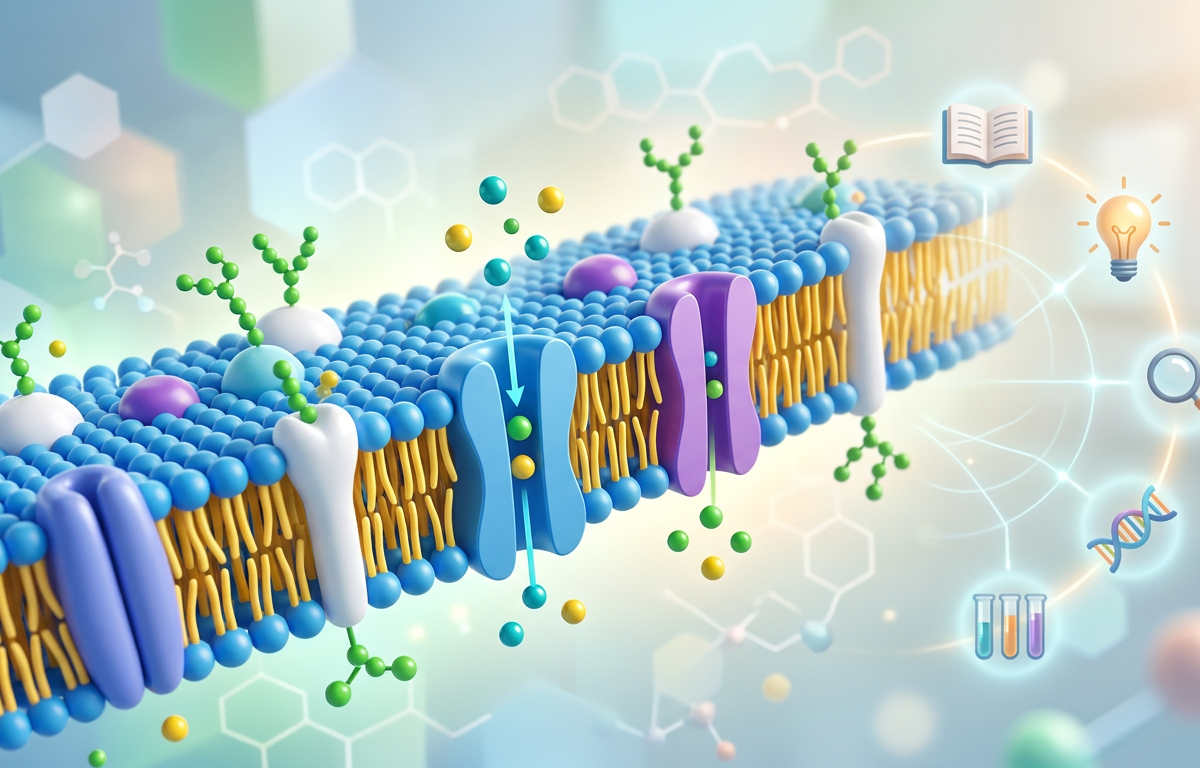
Easy Cell Membrane Questions Practice Questions
The cell membrane is a fundamental component of all living cells, acting as the gatekeeper that controls what enters and exits. Understanding its structure and function is crucial for mastering biology. This guide provides clear explanations, solved examples, and a series of easy cell membrane questions to test your knowledge and build your confidence. Whether you're just starting out or need a quick refresher, these practice problems will help solidify your understanding of this vital cellular structure.
Concept Explanation
The cell membrane, also known as the plasma membrane, is the semipermeable barrier that surrounds the cytoplasm of a cell. Its primary role is to protect the cell from its surroundings and regulate the movement of substances in and out. The structure of the membrane is described by the fluid mosaic model. This model explains that the membrane is not a static structure but a dynamic and flexible one, composed of various components that can move relative to one another. The main components are phospholipids, proteins, cholesterol, and carbohydrates.
- Phospholipid Bilayer: This forms the basic fabric of the membrane. Each phospholipid molecule has a hydrophilic (water-loving) head and two hydrophobic (water-fearing) tails. They arrange themselves in a double layer, with the tails facing inward, away from the water, and the heads facing outward. This structure is essential for the membrane's barrier function. For a deeper dive into this model, see Nature Education's article on the Fluid Mosaic Model.
- Proteins: Embedded within or attached to the phospholipid bilayer are various proteins. Integral proteins span the entire membrane and often act as channels or transporters for specific molecules. Peripheral proteins are attached to the inner or outer surface and can act as enzymes or structural attachments.
- Cholesterol: Found wedged between phospholipid molecules, cholesterol helps regulate the membrane's fluidity. It prevents the membrane from becoming too rigid in the cold or too fluid in the heat.
- Carbohydrates: These are attached to proteins (forming glycoproteins) or lipids (forming glycolipids) on the outer surface of the membrane. They play a crucial role in cell-to-cell recognition, communication, and adhesion.
The membrane's ability to allow some substances to pass through while blocking others is called selective permeability. Small, nonpolar molecules like oxygen and carbon dioxide can pass through freely, while larger or charged molecules require the help of transport proteins. This selective nature is fundamental to maintaining cellular homeostasis.
Solved Examples of Cell Membrane Questions
These solved examples break down common cell membrane questions, illustrating how to apply the core concepts to find the solution. Each step is explained to help you understand the reasoning behind the answer.
Example 1: Identifying Components
Question: A molecule in the cell membrane is described as having a phosphate head and two fatty acid tails. What is this molecule, and how does it orient itself in the membrane?
Solution:
- Identify the molecule: The description of a phosphate head and fatty acid tails perfectly matches a phospholipid. The head is hydrophilic, and the tails are hydrophobic.
- Describe its orientation: Phospholipids form a bilayer. The hydrophilic heads face the watery environments inside and outside the cell. The hydrophobic tails face inward, away from the water, creating a nonpolar barrier in the center of the membrane.
- Final Answer: The molecule is a phospholipid. It orients itself in a bilayer with its hydrophilic heads facing outwards and its hydrophobic tails facing inwards.
Example 2: The Fluid Mosaic Model
Question: Why is the cell membrane's structure referred to as a "fluid mosaic"?
Solution:
- Break down the term "fluid": The "fluid" part refers to the fact that the individual components of the membrane, such as phospholipids and proteins, are not fixed in place. They can move laterally, similar to how items might float in a liquid. This flexibility is crucial for membrane function.
- Break down the term "mosaic": The "mosaic" part refers to the membrane being composed of many different types of molecules (phospholipids, proteins, cholesterol, carbohydrates) fitted together, much like the tiles in a mosaic art piece.
- Combine the concepts: The model is called the fluid mosaic model because it describes the cell membrane as a patchwork of various components that are constantly in motion.
Example 3: Function of Cholesterol
Question: What is the primary role of cholesterol within the cell membrane?
Solution:
- Recall cholesterol's location: Cholesterol molecules are interspersed among the hydrophobic tails of the phospholipid bilayer.
- Explain its function as a buffer: Cholesterol acts as a fluidity buffer. At warm temperatures, it restrains the movement of phospholipids, preventing the membrane from becoming too fluid. At cool temperatures, it maintains fluidity by preventing tight packing of the phospholipids, thus stopping the membrane from becoming too rigid or freezing.
- Final Answer: Cholesterol's primary role is to regulate and maintain the fluidity of the cell membrane across a range of temperatures.
Practice Questions
Now it's your turn to solve some cell membrane questions. Use the concepts and examples above to guide you. You'll find the answers and detailed explanations in the next section.
- What are the two main chemical components of the cell membrane's bilayer?
- Which part of a phospholipid is hydrophobic?
- What is the primary function of proteins embedded in the cell membrane?
- Define "selective permeability" in the context of the cell membrane.
- Why can a small molecule like oxygen (O₂) pass directly through the lipid bilayer, while a charged ion like sodium (Na⁺) cannot?
- What is the name for a protein with a carbohydrate chain attached to it, and what is one of its functions?
- How does the cell membrane contribute to maintaining homeostasis?
- Describe the difference between an integral protein and a peripheral protein.
- If a cell membrane had no cholesterol, how would it be affected by a significant drop in temperature?
Answers & Explanations
Here are the detailed answers to the practice questions. Check your work and review the explanations to reinforce your understanding of cell membrane concepts.
- Answer: The two main chemical components are lipids (specifically, phospholipids) and proteins.
- Answer: The fatty acid tails of a phospholipid are hydrophobic (water-fearing). This is why they face inward, away from the aqueous environment inside and outside the cell.
- Answer: The primary function of proteins in the cell membrane is transport. They act as channels or carriers to help move substances, especially those that cannot pass through the lipid bilayer, across the membrane. Other functions include enzymatic activity, signal transduction, and cell-cell recognition.
- Answer: "Selective permeability" means that the membrane allows certain molecules or ions to pass through it by means of active or passive transport, while preventing others from passing. This selectivity is crucial for the cell's survival. You can learn more about membrane properties on the Wikipedia page for Cell Membrane.
- Answer: Oxygen (O₂) is a small, nonpolar molecule. It can easily dissolve in the nonpolar lipid bilayer and pass through. A sodium ion (Na⁺), however, is charged. The nonpolar, hydrophobic interior of the membrane repels charged particles, preventing them from crossing without the help of a specific protein channel or pump. This concept is similar to how different variables are treated in statistical analysis, which you can explore with our easy probability practice questions.
- Answer: A protein with a carbohydrate chain attached is called a glycoprotein. One of its primary functions is cell-cell recognition, which is how cells identify each other as belonging to the same organism (or as foreign invaders).
- Answer: The cell membrane contributes to homeostasis by controlling what enters and leaves the cell. By being selectively permeable, it ensures that essential nutrients can enter, waste products can be removed, and the internal environment (like ion concentration and pH) remains stable and within a narrow, optimal range. Maintaining this balance is a core part of biology, just as understanding basic calculations is for science, which you can practice with unit conversion practice questions.
- Answer: An integral protein is permanently embedded within the membrane and often spans its entire width (transmembrane protein). A peripheral protein is not embedded in the lipid bilayer but is attached more loosely to the surface of the membrane, often to an integral protein.
- Answer: Without cholesterol, a significant drop in temperature would cause the phospholipid molecules to pack together very tightly. This would make the membrane rigid and brittle, potentially causing it to break. Cholesterol normally prevents this by fitting between the phospholipids and keeping them from packing too closely.
1. Test your knowledge with this quick multiple-choice quiz on the cell membrane. 1. Which component of the cell membrane is responsible for its fluidity and flexibility?
Frequently Asked Questions
Here are answers to some frequently asked cell membrane questions.
What is the fluid mosaic model?
The fluid mosaic model describes the cell membrane as a dynamic structure composed of a mosaic of components—phospholipids, cholesterol, proteins, and carbohydrates—that are able to flow and change position while maintaining the basic integrity of the membrane. For a detailed overview, see Khan Academy's guide to the plasma membrane.
Why is the cell membrane called selectively permeable?
It is called selectively permeable because it allows only certain molecules and ions to pass through it. This selectivity is due to the nonpolar lipid bilayer, which blocks polar or charged substances, and the presence of specific transport proteins that facilitate the passage of necessary molecules.
What happens if the cell membrane breaks?
If the cell membrane ruptures, the boundary between the cell's internal environment and the outside is lost. This leads to the leakage of cytoplasm and organelles, a loss of the cell's internal balance (homeostasis), and ultimately, cell death.
Are all cell membranes the same?
While all cell membranes share the basic phospholipid bilayer structure, they are not all the same. The types and amounts of proteins, carbohydrates, and lipids (like cholesterol) can vary significantly between different types of cells and even within different regions of a single cell, reflecting their specialized functions.
What is the difference between active and passive transport?
Passive transport (like simple diffusion) does not require the cell to expend energy because molecules move down their concentration gradient (from high to low concentration). Active transport requires energy, usually in the form of ATP, to move molecules against their concentration gradient (from low to high concentration).
How does cholesterol affect membrane fluidity?
Cholesterol acts as a bidirectional regulator of membrane fluidity. At high temperatures, it decreases fluidity by restricting phospholipid movement. At low temperatures, it increases fluidity by preventing the phospholipids from packing too tightly together.
Enjoyed this article?
Share it with others who might find it helpful.
Related Articles
Medium Cell Membrane Questions Practice Questions
Medium Cell Membrane Questions Practice Questions
Apr 25, 2026
Hard Cell Membrane Questions Practice Questions
Master advanced cell biology with our hard cell membrane practice questions. Test your knowledge on electrochemical gradients, transport mechanisms, and more.
Apr 25, 2026
Cell Membrane Questions Practice Questions with Answers
Master Cell Membrane Questions with our comprehensive guide featuring solved examples, practice problems, and detailed explanations of the fluid mosaic model.
Apr 25, 2026
Hard Microbiology Practice Questions Practice Questions
Hard Microbiology Practice Questions Practice Questions
Apr 26, 2026

Medium Microbiology Practice Questions Practice Questions
Master microbiology with our medium-level practice questions covering bacterial growth, genetics, and metabolism. Includes solved examples and a quick quiz.
Apr 26, 2026

Easy Microbiology Practice Questions Practice Questions
Easy Microbiology Practice Questions Practice Questions
Apr 26, 2026

Hard Enzyme Questions Practice Questions
Master complex biochemistry with these hard enzyme questions. Cover Michaelis-Menten kinetics, inhibition types, and Lineweaver-Burk plots with solved examples.
Apr 26, 2026

Medium Enzyme Questions Practice Questions
Master enzyme kinetics and regulation with our Medium Enzyme Questions Practice Questions. Includes solved examples, detailed explanations, and a quick quiz.
Apr 26, 2026