Stop Falling for SAT Math Traps: 25 Errors That Cost Points
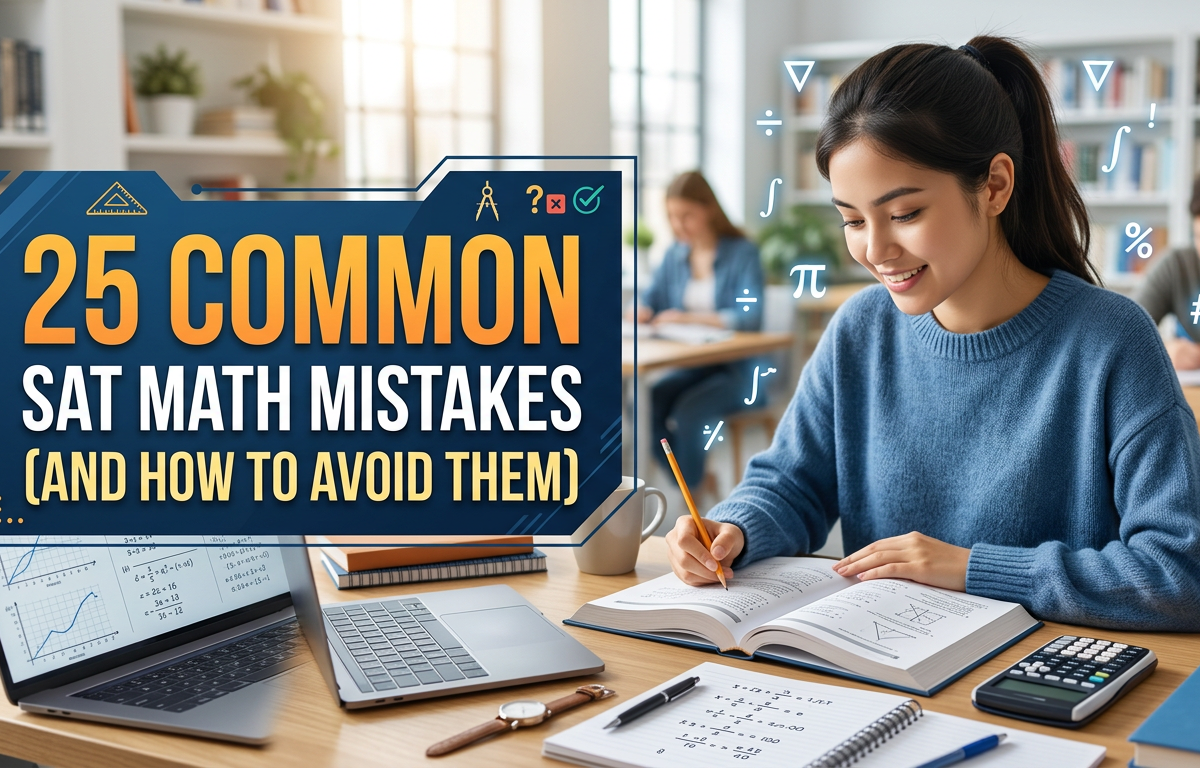
You have just spent ninety seconds navigating a complex system of linear equations. You arrive at x = 4, see 4 as option A, and bubble it in with a sense of relief. However, the final line of the prompt actually asked for the value of x + 5. This single moment of premature completion is why high-achieving students often stall at a 650 math score despite knowing the material. The College Board does not just test your ability to solve for a variable; it tests your ability to maintain focus until the very last character of the question.
Beyond these mechanical slips, points are frequently lost in the transition from one unit to another. A problem may provide a rate in gallons per minute but require a final answer in liters per hour. Without writing out a physical unit conversion chain, your brain will likely default to a simple multiplication that ignores the metric shift. By identifying these specific cognitive triggers, such as the failure to flip an inequality sign when dividing by a negative, you can move from reactive calculating to proactive score protection.
The Psychology of SAT Math Errors: Why Smart Students Lose Points
Most Common SAT Math Mistakes do not stem from a lack of intelligence; they result from the psychological design of the test itself. The College Board constructs problems specifically to exploit the way the human brain shortcuts complex processing. You might understand the underlying calculus but fail a basic arithmetic step because your brain is already racing toward the next objective.
Psychologically, we categorize these errors into two buckets: knowledge gaps and procedural slips. A knowledge gap means you simply haven't learned how to calculate the volume of a cylinder. A procedural error, however, occurs when you know the formula but accidentally use the diameter instead of the radius. Research from the National Center for Education Statistics suggests that standardized test performance often fluctuates based on procedural fluency rather than raw conceptual capacity.
The SAT also employs "distractor" answers that act as mirrors for these cognitive slips. If a problem requires you to find the value of 2x + 1, the first answer choice will almost certainly be the value of x. Because you feel the relief of solving for a variable, your brain signals "mission accomplished," leading you to bubble in the wrong choice before finishing the prompt. This "answer fatigue" is a primary reason why even high achievers fall into traps.
Algebraic Pitfalls: Mastering the Heart of Algebra
Algebraic errors are the most frequent Common SAT Math Mistakes simply because algebra comprises nearly 40% of the entire exam. Students often rush through linear equations, assuming they are "easy," only to lose points on technicalities. For instance, the "Sign Error" remains the undisputed king of mechanical mistakes, where a single forgotten negative sign cascades through an entire system of equations.
Solving for the wrong variable is a classic SAT "gotcha" moment. If the question asks for the value of y-5, and you successfully solve the equation for y = 10, you must resist the urge to select 10. Always underline precisely what the question is asking for before your pencil hits the paper. If you find yourself struggling with the foundations of these problems, exploring Medium SAT Integers Practice Questions can help solidify your mental math speed.
Another dangerous area involves inequality sign reversals. Whenever you multiply or divide an inequality by a negative number, the sign must flip. It sounds simple, yet under the ticking clock of the testing center, this rule often evaporates. Similarly, failing to distribute negative signs across parentheses—treating -(x - 4) as -x - 4 instead of -x + 4—is a guaranteed way to land on a distractor answer. If you're looking to push your skills, try these Hard SAT Number Properties Practice Questions to test your resilience against complex algebraic traps.
Data Analysis and Problem Solving: Avoiding Statistical Slips
Data analysis mistakes usually involve misreading the scale of a graph or failing to convert units. The SAT frequently presents data in one unit—say, minutes—and asks for a final answer in another, like hours. If you don't use dimensional analysis, you are essentially guessing. Always write out your units as fractions to ensure they cancel out correctly.
In the realm of statistics, students frequently confuse the mean, median, and mode when looking at frequency tables. The mean is the average, the median is the middle value, and the mode is the most frequent. On a frequency table, the median is not the middle row; it is the value associated with the middle data point in the total count. For a refresher on these distinctions, check out our guide on Easy SAT Mean Median Mode Practice Questions.
Conditional probability is another high-stakes area. The SAT might ask for the probability that a student "who takes Spanish" also takes Art. In this case, your denominator is only the Spanish-speaking students, not the entire student body. Overlooking the "Not" or "Except" in these data prompts accounts for a massive chunk of Common SAT Math Mistakes. You must read the constraints of the data set twice before calculating anything.
Passport to Advanced Math: High-Level Concepts to Watch Out For
The "Passport to Advanced Math" section focuses on nonlinear expressions, and the most notorious error here is "The Freshman's Dream." This is the mistaken belief that (x + y)² = x² + y². In reality, you must FOIL (First, Outer, Inner, Last), resulting in x² + 2xy + y². Forget that middle term, and you've lost the point.
Function notation also trips up students who treat f(x) like f times x. If the test gives you f(x) = x² + 2 and asks for f(x + 1), you must substitute the entire (x + 1) into every instance of x. This often leads to complex radical expressions. Practicing with Hard SAT Radicals Practice Questions can help you get comfortable with these multi-step substitutions.
Distinguishing between exponential and linear growth is equally vital. Linear growth adds a constant amount over time, while exponential growth multiplies by a constant rate. Many students see a percentage increase and mistakenly apply a linear formula. According to the College Board, understanding the behavior of these functions is critical for the "Passport to Advanced Math" domain. If you want to master these exponents, transition to Easy SAT Exponents Practice Questions to build a base and then move to harder drills.
Master the Digital SAT with Bevinzey
Stop losing points to "silly" errors. Our platform uses AI-driven practice to identify your specific trap patterns and helps you build the stamina needed for a perfect 800.
Get Started FreeGeometry and Trigonometry: Tricky Shapes and Ratios
The most dangerous words on the SAT are "Note: Figure not drawn to scale." Students often try to "eyeball" the measure of an angle or the length of a segment. If you assume an angle is 90 degrees just because it looks like a right angle, you are falling for one of the most classic Common SAT Math Mistakes. Always rely on the provided numbers and theorems, never your visual intuition.
Circle theorems are another frequent pain point. Students often confuse area (πr²) with circumference (2πr) or forget that arc length is simply a fraction of the circumference. If you struggle with these shapes, reviewing Hard SAT Circle Practice Questions will expose you to the toughest ways the College Board tests these properties. Additionally, make sure your calculator is in the correct mode—degrees or radians—depending on what the question specifies.
In trigonometry, the SOHCAHTOA mnemonic is your best friend, but only if you use it correctly. A common slip-up is swapping the opposite and adjacent sides because of the way a triangle is rotated. Always identify the hypotenuse first (the side across from the 90-degree angle) to prevent confusion. For more practice on spatial reasoning, explore Medium SAT Geometry Practice Questions to refine your approach.
Calculator Mismanagement: When Technology Becomes a Liability
Your calculator is a tool, not a crutch. One of the most pervasive Common SAT Math Mistakes is using the calculator for operations that are faster by hand. If you have to calculate 15 × 2 on your keypad, you are wasting valuable seconds that could be used on a complex word problem. Mental math keeps your brain engaged and helps you spot obvious errors that a calculator might hide.
When you do use your calculator, parentheses are non-negotiable. If you type -3² into many calculators, you will get -9 because the calculator squares 3 and then applies the negative. To square -3, you must type (-3)² to get the correct answer of 9. This single keystroke error accounts for countless lost points in the quadratic sections.
Furthermore, the Digital SAT now features an embedded Desmos calculator. This tool is incredibly powerful for graphing, but relying on it too early can lead to rounding errors. Always carry your calculations to the very end of the problem before rounding to the nearest hundredth or thousandth as requested. Familiarize yourself with official Desmos SAT practices to ensure you aren't fumbling with the interface during the actual exam.
Strategic Mistakes: Test-Taking Habits That Kill Your Score
Strategy is just as important as math knowledge. A "Strategic Mistake" often looks like the "Sunk Cost Fallacy": spending four minutes on a single difficult question because you’ve already spent two minutes on it. If a question isn't clicking after 60 seconds, circle it and move on. Every question is worth the same amount of points, whether it’s a basic addition problem or a complex trigonometry proof.
The "Second Pass" strategy is the hallmark of high scorers. Use your first pass to knock out every question you find easy or medium, and save the "Level 4" monsters for the end. This ensures that you don't run out of time and leave "easy" points on the table. Studies from Harvard Business Review on cognitive performance indicate that tackling low-friction tasks first can build the "success momentum" needed for harder challenges.
Finally, never change an answer at the last second unless you have found a concrete, provable error in your original work. Research shows that your first instinct is statistically more likely to be correct. "Second-guessing" is often just test anxiety in disguise. Trust your preparation and your scratch work.
Conclusion: Building an Error-Proof SAT Math Routine
To eliminate Common SAT Math Mistakes, you must treat your practice tests like a diagnostic lab. Don't just look at your score; look at why you missed the questions you did. Was it a lack of knowledge, or did you simply solve for x when they asked for y? Keeping an "Error Log" is the most effective way to identify your personal patterns.
The "Read Twice, Solve Once" rule should be your mantra. Read the prompt, identify the goal, solve the problem, and then read the prompt one more time before bubbling in the answer. This final check takes three seconds but can save you 10-20 points per section. Combine this habit with focused drills like Hard SAT Statistics Practice Questions to ensure no topic remains a mystery.
Simulating true testing conditions is your final hurdle. Practice in a quiet room, use the actual timing constraints, and avoid all distractions. This builds the mental stamina required to maintain accuracy through the very last question of the module. With a disciplined routine and a sharp eye for traps, those "silly mistakes" will soon become a thing of the past.
Ready to Stop Making Silly Mistakes?
Join thousands of students using Bevinzey to identify their weak spots and master SAT Math formulas with ease. Start your journey to a top-tier score today.
Get Started FreeFrequently Asked Questions
How do I stop making 'silly' mistakes on the SAT math section?
Create an error log to track every mistake you make during practice. By categorizing errors (e.g., "misread question" or "calculation slip"), you become hyper-aware of your specific patterns and can actively look for them during the real test.
What is the most common mistake on SAT Math?
The most common mistake is solving for the wrong value, such as finding x when the question asks for x + 5. The SAT almost always includes the intermediate step's result as a distractor answer choice.
Is it better to guess or leave a question blank on the SAT?
Always guess. The SAT no longer has a guessing penalty, so leaving a question blank is a guaranteed zero, while a guess gives you a 25% chance (on multiple choice) of getting the points.
How can I improve my speed without losing accuracy?
Focus on "procedural fluency" by practicing basic algebra until it becomes second nature. When you don't have to think about how to solve a simple equation, you free up cognitive bandwidth to focus on the nuances of the question prompt.
Do I need to memorize all the math formulas for the SAT?
While the SAT provides a basic formula sheet, you should memorize common ones like the quadratic formula and circle properties. Relying on the sheet wastes time and disrupts your flow during the exam.
How often should I use my calculator during the test?
Use your calculator for complex arithmetic or graphing functions, but avoid it for simple mental math. A good rule of thumb is to only touch the calculator when the calculation has more than two steps or involves large decimals.
Enjoyed this article?
Share it with others who might find it helpful.
Related Articles
Why Students Get SAT Math Questions Wrong: 7 Critical Errors
Discover why students miss SAT Math points and learn how to fix common errors, from trap answers to conceptual gaps, to boost your score effectively.
Apr 27, 2026
How to Improve SAT Math Score: The Ultimate Expert Strategy Guide
Stuck on SAT Math? Learn the proven strategies to boost your score, master the Digital SAT interface, and eliminate careless errors with our expert guide.
Apr 27, 2026
Stop Missing Easy SAT Percent Points: The 100-Base Shortcut
Easy SAT Percent Practice Questions
Apr 27, 2026
SAT Decimals: Avoiding Precision Traps and Grid-in Errors
SAT Decimals Practice Questions with Answers
Apr 27, 2026
Solving SAT Linear Systems Without Falling for Common Traps
Easy SAT Systems of Equations Practice Questions
Apr 26, 2026
SAT Math Practice Questions Set 3
SAT Math Practice Questions Set 3
Apr 26, 2026
SAT Math Practice Questions Set 1
SAT Math Practice Questions Set 1
Apr 26, 2026
SAT Math Practice Questions Set 2
SAT Math Practice Questions Set 2
Apr 26, 2026