Medium SAT Integers Practice Questions
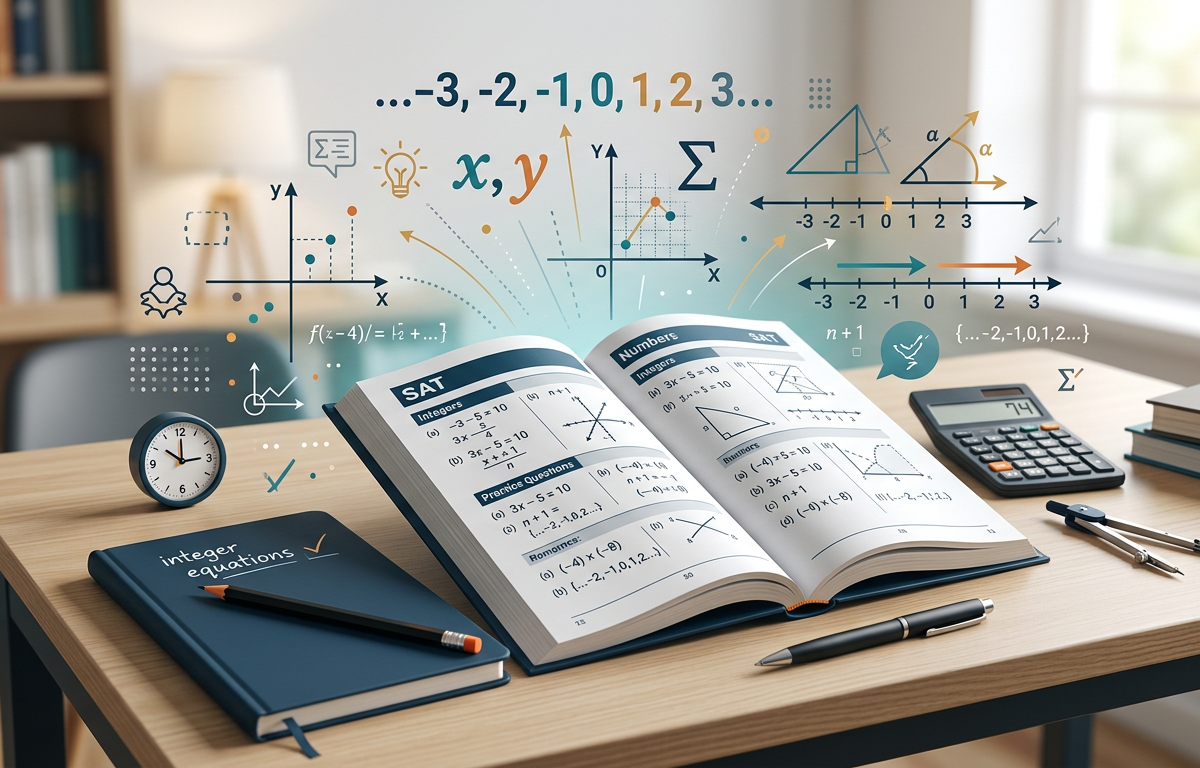
Medium SAT Integers Practice Questions
Mastering integers is a fundamental step toward achieving a high score on the SAT Math section, as these concepts appear across algebra, data analysis, and problem-solving modules. This guide provides Medium SAT Integers Practice Questions designed to bridge the gap between basic arithmetic and complex reasoning. By practicing with these targeted problems, you will sharpen your ability to handle properties of numbers, divisibility, and consecutive integers under timed conditions.
Concept Explanation
Integers are the set of all whole numbers, including positive numbers, negative numbers, and zero, but excluding any fractional or decimal components. On the SAT, integer problems typically test your understanding of number properties such as parity (even vs. odd), divisibility, prime factorization, and the behavior of consecutive integers. According to Wikipedia, the set of integers is denoted by the symbol Z. Understanding how these numbers interact is crucial for solving Medium SAT Algebra Word Practice Questions and other quantitative comparisons.
Key Properties to Remember:
- Even and Odd Rules: Adding two evens or two odds results in an even; adding an even and an odd results in an odd. Multiplying by an even always results in an even.
- Consecutive Integers: These are integers that follow each other in order, such as . For consecutive even or odd integers, the pattern is .
- Divisibility: An integer is divisible by if the result of is itself an integer with no remainder.
- Prime Numbers: Integers greater than 1 that have only two factors: 1 and themselves. Note that 2 is the only even prime number.
Solved Examples
Reviewing worked solutions helps clarify how to apply integer properties to SAT Math practice questions. Here are three examples with detailed steps.
- Example 1: If and are positive integers such that , what is the sum of all possible values of ?
- Isolate one variable to test values: .
- Since and must be positive integers, must be a multiple of 3 and greater than 0.
- Test : .
- Test : .
- Test : . Since must be positive, this is not a solution.
- The possible values of are 4 and 2. Sum: .
- Example 2: The sum of five consecutive integers is 135. What is the value of the largest integer?
- Set up the equation using as the middle integer: .
- Simplify: .
- Divide by 5: .
- The largest integer is , so .
- Example 3: If is an odd integer, which of the following must be an even integer: , , or ?
- Test (the simplest odd integer).
- (Odd).
- (Odd).
- (Even).
- The expression must be even because an odd times an odd is odd, and an odd plus 1 is even.
Practice Questions
Test your knowledge with these Medium SAT Integers Practice Questions. These problems reflect the difficulty level of the middle-to-late questions in an SAT Math module.
- If is an even integer and is an odd integer, which of the following must be an odd integer?
- The product of two positive integers is 48. If the sum of these two integers is 16, what is the positive difference between the two integers?
- How many prime numbers are there between 10 and 30?
- If is an integer and , how many possible values are there for ?
- If the sum of three consecutive even integers is 72, what is the smallest of these integers?
- If is a prime number and , which of the following must be even?
- A set of four consecutive integers has a sum of 10. What is the product of these four integers?
- If and are integers such that , how many possible pairs of exist?
- The integer is a multiple of 4 and the integer is a multiple of 6. Which of the following must be a multiple of 12?
- If and are consecutive odd integers such that , and , what is the value of ?
Answers & Explanations
- Answer: C. Let and .
A) (Even).
B) (Even).
C) (Odd).
D) (Even). The rule is that is always even, and . - Answer: 8. We need two numbers where and . The factors of 48 are (1, 48), (2, 24), (3, 16), (4, 12), (6, 8). The pair (4, 12) sums to 16. The difference is .
- Answer: 6. Prime numbers between 10 and 30 are: 11, 13, 17, 19, 23, and 29. Total count: 6.
- Answer: 8. Multiply the inequality by 3: . The integers between 6 and 15 are 7, 8, 9, 10, 11, 12, 13, and 14. There are 8 such values.
- Answer: 22. Let the integers be . The smallest integer is 22.
- Answer: C. Since all prime numbers greater than 2 are odd, is odd. . Therefore, must be even.
- Answer: 120. Let the integers be . The integers are 1, 2, 3, 4. Product: . (Wait, let's recheck). If sum is 10: . Product is 24.
- Answer: 10. Possible values for and from {1, 2, 3, 4, 5}: - If , can be 2, 3, 4, 5 (4 pairs). - If , can be 3, 4, 5 (3 pairs). - If , can be 4, 5 (2 pairs). - If , can be 5 (1 pair). Total: .
- Answer: B. and . Their product . Since 24 is a multiple of 12, must be a multiple of 12. Addition or subtraction doesn't guarantee this (e.g., , not a multiple of 12).
- Answer: 19. Let the middle odd integer be . Then . The sequence is 15, 17, 19. The largest value is 19.
1. If \( n \) is an even integer, which of the following must be odd?
Frequently Asked Questions
Is zero considered an integer on the SAT?
Yes, zero is an integer. It is specifically categorized as an even integer, but it is neither positive nor negative, which is a distinction often tested on the SAT.
How do I identify a prime number quickly?
A prime number has exactly two factors: 1 and itself. On the SAT, it is helpful to memorize primes up to 30: 2, 3, 5, 7, 11, 13, 17, 19, 23, and 29.
What is the difference between an integer and a real number?
Integers are whole numbers without fractional parts, whereas real numbers include integers, fractions, and decimals like or . You can learn more about number sets at Khan Academy.
Are negative numbers even or odd?
Negative integers follow the same parity rules as positive integers. For example, -2, -4, and -6 are even, while -1, -3, and -5 are odd.
How do I solve problems with "consecutive" integers?
Represent the integers algebraically, usually as for consecutive integers or for consecutive even or odd integers. This setup allows you to solve for using a simple linear equation, similar to techniques used in Medium SAT Linear Equations Practice Questions.
Enjoyed this article?
Share it with others who might find it helpful.
Related Articles

Easy SAT Integers Practice Questions
Easy SAT Integers Practice Questions
Apr 27, 2026

SAT Integers Practice Questions with Answers
SAT Integers Practice Questions with Answers
Apr 27, 2026
Solving High-Level SAT Integer Logic and Number Theory Problems
Hard SAT Integers Practice Questions
Apr 27, 2026

Hard SAT Number Properties Practice Questions
Hard SAT Number Properties Practice Questions
Apr 27, 2026
Defeating Extraneous Solutions and Rational Exponents on the SAT
Hard SAT Radicals Practice Questions
Apr 27, 2026
Hard SAT Exponents Practice Questions
Hard SAT Exponents Practice Questions
Apr 27, 2026

Hard SAT Percent Practice Questions
Hard SAT Percent Practice Questions
Apr 27, 2026

Hard SAT Decimals Practice Questions
Hard SAT Decimals Practice Questions
Apr 27, 2026