NCLEX Hygiene: Prioritizing Safety in Basic Care Scenarios
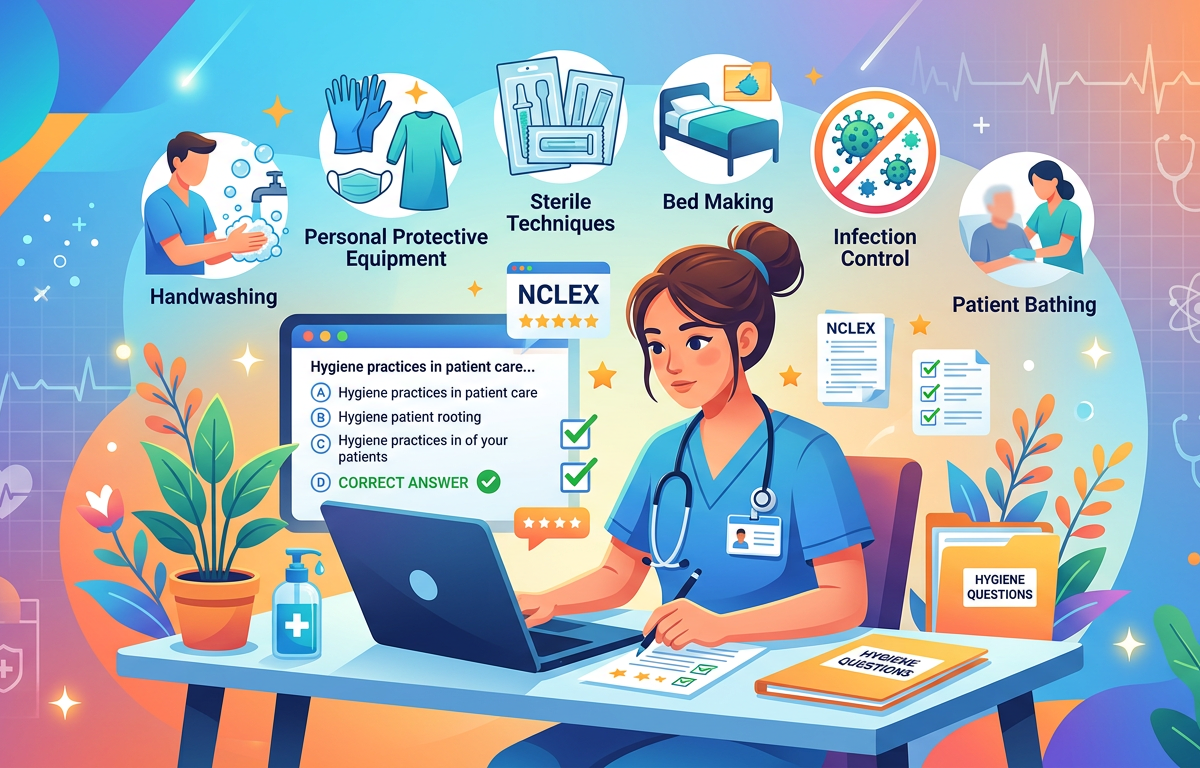
A nurse enters the room of an unconscious patient to perform oral care and immediately reaches for the suction. The critical decision here is not just the equipment used, but the lateral positioning required to prevent a silent aspiration event. Many students lose points on the NCLEX by focusing on the cleanliness of the procedure rather than the physiological safety of the airway. Hygiene questions often disguise high-stakes respiratory and integumentary risks as simple comfort measures, forcing you to prioritize clinical safety over routine aesthetics.
When tackling these scenarios, you must apply the cleanest-to-dirty principle with surgical precision. For example, failing to change washcloth sections during female perineal care is a direct path to a healthcare-associated UTI. Similarly, managing a patient with a fractured limb requires a specific sequence: undress the unaffected side first, but dress the affected side first. This guide breaks down these specific mechanical sequences and the rationale behind non-blanchable erythema assessments to ensure you do not fall for common distractor options involving soaking diabetic feet or massaging bony prominences.
NCLEX Hygiene Practice Questions with Answers
Mastering NCLEX hygiene principles is essential for nursing students because basic care and comfort represent a significant portion of the NCLEX-RN and NCLEX-PN exams. Proper hygiene prevents healthcare-associated infections (HAIs), maintains skin integrity, and promotes patient dignity. This guide provides a deep dive into the clinical standards for personal care, infection control, and patient safety, ensuring you are prepared for the NCLEX hygiene practice questions you will encounter on test day.
Clinical Protocols for Patient Comfort
Hygiene in nursing refers to the set of practices and clinical interventions used to maintain health and prevent the spread of disease through cleanliness. It encompasses skin care, oral care, perineal care, and the maintenance of a safe environment. Effective hygiene is not merely about aesthetics; it is a primary defense mechanism. For instance, maintaining the acid mantle of the skin prevents bacterial colonization and pressure injury development.
Key areas of focus for the NCLEX include:
- Infection Control: Adhering to standard and transmission-based precautions.
- Skin Integrity: Identifying patients at high risk for breakdown using tools like the Braden Scale.
- Safety: Maintaining the correct bed height, using side rails appropriately, and ensuring the call light is within reach during and after hygiene care.
- Special Populations: Adapting hygiene for unconscious patients, those with diabetes (foot care), or patients with indwelling catheters.
When studying these concepts, many students find that using a smart flashcard generator helps memorize specific protocols like the order of a bed bath (cleanest to dirtiest) or the frequency of oral care for ventilated patients. Understanding these fundamentals is just as critical as mastering NCLEX dosage calculation practice questions for overall exam success.
Solved Examples
These examples demonstrate the critical thinking required to answer hygiene-related questions correctly.
- Scenario: A nurse is performing a bed bath for a patient with a fractured right arm. How should the nurse proceed with removing the patient's gown?
Solution:- Assess the patient's mobility and pain level.
- Remove the gown from the unaffected (left) side first.
- Carefully slide the gown off the affected (right) side.
- Rationale: Removing the gown from the unaffected side first allows for easier manipulation of the clothing around the injured limb, minimizing pain and further injury.
- Scenario: A nurse is providing oral hygiene to an unconscious patient. What is the priority action?
Solution:- Position the patient in a side-lying (lateral) position with the head of the bed slightly elevated.
- Place a towel under the chin and an emesis basin near the mouth.
- Use a small amount of liquid or a suction toothbrush to prevent aspiration.
- Rationale: The primary risk for an unconscious patient during oral care is aspiration; lateral positioning allows fluids to drain out of the mouth by gravity.
- Scenario: A nurse is performing perineal care for a female patient. What is the correct technique?
Solution:- Explain the procedure and provide privacy.
- Wash from the pubic area toward the anus (front to back).
- Use a fresh section of the washcloth for each stroke.
- Rationale: Cleaning from front to back prevents the transfer of fecal bacteria into the urinary meatus, reducing the risk of urinary tract infections (UTIs).
Practice Questions
- A nurse is preparing to provide foot care for a patient with Type 2 Diabetes Mellitus. Which action by the nurse is appropriate?
- A. Soak the feet in warm water for 20 minutes to soften the cuticles.
- B. Apply moisturizing lotion between the toes to prevent cracking.
- C. Use a pumice stone to vigorously remove calluses.
- D. Inspect the feet daily for redness, sores, or drainage.
- During a complete bed bath, the nurse discovers a reddened area on the patient’s sacrum that does not blanch when pressed. What is the nurse's priority action?
- A. Massage the reddened area to improve circulation.
- B. Apply a heating pad to the area to promote vasodilation.
- C. Document the finding and notify the healthcare provider.
- D. Reposition the patient and avoid pressure on the area.
- A nurse is assisting a patient with a left-sided weakness (hemiparesis) to put on a clean shirt. Which technique should the nurse use?
- A. Put the sleeve on the left arm first.
- B. Put the sleeve on the right arm first.
- C. Have the patient choose which arm to start with.
- D. Dress both arms simultaneously.
Train under NCLEX-style pressure.
Use timed NCLEX practice questions and adaptive quizzes to improve speed, accuracy, and confidence.
Start Timed Practice- Which of the following interventions is most important when providing eye care for a patient with diminished blink reflexes?
- A. Use a different part of the washcloth for each eye.
- B. Wipe from the outer canthus to the inner canthus.
- C. Apply saline drops or artificial tears as prescribed.
- D. Encourage the patient to keep their eyes closed at all times.
- A nurse is delegating morning hygiene to an unlicensed assistive personnel (UAP). Which instruction is most important for the nurse to provide?
- A. "Make sure to use plenty of soap on the patient's dry skin."
- B. "Report any new skin breakdown or redness immediately."
- C. "Bathe the patient as quickly as possible to save time."
- D. "Only change the linens if they are visibly soiled."
- The nurse is performing hair care for a patient with very curly, matted hair. What is the best approach?
- A. Cut the mats out with scissors to prevent pulling.
- B. Use a fine-tooth comb and start at the scalp.
- C. Apply a moisturizing conditioner or mineral oil and use a wide-tooth comb.
- D. Shave the scalp for easier maintenance.
- When performing a bed bath, in which order should the nurse wash the following body parts?
- A. Face, Arms, Chest, Abdomen, Legs, Perineum.
- B. Perineum, Legs, Abdomen, Chest, Arms, Face.
- C. Face, Perineum, Arms, Legs, Chest.
- D. Arms, Legs, Face, Chest, Perineum.
- A patient with an indwelling urinary catheter requires perineal care. Which action is correct?
- A. Clean the catheter starting from the drainage bag upward.
- B. Clean the catheter starting at the meatus and moving outward.
- C. Use povidone-iodine to clean the catheter every 8 hours.
- D. Avoid cleaning the catheter to prevent displacement.
Answers & Explanations
- Answer: D. Patients with diabetes have decreased peripheral sensation (neuropathy) and poor circulation. Daily inspection is vital to catch injuries early. Rationale: Soaking (A) can lead to skin maceration; lotion between toes (B) promotes fungal growth; and pumice stones (C) can cause trauma. Detailed protocols can be found on the CDC's diabetes foot care page.
- Answer: D. A non-blanchable reddened area indicates a Stage 1 pressure injury. The priority is to remove pressure. Rationale: Massaging (A) can cause further tissue damage. Documentation (C) is necessary but only after the immediate intervention of repositioning.
- Answer: A. When dressing a patient with one-sided weakness, always "dress the affected side first." Rationale: This minimizes the effort needed to move the weak limb into the sleeve. For undressing, the rule is reversed: undress the strong side first. This is a common concept in NCLEX nursing care modules.
- Answer: C. Patients who cannot blink are at risk for corneal ulceration and drying. Artificial tears maintain moisture. Rationale: Eye care should be wiped from the inner canthus to the outer canthus (B) to prevent debris from entering the tear duct.
- Answer: B. Assessment remains the responsibility of the RN, but the UAP is the one providing the direct care and must know what to monitor and report. Rationale: This ensures patient safety and early intervention for skin issues.
- Answer: C. Conditioning agents help untangle hair without causing trauma to the scalp or hair shaft. Rationale: Cutting (A) or shaving (D) hair requires specific consent and is generally avoided unless medically necessary.
- Answer: A. The standard sequence for a bed bath is to work from the cleanest areas to the dirtiest areas to prevent cross-contamination. Rationale: The face is considered the cleanest, and the perineum is the dirtiest.
- Answer: B. Cleaning from the meatus outward (distally) prevents the migration of bacteria from the tube into the bladder. Rationale: According to CDC CAUTI guidelines, routine hygiene with soap and water is sufficient; harsh antiseptics like iodine are not recommended for routine care.
1. Which temperature range is generally considered safe and comfortable for a patient's bath water?
Frequently Asked Questions
How often should oral hygiene be performed for a patient on a ventilator?
Oral hygiene for ventilated patients should typically be performed every 2 to 4 hours. This frequency is necessary to reduce the risk of Ventilator-Associated Pneumonia (VAP) by minimizing the bacterial load in the oropharynx.
Can a nurse delegate a bed bath for a stable patient to a UAP?
Yes, the task of providing a bed bath to a stable patient can be delegated to unlicensed assistive personnel (UAP). However, the nurse remains responsible for assessing the patient's skin condition and overall response to the procedure.
What is the correct way to clean the eyes during a bath?
The eyes should be cleaned using plain water (no soap) and wiping from the inner canthus toward the outer canthus. A different section of the washcloth should be used for each eye to prevent the spread of potential infection between eyes.
Why is foot care so critical for patients with peripheral vascular disease?
Patients with peripheral vascular disease have reduced blood flow to their extremities, which impairs wound healing and increases the risk of infection. Small injuries can quickly escalate into serious ulcers or gangrene if hygiene is not meticulously maintained.
Should the nurse use soap when washing a patient's face?
Generally, it is best to use only plain water for the face unless the patient specifically requests soap or has excessively oily skin. Soap can be drying and irritating to the sensitive skin of the face and may cause discomfort if it gets into the eyes.
If you are looking for more ways to test your knowledge on nursing fundamentals, consider trying a medium-difficulty practice set or utilize our AI Exam Simulator for a full-length testing experience.
Train under NCLEX-style pressure.
Use timed NCLEX practice questions and adaptive quizzes to improve speed, accuracy, and confidence.
Start Timed PracticeEnjoyed this article?
Share it with others who might find it helpful.
Related Articles

Hard NCLEX Prenatal Care Practice Questions
Hard NCLEX Prenatal Care Practice Questions
May 21, 2026
Hard NCLEX Pediatric Safety Practice Questions
Hard NCLEX Pediatric Safety Practice Questions
May 21, 2026

Hard NCLEX Safety Practice Questions
Master hard NCLEX safety practice questions with this comprehensive guide covering infection control, fall prevention, and clinical judgment prioritization.
May 21, 2026

Medium NCLEX Prenatal Care Practice Questions
Medium NCLEX Prenatal Care Practice Questions
May 21, 2026

Medium NCLEX Pediatric Safety Practice Questions
Medium NCLEX Pediatric Safety Practice Questions
May 21, 2026
Medium NCLEX Safety Practice Questions
Master medium-level NCLEX safety practice questions with our comprehensive guide featuring solved examples, practice quizzes, and detailed explanations.
May 21, 2026

Easy NCLEX Prenatal Care Practice Questions
Easy NCLEX Prenatal Care Practice Questions
May 21, 2026
Easy NCLEX Pediatric Safety Practice Questions
Easy NCLEX Pediatric Safety Practice Questions
May 21, 2026