Medium SN1 vs SN2 Reaction Practice Questions
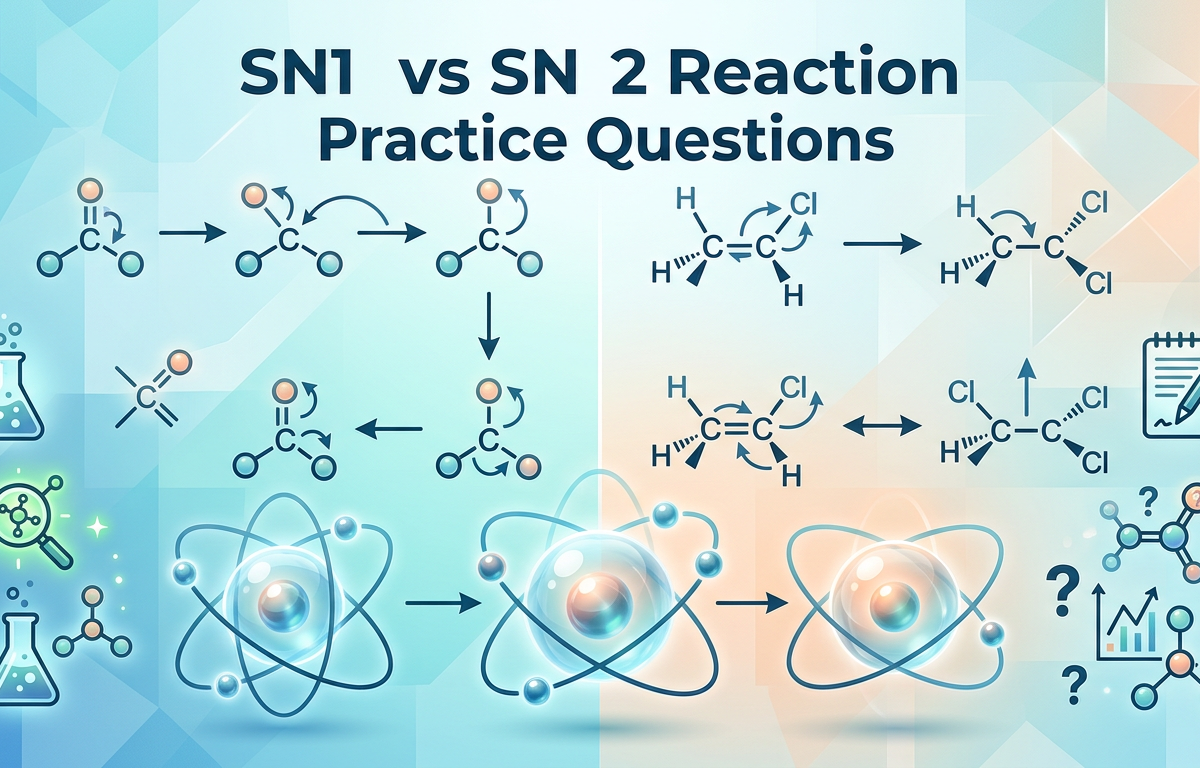
Mastering the distinction between nucleophilic substitution pathways is a cornerstone of organic chemistry, and these Medium SN1 vs SN2 Reaction Practice Questions are designed to sharpen your predictive skills. Choosing between these two mechanisms requires a careful analysis of the substrate structure, the strength of the nucleophile, the nature of the solvent, and the leaving group's ability. While introductory problems often present clear-cut cases, medium-level challenges involve secondary substrates where multiple factors compete, forcing you to weigh conflicting variables to determine the major product and stereochemical outcome.
Concept Explanation
The core concept of SN1 vs SN2 reactions revolves around whether a nucleophilic substitution occurs in a stepwise fashion with a carbocation intermediate (SN1) or via a single-step, concerted process (SN2). These pathways represent the two primary ways a nucleophile can replace a leaving group on a saturated carbon atom. To differentiate between them, chemists evaluate the "Big Four" factors: the substrate, the nucleophile, the solvent, and the leaving group.
Substrate structure is often the most decisive factor. SN1 reactions favor tertiary (3°) substrates because they can form stable carbocations, whereas SN2 reactions favor primary (1°) and methyl substrates due to minimal steric hindrance. Secondary (2°) substrates are the "middle ground" where the mechanism is highly sensitive to external conditions. The nucleophile's strength also plays a pivotal role; strong, negatively charged nucleophiles (like OH⁻ or CN⁻) promote SN2 by attacking the substrate directly. In contrast, weak, neutral nucleophiles (like H₂O or CH₃OH) often wait for the leaving group to depart, facilitating the SN1 pathway. This is often explored further in reaction mechanism practice questions.
Solvent effects provide the final steering force. Protic solvents (containing O-H or N-H bonds) stabilize carbocations and leaving groups through hydrogen bonding, aiding SN1. Polar aprotic solvents (like DMSO or Acetone) do not solvate the nucleophile strongly, keeping it "naked" and reactive for an SN2 back-side attack. Understanding these nuances is as essential as mastering isomer identification when determining the final stereochemistry of a product.
Feature SN1 Mechanism SN2 Mechanism Kinetics Unimolecular: Rate = k[Substrate] Bimolecular: Rate = k[Substrate][Nu] Stereochemistry Racemization (mixture of enantiomers) Inversion of configuration (Walden inversion) Substrate Preference 3° > 2° >> 1° Methyl > 1° > 2° >> 3° Solvent Polar Protic (e.g., H₂O, EtOH) Polar Aprotic (e.g., DMSO, DMF)
Solved Examples
Review these worked examples to understand how to apply the rules of substitution in competitive scenarios.
Example 1: Predict the mechanism and product for (S)-2-bromobutane reacting with NaCN in DMSO.
Analyze the substrate: 2-bromobutane is a secondary (2°) alkyl halide.
Analyze the nucleophile: NaCN provides CN⁻, which is a strong nucleophile.
Analyze the solvent: DMSO is a polar aprotic solvent.
Conclusion: The combination of a 2° substrate, a strong nucleophile, and a polar aprotic solvent strongly favors SN2.
Stereochemistry: SN2 causes inversion. The (S) configuration becomes (R)-2-cyanobutane.
Example 2: Predict the mechanism for tert-butyl chloride reacting with methanol (CH₃OH).
Analyze the substrate: tert-butyl chloride is a tertiary (3°) alkyl halide.
Analyze the nucleophile/solvent: Methanol is a weak nucleophile and a polar protic solvent (solvolysis).
Conclusion: Steric hindrance prevents SN2 on a 3° carbon. The polar protic solvent stabilizes the carbocation intermediate. This is an SN1 reaction.
Result: Formation of tert-butyl methyl ether via a carbocation.
Example 3: Reaction of 2-iodopentane with Sodium Azide (NaN₃) in Ethanol.
Analyze the substrate: 2-iodopentane is secondary (2°).
Analyze the nucleophile: Azide (N₃⁻) is a very strong, small nucleophile.
Analyze the solvent: Ethanol is polar protic.
Evaluation: While the solvent favors SN1, the strength of the azide nucleophile usually forces an SN2 pathway on secondary substrates.
Conclusion: SN2 is the dominant mechanism due to the high nucleophilicity of N₃⁻.
Practice Questions
Test your knowledge with these medium-difficulty questions. Consider all factors before deciding on the mechanism.
1. Predict the major mechanism for the reaction of 2-chloro-2-methylbutane with water.
2. Identify the product and stereochemistry when (R)-2-iodooctane reacts with Sodium Acetate (CH₃COONa) in DMF.
3. Which reaction will proceed faster via an SN2 mechanism: 1-bromopropane with NaOH or 2-bromopropane with NaOH?
4. Explain why the reaction of (S)-3-bromo-3-methylhexane with methanol results in a racemic mixture of ethers.
5. Arrange the following in order of increasing SN2 reactivity: 2-bromo-2-methylbutane, 1-bromobutane, 2-bromobutane.
6. Predict the effect on the rate of the reaction between methyl iodide and NaOH if the concentration of NaOH is doubled.
7. A student attempts to perform an SN2 reaction on 1-chloro-1-methylcyclohexane using NaSH. Will this reaction be successful? Why or why not?
8. Predict the major product for the reaction of (R)-2-bromopentane with KCN in Acetone.
9. In the solvolysis of 2-bromo-2-methylpropane in a mixture of ethanol and water, two products are formed. Name the mechanism and the products.
10. Why does 1-bromoadamantane fail to undergo SN1 reactions despite being a tertiary substrate?
Answers & Explanations
SN1. The substrate is tertiary (2-chloro-2-methylbutane). Tertiary halides cannot undergo SN2 due to steric hindrance. Water is a weak nucleophile and a polar protic solvent, which promotes the formation of a stable tertiary carbocation intermediate.
(S)-2-octyl acetate via SN2. The substrate is secondary, the nucleophile (acetate) is moderately strong, and DMF is a polar aprotic solvent. These conditions favor SN2, leading to a complete inversion of the (R) configuration to (S).
1-bromopropane. SN2 reactions are highly sensitive to steric hindrance. 1-bromopropane is a primary (1°) alkyl halide, whereas 2-bromopropane is secondary (2°). The nucleophile can attack the primary carbon much more easily.
SN1 Mechanism. The substrate is tertiary, leading to the formation of a planar carbocation intermediate. Since the carbocation is flat, the methanol nucleophile can attack from either the top or bottom face with equal probability, resulting in a 50:50 mixture of (R) and (S) enantiomers (racemization).
2-bromo-2-methylbutane < 2-bromobutane < 1-bromobutane. SN2 reactivity decreases with increasing steric hindrance: 1° (1-bromobutane) is fastest, 2° (2-bromobutane) is slower, and 3° (2-bromo-2-methylbutane) is essentially unreactive.
The rate doubles. The reaction between methyl iodide and NaOH follows an SN2 mechanism. The rate law for SN2 is Rate = k[Substrate][Nucleophile]. Since the rate is first-order with respect to the nucleophile, doubling [NaOH] doubles the rate.
No. 1-chloro-1-methylcyclohexane is a tertiary alkyl halide. The carbon attached to the chlorine is bonded to three other carbons. Steric hindrance prevents the NaSH nucleophile from performing a back-side attack, making SN2 impossible.
(S)-2-cyanopentane. Secondary substrate + strong nucleophile (CN⁻) + polar aprotic solvent (Acetone) = SN2. The result is an inversion of the (R) stereocenter to (S).
SN1 mechanism. The products are 2-ethoxy-2-methylpropane (from ethanol attack) and 2-methyl-2-propanol (from water attack). In solvolysis with mixed solvents, both components of the solvent act as nucleophiles.
Bridgehead constraint. While it is tertiary, 1-bromoadamantane cannot form a stable carbocation because the rigid cage structure prevents the carbon from achieving the required planar (sp2) geometry. Furthermore, back-side attack for SN2 is physically blocked by the cage. This is a classic example often found in Wikipedia's coverage of substitution mechanisms.
1. Which of the following solvents would most likely accelerate an SN2 reaction?
Frequently Asked Questions
How do I choose between SN1 and SN2 for a secondary alkyl halide?
For secondary substrates, look at the nucleophile and solvent. A strong nucleophile in a polar aprotic solvent favors SN2, while a weak nucleophile in a polar protic solvent favors SN1.
Why are polar aprotic solvents better for SN2?
Polar aprotic solvents do not hydrogen bond with the nucleophile, leaving it more reactive and free to attack the substrate. In contrast, protic solvents create a "solvent shell" around the nucleophile, reducing its strength.
Can a primary alkyl halide ever undergo an SN1 reaction?
Generally, no, because primary carbocations are too unstable. However, if the primary carbon is resonance-stabilized (like an allylic or benzylic position), an SN1 pathway may become possible. You can learn more about these exceptions in our comprehensive SN1/SN2 guide.
What is the role of the leaving group in these reactions?
A good leaving group, such as Iodide or Tosylate, is essential for both mechanisms as it must be able to stabilize the negative charge after departure. Weak bases make the best leaving groups, as noted in resources like Khan Academy's organic chemistry modules.
Does temperature affect the competition between substitution and elimination?
Yes, increasing the temperature generally favors elimination (E1 or E2) over substitution (SN1 or SN2). This is because elimination reactions increase the number of particles in the system, leading to a more favorable entropy change at high temperatures.
Enjoyed this article?
Share it with others who might find it helpful.
Related Articles
Hard Le Chatelier’s Principle Practice Questions
Master Hard Le Chatelier’s Principle Practice Questions with our comprehensive guide featuring solved examples, practice problems, and detailed explanations.
Mar 30, 2026
Hard Reaction Quotient (Q) Practice Questions
Hard Reaction Quotient (Q) Practice Questions
Mar 30, 2026
Grams to Moles Practice Questions with Answers
Master grams to moles conversions with our comprehensive guide. Includes step-by-step examples, practice questions, and detailed answers for chemistry students.
Mar 26, 2026
Avogadro’s Number Practice Questions with Answers
Master the mole concept with our Avogadro’s Number practice questions. Includes step-by-step solved examples, a quick quiz, and detailed explanations.
Mar 26, 2026

Empirical Formulas: Solving Ratios from Mass and Percent Data
Master empirical formula calculations with 10 practice questions, worked answers, and a free step-by-step calculator for mass, percentage, and combustion problems.
Mar 26, 2026