Medium Sampling Distribution Practice Questions

Medium Sampling Distribution Practice Questions
Understanding the sampling distribution is a cornerstone of inferential statistics, allowing us to make educated guesses about a whole population based on a smaller sample. This concept bridges the gap between descriptive statistics (like calculating a sample mean) and making broader conclusions through techniques like hypothesis testing. This guide provides a clear explanation, worked examples, and practice questions to help you master the sampling distribution.
Concept Explanation
A sampling distribution is the probability distribution of a statistic, such as a sample mean or sample proportion, that is formed by repeatedly taking a large number of samples of a fixed size from a specific population. Imagine you have a population, and you take a random sample of size 'n' and calculate its mean. Then you take another random sample of the same size and calculate its mean. If you were to repeat this process thousands of times, the distribution of all those sample means would be the sampling distribution of the mean. This concept is fundamental because it allows us to determine the probability of observing a particular sample statistic.
The Central Limit Theorem (CLT)
The most important concept related to the sampling distribution is the Central Limit Theorem (CLT). The CLT states that for a sufficiently large sample size (usually n ≥ 30), the sampling distribution of the sample mean (x̄) will be approximately normally distributed, regardless of the shape of the original population's distribution. If the original population is already normally distributed, then the sampling distribution of the mean will be normal for any sample size 'n'.
Properties of the Sampling Distribution of the Mean
Mean (μx̄): The mean of the sampling distribution of the sample means is equal to the population mean (μ). So, μx̄ = μ.
Standard Deviation (σx̄): The standard deviation of the sampling distribution of the sample means is called the standard error of the mean. It is calculated by dividing the population standard deviation (σ) by the square root of the sample size (n). The formula is: σx̄ = σ / √n.
These properties are powerful because they allow us to use our knowledge of the normal distribution and Z-scores to find probabilities associated with sample means.
Solved Examples for Sampling Distribution
These solved examples demonstrate how to apply the concepts of the sampling distribution and the Central Limit Theorem to solve common statistical problems. Each example breaks down the process step-by-step.
Example 1: Normally Distributed Population
Problem: The weights of apples from a large orchard are normally distributed with a mean of 175 grams and a standard deviation of 15 grams. If you take a random sample of 9 apples, what is the probability that the sample mean weight is greater than 180 grams?
Solution:
Identify the parameters:
Population mean (μ) = 175 g
Population standard deviation (σ) = 15 g
Sample size (n) = 9Check conditions: The population is stated to be normally distributed, so we can assume the sampling distribution of the mean is also normal, even though the sample size (n=9) is less than 30.
Calculate the mean and standard error of the sampling distribution:
Mean of the sampling distribution (μx̄) = μ = 175 g.
Standard error (σx̄) = σ / √n = 15 / √9 = 15 / 3 = 5 g.Calculate the Z-score for the sample mean: The formula for the Z-score of a sample mean is Z = (x̄ - μ) / σx̄.
Z = (180 - 175) / 5 = 5 / 5 = 1.00.Find the probability: We need to find P(x̄ > 180), which is equivalent to P(Z > 1.00). Using a standard normal distribution table or calculator, the area to the left of Z = 1.00 is 0.8413. Since we want the area to the right (greater than), we calculate:
P(Z > 1.00) = 1 - P(Z < 1.00) = 1 - 0.8413 = 0.1587.
Answer: The probability that the sample mean weight is greater than 180 grams is approximately 0.1587 or 15.87%.
Example 2: Non-Normal Population (Using CLT)
Problem: The mean time to complete a certain task is 24 minutes, with a standard deviation of 6 minutes. The distribution of completion times is skewed to the right. A random sample of 36 individuals is selected. What is the probability that their mean completion time is between 23 and 25 minutes?
Solution:
Identify the parameters:
Population mean (μ) = 24 min
Population standard deviation (σ) = 6 min
Sample size (n) = 36Check conditions: The population is not normal, but the sample size (n=36) is greater than 30. Therefore, by the Central Limit Theorem, the sampling distribution of the sample mean can be approximated by a normal distribution.
Calculate the mean and standard error of the sampling distribution:
Mean (μx̄) = μ = 24 min.
Standard error (σx̄) = σ / √n = 6 / √36 = 6 / 6 = 1 min.Calculate the Z-scores for both values of the sample mean:
For x̄ = 23: Z1 = (23 - 24) / 1 = -1.00.
For x̄ = 25: Z2 = (25 - 24) / 1 = 1.00.Find the probability: We need to find P(23 < x̄ < 25), which is equivalent to P(-1.00 < Z < 1.00).
P(-1.00 < Z < 1.00) = P(Z < 1.00) - P(Z < -1.00).
From a Z-table, P(Z < 1.00) = 0.8413 and P(Z < -1.00) = 0.1587.
Probability = 0.8413 - 0.1587 = 0.6826.
Answer: The probability that the sample mean completion time is between 23 and 25 minutes is approximately 0.6826 or 68.26%.
Example 3: Finding a Percentile
Problem: The IQ scores of adults in a certain city are normally distributed with a mean of 105 and a standard deviation of 16. If a sample of 64 adults is taken, what sample mean IQ score would represent the 95th percentile?
Solution:
Identify the parameters:
Population mean (μ) = 105
Population standard deviation (σ) = 16
Sample size (n) = 64Calculate the standard error:
Standard error (σx̄) = σ / √n = 16 / √64 = 16 / 8 = 2.Find the Z-score corresponding to the 95th percentile: We need to find the Z-value such that the area to its left is 0.95. Looking this up in a Z-table or using an inverse normal function on a calculator, we find Z ≈ 1.645.
Use the Z-score formula to solve for the sample mean (x̄):
Z = (x̄ - μ) / σx̄
1.645 = (x̄ - 105) / 2Solve for x̄:
x̄ - 105 = 1.645 * 2
x̄ - 105 = 3.29
x̄ = 105 + 3.29 = 108.29.
Answer: A sample mean IQ score of 108.29 would represent the 95th percentile for a sample of 64 adults.
Practice Questions
Test your understanding of the sampling distribution with these practice questions. The difficulty ranges from straightforward calculations to more complex applications of the Central Limit Theorem.
1. (Easy) A population has a mean (μ) of 500 and a standard deviation (σ) of 80. If a random sample of size n = 64 is taken, what is the standard error of the mean?
2. (Easy) The heights of a certain species of plant are normally distributed with a mean of 30 cm and a standard deviation of 4 cm. If you take a sample of 16 plants, what is the expected mean of the sampling distribution of the sample mean (μx̄)?
3. (Medium) The average daily caffeine consumption of adults is 180 mg with a standard deviation of 48 mg. If a random sample of 64 adults is selected, what is the probability that the sample mean caffeine consumption is less than 170 mg? Assume the conditions for the Central Limit Theorem are met.
Want unlimited practice questions like these?
Generate AI-powered questions with step-by-step solutions on any topic.
Try Question Generator Free →4. (Medium) The scores on a standardized test are normally distributed with a mean of 1000 and a standard deviation of 150. What is the probability that the mean score of a random sample of 25 test-takers is between 950 and 1050?
5. (Medium) A light bulb manufacturer claims that its bulbs have an average lifespan of 1200 hours, with a standard deviation of 100 hours. A consumer watchdog group tests a sample of 49 bulbs. What is the probability that the sample mean lifespan is 1180 hours or less?
6. (Medium) The cholesterol levels of adult males are normally distributed with a mean of 198 mg/dL and a standard deviation of 25 mg/dL. For a sample of 100 men, what is the probability that their mean cholesterol level is above 200 mg/dL?
7. (Hard) The amount of time students spend studying per week is skewed right with a mean of 8.5 hours and a standard deviation of 3.5 hours. A random sample of 40 students is taken. What is the probability that the sample mean study time is at least 9 hours?
8. (Hard) A machine fills bottles with a beverage. The amount of liquid dispensed is normally distributed with a mean of 500 ml and a standard deviation of 5 ml. What sample size would be required to ensure that the probability of the sample mean being within 1 ml of the population mean (i.e., between 499 ml and 501 ml) is at least 95%?
9. (Hard) The reaction time of pilots is known to have a mean of 0.45 seconds and a standard deviation of 0.08 seconds. An aviation academy tests a new training program with a class of 32 pilots. After the program, the class's mean reaction time is 0.42 seconds. Assuming the standard deviation remains unchanged, what is the probability of observing a sample mean this low or lower if the training program had no effect?
10. (Hard) A company's delivery times are skewed with a mean of 45 minutes and a standard deviation of 12 minutes. A sample of 36 deliveries is taken from City A, and a sample of 64 deliveries is taken from City B. Which city's sample is more likely to have a sample mean greater than 50 minutes? Justify your answer with calculations.
Answers & Explanations
Here are the detailed solutions for the practice questions. Each explanation walks through the calculation and reasoning required to arrive at the correct answer.
1. (Easy)
Answer: The standard error of the mean is 10.
Explanation: The formula for the standard error of the mean (σx̄) is σ / √n. Given σ = 80 and n = 64, the calculation is:
σx̄ = 80 / √64 = 80 / 8 = 10.
2. (Easy)
Answer: The expected mean is 30 cm.
Explanation: The mean of the sampling distribution of the sample mean (μx̄) is always equal to the population mean (μ). Since the population mean height is 30 cm, the expected mean of the sampling distribution is also 30 cm.
3. (Medium)
Answer: The probability is approximately 0.0475.
Explanation:
Parameters: μ = 180, σ = 48, n = 64.
Standard Error: σx̄ = 48 / √64 = 48 / 8 = 6.
Z-score: Z = (x̄ - μ) / σx̄ = (170 - 180) / 6 = -10 / 6 ≈ -1.67.
Probability: We need P(x̄ < 170), which is P(Z < -1.67). Looking this up on a Z-table gives approximately 0.0475.
4. (Medium)
Answer: The probability is approximately 0.9044.
Explanation:
Parameters: μ = 1000, σ = 150, n = 25. The population is normal.
Standard Error: σx̄ = 150 / √25 = 150 / 5 = 30.
Z-scores:
For x̄ = 950: Z1 = (950 - 1000) / 30 = -50 / 30 ≈ -1.67.
For x̄ = 1050: Z2 = (1050 - 1000) / 30 = 50 / 30 ≈ 1.67.Probability: We need P(950 < x̄ < 1050) = P(-1.67 < Z < 1.67).
P(Z < 1.67) - P(Z < -1.67) = 0.9525 - 0.0475 = 0.9050. (Using more precise Z-values gives 0.9044).
5. (Medium)
Answer: The probability is approximately 0.0808.
Explanation:
Parameters: μ = 1200, σ = 100, n = 49. CLT applies since n > 30.
Standard Error: σx̄ = 100 / √49 = 100 / 7 ≈ 14.286.
Z-score: Z = (1180 - 1200) / 14.286 = -20 / 14.286 ≈ -1.40.
Probability: We need P(x̄ ≤ 1180), which is P(Z ≤ -1.40). From a Z-table, this is approximately 0.0808.
6. (Medium)
Answer: The probability is approximately 0.2119.
Explanation:
Parameters: μ = 198, σ = 25, n = 100. Population is normal.
Standard Error: σx̄ = 25 / √100 = 25 / 10 = 2.5.
Z-score: Z = (200 - 198) / 2.5 = 2 / 2.5 = 0.80.
Probability: We need P(x̄ > 200), which is P(Z > 0.80).
P(Z > 0.80) = 1 - P(Z < 0.80) = 1 - 0.7881 = 0.2119.
7. (Hard)
Answer: The probability is approximately 0.1841.
Explanation:
Parameters: μ = 8.5, σ = 3.5, n = 40. CLT applies as n > 30.
Standard Error: σx̄ = 3.5 / √40 ≈ 3.5 / 6.325 ≈ 0.553.
Z-score: Z = (9 - 8.5) / 0.553 = 0.5 / 0.553 ≈ 0.90.
Probability: We need P(x̄ ≥ 9), which is P(Z ≥ 0.90).
P(Z ≥ 0.90) = 1 - P(Z < 0.90) = 1 - 0.8159 = 0.1841.
8. (Hard)
Answer: The required sample size is approximately 97.
Explanation: This is a reverse problem. We want P(499 < x̄ < 501) ≥ 0.95. This corresponds to the central 95% of the distribution. The Z-scores for the central 95% are ±1.96. We use the Z-score formula and solve for n.
Set up the equation using the margin of error: The margin of error (E) is the distance from the mean, which is 1 ml. The formula is E = Z * σx̄ = Z * (σ / √n).
Plug in values: 1 = 1.96 * (5 / √n).
Solve for √n: √n = (1.96 * 5) / 1 = 9.8.
Solve for n: n = (9.8)² = 96.04.
Round up: Since sample size must be a whole number, we always round up to ensure the probability is at least 95%. So, n = 97. If you're creating confidence intervals, this skill is essential.
9. (Hard)
Answer: The probability is approximately 0.0170.
Explanation: We are testing if the observed mean of 0.42 is unusually low, assuming the true mean is still 0.45.
Parameters: μ = 0.45, σ = 0.08, n = 32. CLT applies as n > 30. The value x̄ = 0.42.
Standard Error: σx̄ = 0.08 / √32 ≈ 0.08 / 5.657 ≈ 0.01414.
Z-score: Z = (0.42 - 0.45) / 0.01414 = -0.03 / 0.01414 ≈ -2.12.
Probability: We need P(x̄ ≤ 0.42), which is P(Z ≤ -2.12). From a Z-table, this is 0.0170. This low probability might suggest the training program was effective, a core idea in hypothesis testing.
10. (Hard)
Answer: City A's sample is more likely to have a mean greater than 50 minutes.
Explanation: We need to calculate the probability for each city and compare.
For City A (n=36):
Standard Error: σx̄A = 12 / √36 = 12 / 6 = 2.
Z-score: ZA = (50 - 45) / 2 = 5 / 2 = 2.50.
Probability: P(Z > 2.50) = 1 - 0.9938 = 0.0062.For City B (n=64):
Standard Error: σx̄B = 12 / √64 = 12 / 8 = 1.5.
Z-score: ZB = (50 - 45) / 1.5 = 5 / 1.5 ≈ 3.33.
Probability: P(Z > 3.33) = 1 - 0.9996 = 0.0004.
Justification: The probability for City A (0.62%) is much higher than for City B (0.04%). This is because City A has a smaller sample size, which leads to a larger standard error and a wider sampling distribution. A wider distribution means there is more area in the tails, making more extreme sample means (like 50 minutes) more likely to occur. For more practice with this type of problem, see our general sampling distribution practice questions.
1. Test your knowledge with this quick-fire quiz on the sampling distribution.1. What is the standard deviation of a sampling distribution of sample means called?
Frequently Asked Questions
What is the Central Limit Theorem (CLT)?
The Central Limit Theorem is a statistical principle stating that if you take sufficiently large random samples from a population with a given mean and standard deviation, the distribution of the sample means will be approximately normal, regardless of the original population's distribution. This theorem is powerful because the normal distribution is well-understood and easy to work with.
What is the difference between standard deviation and standard error?
Standard deviation (σ) measures the amount of variability or dispersion of individual data points within a single population or sample. In contrast, the standard error (σx̄) measures the variability of a statistic (like the sample mean) across multiple samples drawn from the same population. It is the standard deviation of the sampling distribution and tells you how precisely a sample mean estimates the true population mean.
Why is the sampling distribution a crucial concept in statistics?
The sampling distribution is crucial because it forms the theoretical basis for inferential statistics, such as confidence intervals and hypothesis testing. It allows us to quantify the uncertainty in a sample statistic and use probability to make inferences about the unknown population parameter. Without it, we would have no way of knowing how reliable our sample-based estimates are.
How does sample size affect the sampling distribution?
As the sample size (n) increases, the sampling distribution of the mean becomes less spread out and more closely clustered around the population mean. This is because the standard error (σ/√n) decreases as n increases. A larger sample provides a more precise estimate of the population mean, resulting in a narrower, more peaked normal curve.
When can I not use the Central Limit Theorem?
You should be cautious about applying the CLT in two main situations. First, if the sample size is small (typically n < 30) and the underlying population distribution is not known to be normal (e.g., it is heavily skewed or has multiple modes). Second, if the data points in the sample are not independent. The CLT relies on the assumption of random sampling and independence. More information on this can be found at university statistics departments, like this resource from Penn State.
What is the difference between population distribution and sampling distribution?
The population distribution is the distribution of all individual values in the entire population. The sampling distribution is the distribution of a statistic (like the mean) calculated from many different samples of the same size taken from that population. For example, the distribution of the heights of all adult humans is a population distribution, while the distribution of the *average heights* from 1,000 different samples of 50 humans each is a sampling distribution.
Want unlimited practice questions like these?
Generate AI-powered questions with step-by-step solutions on any topic.
Try Question Generator Free →
Want unlimited practice questions like these?
Generate AI-powered questions with step-by-step solutions on any topic.
Try Question Generator Free →Enjoyed this article?
Share it with others who might find it helpful.
Related Articles

Easy Sampling Distribution Practice Questions
Master the fundamentals of the sampling distribution with easy-to-understand explanations, solved examples, and practice questions. Learn how to apply the Central Limit Theorem.
Apr 5, 2026
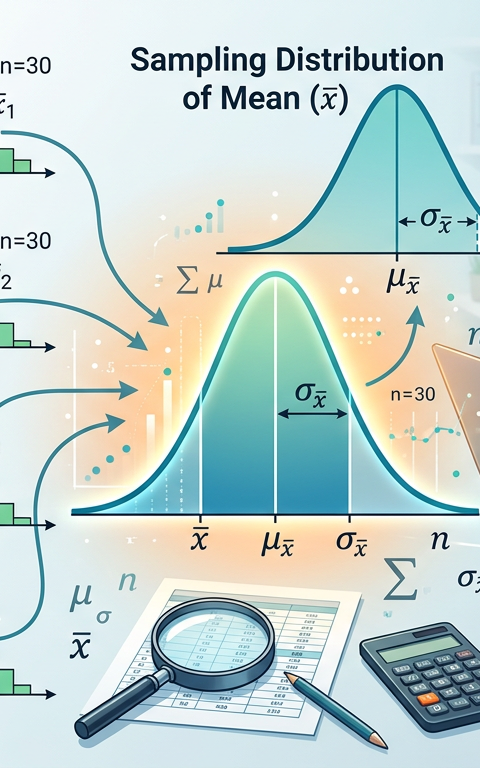
Sampling Distribution Practice Questions with Answers
Master sampling distribution concepts with our comprehensive practice questions. Learn about the Central Limit Theorem, standard error, and Z-scores.
Apr 5, 2026

Easy Normal Distribution Practice Questions
Easy Normal Distribution Practice Questions
Apr 5, 2026

Normal Distribution Practice Questions with Answers
Master the normal distribution with our comprehensive guide featuring solved examples, z-score calculations, and the Empirical Rule.
Apr 5, 2026
Hard Confidence Interval Practice Questions
Challenge your statistical skills with hard confidence interval practice questions. This guide covers complex scenarios like two-sample tests and sample size determination.
Apr 5, 2026

Medium Hypothesis Testing Practice Questions
Master hypothesis testing with our comprehensive guide. This page includes solved examples, practice questions with detailed answers, a quiz, and FAQs.
Apr 5, 2026

Medium Confidence Interval Practice Questions
Master the art of estimating population parameters with our comprehensive guide. This page features medium-level confidence interval practice questions with full solutions.
Apr 5, 2026

Medium Standard Deviation Practice Questions
Master standard deviation with our comprehensive guide. Features clear explanations, solved examples, and medium-difficulty practice questions with detailed answers.
Apr 5, 2026