Medium Ka and Kb Calculations Practice Questions
Concept Explanation
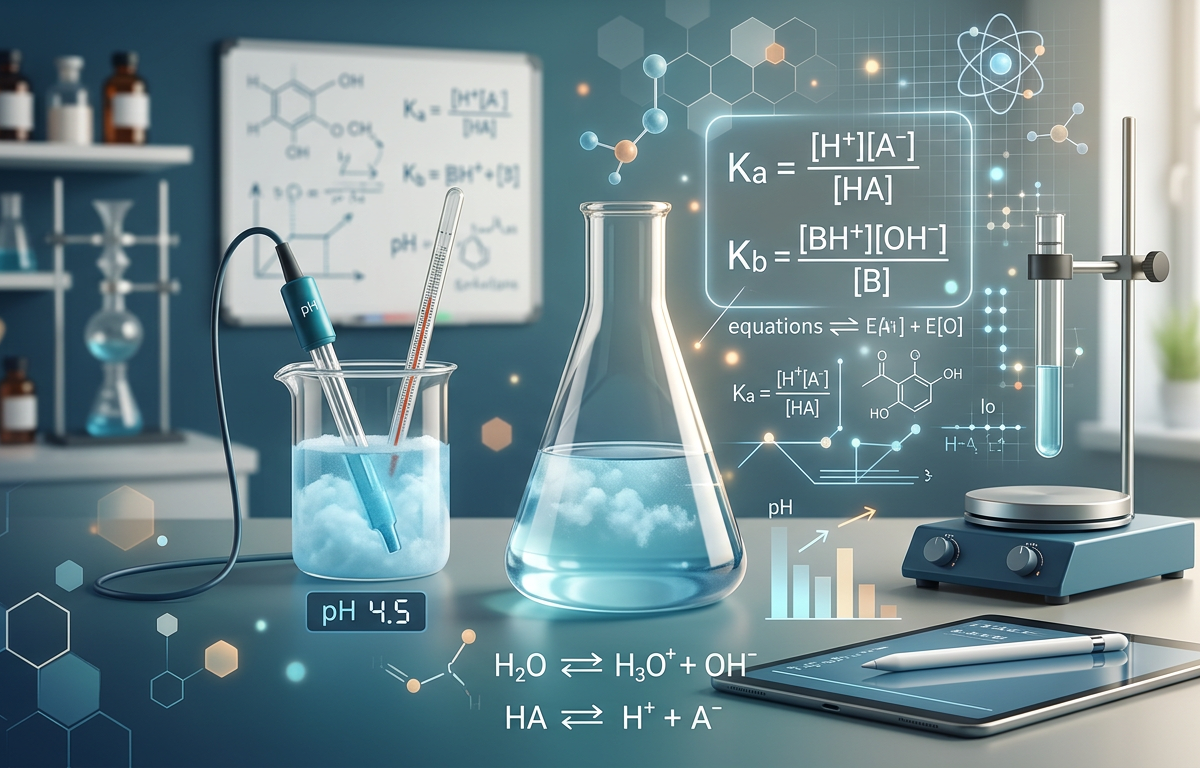
Medium Ka and Kb calculations involve determining the equilibrium constants for acid and base dissociation using initial concentrations, pH, pOH, or percent ionization data. The acid dissociation constant () measures the strength of an acid in solution, while the base dissociation constant () measures the strength of a base. For a weak acid (HA) reacting with water, the equilibrium is expressed as , and the constant is calculated as . Conversely, for a weak base (B), the reaction is , with . Understanding these relationships is essential for predicting the behavior of strong acid vs weak acid systems. In medium-level problems, we often use the \"x is small\" approximation or the quadratic formula to solve for unknown concentrations. Additionally, the relationship ($1.0 \times 10^{-14}$ at 25°C) allows us to convert between the two constants for conjugate acid-base pairs, a concept frequently used in pKa and pKb practice questions.
Solved Examples
The following examples demonstrate how to set up ICE (Initial, Change, Equilibrium) tables and solve for constants or concentrations.
Calculating Ka from pH: A 0.120 M solution of a monoprotic weak acid has a pH of 2.85. Calculate the of the acid.
Convert pH to : .
Set up the equilibrium expression: . Since , .
Solve: .
Calculating pH from Kb: Find the pH of a 0.25 M solution of methylamine (), given .
Set up the ICE table: , .
.
.
Calculate pOH: .
Calculate pH: .
Calculating Percent Ionization: A 0.50 M solution of HF () is prepared. What is the percent ionization?
Set up the expression: $6.6 \times 10^{-4} = x^2 / 0.50$.
Solve for $x$: .
Percent Ionization = .
.
Practice Questions
A 0.15 M solution of a weak acid has a of $4.5 \times 10^{-7}$. Calculate the equilibrium concentration of .
The pH of a 0.10 M solution of a weak base is 11.24. Calculate the for this base.
Calculate the of the conjugate base of an acid that has a of 4.75.
Find the pH of a 0.050 M solution of nitrous acid (), where .
A 0.20 M solution of a weak acid is 2.5% ionized. Determine the value.
Calculate the concentration of a pyridine solution () that has a pOH of 4.50, given .
Hypochlorous acid ($HClO$) has a of $3.0 \times 10^{-8}$. What is the of its conjugate base, ?
Determine the pH of a 0.10 M solution of , given the for is $1.8 \times 10^{-5}$.
A weak acid solution with a concentration of 0.010 M exhibits a pH of 4.0. What is the ?
Calculate the percent ionization of a 0.100 M solution of chloroacetic acid () with .
Answers & Explanations
: Using , .
: . . .
: . .
pH = 2.33: $4.6 \times 10^{-4} = x^2 / 0.050 \implies x = 4.8 \times 10^{-3} M$. .
: . .
Concentration = 0.59 M: . $1.7 \times 10^{-9} = (3.16 \times 10^{-5})^2 / C$.
: .
pH = 5.13: is the acid. . .
: . .
Ionization = 11.1%: Solve $1.4 \times 10^{-3} = x^2 / (0.100 - x)$ using the quadratic formula or approximation (). .
1. If the Ka of an acid increases, what happens to the strength of the acid?
Frequently Asked Questions
What is the difference between Ka and pKa?
Ka is the acid dissociation constant representing the equilibrium ratio of products to reactants, while pKa is the negative logarithm of Ka. A higher Ka indicates a stronger acid, whereas a lower pKa indicates a stronger acid, similar to the relationship explored in pH calculation practice questions.
Can Kb be used to find the pH of a solution?
Yes, Kb is used to find the concentration of hydroxide ions [OH-] in a base solution, which allows for the calculation of pOH. You can then subtract the pOH from 14 to determine the pH of the solution at standard temperature.
When is the \"x is small\" approximation invalid?
The approximation is generally considered invalid if the value of x is more than 5% of the initial concentration of the acid or base. In such cases, you must use the quadratic formula to ensure accuracy in your Ka and Kb calculations.
How do Ka and Kb relate to the autoionization of water?
The product of the dissociation constants for a conjugate acid-base pair always equals the water dissociation constant, Kw, which is $1.0 \times 10^{-14}$ at 25°C. This relationship is fundamental to understanding aqueous equilibrium as documented by LibreTexts Chemistry.
Why does percent ionization decrease as concentration increases?
According to Le Chatelier's Principle, increasing the concentration of a weak acid shifts the equilibrium toward the undissociated form, resulting in a smaller fraction of the molecules ionizing compared to a more dilute solution. This concept is a staple in Khan Academy chemistry tutorials.
Start Learning Smarter Today
Join thousands of students using AI-powered study tools to achieve better results.
Get Started FreeEnjoyed this article?
Share it with others who might find it helpful.
Related Articles
Hard Le Chatelier’s Principle Practice Questions
Master Hard Le Chatelier’s Principle Practice Questions with our comprehensive guide featuring solved examples, practice problems, and detailed explanations.
Mar 30, 2026
Hard Reaction Quotient (Q) Practice Questions
Hard Reaction Quotient (Q) Practice Questions
Mar 30, 2026
Grams to Moles Practice Questions with Answers
Master grams to moles conversions with our comprehensive guide. Includes step-by-step examples, practice questions, and detailed answers for chemistry students.
Mar 26, 2026
Avogadro’s Number Practice Questions with Answers
Master the mole concept with our Avogadro’s Number practice questions. Includes step-by-step solved examples, a quick quiz, and detailed explanations.
Mar 26, 2026
Empirical Formulas: Solving Ratios from Mass and Percent Data
Master empirical formula calculations with 10 practice questions, worked answers, and a free step-by-step calculator for mass, percentage, and combustion problems.
Mar 26, 2026