Medium Reaction Mechanism Practice Questions
Concept Explanation
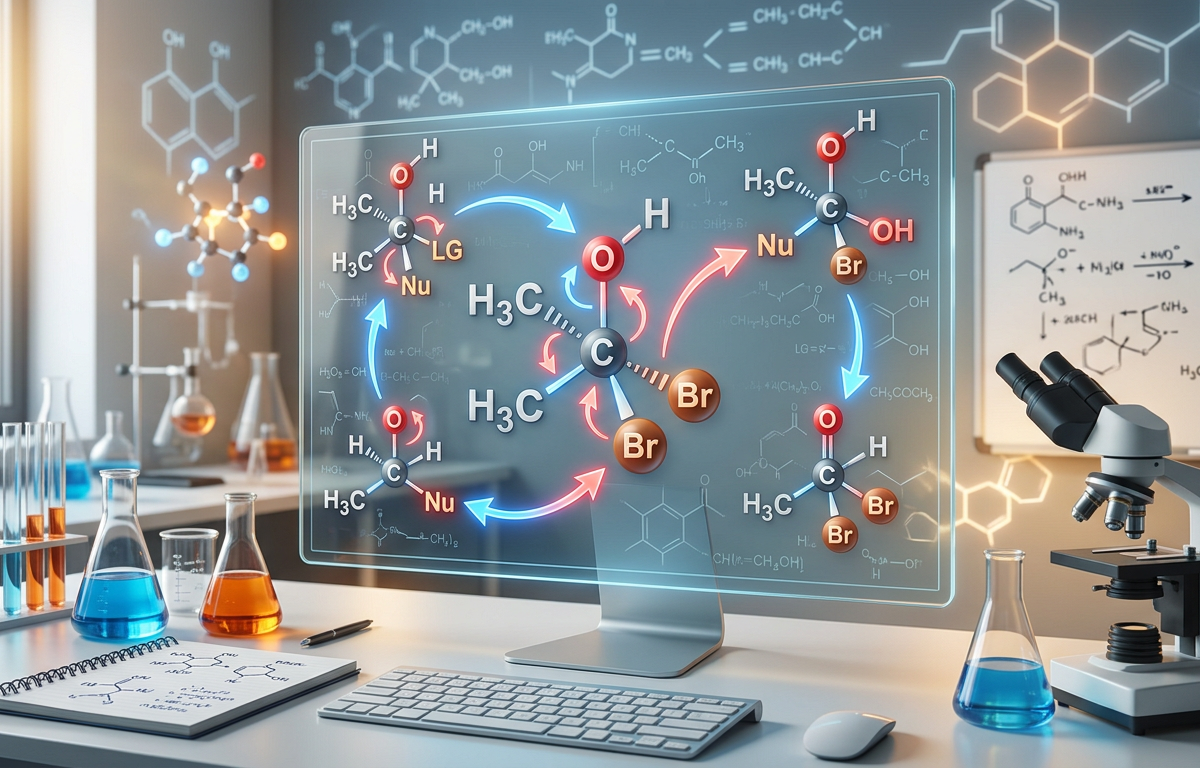
A reaction mechanism is a step-by-step description of the molecular pathway that reactants take to transform into products, detailing every individual elementary step and the movement of electrons. While a balanced chemical equation shows the starting materials and the final result, the mechanism uncovers the "hidden" intermediates and transition states that dictate the rate of the reaction. In organic chemistry, these mechanisms are typically visualized using curved arrows to represent the flow of electron pairs, starting from an electron-rich nucleophile and moving toward an electron-poor electrophile. Understanding these pathways is essential for predicting the outcome of complex transformations, such as those found in SN1 vs SN2 reaction practice questions.
Key components of a reaction mechanism include:
Elementary Steps: Individual molecular events that occur in a single stage.
Reaction Intermediates: Chemical species that are formed in one step and consumed in a subsequent step (e.g., carbocations, carbanions, or radicals).
Rate-Determining Step (RDS): The slowest step in a multi-step mechanism, which determines the overall reaction rate.
Transition State: A high-energy, unstable state where old bonds are breaking and new bonds are forming simultaneously.
Developing proficiency in reaction mechanisms requires a solid foundation in electronic effects, such as induction and resonance, which influence the stability of intermediates. For instance, the stability of a carbocation intermediate greatly impacts the feasibility of an SN1 pathway. To deepen your understanding of molecular structures before tackling mechanisms, you might find it helpful to review medium Lewis structure practice questions to ensure your electron bookkeeping is accurate.
Solved Examples
The following examples demonstrate how to break down complex chemical transformations into logical elementary steps.
Example 1: Acid-Catalyzed Hydration of Ethene
Explain the mechanism for the reaction of ethene (CH₂=CH₂) with water in the presence of an acid catalyst (H₂SO₄) to form ethanol.
Protonation: The π electrons of the ethene double bond act as a nucleophile and attack a hydronium ion (H₃O⁺). This forms a carbocation intermediate (CH₃-CH₂⁺) and releases a water molecule.
Nucleophilic Attack: A water molecule (acting as the nucleophile) attacks the electrophilic carbocation, forming a protonated alcohol intermediate (CH₃-CH₂-OH₂⁺).
Deprotonation: Another water molecule removes a proton from the protonated alcohol to regenerate the hydronium catalyst and yield the final product, ethanol (CH₃-CH₂-OH).
Example 2: Bromination of Methane (Free Radical Mechanism)
Outline the steps for the photochemical bromination of methane to form methyl bromide.
Initiation: Ultraviolet light provides energy to break the Br-Br bond homolytically, creating two bromine radicals (Br•).
Propagation (Part A): A bromine radical abstracts a hydrogen atom from methane, producing a methyl radical (•CH₃) and hydrogen bromide (HBr).
Propagation (Part B): The methyl radical reacts with a bromine molecule (Br₂), forming methyl bromide (CH₃Br) and regenerating a bromine radical to continue the chain.
Termination: Two radicals collide (e.g., two Br• or two •CH₃) to form a stable molecule, ending the chain reaction.
Example 3: Base-Catalyzed Aldol Condensation (Initial Steps)
Show the formation of the enolate and the subsequent nucleophilic attack in the reaction of acetaldehyde with NaOH.
Enolate Formation: The hydroxide ion (OH⁻) acts as a base and abstracts an alpha-hydrogen from acetaldehyde, creating a resonance-stabilized enolate ion and water.
Nucleophilic Attack: The enolate ion (nucleophile) attacks the carbonyl carbon of a second acetaldehyde molecule (electrophile), forming a new C-C bond and an alkoxide intermediate.
Practice Questions
Test your knowledge with these medium-level reaction mechanism practice questions. Ensure you have a firm grasp of IUPAC naming to correctly identify the molecules involved.
Describe the three-step mechanism for the SN1 reaction between 2-chloro-2-methylpropane and water.
In the electrophilic aromatic substitution of benzene with nitronium ion (NO₂⁺), what is the structure of the sigma complex (Wheland intermediate)?
Explain why the addition of HBr to propene in the presence of peroxides yields 1-bromopropane instead of 2-bromopropane.
Want unlimited practice questions like these?
Generate AI-powered questions with step-by-step solutions on any topic.
Try Question Generator Free →Draw the mechanism for the E2 elimination of 2-bromobutane using ethoxide (EtO⁻) as the base. Which product is major: 1-butene or 2-butene?
For the acid-catalyzed Fischer esterification of acetic acid and methanol, identify the step where the tetrahedral intermediate is formed.
The hydroboration-oxidation of 1-methylcyclopentene results in syn-addition. Explain the mechanistic reason for this stereochemical outcome.
During the ozonolysis of an alkene, a molozonide is formed first. Describe its rearrangement into the more stable ozonide.
In a nucleophilic acyl substitution reaction, such as the hydrolysis of an ester under basic conditions (saponification), why is the reaction irreversible?
Explain the mechanism of the Claisen rearrangement of allyl phenyl ether. Is this a radical or a pericyclic process?
Predict the mechanism for the reaction of cyclohexene with OsO₄ followed by NaHSO₃/H₂O. What is the stereochemistry of the resulting diol?
Answers & Explanations
SN1 Mechanism: (1) Dissociation of the C-Cl bond to form a tertiary carbocation and a chloride ion. (2) Nucleophilic attack of H₂O on the carbocation to form a protonated alcohol. (3) Deprotonation by another water molecule to form 2-methyl-2-propanol.
Sigma Complex: The nitronium ion attacks the benzene ring, breaking the aromaticity. The carbon receiving the NO₂ group becomes sp³ hybridized, while the positive charge is delocalized over the remaining five carbons of the ring through resonance.
Peroxide Effect: Peroxides initiate a radical mechanism. The bromine radical attacks the terminal carbon of propene to form a more stable secondary radical (CH₃-•CH-CH₂Br). Subsequent hydrogen abstraction yields 1-bromopropane (Anti-Markovnikov).
E2 Elimination: The base removes a proton from a beta-carbon simultaneously as the bromide leaves. 2-butene is the major product (Zaitsev's rule) because it is more substituted and thus more stable.
Fischer Esterification: The tetrahedral intermediate is formed when the alcohol (methanol) nucleophilically attacks the protonated carbonyl carbon of the acetic acid.
Hydroboration-Oxidation: The BH₃ adds across the double bond in a single concerted step. The boron and hydrogen must add to the same face of the alkene simultaneously, necessitating syn-addition.
Ozonolysis: The molozonide (1,2,3-trioxolane) is unstable and undergoes a retro-1,3-dipolar cycloaddition to break apart, followed by a 1,3-dipolar cycloaddition to reform as the more stable ozonide (1,2,4-trioxolane).
Saponification: The final step involves the deprotonation of the carboxylic acid by the hydroxide ion to form a carboxylate salt. This acid-base reaction is highly exothermic and effectively irreversible, driving the reaction to completion.
Claisen Rearrangement: This is a [3,3]-sigmatropic rearrangement, which is a type of pericyclic reaction. It involves a concerted movement of six electrons in a cyclic transition state.
Dihydroxylation: OsO₄ forms a cyclic osmate ester across the double bond via a concerted syn-addition. Hydrolysis then yields a cis-1,2-cyclohexanediol.
1. Which intermediate is characteristic of an SN1 reaction?
Frequently Asked Questions
What is the difference between a reaction intermediate and a transition state?
A reaction intermediate is a relatively stable species with a finite lifetime that exists at a local energy minimum on a reaction coordinate diagram. In contrast, a transition state is a high-energy arrangement of atoms at an energy maximum that cannot be isolated or directly observed.
How do you identify the rate-determining step in a mechanism?
The rate-determining step is the elementary step with the highest activation energy on the potential energy profile. It acts as a bottleneck for the overall process, meaning the total reaction rate cannot exceed the rate of this specific step.
What does the term 'concerted mechanism' mean?
A concerted mechanism refers to a reaction where all bond-breaking and bond-forming events occur simultaneously in a single elementary step. There are no intermediates formed in a concerted process, such as in SN2 or E2 reactions.
Why are carbocations more stable when they are more substituted?
More substituted carbocations are stabilized through inductive effects and hyperconjugation. Alkyl groups donate electron density through sigma bonds and overlap filled C-H sigma orbitals with the empty p-orbital of the carbocation, spreading out the positive charge.
Can a reaction mechanism be proven?
A reaction mechanism can never be definitively proven; it can only be supported by experimental evidence such as kinetic data, isotope labeling, and stereochemical outcomes. If new evidence contradicts a proposed mechanism, the mechanism must be revised or discarded in accordance with the scientific method.
Want unlimited practice questions like these?
Generate AI-powered questions with step-by-step solutions on any topic.
Try Question Generator Free →
Want unlimited practice questions like these?
Generate AI-powered questions with step-by-step solutions on any topic.
Try Question Generator Free →Enjoyed this article?
Share it with others who might find it helpful.
Related Articles
Hard Le Chatelier’s Principle Practice Questions
Master Hard Le Chatelier’s Principle Practice Questions with our comprehensive guide featuring solved examples, practice problems, and detailed explanations.
Mar 30, 2026

Hard Reaction Quotient (Q) Practice Questions
Hard Reaction Quotient (Q) Practice Questions
Mar 30, 2026
Grams to Moles Practice Questions with Answers
Master grams to moles conversions with our comprehensive guide. Includes step-by-step examples, practice questions, and detailed answers for chemistry students.
Mar 26, 2026
Avogadro’s Number Practice Questions with Answers
Master the mole concept with our Avogadro’s Number practice questions. Includes step-by-step solved examples, a quick quiz, and detailed explanations.
Mar 26, 2026
Empirical Formulas: Solving Ratios from Mass and Percent Data
Master empirical formula calculations with 10 practice questions, worked answers, and a free step-by-step calculator for mass, percentage, and combustion problems.
Mar 26, 2026