Medium pOH Calculation Practice Questions
Concept Explanation
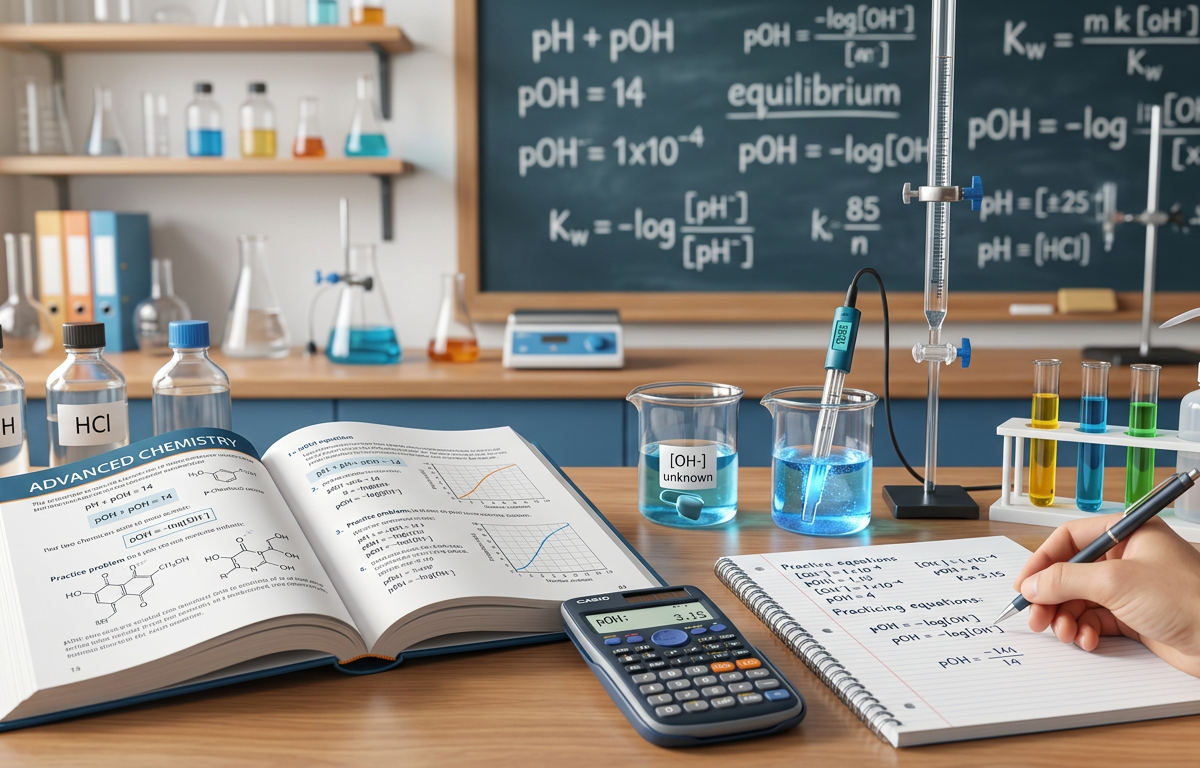
The pOH of a solution is a measure of its hydroxide ion (OH⁻) alkalinity, defined mathematically as the negative logarithm (base 10) of the molar concentration of hydroxide ions. While pH is the most common scale for acidity, pOH offers a direct way to quantify the basicity of aqueous solutions, particularly when dealing with strong and weak bases. In any aqueous solution at 25°C, the relationship between pH and pOH is governed by the self-ionization constant of water (), leading to the fundamental equation: .
To perform a pOH calculation, you typically follow these steps:
Identify the hydroxide ion concentration in moles per liter (Molarity).
Apply the formula: .
If given the pH, subtract it from 14 to find the pOH.
If given the concentration of a strong base like $NaOH$ or , determine the stoichiometry to find the total .
Understanding these relationships is crucial for mastering pH calculation practice questions and advanced chemical equilibrium. According to Wikipedia's entry on pOH, this logarithmic scale helps scientists handle the vast range of ion concentrations found in nature, which can span over 14 orders of magnitude.
Solved Examples
Review these step-by-step solutions to understand how to approach medium-level pOH problems.
Example 1: Strong Base Dissociation
Calculate the pOH of a 0.025 M solution of Barium Hydroxide, .Identify the base type: is a strong base that dissociates completely.
Determine : Each mole of produces 2 moles of . Therefore, .
Apply the formula: .
Calculate: .
Example 2: Finding pOH from pH
A sample of acid rain has a pH of 4.20. What is the pOH of this sample at 25°C?Recall the relationship: .
Rearrange the equation: .
Substitute the value: .
Result: .
Example 3: Concentration from pOH
A cleaning solution has a pOH of 3.15. Calculate the hydroxide ion concentration.Use the inverse log formula: .
Substitute the value: .
Calculate: .
Practice Questions
Test your knowledge with these 10 practice questions. Ensure you have a scientific calculator ready for the logarithmic functions.
1. Calculate the pOH of a solution with a hydroxide ion concentration of $4.5 \times 10^{-5}\text{ M}$.
2. A solution of Potassium Hydroxide ($KOH$) has a concentration of 0.0082 M. Determine its pOH.
3. If the hydrogen ion concentration of a solution is $2.0 \times 10^{-9}\text{ M}$, what is the pOH?
4. Determine the pOH of a 0.015 M solution of Calcium Hydroxide, .
5. A buffer solution has a pH of 8.45. What is the hydroxide ion concentration? (Hint: Find pOH first).
6. Calculate the pOH when 0.50 grams of $NaOH$ (molar mass = 40.00 g/mol) is dissolved in 2.0 liters of water.
7. A solution is prepared by diluting 10 mL of 1.0 M $NaOH$ to a total volume of 500 mL. Calculate the pOH of the final solution.
8. The pOH of a solution is 11.20. Is this solution acidic, basic, or neutral?
9. Calculate the pOH of a $1.2 \times 10^{-3}\text{ M}$ solution of $HCl$. (Hint: Use the constant or find pH first).
10. If a solution has a pOH of 5.67, what is its concentration?
Answers & Explanations
Answer: 4.35
Explanation: . Rounded to two decimal places, it is 4.35.Answer: 2.09
Explanation: $KOH$ is a strong monoprotic base, so . .Answer: 5.30
Explanation: First, find . Then, . Alternatively, use to find first.Answer: 1.52
Explanation: . So, . .Answer: $2.82 \times 10^{-6}\text{ M}$
Explanation: . . For more on buffers, see buffer solution practice questions.Answer: 2.20
Explanation: Moles of . Molarity . .Answer: 1.70
Explanation: Using the dilution formula : . . .Answer: Acidic
Explanation: A pOH of 11.20 corresponds to a pH of $14 - 11.20 = 2.80$. Since pH < 7, the solution is acidic.Answer: 11.08
Explanation: $HCl$ is a strong acid, so . . .Answer: $4.68 \times 10^{-9}\text{ M}$
Explanation: . .
1. What is the pOH of a solution where [OH⁻] = 1.0 x 10⁻⁷ M?
Frequently Asked Questions
What is the difference between pH and pOH?
pH measures the concentration of hydrogen ions () in a solution, while pOH measures the concentration of hydroxide ions (). Both use negative logarithmic scales, and their sum equals 14 in aqueous solutions at room temperature.
Can pOH be negative?
Yes, pOH can be negative if the concentration of hydroxide ions is greater than 1.0 M. For example, a 2.0 M solution of $NaOH$ would have a pOH of approximately -0.30.
How do you calculate pOH for a weak base?
For a weak base, you must first use the base dissociation constant () and an ICE table to find the equilibrium concentration of . Once you have the concentration, you apply the formula. Check out Ka and Kb calculations practice questions for more details.
Why is 14 used in the pH + pOH = 14 equation?
The number 14 comes from the negative logarithm of the water self-ionization constant (), which is $1.0 \times 10^{-14}$ at 25°C. This constant is a product of the molarities of and ions in water.
Does temperature affect pOH calculations?
Yes, temperature changes the value of . While 14 is the standard at 25°C, higher temperatures increase the dissociation of water, which lowers the neutral point of the pH and pOH scales. For more on how temperature affects chemical constants, visit LibreTexts Chemistry.
Start Learning Smarter Today
Join thousands of students using AI-powered study tools to achieve better results.
Get Started FreeEnjoyed this article?
Share it with others who might find it helpful.
Related Articles
Hard Le Chatelier’s Principle Practice Questions
Master Hard Le Chatelier’s Principle Practice Questions with our comprehensive guide featuring solved examples, practice problems, and detailed explanations.
Mar 30, 2026
Hard Reaction Quotient (Q) Practice Questions
Hard Reaction Quotient (Q) Practice Questions
Mar 30, 2026
Grams to Moles Practice Questions with Answers
Master grams to moles conversions with our comprehensive guide. Includes step-by-step examples, practice questions, and detailed answers for chemistry students.
Mar 26, 2026
Avogadro’s Number Practice Questions with Answers
Master the mole concept with our Avogadro’s Number practice questions. Includes step-by-step solved examples, a quick quiz, and detailed explanations.
Mar 26, 2026
Empirical Formulas: Solving Ratios from Mass and Percent Data
Master empirical formula calculations with 10 practice questions, worked answers, and a free step-by-step calculator for mass, percentage, and combustion problems.
Mar 26, 2026