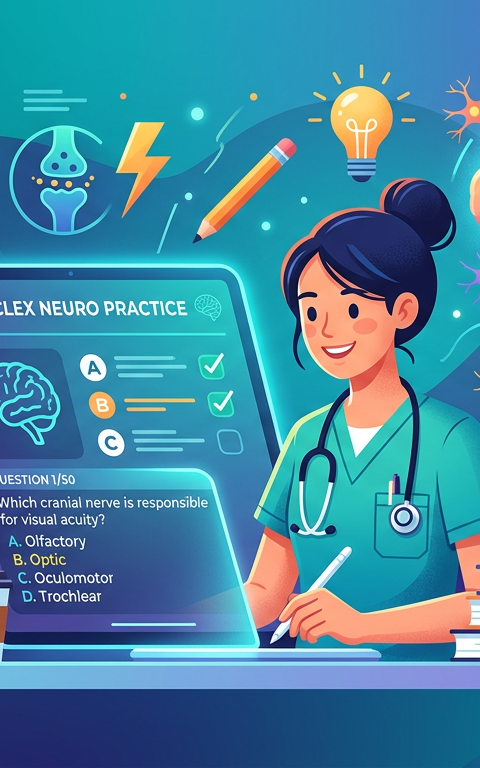
Medium NCLEX Neurology Practice Questions

Concept Explanation
Medium NCLEX Neurology Practice Questions focus on assessing a nurse's ability to apply clinical judgment to common neurological disorders such as stroke, seizure activity, increased intracranial pressure (ICP), and degenerative conditions. Success in this area requires understanding the physiological changes in the central and peripheral nervous systems and prioritizing interventions based on the ABCs (Airway, Breathing, Circulation) and safety. For instance, managing a patient with a suspected spinal cord injury requires immediate stabilization, while a patient experiencing a stroke necessitates rapid assessment using the NIH Stroke Scale. Nurses must also be proficient in recognizing subtle changes in the Glasgow Coma Scale, which can indicate life-threatening neurological deterioration. Mastering these concepts is a fundamental part of general NCLEX Med Surg Practice Questions with Answers, as neurological status influences every other body system.
Solved Examples
- Example: Managing Increased Intracranial Pressure (ICP)
A client with a head injury has an ICP of . The nurse notes the client is restless and the pupils are sluggish. What is the priority nursing action?- Assess the client's airway and oxygenation.
- Elevate the head of the bed to .
- Administer a prescribed sedative.
- Notify the healthcare provider immediately.
- Example: Seizure Precautions
A nurse is caring for a client with a history of tonic-clonic seizures. Which equipment is most essential to have at the bedside?- Padded tongue blades and a reflex hammer.
- Suction equipment and an oxygen mask.
- An oral airway and a tracheostomy kit.
- Restraints and a bedside commode.
- Example: Myasthenia Gravis (MG) Medication Timing
A client with Myasthenia Gravis is prescribed pyridostigmine. To maximize the client's ability to eat safely, when should the nurse administer this medication?- Immediately after meals.
- Two hours before meals.
- 30 to 60 minutes before meals.
- At bedtime.
Practice Questions
1. A nurse is assessing a client who just returned from a lumbar puncture. Which finding requires immediate intervention?
2. A client with a C6 spinal cord injury reports a sudden, severe headache and has a blood pressure of . What is the nurse's first action?
3. A nurse is caring for a client with Parkinson’s disease. Which intervention should the nurse include in the plan of care to improve mobility?
Train under NCLEX-style pressure.
Use timed NCLEX practice questions and adaptive quizzes to improve speed, accuracy, and confidence.
Start Timed Practice4. A client is admitted with suspected bacterial meningitis. Which isolation precaution should the nurse initiate?
5. Which cranial nerve is the nurse assessing when asking a client to shrug their shoulders against resistance?
6. A client who suffered a stroke two days ago has expressive aphasia. Which communication strategy is most effective?
7. The nurse is preparing to administer Mannitol to a client with cerebral edema. What is a critical nursing assessment before administration?
8. A client with Multiple Sclerosis (MS) reports extreme fatigue. Which instruction should the nurse provide?
Answers & Explanations
- Answer: Clear drainage on the dressing. Clear drainage may indicate a cerebrospinal fluid (CSF) leak, which increases the risk of meningitis and needs immediate reporting. A headache is common but managed with fluids and lying flat.
- Answer: Sit the client upright. This client is showing signs of autonomic dysreflexia. Sitting the client up is the first step to help lower blood pressure through orthostatic changes before identifying the trigger (like a full bladder).
- Answer: Teach the client to walk with a wide-based gait and look at the horizon. This helps maintain balance and counteracts the shuffling gait characteristic of Parkinson's.
- Answer: Droplet precautions. Bacterial meningitis is transmitted through respiratory secretions; therefore, droplet precautions (mask) are required until the client has been on antibiotics for 24 hours. Refer to the CDC guidelines on isolation for more details on transmission-based precautions.
- Answer: Cranial Nerve XI (Spinal Accessory). This nerve controls the sternocleidomastoid and trapezius muscles, which are responsible for shoulder shrugging and head turning.
- Answer: Provide a picture board or use simple "yes/no" questions. Expressive aphasia means the client knows what they want to say but cannot produce the words; visual aids reduce frustration.
- Answer: Check the medication for crystals and use a filtered needle. Mannitol can crystallize in the vial, especially when cool. It is an osmotic diuretic that requires careful monitoring of renal function. You can practice related calculations with Medium Dosage Calculation Word Problems Practice Questions.
- Answer: Group activities together with frequent rest periods in between. Energy conservation is vital for MS patients to prevent exacerbations caused by overexertion. Utilizing the AI MasterPlan can help nursing students balance their own study schedules to avoid similar burnout.
1. Which assessment finding is a component of Cushing’s Triad, indicating late-stage increased ICP?
Frequently Asked Questions
What is the difference between an ischemic and hemorrhagic stroke on the NCLEX?
An ischemic stroke occurs when a clot blocks blood flow to the brain, whereas a hemorrhagic stroke involves bleeding into the brain tissue. On the NCLEX, the priority is often determining the type via a CT scan because treatments like anticoagulants or tPA are contraindicated in hemorrhagic strokes.
How do I remember the levels of a Glasgow Coma Scale (GCS) score?
The GCS measures Eye Opening (4 points), Verbal Response (5 points), and Motor Response (6 points) for a total of 15. A score of 8 or less typically indicates a severe brain injury, often summarized by the phrase "Less than 8, intubate."
What is the priority for a patient with Autonomic Dysreflexia?
The immediate priority is to sit the patient up to lower blood pressure and then identify the noxious stimulus, which is usually a distended bladder or impacted bowel. Untreated, it can lead to a stroke or seizure due to extreme hypertension.
Why is Decerebrate posturing considered worse than Decorticate posturing?
Decerebrate posturing (arms extended) indicates damage to the brainstem, which controls vital life functions. Decorticate posturing (arms flexed toward the core) indicates damage to the cerebral hemispheres but is generally associated with a slightly better prognosis than brainstem involvement.
What are the primary nursing considerations for a patient with Meningitis?
Nurses must prioritize droplet precautions, maintain a quiet and dark environment to reduce stimuli, and monitor for signs of increased intracranial pressure. Frequent neurological checks and seizure precautions are also essential components of care.
Train under NCLEX-style pressure.
Use timed NCLEX practice questions and adaptive quizzes to improve speed, accuracy, and confidence.
Start Timed PracticeEnjoyed this article?
Share it with others who might find it helpful.
Related Articles

Hard NCLEX Neurology Practice Questions
Master high-level neurology concepts with these hard NCLEX practice questions. Covers ICP, stroke management, spinal cord injuries, and more.
May 21, 2026
Easy NCLEX Neurology Practice Questions
Master the basics of neuro nursing with these easy NCLEX neurology practice questions, covering GCS, stroke, seizures, and ICP management for nursing students.
May 21, 2026

NCLEX Neurology Practice Questions with Answers
Master NCLEX neurology concepts with practice questions on ICP, stroke, seizures, and spinal cord injuries. Includes detailed answers and explanations.
May 21, 2026

Hard NCLEX Prenatal Care Practice Questions
Hard NCLEX Prenatal Care Practice Questions
May 21, 2026

Medium NCLEX Prioritization Practice Questions
Medium NCLEX Prioritization Practice Questions
May 21, 2026

Medium NCLEX Pediatric Practice Questions
Medium NCLEX Pediatric Practice Questions
May 21, 2026

Hard NCLEX Mixed Medication Practice Questions
Master high-difficulty NCLEX mixed medication questions with our comprehensive guide featuring solved examples, practice questions, and expert explanations.
May 21, 2026

Hard NCLEX Mixed SATA Practice Questions
Hard NCLEX Mixed SATA Practice Questions
May 21, 2026