Medium NCLEX Anxiety Disorder Practice Questions

Medium NCLEX Anxiety Disorder Practice Questions
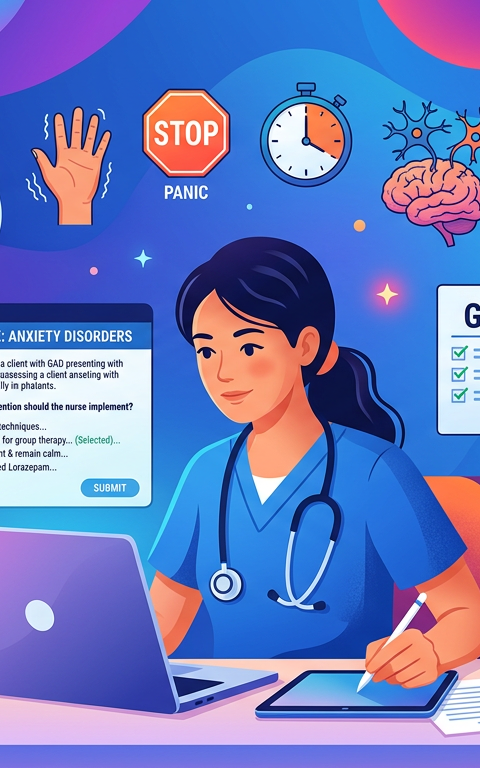
Preparing for the NCLEX requires a deep understanding of psychiatric nursing, particularly when managing patients with anxiety-related conditions. This guide provides Medium NCLEX Anxiety Disorder Practice Questions designed to challenge your clinical judgment and help you master the nuances of therapeutic communication, pharmacology, and safety interventions. By engaging with these scenarios, you will sharpen your ability to distinguish between different levels of anxiety and apply the correct nursing interventions in high-stakes environments.
Concept Explanation
Anxiety disorders are a group of mental health conditions characterized by excessive fear or worry that is disproportionate to the actual danger or situation, leading to significant functional impairment. These disorders include Generalized Anxiety Disorder (GAD), Panic Disorder, Phobias, and Obsessive-Compulsive Disorder (OCD). In a clinical setting, nurses must assess the patient's level of anxiety—mild, moderate, severe, or panic—to determine the appropriate intervention. For example, a patient in a panic state requires a quiet environment and short, simple instructions, whereas a patient with mild anxiety may benefit from therapeutic communication to explore the source of their stress. Understanding the physiological manifestations, such as tachycardia and tachypnea, is vital for differentiating anxiety from medical emergencies like myocardial infarction or pulmonary embolism. According to the National Institute of Mental Health, anxiety disorders are the most common mental illness in the U.S., affecting millions of adults annually. Nurses often use tools like the DSM-5 criteria to guide their assessments and care plans.
Solved Examples
- Scenario: A client is admitted with severe anxiety and is pacing the hallway, breathing rapidly, and reporting a feeling of "impending doom."
Solution:- Assess the level of anxiety: The symptoms (pacing, tachypnea, impending doom) indicate severe to panic-level anxiety.
- Prioritize safety: The nurse should stay with the client to ensure they do not harm themselves or others.
- Reduce stimuli: Move the client to a quiet, dimly lit room.
- Communicate effectively: Use short, simple, and firm sentences to provide direction.
- Scenario: A client with Obsessive-Compulsive Disorder (OCD) spends 2 hours washing their hands every morning, causing them to miss breakfast.
Solution:- Acknowledge the ritual: Do not abruptly stop the behavior, as this will increase anxiety.
- Adjust the schedule: Allow extra time in the morning for the ritual initially to ensure the client can attend to nutritional needs.
- Set limits: Gradually work with the client and the treatment team to set time limits on the ritualistic behavior.
- Provide skin care: Monitor for skin breakdown and provide moisturizing agents.
- Scenario: A nurse is preparing to administer Lorazepam to a client experiencing an acute panic attack.
Solution:- Verify the order: Ensure the dosage and route are correct for acute management.
- Assess baseline vitals: Check respiratory rate and blood pressure, as benzodiazepines can cause CNS depression.
- Educate the client: Inform them that the medication may cause drowsiness and they should not get out of bed without assistance.
- Monitor for efficacy: Evaluate if the client's physical symptoms and subjective feelings of panic decrease within 30-60 minutes.
Practice Questions
1. A nurse is caring for a client who is experiencing a panic attack. Which of the following nursing interventions is the priority?
2. A client with Generalized Anxiety Disorder (GAD) is prescribed Buspirone. Which statement by the client indicates a need for further teaching regarding this medication?
3. A client is diagnosed with Agoraphobia. The nurse understands that this condition is primarily characterized by which of the following?
Feel more prepared for exam day.
Strengthen your clinical judgment and retention with AI-powered NCLEX preparation tools.
Start Preparing Free4. During a group therapy session, a client with Social Anxiety Disorder begins to sweat profusely and states, "Everyone is judging how I speak." What is the nurse's best response?
5. A nurse is assessing a client for potential side effects of long-term Alprazolam use. Which finding should the nurse report to the provider immediately?
6. A client with OCD is being treated with Clomipramine. The nurse should monitor the client for which of the following common side effects? (Select all that apply.)
7. A nurse is evaluating a client's progress in managing their GAD. Which outcome indicates that the client’s coping mechanisms are effective?
8. A client is admitted to the psychiatric unit with a diagnosis of Body Dysmorphic Disorder. The nurse should prioritize which assessment?
9. A client is experiencing moderate anxiety before a scheduled surgical procedure. Which action should the nurse take first?
10. A nurse is providing discharge teaching for a client with a history of panic attacks. Which lifestyle modification should be emphasized to reduce the frequency of attacks?
Answers & Explanations
- Answer: Stay with the client and remain calm.
During a panic attack, the client's safety is the priority. Staying with the client provides a sense of security and prevents injury. Using a calm, low-pitched voice helps de-escalate the situation. This is a core concept often covered in mental health exam practice. - Answer: "I will take this medicine only when I feel a panic attack coming on."
Buspirone is not an "as-needed" (PRN) medication; it must be taken daily as prescribed to maintain therapeutic levels. It usually takes 2-4 weeks to reach full effect. - Answer: Fear of being in places or situations from which escape might be difficult.
Agoraphobia involves intense fear of open spaces, crowds, or being outside alone because the individual feels they cannot escape if they have a panic attack. - Answer: "I can see that you are feeling uncomfortable; let's step into the hall for a moment."
Removing the client from the stressful stimulus (the group) and acknowledging their feelings is an appropriate intervention for acute social anxiety. - Answer: Increased confusion and ataxia.
In older adults or with long-term use, benzodiazepines like Alprazolam can cause significant cognitive impairment and coordination issues, increasing the risk of falls. - Answer: Dry mouth, Constipation, and Blurred vision.
Clomipramine is a tricyclic antidepressant often used for OCD, known for its strong anticholinergic side effects. - Answer: The client identifies triggers that increase their worry and uses deep breathing.
Effective coping involves recognizing stressors and utilizing healthy relaxation techniques to manage the physiological response to anxiety. Many students use the AI MasterPlan to schedule specific study sessions on these behavioral interventions. - Answer: Risk for self-harm or suicide.
Clients with Body Dysmorphic Disorder have high rates of depression and suicidal ideation due to their intense dissatisfaction with their appearance. - Answer: Encourage the client to verbalize their feelings and concerns.
In moderate anxiety, the client's perceptual field is narrowed but they can still process information. Talking through the anxiety can help them regain control. - Answer: Avoiding caffeine and other stimulants.
Caffeine can mimic or exacerbate the physiological symptoms of anxiety, such as tachycardia, which can trigger a panic attack in susceptible individuals.
1. Which level of anxiety is characterized by a greatly reduced perceptual field where the individual can only focus on one detail?
Frequently Asked Questions
What is the difference between GAD and Panic Disorder?
Generalized Anxiety Disorder (GAD) involves chronic, persistent worry about everyday life for at least six months, while Panic Disorder is characterized by sudden, intense, and recurrent episodes of terror known as panic attacks. GAD is a constant state of tension, whereas Panic Disorder involves discrete periods of acute physiological distress.
How do SSRIs help with anxiety disorders?
Selective Serotonin Reuptake Inhibitors (SSRIs) increase the availability of serotonin in the synaptic cleft, which helps regulate mood and reduce the symptoms of anxiety over time. They are considered first-line long-term treatments because they are non-habit forming compared to benzodiazepines.
What are the physical symptoms of severe anxiety?
Physical symptoms of severe anxiety include tachycardia, palpitations, rapid shallow breathing, diaphoresis, and trembling. The individual may also experience nausea, dizziness, and a sense of "impending doom" or loss of control.
Can anxiety mimic a heart attack?
Yes, the symptoms of a panic attack, such as chest pain and shortness of breath, closely resemble a myocardial infarction. Nurses must always perform a focused physical assessment and often an EKG to rule out cardiac issues before concluding the symptoms are purely psychological.
Why is it important not to stop rituals in OCD abruptly?
Abruptly stopping a ritualistic behavior in a client with OCD can lead to an overwhelming spike in anxiety and potential panic. The rituals serve as a maladaptive defense mechanism to manage intrusive thoughts, so they must be reduced gradually through therapy like Exposure and Response Prevention (ERP).
What is the nurse's role in Systematic Desensitization?
The nurse supports the client as they are gradually exposed to a feared object or situation while using relaxation techniques. The goal is to replace the fear response with a relaxation response through incremental steps, often used for phobias. For more on behavioral health scenarios, check out psychiatric practice questions.
Feel more prepared for exam day.
Strengthen your clinical judgment and retention with AI-powered NCLEX preparation tools.
Start Preparing FreeEnjoyed this article?
Share it with others who might find it helpful.
Related Articles
Hard NCLEX Anxiety Disorder Practice Questions
Master Hard NCLEX Anxiety Disorder Practice Questions with our comprehensive guide. Learn priority interventions, pharmacology, and clinical judgment for psych nursing.
May 21, 2026

Easy NCLEX Anxiety Disorder Practice Questions
Master Easy NCLEX Anxiety Disorder Practice Questions with our guide on anxiety levels, nursing interventions, and medications. Boost your exam confidence today!
May 21, 2026

NCLEX Anxiety Disorder Practice Questions with Answers
NCLEX Anxiety Disorder Practice Questions with Answers
May 21, 2026

Hard NCLEX Prenatal Care Practice Questions
Hard NCLEX Prenatal Care Practice Questions
May 21, 2026

Medium NCLEX Prioritization Practice Questions
Medium NCLEX Prioritization Practice Questions
May 21, 2026

Medium NCLEX Pediatric Practice Questions
Medium NCLEX Pediatric Practice Questions
May 21, 2026

Hard NCLEX Mixed Medication Practice Questions
Master high-difficulty NCLEX mixed medication questions with our comprehensive guide featuring solved examples, practice questions, and expert explanations.
May 21, 2026

Hard NCLEX Mixed SATA Practice Questions
Hard NCLEX Mixed SATA Practice Questions
May 21, 2026