Medium MCAT Reproduction Practice Questions
Medium MCAT Reproduction Practice Questions
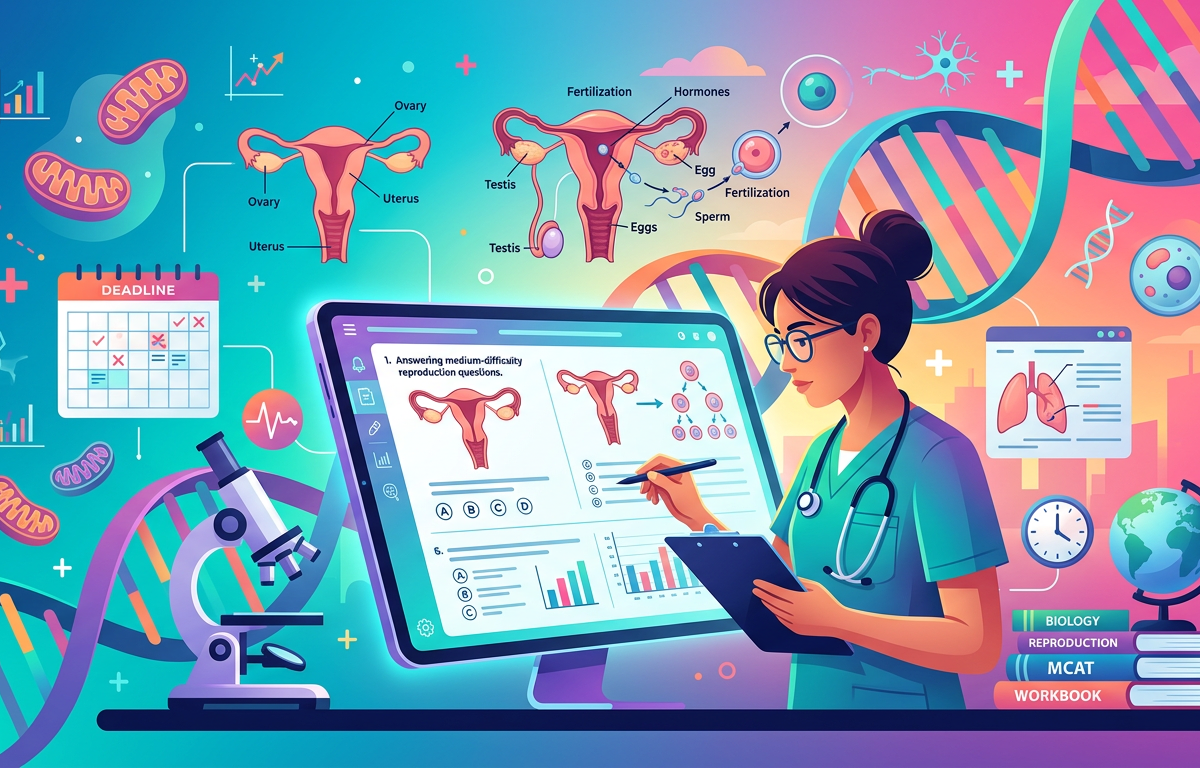
Mastering the biology of human development and fertility is a cornerstone of medical education, making reproduction a high-yield topic on the MCAT. These Medium MCAT Reproduction Practice Questions are designed to test your understanding of hormonal cycles, gametogenesis, and embryological development. By using retrieval practice, you can strengthen your memory of the complex feedback loops that govern the human reproductive system.
Concept Explanation
MCAT reproduction covers the physiological and anatomical processes involved in human procreation, including gametogenesis, the menstrual cycle, fertilization, and embryogenesis. At its core, this topic focuses on how the hypothalamus, anterior pituitary, and gonads interact via the hypothalamic-pituitary-gonadal (HPG) axis. For instance, Gonadotropin-releasing hormone (GnRH) stimulates the release of Follicle-Stimulating Hormone (FSH) and Luteinizing Hormone (LH), which then regulate the production of testosterone in males or estrogen and progesterone in females. Understanding these pathways is essential for solving MCAT reproduction practice questions that involve hormonal imbalances or developmental defects. Furthermore, embryogenesis follows a predictable path from zygote to blastocyte, followed by gastrulation—where the three germ layers (ectoderm, mesoderm, and endoderm) are formed—and finally neurulation.
Solved Examples
Review these worked examples to understand the logic required for medium-difficulty reproduction questions.
- Question: A patient has a mutation that prevents the formation of the corpus luteum after ovulation. Which hormone level would be most significantly decreased during the secretory phase of the menstrual cycle?
Solution:- Identify the role of the corpus luteum: It is the structure formed from the ruptured follicle after ovulation.
- Recall the hormones produced: The corpus luteum primarily secretes progesterone (and some estrogen) to maintain the uterine lining.
- Connect to the secretory phase: The secretory phase is dominated by progesterone.
- Conclusion: Progesterone levels would be significantly decreased.
- Question: During spermatogenesis, at which stage does the cell first become haploid?
Solution:- Trace the lineage: Spermatogonium (2n) → Primary Spermatocyte (2n) → Secondary Spermatocyte (n).
- Identify the division: Meiosis I is the reductional division where homologous chromosomes separate.
- Conclusion: The secondary spermatocyte is the first haploid cell in the lineage.
- Question: Which germ layer is responsible for the development of the adrenal medulla?
Solution:- Recall the origin of the nervous system: The ectoderm gives rise to the neural tube and neural crest cells.
- Identify the adrenal medulla's function: It secretes catecholamines (epinephrine/norepinephrine) and is essentially a modified postganglionic sympathetic neuron.
- Connect the tissue type: Since it originates from neural crest cells, it comes from the ectoderm. (Note: The adrenal cortex comes from the mesoderm).
Practice Questions
Test your knowledge with these practice questions. Ensure you can explain the "why" behind each answer to maximize your MCAT biology exam practice.
- Which of the following hormones reaches its peak concentration just before ovulation occurs?
- A researcher inhibits the acrosomal reaction in a population of sperm. What is the most likely result when these sperm are introduced to healthy oocytes?
- During the third week of human development, a process occurs that transforms the blastula into a three-layered structure. What is this process called?
Need more MCAT practice questions?
Generate unlimited MCAT-style questions with instant explanations and adaptive practice powered by Bevinzey AI.
Generate Questions Free- In the male reproductive system, where do sperm cells gain motility and the ability to fertilize an egg?
- A drug that blocks the action of Follicle-Stimulating Hormone (FSH) in a male would most likely result in what physiological change?
- Which embryonic structure is responsible for the formation of the vertebral column?
- At the end of Meiosis I in oogenesis, the cell divides asymmetrically. What is the smaller, non-functional cell called?
- The "fast block" to polyspermy involves which of the following mechanisms?
- Which of the following tissues is derived from the endoderm?
- If the hCG (human chorionic gonadotropin) signal fails during the first trimester of pregnancy, what is the immediate consequence?
Answers & Explanations
- Luteinizing Hormone (LH): A sudden surge in LH, triggered by high levels of estrogen, is the direct cause of ovulation.
- Failure to penetrate the zona pellucida: The acrosomal reaction releases enzymes that digest the protective zona pellucida of the egg. Without it, the sperm cannot reach the egg's plasma membrane.
- Gastrulation: This is the phase where the single-layered blastula reorganizes into a gastrula with three germ layers: ectoderm, mesoderm, and endoderm.
- Epididymis: While sperm are produced in the seminiferous tubules, they migrate to the epididymis to mature, gain motility, and be stored.
- Decreased spermatogenesis: FSH stimulates the Sertoli cells in the testes, which are necessary for proper sperm development.
- Notochord: The notochord (derived from mesoderm) induces the formation of the neural plate and eventually contributes to the intervertebral discs.
- First Polar Body: Oogenesis produces one large secondary oocyte and one small polar body to conserve cytoplasm for the potential zygote.
- Depolarization of the egg plasma membrane: The fast block occurs when sodium channels open, changing the membrane potential to prevent other sperm from fusing.
- Lining of the digestive tract: The endoderm forms the "inner" linings, including the epithelial lining of the gastrointestinal and respiratory tracts.
- Degeneration of the corpus luteum: hCG mimics LH to maintain the corpus luteum. Without it, progesterone levels drop, leading to the shedding of the endometrium (miscarriage).
1. Which structure secretes progesterone during the second and third trimesters of pregnancy?
Frequently Asked Questions
What is the difference between the follicular phase and the luteal phase?
The follicular phase occurs before ovulation and is characterized by follicle growth and rising estrogen, while the luteal phase occurs after ovulation and is defined by the activity of the corpus luteum and high progesterone levels.
How does the MCAT test the germ layers?
The MCAT frequently asks you to categorize adult tissues into their embryonic origins: ectoderm (nervous system/skin), mesoderm (muscle/circulatory/bone), and endoderm (internal linings/organs). You can find more details in our MCAT physiology practice questions.
What is the role of the Sertoli cells?
Sertoli cells are located in the seminiferous tubules and act as "nurse" cells that nourish and support developing sperm cells during spermatogenesis.
When does an egg complete Meiosis II?
A secondary oocyte remains arrested in metaphase II until it is fertilized by a sperm cell, at which point it completes the second meiotic division.
What are the three fetal shunts and why are they important?
The foramen ovale, ductus arteriosus, and ductus venosus redirect blood flow away from the non-functional fetal lungs and liver, according to clinical embryology resources.
Need more MCAT practice questions?
Generate unlimited MCAT-style questions with instant explanations and adaptive practice powered by Bevinzey AI.
Generate Questions FreeReviewed by
Michael Danquah, MS, PhD
Dr. Michael Danquah is a professor of pharmaceutical sciences and founder of several educational technology platforms focused on improving student learning and performance.
Enjoyed this article?
Share it with others who might find it helpful.
Related Articles
Hard MCAT Reproduction Practice Questions
Hard MCAT Reproduction Practice Questions
May 9, 2026

Hard MCAT Philosophy Passage Practice Questions
Master Hard MCAT Philosophy Passage Practice Questions with our comprehensive guide featuring solved examples, practice questions, and expert explanations.
May 17, 2026

Hard MCAT Humanities Passage Practice Questions
Master Hard MCAT Humanities Passage Practice Questions with our comprehensive guide featuring solved examples, practice questions, and expert strategies.
May 17, 2026

Hard MCAT Critical Analysis Practice Questions
Hard MCAT Critical Analysis Practice Questions
May 17, 2026

Hard MCAT Reading Comprehension Practice Questions
Hard MCAT Reading Comprehension Practice Questions
May 17, 2026

Hard MCAT CARS Passage Practice Questions
Master high-difficulty MCAT CARS passages with our expert guide featuring solved examples, practice questions, and detailed logical analysis.
May 17, 2026

Hard MCAT CARS Practice Questions
Master Hard MCAT CARS Practice Questions with our comprehensive guide featuring solved examples, practice passages, and expert reasoning strategies.
May 17, 2026

Hard MCAT Sensation and Perception Practice Questions
Master advanced MCAT Sensation and Perception concepts with hard practice questions, Weber's Law calculations, and detailed explanations of sensory pathways.
May 17, 2026