Medium Cell Structure Practice Questions Practice Questions
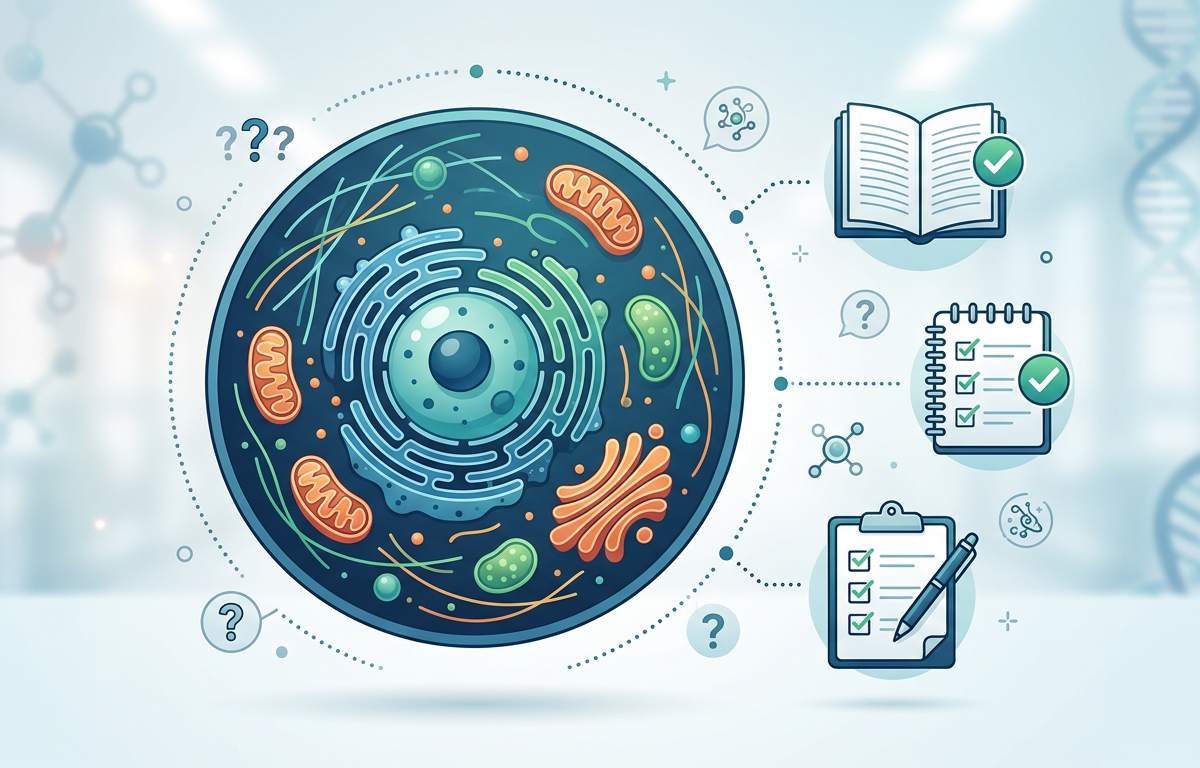
Medium Cell Structure Practice Questions Practice Questions
Understanding the intricate world inside a cell is a cornerstone of biology. From the energy-producing mitochondria to the genetic blueprint in the nucleus, each component has a vital role. This guide provides a series of medium-level cell structure practice questions designed to test and deepen your knowledge of how these microscopic factories operate. Mastering these concepts is essential for success in any biology course.
Concept Explanation
Cell structure refers to the arrangement of different components, known as organelles, within a cell, as well as the overall organization of the cell itself. All life on Earth is composed of cells, which are the smallest units of life. There are two primary categories of cells: prokaryotic and eukaryotic. Prokaryotic cells (like bacteria) are simpler, lacking a true nucleus and other membrane-bound organelles. Eukaryotic cells (found in plants, animals, fungi, and protists) are more complex, featuring a nucleus that houses the cell's genetic material and numerous specialized organelles suspended in the cytoplasm.
Key Eukaryotic Organelles and Their Functions:
- Nucleus: Contains the cell's DNA and controls cell activities by regulating gene expression.
- Ribosomes: Responsible for protein synthesis. They can be free in the cytoplasm or attached to the endoplasmic reticulum.
- Endoplasmic Reticulum (ER): A network of membranes involved in protein and lipid synthesis. The Rough ER is studded with ribosomes for protein modification, while the Smooth ER specializes in lipid synthesis, detoxification, and calcium storage.
- Golgi Apparatus (or Golgi Complex): Modifies, sorts, and packages proteins and lipids for secretion or delivery to other organelles.
- Mitochondria: The sites of cellular respiration, generating most of the cell's supply of adenosine triphosphate (ATP), used as a source of chemical energy.
- Lysosomes: Contain digestive enzymes to break down waste materials, cellular debris, and foreign invaders.
- Cell Membrane: A selectively permeable barrier that encloses the cell, regulating what enters and exits.
Plant Cells vs. Animal Cells
While sharing many common organelles, plant and animal cells have key differences. Plant cells have a rigid cell wall outside the cell membrane for structural support, a large central vacuole that stores water and maintains turgor pressure, and chloroplasts, the site of photosynthesis. Animal cells lack these structures but may have smaller vacuoles and centrioles, which are involved in cell division. For more in-depth information on cell types, Khan Academy provides an excellent overview.
Solved Examples of Cell Structure Practice Questions
This section provides worked-out solutions to common questions about cell structure, demonstrating how to identify organelles and their functions. Each solution follows a step-by-step logical process.
Example 1: Identifying a Cell Type
Question: A scientist observes a cell under a microscope that has a distinct cell wall, a large central vacuole, and numerous small green organelles. What type of cell is it, and what are the green organelles?
Solution:
- Analyze the given features: The cell has a cell wall, a large central vacuole, and green organelles.
- Compare features to known cell types: Animal cells lack a cell wall and a large central vacuole. Plant cells possess both of these structures. Prokaryotic cells have a cell wall but lack complex organelles like a large vacuole.
- Identify the cell type: The presence of a cell wall and a large central vacuole are hallmark features of a plant cell.
- Identify the green organelles: The green color and the context of a plant cell strongly suggest the organelles are chloroplasts. Chloroplasts contain the pigment chlorophyll, which is green and is the site of photosynthesis.
- Final Answer: The cell is a plant cell. The green organelles are chloroplasts.
Example 2: Relating Organelle Abundance to Function
Question: Cells in the pancreas are responsible for producing and secreting large amounts of digestive enzymes, which are proteins. Which two organelles would you expect to be particularly abundant in these pancreatic cells?
Solution:
- Identify the primary function of the cell: The cell's main job is to produce and secrete proteins (digestive enzymes).
- Trace the path of protein production and secretion: This process, part of the endomembrane system, starts with protein synthesis and ends with export from the cell.
- Identify the organelle for protein synthesis: Ribosomes are the sites of protein synthesis. Proteins destined for secretion are synthesized on ribosomes attached to the Rough Endoplasmic Reticulum (Rough ER). Therefore, a high abundance of Rough ER (and its associated ribosomes) is expected.
- Identify the organelle for protein packaging and export: After synthesis and modification in the ER, proteins are sent to the Golgi apparatus. The Golgi further modifies, sorts, and packages these proteins into vesicles for secretion. A high rate of secretion requires a well-developed Golgi apparatus.
- Final Answer: Pancreatic cells would have an abundance of Rough Endoplasmic Reticulum and Golgi apparatus to handle the high volume of protein synthesis and secretion.
Example 3: Consequence of Organelle Malfunction
Question: A genetic disorder causes lysosomes to lack a specific digestive enzyme. How would this affect the cell?
Solution:
- Recall the function of lysosomes: Lysosomes are the cell's recycling center. They contain hydrolytic enzymes that break down waste products, damaged organelles, and macromolecules.
- Consider the consequence of a missing enzyme: If a specific enzyme is missing, the lysosome cannot break down the substrate that enzyme targets.
- Predict the cellular outcome: The undigested substrate will accumulate within the lysosomes. This causes the lysosomes to swell, which can interfere with normal cell processes and eventually lead to cell damage or death.
- Relate to a real-world example: This scenario describes a category of diseases known as lysosomal storage diseases, such as Tay-Sachs disease, where the lack of an enzyme leads to the buildup of lipids in nerve cells.
- Final Answer: The absence of a lysosomal enzyme would lead to the accumulation of undigested material within the cell, causing swelling of lysosomes and disrupting cellular function, potentially leading to cell death.
Practice Questions
Test your understanding of cell biology with these 10 medium-difficulty cell structure practice questions. Detailed answers are provided below.
1. A cell is observed to have a high concentration of smooth endoplasmic reticulum (Smooth ER). What is a likely primary function of this cell?
2. If a cell's mitochondria were to stop functioning, what would be the most immediate and significant consequence?
3. A toxin is introduced to a group of cells that specifically destroys the Golgi apparatus. Which of the following processes would be most directly inhibited?
4. Which of the following correctly traces the path of a protein that is destined for secretion from a eukaryotic cell?
5. A key difference between prokaryotic and eukaryotic cells is that prokaryotic cells lack what specific feature?
6. A plant cell is placed in a hypotonic solution (pure water). It swells but does not burst. What cellular structure is primarily responsible for preventing the cell from bursting?
7. Muscle cells require large amounts of energy to contract. Which organelle would you expect to be found in high numbers in muscle cells compared to skin cells?
8. What is the primary role of ribosomes in a cell?
9. How does the structure of the cell membrane relate to its function of selective permeability?
10. A cell is identified as a prokaryote. Which of the following structures could it possess?
Answers & Explanations
This section contains detailed answers and explanations for all the practice questions on cell structure listed above.
- Answer: A likely primary function is detoxification or lipid synthesis. Explanation: The smooth endoplasmic reticulum (Smooth ER) has several key functions, including the synthesis of lipids, phospholipids, and steroids. It is also crucial for detoxifying drugs and poisons. Therefore, a cell with abundant Smooth ER, such as a liver cell, is likely specialized in one of these roles.
- Answer: The cell would be unable to produce sufficient ATP to power its metabolic processes. Explanation: Mitochondria are the primary sites of cellular respiration, the process that generates the vast majority of a cell's ATP. Without functional mitochondria, the cell would have to rely solely on glycolysis, which produces far less ATP. This energy crisis would quickly halt most cellular activities.
- Answer: The modification, sorting, and packaging of proteins for secretion. Explanation: The Golgi apparatus acts as the cell's post office. It receives proteins and lipids from the endoplasmic reticulum, modifies them, sorts them, and packages them into vesicles for delivery to other destinations, including outside the cell (secretion). While protein synthesis (ribosomes/ER) might continue for a short time, the processing and export pathway would be completely blocked.
- Answer: Rough ER → Golgi apparatus → Vesicle → Plasma membrane. Explanation: A protein destined for secretion is first synthesized on a ribosome and threaded into the Rough ER for folding and modification. It then travels via a transport vesicle to the Golgi apparatus for further processing and packaging. Finally, it is enclosed in another vesicle that fuses with the plasma membrane, releasing the protein outside the cell.
- Answer: A membrane-bound nucleus. Explanation: The defining characteristic that separates eukaryotes from prokaryotes is the presence of a true nucleus, an organelle enclosed by a double membrane that contains the cell's primary genetic material. Prokaryotes have a nucleoid region where DNA is located, but it is not enclosed by a membrane. They also lack other membrane-bound organelles like mitochondria and the ER.
- Answer: The cell wall. Explanation: When a plant cell is in a hypotonic solution, water rushes into the cell via osmosis, increasing the pressure against the cell membrane. The rigid cell wall, made primarily of cellulose, provides structural support and pushes back against this pressure (turgor pressure), preventing the cell from swelling to the point of bursting (lysis). Animal cells, lacking a cell wall, would burst in the same environment.
- Answer: Mitochondria. Explanation: Muscle contraction is a highly energy-intensive process that requires a constant supply of ATP. Mitochondria are the organelles responsible for generating most of the cell's ATP through cellular respiration. Therefore, cells with high energy demands, like muscle cells, are densely packed with mitochondria. Converting measurements for these organelles often requires skill with decimals and powers, similar to what's covered in Unit Conversion Practice Questions.
- Answer: Protein synthesis. Explanation: Ribosomes are the cellular machinery responsible for translating the genetic code carried by messenger RNA (mRNA) into polypeptide chains, which then fold into functional proteins. They are fundamental to virtually all cell functions, as proteins act as enzymes, structural components, and signaling molecules.
- Answer: The cell membrane is a phospholipid bilayer with embedded proteins, which allows it to be selectively permeable. Explanation: The phospholipid bilayer itself is permeable to small, nonpolar molecules but impermeable to most ions and large polar molecules. The embedded proteins act as channels and transporters that regulate the passage of specific substances across the membrane. This combination of a restrictive lipid barrier and specific protein gateways is the basis of selective permeability.
- Answer: A cell wall, ribosomes, and a plasma membrane. Explanation: While prokaryotes lack a nucleus and membrane-bound organelles, they share some fundamental structures with eukaryotes. All cells have a plasma membrane to enclose their contents, ribosomes for protein synthesis, and cytoplasm. Many prokaryotes, like bacteria, also have a cell wall for protection and structural integrity, though its composition (peptidoglycan) differs from that of plant cell walls.
1. Take this quick multiple-choice quiz to rapidly assess your knowledge of key cell structure concepts. 1. Which organelle is primarily responsible for synthesizing lipids and detoxifying harmful substances?
Frequently Asked Questions
Find answers to common questions about cell structure, including the differences between cell types and the functions of key organelles.
What is the main difference between a prokaryotic and a eukaryotic cell?
The main difference is that eukaryotic cells have a membrane-bound nucleus that contains their genetic material, while prokaryotic cells do not. Eukaryotic cells also have other membrane-bound organelles like mitochondria and the endoplasmic reticulum, which are absent in prokaryotes.
What are the three main components found in all cells?
All cells, whether prokaryotic or eukaryotic, have three common components: a plasma membrane that acts as an outer boundary, cytoplasm filling the cell's interior, and ribosomes to synthesize proteins. They also all contain DNA as their genetic material.
Why are plant cells more rigid than animal cells?
Plant cells are more rigid because they have a cell wall located outside of their plasma membrane. This wall is primarily composed of cellulose, a sturdy polymer that provides structural support and protection, giving the plant its shape and preventing it from bursting due to water intake.
What is the function of the Golgi apparatus?
The Golgi apparatus functions like a cellular post office. It receives proteins and lipids from the endoplasmic reticulum, modifies them (e.g., by adding carbohydrates), sorts them, and packages them into vesicles for transport to their final destination, either inside or outside the cell.
How do mitochondria generate energy for the cell?
Mitochondria generate energy through a process called cellular respiration. They take in nutrients like glucose and use oxygen to break them down in a series of chemical reactions, releasing energy that is captured in the form of adenosine triphosphate (ATP), the cell's main energy currency.
What is the cytoskeleton and what does it do?
The cytoskeleton is a complex network of protein filaments (microtubules, microfilaments, and intermediate filaments) extending throughout the cytoplasm. It provides structural support to the cell, helps maintain its shape, facilitates cell movement, and acts as a track for transporting organelles within the cell. The forces involved in these processes can be complex, much like those studied in Newton's Laws Practice Questions.
Enjoyed this article?
Share it with others who might find it helpful.
Related Articles
Hard Cell Structure Practice Questions Practice Questions
Challenge your understanding of cell biology with these hard cell structure practice questions, complete with solved examples, detailed answers, and a quick quiz.
Apr 25, 2026
Easy Cell Structure Practice Questions Practice Questions
Master the basics of biology with our easy cell structure practice questions. This guide includes clear explanations, solved examples, and a quiz to test your knowledge.
Apr 25, 2026
Cell Structure Practice Questions Practice Questions with Answers
Cell Structure Practice Questions Practice Questions with Answers
Apr 25, 2026
Hard Microbiology Practice Questions Practice Questions
Hard Microbiology Practice Questions Practice Questions
Apr 26, 2026
Medium Microbiology Practice Questions Practice Questions
Master microbiology with our medium-level practice questions covering bacterial growth, genetics, and metabolism. Includes solved examples and a quick quiz.
Apr 26, 2026

Easy Microbiology Practice Questions Practice Questions
Easy Microbiology Practice Questions Practice Questions
Apr 26, 2026

Hard Enzyme Questions Practice Questions
Master complex biochemistry with these hard enzyme questions. Cover Michaelis-Menten kinetics, inhibition types, and Lineweaver-Burk plots with solved examples.
Apr 26, 2026

Medium Enzyme Questions Practice Questions
Master enzyme kinetics and regulation with our Medium Enzyme Questions Practice Questions. Includes solved examples, detailed explanations, and a quick quiz.
Apr 26, 2026