MCAT Glycolysis Practice Questions with Answers
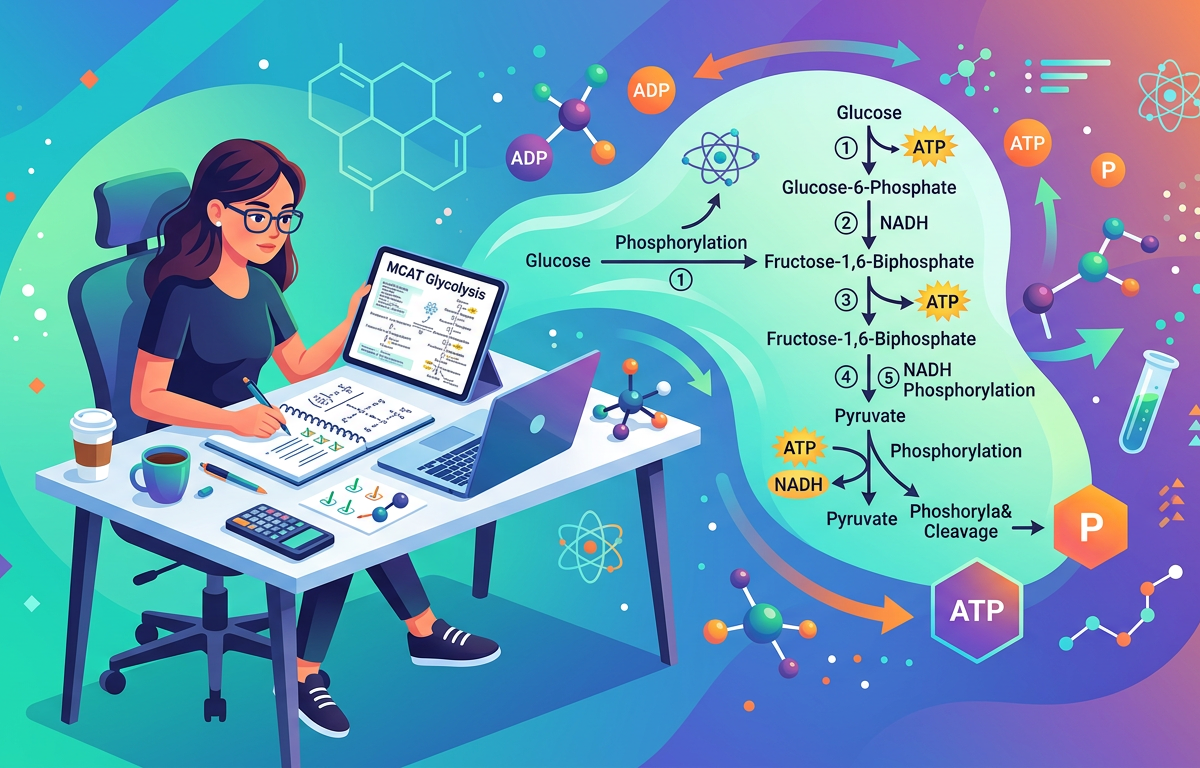
MCAT Glycolysis Practice Questions with Answers
Mastering MCAT Glycolysis is essential for any aspiring medical student, as this metabolic pathway serves as the foundation for cellular energy production and biochemical regulation. This guide provides a deep dive into the enzymatic steps, regulatory checkpoints, and net yields of the glycolytic pathway, followed by high-quality practice questions designed to mimic the rigor of the actual exam.
Concept Explanation
Glycolysis is a cytoplasmic metabolic pathway that oxidizes one molecule of glucose into two molecules of pyruvate, producing a net gain of two ATP and two NADH molecules. This process occurs in nearly all living cells and functions under both aerobic and anaerobic conditions. The pathway is divided into two main phases: the energy investment phase, where 2 ATP are consumed to prime the glucose molecule, and the energy payoff phase, where 4 ATP and 2 NADH are generated via substrate-level phosphorylation and redox reactions. Key regulatory enzymes include hexokinase (or glucokinase in the liver), phosphofructokinase-1 (PFK-1), and pyruvate kinase. These enzymes catalyze irreversible steps and are subject to allosteric regulation by the energy status of the cell (ATP/AMP ratios) and hormonal signals like insulin and glucagon. Understanding these mechanisms is as critical as mastering general chemistry principles when preparing for the biological sciences section of the MCAT.
The net reaction for glycolysis is represented as:
For more information on the biochemical thermodynamics of such pathways, you can explore resources from Khan Academy or the Nature Education Scitable.
Solved Examples
Example 1: Calculating Net ATP Yield
If a cell begins glycolysis with one molecule of glucose-6-phosphate (G6P) instead of free glucose, what is the net yield of ATP at the end of the pathway?
- Identify the starting point: G6P enters after the hexokinase step.
- The hexokinase step normally consumes 1 ATP. By starting with G6P, the cell bypasses this first investment step.
- The second investment step (PFK-1) still consumes 1 ATP.
- The payoff phase still produces 4 ATP.
- Net ATP = Payoff (4) - Investment (1) = 3 ATP.
Example 2: Redox State and Glyceraldehyde-3-Phosphate Dehydrogenase
Explain the role of in the conversion of glyceraldehyde-3-phosphate (GAP) to 1,3-bisphosphoglycerate (1,3-BPG).
- GAP is oxidized, and an inorganic phosphate is added to the molecule.
- The enzyme Glyceraldehyde-3-phosphate dehydrogenase facilitates this reaction.
- During oxidation, GAP loses electrons (and hydrogens), which are transferred to .
- This reduces to , which carries high-energy electrons to the electron transport chain.
Example 3: Regulation of PFK-1
How does Fructose-2,6-bisphosphate (F-2,6-BP) affect the rate of glycolysis in the liver?
- F-2,6-BP is a potent allosteric activator of PFK-1.
- When insulin levels are high, PFK-2 is activated, increasing levels of F-2,6-BP.
- F-2,6-BP binds to PFK-1, increasing its affinity for fructose-6-phosphate and decreasing the inhibitory effect of ATP.
- This results in an accelerated rate of glycolysis, allowing the liver to process excess blood glucose.
Practice Questions
1. Which enzyme catalyzes the first committed step of glycolysis and is considered the primary rate-limiting enzyme?
2. In the absence of oxygen, how do yeast cells regenerate to allow glycolysis to continue?
3. A patient presents with a rare deficiency in phosphoglycerate kinase. Which step of the payoff phase would be directly inhibited by this condition?
Your MCAT prep should adapt to you.
Bevinzey analyzes your performance and helps you focus on the concepts you need most.
Try Adaptive Practice4. Arsenate () is a toxic analog of phosphate that can be used by glyceraldehyde-3-phosphate dehydrogenase. If arsenate replaces phosphate, 1-arseno-3-phosphoglycerate is formed and spontaneously hydrolyzes to 3-phosphoglycerate. What is the net ATP yield of glycolysis per glucose molecule in the presence of arsenate?
5. Compare the and of hexokinase and glucokinase. Why is this difference physiologically significant in the liver vs. muscle tissue?
6. Which glycolytic intermediate is a precursor for triacylglycerol synthesis in adipocytes?
7. During intense exercise, skeletal muscle produces large amounts of lactate. What is the metabolic purpose of this conversion from pyruvate?
8. 2,3-bisphosphoglycerate (2,3-BPG) is a side product of glycolysis in red blood cells. Which enzyme's substrate is diverted to produce 2,3-BPG?
9. How does a high concentration of ATP affect the activity of PFK-1, and what type of inhibition is this?
10. If a cell is treated with a drug that inhibits triose phosphate isomerase, how many molecules of pyruvate will be produced from one molecule of glucose?
Answers & Explanations
1. Phosphofructokinase-1 (PFK-1). While hexokinase catalyzes the first step, it is not the committed step because glucose-6-phosphate can enter other pathways like the pentose phosphate pathway or glycogen synthesis. PFK-1 converts fructose-6-phosphate to fructose-1,6-bisphosphate, a molecule destined for glycolysis.
2. Ethanol Fermentation. Yeast reduces pyruvate to ethanol and . In the final step, catalyzed by alcohol dehydrogenase, is oxidized back to , which is a required cofactor for the glyceraldehyde-3-phosphate dehydrogenase step in glycolysis.
3. The conversion of 1,3-bisphosphoglycerate to 3-phosphoglycerate. This is the first step of substrate-level phosphorylation where ADP is converted to ATP. A deficiency here would halt the energy payoff phase.
4. Zero (0) net ATP. In the presence of arsenate, the step that normally produces 1,3-BPG (which would later yield ATP) is bypassed because 1-arseno-3-phosphoglycerate hydrolyzes without capturing energy in a phosphate bond. The 2 ATP produced at the pyruvate kinase step would just balance the 2 ATP consumed in the investment phase.
5. Glucokinase has a high and high . This allows the liver to respond to high blood glucose levels after a meal without becoming saturated. Hexokinase has a low , meaning it is active even at low glucose concentrations, ensuring muscle and other tissues get glucose first. This mirrors concepts found in enzyme kinetics.
6. Dihydroxyacetone phosphate (DHAP). DHAP can be reduced to glycerol-3-phosphate, which provides the glycerol backbone for the synthesis of fats (triacylglycerols).
7. Regeneration of . Under anaerobic conditions, the electron transport chain cannot oxidize . Lactate dehydrogenase reduces pyruvate to lactate to oxidize to , ensuring glycolysis can continue to provide a small amount of ATP.
8. 1,3-bisphosphoglycerate (1,3-BPG). In erythrocytes, the enzyme bisphosphoglycerate mutase converts 1,3-BPG into 2,3-BPG, which regulates hemoglobin's affinity for oxygen. This is a crucial concept often tested alongside biochemical organic reactions.
9. It decreases activity via allosteric inhibition. ATP acts as a feedback inhibitor. When energy levels are high, ATP binds to an allosteric site on PFK-1 (not the active site), lowering the enzyme's affinity for its substrate.
10. One (1) molecule of pyruvate. Triose phosphate isomerase converts DHAP into GAP. If inhibited, only the GAP produced directly from the cleavage of fructose-1,6-bisphosphate continues through the payoff phase. The DHAP molecule would be "trapped," resulting in half the normal output.
1. Which of the following enzymes catalyzes an irreversible reaction in glycolysis?
Frequently Asked Questions
What is the difference between aerobic and anaerobic glycolysis?
Aerobic glycolysis occurs when oxygen is present, allowing pyruvate to enter the mitochondria for the Krebs cycle and oxidative phosphorylation. Anaerobic glycolysis occurs in the absence of oxygen, where pyruvate is reduced to lactate (in humans) or ethanol (in yeast) to regenerate the needed for the pathway to persist.
Why is hexokinase inhibited by its product, glucose-6-phosphate?
This is a form of negative feedback inhibition that prevents the cell from hoarding excessive glucose and depleting cellular phosphate levels when energy is not needed. It ensures that glucose remains in the bloodstream for other tissues, like the brain, that have a higher demand for fuel.
Where in the cell does glycolysis take place?
Glycolysis takes place entirely within the cytosol of the cell. This location is advantageous because it allows the pathway to function independently of mitochondria, which is necessary for cells like mature red blood cells that lack organelles.
How does insulin regulate glycolysis?
Insulin promotes glycolysis by upregulating the transcription of key enzymes like glucokinase, PFK-1, and pyruvate kinase. It also activates PFK-2, leading to increased levels of fructose-2,6-bisphosphate, which strongly activates PFK-1 and overrides inhibition by ATP.
What are the three irreversible steps of glycolysis?
The three irreversible steps are catalyzed by hexokinase (Step 1), phosphofructokinase-1 (Step 3), and pyruvate kinase (Step 10). Because these steps have a large negative Gibbs free energy change (), they serve as the primary control points for the entire metabolic flux of the pathway.
Your MCAT prep should adapt to you.
Bevinzey analyzes your performance and helps you focus on the concepts you need most.
Try Adaptive PracticeReviewed by
Michael Danquah, MS, PhD
Dr. Michael Danquah is a professor of pharmaceutical sciences and founder of several educational technology platforms focused on improving student learning and performance.
Enjoyed this article?
Share it with others who might find it helpful.
Related Articles
Hard MCAT Glycolysis Practice Questions
Hard MCAT Glycolysis Practice Questions
May 14, 2026
Medium MCAT Glycolysis Practice Questions
Medium MCAT Glycolysis Practice Questions
May 14, 2026
Easy MCAT Glycolysis Practice Questions
Easy MCAT Glycolysis Practice Questions
May 14, 2026

Hard MCAT Philosophy Passage Practice Questions
Master Hard MCAT Philosophy Passage Practice Questions with our comprehensive guide featuring solved examples, practice questions, and expert explanations.
May 17, 2026

Hard MCAT Humanities Passage Practice Questions
Master Hard MCAT Humanities Passage Practice Questions with our comprehensive guide featuring solved examples, practice questions, and expert strategies.
May 17, 2026

Hard MCAT Critical Analysis Practice Questions
Hard MCAT Critical Analysis Practice Questions
May 17, 2026

Hard MCAT Reading Comprehension Practice Questions
Hard MCAT Reading Comprehension Practice Questions
May 17, 2026

Hard MCAT CARS Passage Practice Questions
Master high-difficulty MCAT CARS passages with our expert guide featuring solved examples, practice questions, and detailed logical analysis.
May 17, 2026