Hard Redox Reaction Practice Questions
Concept Explanation
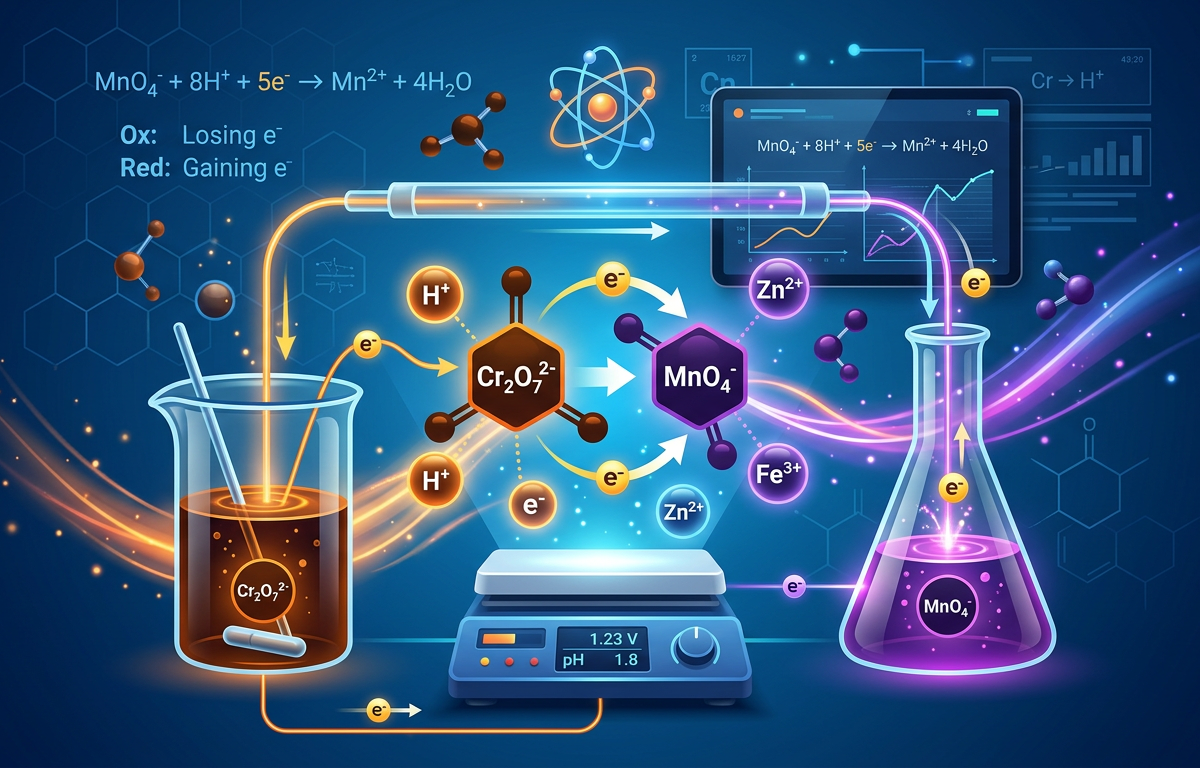
A redox reaction is a chemical process involving the transfer of electrons between two species, resulting in changes to their oxidation states. In these reactions, one substance undergoes oxidation (losing electrons) while another undergoes reduction (gaining electrons). To master Hard Redox Reaction Practice Questions, you must move beyond simple electron counting and understand complex balancing in acidic and basic media, the use of the Nernst Equation to determine non-standard potentials, and the relationship between stoichiometry and electrochemical work. According to the International Union of Pure and Applied Chemistry (IUPAC), the oxidation state is a measure of the degree of oxidation of an atom in a substance. Mastery of these concepts is essential for understanding biological respiration, industrial smelting, and battery technology.
When tackling advanced problems, the half-reaction method is the most reliable strategy. This involves splitting the overall equation into two parts: the oxidation half and the reduction half. For reactions in acidic solutions, we balance oxygen using water (H2O) and hydrogen using protons (H+). In basic solutions, we neutralize those protons with hydroxide ions (OH-). These steps ensure both mass and charge are conserved, which is the foundation of chemical stoichiometry. If you are just starting, you might find Redox Reaction Practice Questions with Answers helpful for building your foundation before attempting these harder challenges.
Solved Examples
The following examples demonstrate the step-by-step logic required to solve complex redox problems.
Example 1: Balancing in Acidic Solution
Balance the following reaction in an acidic medium: Cr2O72- + Fe2+ → Cr3+ + Fe3+
Identify the half-reactions: Fe2+ → Fe3+ (Oxidation) and Cr2O72- → Cr3+ (Reduction).
Balance atoms other than O and H: Fe is already balanced. For Chromium, Cr2O72- → 2Cr3+.
Balance Oxygen by adding H2O: Cr2O72- → 2Cr3+ + 7H2O.
Balance Hydrogen by adding H+: 14H+ + Cr2O72- → 2Cr3+ + 7H2O.
Balance charge by adding electrons: Fe2+ → Fe3+ + 1e- and 6e- + 14H+ + Cr2O72- → 2Cr3+ + 7H2O.
Equalize electrons and combine: 6Fe2+ + 14H+ + Cr2O72- → 6Fe3+ + 2Cr3+ + 7H2O.
Example 2: Disproportionation in Basic Solution
Balance the disproportionation of Cl2 into Cl- and ClO3- in a basic solution.
Write the half-reactions: Cl2 → 2Cl- (Reduction) and Cl2 → 2ClO3- (Oxidation).
Balance Oxidation half-reaction: Cl2 + 6H2O → 2ClO3- + 12H+ + 10e-.
Balance Reduction half-reaction: Cl2 + 2e- → 2Cl-.
Multiply Reduction by 5 to equalize electrons: 5Cl2 + 10e- → 10Cl-.
Combine: 6Cl2 + 6H2O → 10Cl- + 2ClO3- + 12H+. Simplify coefficients: 3Cl2 + 3H2O → 5Cl- + ClO3- + 6H+.
Convert to basic: Add 6OH- to both sides: 3Cl2 + 6OH- → 5Cl- + ClO3- + 3H2O.
Example 3: Calculating Non-Standard Potential
Calculate the cell potential at 25°C for: Zn(s) | Zn2+(0.01M) || Cu2+(2.0M) | Cu(s). E°cell = 1.10V.
Identify n (moles of electrons): Zn → Zn2+ + 2e-, so n = 2.
Set up the Nernst Equation: E = E° - (0.0592/n) log(Q).
Calculate Q: [Zn2+] / [Cu2+] = 0.01 / 2.0 = 0.005.
Calculate E: E = 1.10 - (0.0592/2) log(0.005) = 1.10 - (0.0296 * -2.301) = 1.10 + 0.068 = 1.168V.
Practice Questions
1. Balance the following redox reaction in acidic solution: MnO4- + C2O42- → Mn2+ + CO2.
2. A voltaic cell utilizes the reaction: 2Al(s) + 3Mn2+(aq) → 2Al3+(aq) + 3Mn(s). If E°cell is 0.48V, calculate the ΔG° in kJ for the process.
3. Balance the following reaction in basic solution: NiO2 + S2O32- → Ni(OH)2 + SO32-.
Want unlimited practice questions like these?
Generate AI-powered questions with step-by-step solutions on any topic.
Try Question Generator Free →4. Determine the oxidation state of Xenon in the compound XeO64-.
5. In the reaction P4 + 3OH- + 3H2O → PH3 + 3H2PO2-, identify the oxidizing agent and the reducing agent.
6. Calculate the equilibrium constant (K) at 298 K for a redox reaction where n = 2 and E°cell = 0.030 V.
7. Balance the following in acidic medium: As2O3 + NO3- → H3AsO4 + NO.
8. A sample of iron ore weighing 0.2792 g was dissolved in dilute acid and all the iron converted to Fe2+. The solution required 23.30 mL of 0.0194 M KMnO4 for titration. Calculate the percentage of iron in the ore.
9. Using the LibreTexts Chemistry standard reduction tables, determine if Ag+ can oxidize Cu(s) to Cu2+ under standard conditions.
10. Balance the reaction Br2 → BrO3- + Br- in basic solution and provide the lowest whole-number coefficients.
Answers & Explanations
Answer: 2MnO4- + 5C2O42- + 16H+ → 2Mn2+ + 10CO2 + 8H2O.
Explanation: Mn goes from +7 to +2 (5e- gain). C goes from +3 to +4 (1e- loss per C, 2e- per oxalate). To balance electrons, multiply Mn half-reaction by 2 and C half-reaction by 5. Use H+ to balance the -12 charge on the left and +4 on the right.Answer: -278 kJ.
Explanation: Use ΔG° = -nFE°cell. Here, n = 6 (since 2 Al lose 3e- each). ΔG° = -(6)(96485 C/mol)(0.48 V) = -277,876 J ≈ -278 kJ.Answer: NiO2 + S2O32- + 2H2O → Ni(OH)2 + 2SO32- + 2H+ (then neutralize). Final: NiO2 + S2O32- + H2O → Ni(OH)2 + 2SO32-.
Explanation: Ni is reduced (+4 to +2), S is oxidized (+2 to +4). Balance S first (1 S2O32- to 2SO32-). The electron exchange is 2e- for both, so they combine 1:1.Answer: +8.
Explanation: Oxygen is -2. Let x be Xe. x + 6(-2) = -4; x - 12 = -4; x = +8.Answer: P4 is both the oxidizing and reducing agent.
Explanation: This is a disproportionation reaction. Some Phosphorus atoms are reduced to PH3 (oxidation state -3) and some are oxidized to H2PO2- (oxidation state +1).Answer: 10.4.
Explanation: Use log K = (nE°)/0.0592. log K = (2 * 0.030) / 0.0592 = 1.0135. K = 101.0135 ≈ 10.32.Answer: 3As2O3 + 4NO3- + 7H2O + 4H+ → 6H3AsO4 + 4NO.
Explanation: As goes from +3 to +5 (4e- loss per As2O3). N goes from +5 to +2 (3e- gain). Multiply As reaction by 3 and N reaction by 4.Answer: 45.2%.
Explanation: Moles KMnO4 = 0.0233 L * 0.0194 M = 4.52 x 10⁻⁴ mol. Moles Fe = 5 * Moles KMnO4 = 2.26 x 10⁻³ mol. Mass Fe = 2.26 x 10-3 * 55.85 = 0.1262 g. % = (0.1262 / 0.2792) * 100 = 45.2%.Answer: Yes, E°cell = +0.46V.
Explanation: E°(Ag+/Ag) = 0.80V, E°(Cu2+/Cu) = 0.34V. E°cell = Ecathode - Eanode = 0.80 - 0.34 = +0.46V. Since E° is positive, the reaction is spontaneous.Answer: 3Br2 + 6OH- → BrO3- + 5Br- + 3H2O.
Explanation: Similar to the chlorine disproportionation, the oxidation of Br2 to BrO3- involves 10e-, while reduction to Br- involves 2e-.
1. What is the oxidation state of Manganese in the permanganate ion (MnO4-)?
Frequently Asked Questions
What is the difference between oxidation and reduction?
Oxidation is the loss of electrons by a molecule, atom, or ion, which increases its oxidation state. Reduction is the gain of electrons, which decreases the oxidation state of the species involved.
How do you balance redox reactions in a basic solution?
First, balance the reaction as if it were in an acidic solution using H+ and H2O. Then, add OH- ions to both sides to neutralize the H+, forming water, and simplify the equation.
What is a disproportionation reaction?
A disproportionation reaction is a specific type of redox reaction where a single element in one oxidation state is simultaneously oxidized and reduced to form two different products. A classic example is the decomposition of hydrogen peroxide.
Why is the Nernst Equation used?
The Nernst Equation allows chemists to calculate the cell potential of an electrochemical cell under non-standard conditions, such as varying concentrations or temperatures. It relates the reduction potential to the reaction quotient Q.
What role does the salt bridge play?
The salt bridge maintains electrical neutrality within the internal circuit of a voltaic cell by allowing ions to migrate between the two half-cells. This prevents the buildup of charge that would otherwise stop the reaction.
Can a redox reaction occur without a change in oxidation states?
No, by definition, a redox reaction must involve the transfer of electrons, which inherently causes a change in the oxidation states of at least two atoms in the reactants. If states do not change, it is likely a precipitation or acid-base reaction.
Want unlimited practice questions like these?
Generate AI-powered questions with step-by-step solutions on any topic.
Try Question Generator Free →
Want unlimited practice questions like these?
Generate AI-powered questions with step-by-step solutions on any topic.
Try Question Generator Free →Enjoyed this article?
Share it with others who might find it helpful.
Related Articles
Medium Redox Reaction Practice Questions
Master medium-level redox reaction problems with our comprehensive guide featuring solved examples, balancing tips, and practice questions for students.
Apr 4, 2026
Easy Redox Reaction Practice Questions
Master the basics of electron transfer with these easy redox reaction practice questions, featuring step-by-step solutions and clear explanations.
Apr 4, 2026
Redox Reaction Practice Questions with Answers
Master redox reactions with these practice questions and answers. Learn to identify oxidation, reduction, and balancing techniques for your chemistry exams.
Apr 3, 2026
Hard Balancing Redox Practice Questions
Master complex chemical equations with our hard balancing redox practice questions. Includes step-by-step solutions for acidic and basic media.
Apr 4, 2026
Medium Balancing Redox Practice Questions
Master medium-level redox balancing with our comprehensive guide featuring solved examples, step-by-step methods for acidic/basic solutions, and practice questions.
Apr 4, 2026
Stop Guessing: How to Balance Redox Charges Without Losing Electrons
Master the basics of oxidation-reduction with these easy balancing redox practice questions and step-by-step solutions for students.
Apr 4, 2026
Balancing Redox Practice Questions with Answers
Master balancing redox reactions with our comprehensive guide featuring step-by-step solved examples, practice questions in acidic and basic solutions, and a quick quiz.
Apr 3, 2026

Easy Reaction Order Practice Questions
Master chemical kinetics with these easy reaction order practice questions. Learn to calculate overall reaction orders and understand zero, first, and second-order reactions.
Apr 2, 2026