Hard Quantum Number Practice Questions
Concept Explanation
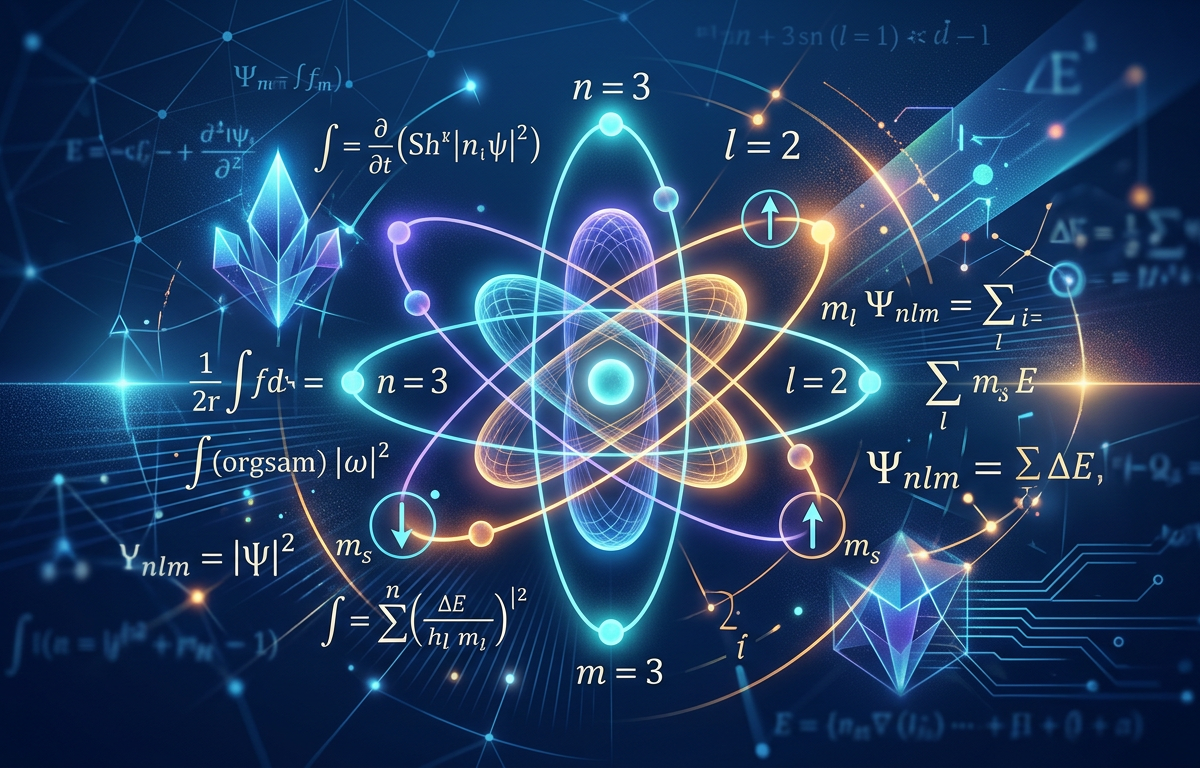
Quantum numbers are a set of four numerical values that describe the unique energy state, spatial distribution, and intrinsic rotation of an electron within an atom. These values serve as the 'address' for an electron, ensuring that no two electrons in the same atom possess the identical set of four numbers, a principle known as the Pauli Exclusion Principle. Understanding these values is essential for mastering electron configuration practice questions and predicting chemical behavior.
The four quantum numbers are defined as follows:
Principal Quantum Number (n): Indicates the main energy level or shell. It must be a positive integer (n = 1, 2, 3...).
Angular Momentum Quantum Number (l): Defines the shape of the orbital (subshell). It ranges from 0 to n-1. (l=0 is s, l=1 is p, l=2 is d, l=3 is f).
Magnetic Quantum Number (ml): Describes the orientation of the orbital in space. It ranges from -l to +l, including zero.
Spin Quantum Number (ms): Describes the direction of the electron's spin. It can only be +1/2 or -1/2.
In advanced chemistry, we often look at how these numbers relate to the Schrödinger wave equation. For instance, the total number of orbitals in a shell is n², and the maximum number of electrons is 2n². When solving hard quantum number practice questions, you must often work backward from an element's position on the periodic table to identify the specific quantum numbers of its valence electrons, a skill that complements periodic trends practice questions.
Solved Examples
The following examples demonstrate how to apply quantum rules to complex scenarios involving transition metals and excited states.
Identify the set of quantum numbers for the 23rd electron added to an atom in its ground state.
First, determine the element: Atomic number 23 is Vanadium (V).
Write the electron configuration: 1s² 2s² 2p⁶ 3s² 3p⁶ 4s² 3d³.
The 23rd electron enters the 3d subshell.
For 3d: n = 3 and l = 2.
In the d-subshell, electrons occupy orbitals ml = -2, -1, 0, 1, 2. The third electron (Hund's Rule) usually occupies ml = 0.
By convention, the first electrons in a subshell have ms = +1/2.
Result: n=3, l=2, ml=0, ms=+1/2.
Determine if the set (n=3, l=3, ml=-1, ms=+1/2) is allowed and explain why.
Check the relationship between n and l: l must be less than n (l ≤ n-1).
Here, n=3 and l=3. Since l is not less than n, this is impossible.
An l=3 orbital is an f-orbital, which only begins at n=4.
Result: Not allowed; l cannot equal n.
Calculate the maximum number of electrons that can have the quantum numbers n=4 and ms=+1/2.
Identify the total number of orbitals in the n=4 shell using n². 4² = 16 orbitals.
Each orbital can hold two electrons: one with ms = +1/2 and one with ms = -1/2.
Therefore, exactly half of the total electrons in the shell will have ms = +1/2.
Total electrons = 2n² = 32. Half of 32 is 16.
Result: 16 electrons.
Practice Questions
Test your knowledge with these hard quantum number practice questions. These require a deep understanding of shell structure and orbital symmetry.
An atom has a valence electron with the quantum numbers n=5, l=2, ml=+1. Which block of the periodic table does this element belong to?
Identify the four quantum numbers for the highest energy electron in a neutral Ground-state Silver (Ag) atom (Atomic Number 47).
How many electrons in a neutral Krypton (Kr) atom can have the quantum number l=1?
Want unlimited practice questions like these?
Generate AI-powered questions with step-by-step solutions on any topic.
Try Question Generator Free →Which of the following sets of quantum numbers represents an electron in a 6f orbital? (n=6, l=4, ml=0) or (n=6, l=3, ml=-2)?
An electron transitions from n=4 to n=2. If the initial state has l=1, what are the possible l values for the final state based on selection rules (Δl = ±1)?
List all possible ml values for a subshell that can hold a maximum of 14 electrons.
A specific ion has the configuration [Ar]3d⁵. What are the possible quantum numbers for the 5th d-electron?
Calculate the total number of electrons in an atom that can share the quantum numbers n=3, l=2.
Why is the set (n=2, l=1, ml=2, ms=-1/2) forbidden?
In a hypothetical universe where the spin quantum number could have three values (+1/2, 0, -1/2), how many electrons could fit in the n=2 shell?
Answers & Explanations
d-block. The angular momentum quantum number l=2 corresponds to a d-orbital. Since n=5 and l=2, this is a 5d electron, placing it in the transition metal (d-block) region.
n=4, l=2, ml=+2, ms=-1/2. Silver is [Kr] 5s¹ 4d¹⁰. The highest energy electron is in the 4d subshell (n=4, l=2). Since 4d is full, ml can be any value from -2 to +2, and the spin must be the second electron in that orbital (-1/2).
18. Krypton (Z=36) has the configuration 1s² 2s² 2p⁶ 3s² 3p⁶ 4s² 3d¹⁰ 4p⁶. Electrons with l=1 are in p-orbitals. We have 2p⁶, 3p⁶, and 4p⁶. 6 + 6 + 6 = 18 electrons.
(n=6, l=3, ml=-2). For an f-orbital, l must equal 3. The first option (l=4) describes a g-orbital.
l=0 or l=2. If the initial state is l=1 (p-orbital), and the change must be ±1, the final state must have l = 1-1=0 (s-orbital) or l = 1+1=2 (d-orbital). However, for n=2, l can only be 0 or 1. Thus, the only possible final state is l=0.
-3, -2, -1, 0, 1, 2, 3. A subshell holding 14 electrons is an f-subshell (l=3). The ml values range from -l to +l.
n=3, l=2, ml=+2, ms=+1/2. For 3d⁵, according to Hund's rule, each of the five orbitals (ml: -2, -1, 0, 1, 2) gets one electron with parallel spin (+1/2). The 5th electron occupies the last orbital.
10. The numbers n=3, l=2 define the 3d subshell. Any d-subshell contains 5 orbitals, each holding 2 electrons, for a total of 10.
ml exceeds l. The magnetic quantum number ml must be between -l and +l. Here, l=1, so ml can only be -1, 0, or 1. A value of 2 is physically impossible.
12. In the n=2 shell, there are n² = 4 orbitals (one 2s and three 2p). If each orbital can hold 3 electrons (due to 3 spin states), then 4 orbitals × 3 electrons/orbital = 12 electrons.
1. Which quantum number determines the orientation of an orbital in space?
Frequently Asked Questions
What is the physical significance of the principal quantum number?
The principal quantum number, n, determines the size and energy of the orbital. As n increases, the electron is further from the nucleus and the atom's energy increases.
Can the magnetic quantum number be a fraction?
No, the magnetic quantum number ml must always be an integer ranging from -l to +l. Only the spin quantum number ms involves fractions (+1/2 or -1/2).
How does l relate to the shape of the orbital?
The angular momentum quantum number l defines the orbital's geometry: 0 produces a spherical s-orbital, 1 produces a dumbbell-shaped p-orbital, and higher values produce more complex shapes like d and f orbitals.
Why is there no 2d subshell?
For any principal energy level n, the maximum value of l is n-1. For n=2, the maximum l value is 1 (p-orbital), so a d-orbital (l=2) cannot exist in the second shell.
What is the difference between a shell and a subshell?
A shell is defined by the principal quantum number n, while a subshell is a subset of a shell defined by both n and the angular momentum quantum number l. For example, the n=3 shell contains 3s, 3p, and 3d subshells.
How do quantum numbers relate to the periodic table blocks?
The l value corresponds directly to the blocks: l=0 is the s-block, l=1 is the p-block, l=2 is the d-block, and l=3 is the f-block. This relationship is a fundamental part of quantum number practice questions with answers.
Want unlimited practice questions like these?
Generate AI-powered questions with step-by-step solutions on any topic.
Try Question Generator Free →
Want unlimited practice questions like these?
Generate AI-powered questions with step-by-step solutions on any topic.
Try Question Generator Free →Enjoyed this article?
Share it with others who might find it helpful.
Related Articles

Hard Le Chatelier’s Principle Practice Questions
Master Hard Le Chatelier’s Principle Practice Questions with our comprehensive guide featuring solved examples, practice problems, and detailed explanations.
Mar 30, 2026

Hard Reaction Quotient (Q) Practice Questions
Hard Reaction Quotient (Q) Practice Questions
Mar 30, 2026

Grams to Moles Practice Questions with Answers
Master grams to moles conversions with our comprehensive guide. Includes step-by-step examples, practice questions, and detailed answers for chemistry students.
Mar 26, 2026

Avogadro’s Number Practice Questions with Answers
Master the mole concept with our Avogadro’s Number practice questions. Includes step-by-step solved examples, a quick quiz, and detailed explanations.
Mar 26, 2026

Empirical Formulas: Solving Ratios from Mass and Percent Data
Master empirical formula calculations with 10 practice questions, worked answers, and a free step-by-step calculator for mass, percentage, and combustion problems.
Mar 26, 2026