Hard IR Spectroscopy Practice Questions
Concept Explanation
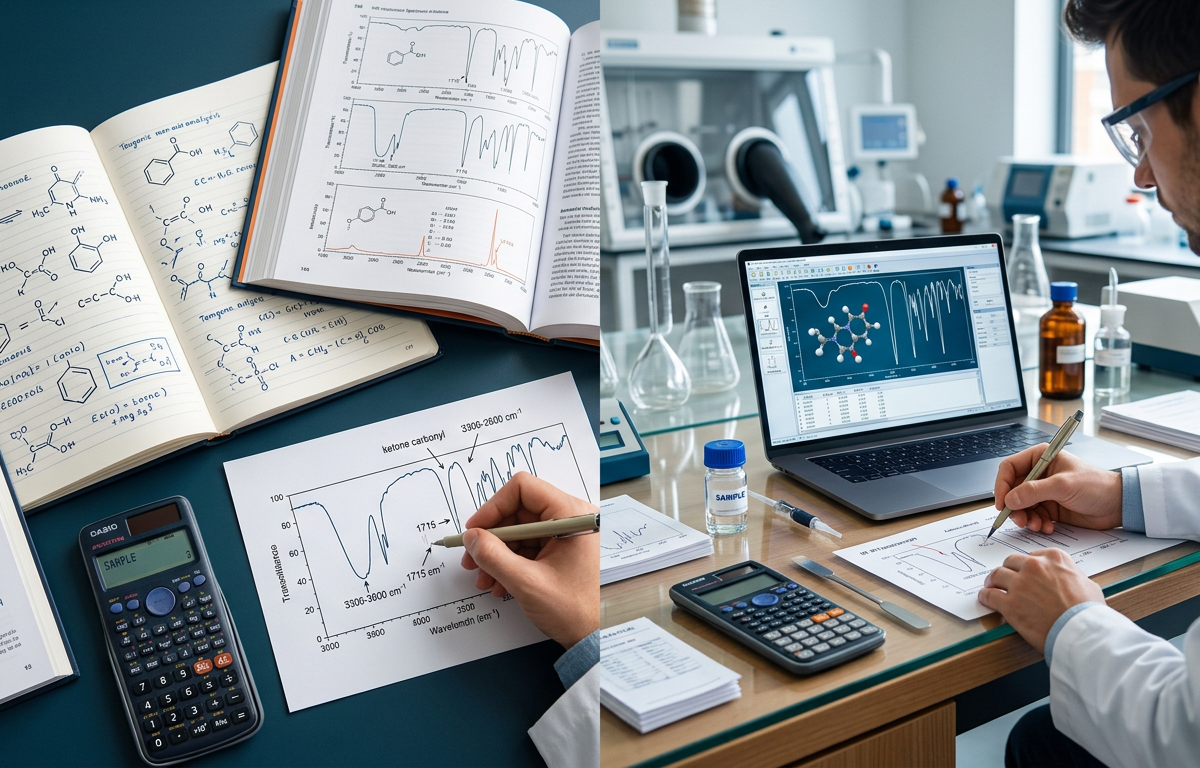
Infrared (IR) spectroscopy is an analytical technique used to identify functional groups within a molecule by measuring the absorption of infrared radiation, which causes specific molecular vibrations. When a molecule absorbs IR radiation, its chemical bonds undergo stretching or bending transitions at frequencies that correspond to the strength of the bond and the mass of the atoms involved.
This relationship is often modeled by Hooke's Law, which states that the frequency of vibration is directly proportional to the square root of the bond's force constant and inversely proportional to the reduced mass of the atoms. For advanced learners, mastering Hard IR Spectroscopy Practice Questions requires understanding subtle effects such as conjugation, ring strain, and hydrogen bonding, all of which shift absorption peaks in predictable ways. For example, conjugation typically lowers the stretching frequency of a carbonyl group (C=O) by approximately 20-30 cm⁻¹, while decreasing the size of a cyclic ketone increases the frequency due to increased s-character in the C=O bond. To fully characterize a structure, researchers often combine these findings with NMR interpretation practice questions to confirm the carbon-hydrogen framework.
The IR spectrum is generally divided into two main regions: the functional group region (4000–1500 cm⁻¹) and the fingerprint region (1500–400 cm⁻¹). While the functional group region reveals broad diagnostic peaks like O-H, N-H, and C=O, the fingerprint region contains complex patterns unique to specific molecules. According to the IUPAC Gold Book, the intensity of these absorptions depends on the change in the molecular dipole moment during the vibration; thus, highly polar bonds like C=O produce intense peaks, while symmetrical non-polar bonds like the C=C in trans-2-butene may be IR-inactive. Understanding these nuances is critical when solving functional group identification practice questions in a laboratory or exam setting.
Solved Examples
Problem: A compound with the formula C₆H₁₀O shows a strong absorption at 1685 cm⁻¹ and a medium peak at 1620 cm⁻¹. Predict the functional groups present and explain the shift from the standard ketone value of 1715 cm⁻¹.
Solution:Identify the peak at 1685 cm⁻¹ as a carbonyl (C=O) group. The standard frequency for an aliphatic ketone is 1715 cm⁻¹.
Note the peak at 1620 cm⁻¹, which corresponds to a C=C double bond.
Recognize that the lower-than-normal C=O frequency (1685 cm⁻¹) suggests conjugation. When a C=O is conjugated with a C=C, resonance delocalizes the electrons, giving the C=O bond more single-bond character and lowering the force constant.
Conclusion: The molecule is an α,β-unsaturated ketone.
Problem: Compare the C=O stretching frequencies of cyclohexanone, cyclopentanone, and cyclobutanone. Rank them from lowest to highest frequency and justify your answer.
Solution:Cyclohexanone: ~1715 cm⁻¹. Standard 6-membered ring with 109.5° ideal angles.
Cyclopentanone: ~1745 cm⁻¹. Ring strain increases the internal bond angle, forcing more s-character into the exocyclic C=O bond.
Cyclobutanone: ~1780 cm⁻¹. Severe ring strain further increases the s-character of the C=O bond, strengthening it and raising the frequency.
Ranking: Cyclohexanone < Cyclopentanone < Cyclobutanone.
Problem: An unknown liquid shows a very broad, strong absorption from 3300–2500 cm⁻¹ and a sharp, intense peak at 1710 cm⁻¹. Identify the functional group.
Solution:The broad peak centered around 3000 cm⁻¹ that overlaps the C-H region is characteristic of the O-H stretch in a carboxylic acid.
The peak at 1710 cm⁻¹ confirms the presence of a carbonyl group.
The extreme broadening of the O-H stretch is due to strong intermolecular hydrogen bonding in carboxylic acid dimers.
Conclusion: The compound contains a carboxylic acid functional group.
Practice Questions
A compound with the molecular formula C₅H₈O shows a sharp peak at 3300 cm⁻¹, a medium peak at 2120 cm⁻¹, and a strong peak at 1715 cm⁻¹. Propose a structure.
Explain why the C-H stretch of an alkyne (≡C-H) appears at ~3300 cm⁻¹, while the C-H stretch of an alkane appears below 3000 cm⁻¹.
A sample of methyl salicylate shows a C=O stretch at 1680 cm⁻¹. Normally, esters appear at 1735 cm⁻¹. Provide two structural reasons for this significant decrease.
Want unlimited practice questions like these?
Generate AI-powered questions with step-by-step solutions on any topic.
Try Question Generator Free →Compare the IR spectra of N,N-dimethylacetamide and acetamide. Which will have a higher frequency C=O stretch and why?
Identify the compound C₄H₆O that exhibits peaks at 2820 cm⁻¹, 2720 cm⁻¹, 1690 cm⁻¹, and 1645 cm⁻¹.
Why does the O-H stretch of a dilute solution of ethanol in carbon tetrachloride appear as a sharp peak at 3600 cm⁻¹, whereas a concentrated solution shows a broad peak at 3350 cm⁻¹?
A molecule has a strong absorption at 1735 cm⁻¹ and 1200 cm⁻¹, but no absorption above 3000 cm⁻¹ except for C-H stretches. What is the most likely functional group?
In the spectrum of benzoyl chloride, two peaks are observed in the carbonyl region (1770 cm⁻¹ and 1735 cm⁻¹). What phenomenon causes this doubling?
Predict the effect on the C=O stretching frequency when an electron-withdrawing group (like -Cl) is attached to the alpha-carbon of a ketone.
A compound C₆H₁₂O₂ shows a strong absorption at 1740 cm⁻¹ and 1240 cm⁻¹. It lacks any signals above 3000 cm⁻¹ or between 1600-1700 cm⁻¹. Suggest a functional group and a possible isomer.
Answers & Explanations
Answer: 4-pentyn-2-one (or similar acetylenic ketone).
Explanation: 3300 cm⁻¹ is a terminal alkyne C-H stretch. 2120 cm⁻¹ is the C≡C triple bond. 1715 cm⁻¹ is the non-conjugated ketone.Answer: Hybridization and bond strength.
Explanation: The alkyne C-H involves an sp-hybridized carbon (50% s-character), which holds electrons closer to the nucleus, creating a shorter, stronger bond. Stronger bonds have higher force constants, leading to higher vibration frequencies according to Hooke's Law.Answer: Conjugation and Intramolecular Hydrogen Bonding.
Explanation: The ester is conjugated with the aromatic ring, lowering the frequency. Additionally, methyl salicylate has a hydroxyl group ortho to the ester, allowing for an intramolecular H-bond that further weakens the C=O bond.Answer: Acetamide will generally have a lower frequency than a simple ester, but comparing the two amides: Acetamide (primary) has stronger H-bonding than N,N-dimethylacetamide (tertiary), which lowers the C=O frequency. However, resonance is the dominant factor in amides; the lone pair on N delocalizes into the C=O, giving it single-bond character.
Answer: 2-butenal (Crotonaldehyde).
Explanation: 2820 and 2720 cm⁻¹ are the "Fermi doublet" characteristic of an aldehyde C-H. 1690 cm⁻¹ is a conjugated C=O, and 1645 cm⁻¹ is the conjugated C=C.Answer: Hydrogen bonding.
Explanation: In dilute solutions, molecules are isolated (free O-H), resulting in a sharp, high-frequency peak. In concentrated solutions, intermolecular H-bonding occurs, which weakens the O-H bond and creates a range of bond environments, resulting in a broad, lower-frequency peak.Answer: An Ester.
Explanation: 1735 cm⁻¹ is the characteristic range for a saturated ester carbonyl. 1200 cm⁻¹ corresponds to the C-O stretch. The absence of peaks above 3000 cm⁻¹ (other than C-H) rules out alcohols and terminal alkynes.Answer: Fermi Resonance.
Explanation: This occurs when a fundamental vibration (like the C=O stretch) interacts with an overtone or combination band of similar energy, causing the peak to split into two.Answer: It increases the frequency.
Explanation: The inductive effect of the electronegative chlorine atom withdraws electron density from the carbonyl carbon, reducing the contribution of the polar C⁺-O⁻ resonance form. This makes the C=O bond more "double-bond" like and stronger.Answer: Ethyl butyrate (or another ester isomer).
Explanation: The formula C₆H₁₂O₂ with a 1740 cm⁻¹ peak strongly indicates an ester. No O-H (above 3000) or C=C (1600-1700) peaks are present, so it is a saturated aliphatic ester.
1. Which factor most significantly decreases the stretching frequency of a carbonyl group?
Frequently Asked Questions
What is the difference between a stretch and a bend in IR?
A stretch involves a change in the bond length along the bond axis, requiring higher energy and appearing at higher frequencies. A bend involves a change in the angle between two bonds, requiring less energy and appearing at lower frequencies in the fingerprint region.
How does isotope substitution affect IR frequencies?
Isotope substitution increases the reduced mass of the vibrating system, which inversely affects the frequency. For example, replacing Hydrogen with Deuterium (C-H to C-D) significantly lowers the stretching frequency because the mass of the atom has doubled.
What is a Fermi doublet in IR spectroscopy?
A Fermi doublet occurs due to Fermi resonance, where an overtone or combination band gains intensity by interacting with a fundamental vibration of similar frequency. This is most commonly observed in the two C-H stretching peaks of aldehydes near 2700-2800 cm⁻¹.
Why do symmetrical molecules sometimes show no IR peaks?
For a molecular vibration to be IR-active, it must result in a change in the molecular dipole moment. Symmetrical vibrations in non-polar molecules, such as the C=C stretch in trans-2-butene, do not change the dipole moment and are therefore transparent to IR radiation.
How is IR spectroscopy used to monitor chemical reactions?
IR is used to track the disappearance of reactant functional groups and the appearance of product groups. For example, during the reduction of a ketone to an alcohol, the disappearance of the 1715 cm⁻¹ peak and the emergence of a broad 3300 cm⁻¹ peak indicates reaction progress.
Can IR spectroscopy determine the molecular weight of a compound?
No, IR spectroscopy only identifies functional groups and bond types based on vibrational frequencies. To determine molecular weight, one must use mass spectrometry practice questions to analyze the mass-to-charge ratio of the molecule.
Want unlimited practice questions like these?
Generate AI-powered questions with step-by-step solutions on any topic.
Try Question Generator Free →
Want unlimited practice questions like these?
Generate AI-powered questions with step-by-step solutions on any topic.
Try Question Generator Free →Enjoyed this article?
Share it with others who might find it helpful.
Related Articles

Hard Le Chatelier’s Principle Practice Questions
Master Hard Le Chatelier’s Principle Practice Questions with our comprehensive guide featuring solved examples, practice problems, and detailed explanations.
Mar 30, 2026

Hard Reaction Quotient (Q) Practice Questions
Hard Reaction Quotient (Q) Practice Questions
Mar 30, 2026

Grams to Moles Practice Questions with Answers
Master grams to moles conversions with our comprehensive guide. Includes step-by-step examples, practice questions, and detailed answers for chemistry students.
Mar 26, 2026
Avogadro’s Number Practice Questions with Answers
Master the mole concept with our Avogadro’s Number practice questions. Includes step-by-step solved examples, a quick quiz, and detailed explanations.
Mar 26, 2026

Empirical Formulas: Solving Ratios from Mass and Percent Data
Master empirical formula calculations with 10 practice questions, worked answers, and a free step-by-step calculator for mass, percentage, and combustion problems.
Mar 26, 2026