Hard Charles’s Law Practice Questions
Concept Explanation
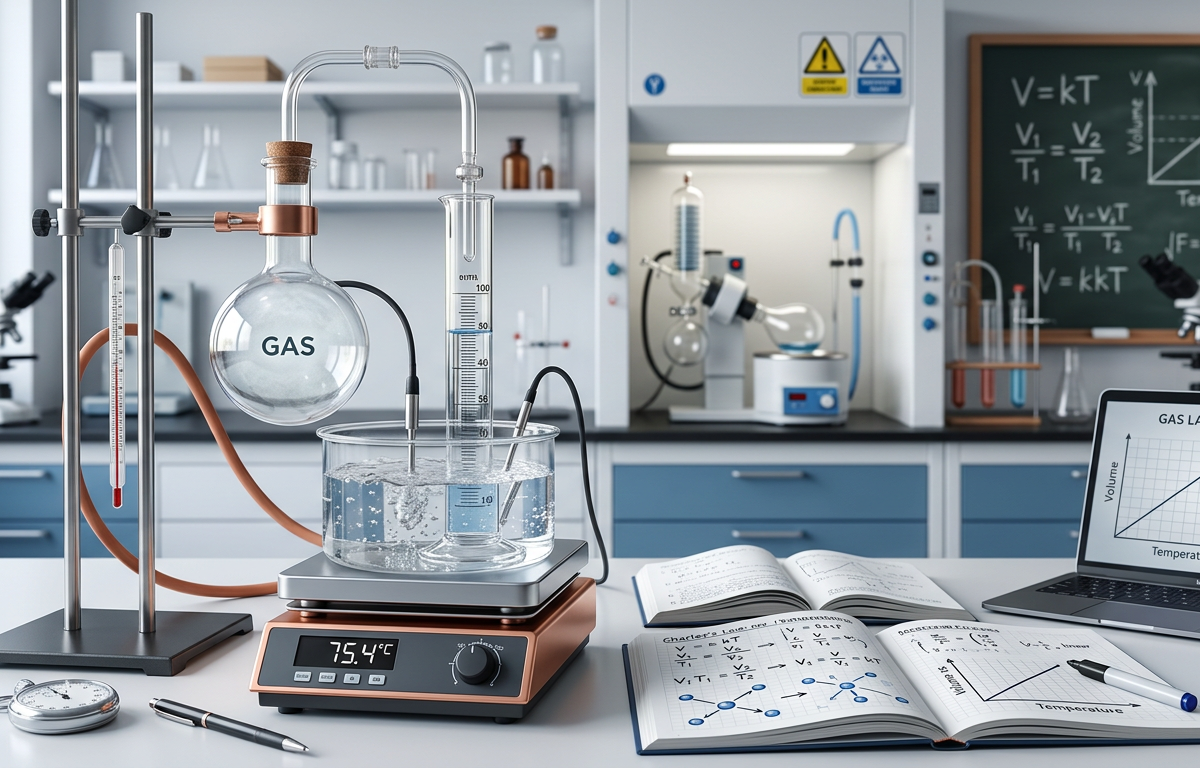
Charles’s Law is a fundamental gas law stating that the volume of a fixed mass of gas is directly proportional to its absolute temperature when the pressure remains constant. This relationship is mathematically expressed as V¹/T¹ = V²/T², where V represents volume and T represents temperature in Kelvins. To master hard Charles’s Law practice questions, one must recognize that the linear relationship only holds true when using the Kelvin scale, where absolute zero (0 K) is the theoretical point at which gas volume would become zero. Unlike Boyle’s Law, which deals with an inverse relationship between pressure and volume, Charles’s Law focuses on the thermal expansion of gases. Advanced problems often involve unit conversions, multi-step scenarios where gas is transferred between containers, or situations where the gas undergoes a density change. Understanding this law is essential for fields ranging from meteorology to aerospace engineering, as it explains why hot air balloons rise and how internal combustion engines manage air-fuel mixtures.
Solved Examples
Reviewing these worked examples will help you prepare for the complexities of the hard Charles’s Law practice questions presented later in this guide.
- Multi-Unit Conversion Problem: A weather balloon contains 150.0 L of helium at 25.0°C. It ascends to an altitude where the temperature drops to -40.0°F while the pressure remains constant. What is the final volume in cubic meters (m³)?
- Convert the initial temperature to Kelvin: T¹ = 25.0 + 273.15 = 298.15 K.
- Convert the final temperature from Fahrenheit to Celsius: C = (F - 32) × 5/9. (-40 - 32) × 5/9 = -40°C.
- Convert the final temperature to Kelvin: T² = -40 + 273.15 = 233.15 K.
- Apply the formula: V² = (V¹ × T²) / T¹ = (150.0 L × 233.15 K) / 298.15 K = 117.29 L.
- Convert Liters to m³: 117.29 L × (1 m³ / 1000 L) = 0.117 m³.
- Density and Temperature: A sample of nitrogen gas has a density of 1.25 g/L at 0°C. If the pressure is constant, at what temperature (in °C) will the density decrease to 0.95 g/L?
- Recognize that density (ρ) is inversely proportional to volume (V = m/ρ). Therefore, V¹/T¹ = V²/T² can be rewritten as 1/(ρ¹T¹) = 1/(ρ²T²), or ρ¹T¹ = ρ²T².
- Initial conditions: ρ¹ = 1.25 g/L, T¹ = 273.15 K.
- Solve for T²: T² = (ρ¹T¹) / ρ² = (1.25 × 273.15) / 0.95 = 359.41 K.
- Convert back to Celsius: 359.41 - 273.15 = 86.26°C.
- Percentage Expansion: To what temperature must a gas at 20°C be heated to increase its volume by 45%?
- Define initial conditions: T¹ = 20 + 273.15 = 293.15 K. Let V¹ = 1.00 unit.
- Define final volume: V² = 1.00 + (0.45 × 1.00) = 1.45 units.
- Rearrange Charles’s Law for T²: T² = (V² × T¹) / V¹ = (1.45 × 293.15) / 1.00 = 425.07 K.
- Convert to Celsius: 425.07 - 273.15 = 151.92°C.
Practice Questions
Challenge yourself with these hard Charles’s Law practice questions. Ensure you convert all temperatures to the absolute scale before calculating.
- A rigid piston holds 4.50 L of argon at 300 K. If the gas is cooled until the volume is 2.10 L at constant pressure, what is the new temperature in degrees Celsius?
- A sample of oxygen gas occupies 550 mL at 75°C. After cooling, the volume is reduced to 0.25 L. Calculate the final temperature in Kelvin.
- A balloon is filled with 2.0 m³ of air at 293 K. If the air is heated to 373 K, what is the change in volume (ΔV) in Liters?
Want unlimited practice questions like these?
Generate AI-powered questions with step-by-step solutions on any topic.
Try Question Generator Free →- A gas occupies 12.0 L at a temperature of 40.0°C. If the volume is increased to 18.0 L, by what percentage must the Kelvin temperature increase?
- A flexible container holds a gas at -150°C. If the volume must be tripled while maintaining constant pressure, what is the final temperature in degrees Celsius?
- A 2.5 L sample of gas at 25°C is heated. If the volume increases by 250 mL for every 10°C rise in temperature, does this gas follow Charles’s Law? Show mathematical proof.
- An ideal gas at 0°C is contained in a cylinder with a movable piston. If the temperature is raised to 273°C, what is the ratio of the final volume to the initial volume?
- A sample of neon gas has a density of 0.900 g/L at 273 K. At what temperature (in Kelvin) will the density be 0.600 g/L?
- A balloon with a volume of 5.0 L at 20°C is placed in liquid nitrogen at 77 K. What is the final volume of the balloon?
- If a gas occupies 1,500 cm³ at 100°C, at what temperature in Fahrenheit will the volume be 1.0 L?
Answers & Explanations
Below are the detailed solutions for the hard Charles’s Law practice questions. If you find these difficult, you might want to review Combined Gas Law practice questions for additional context.
- Answer: -133.15°C. Explanation: V¹=4.50, T¹=300, V²=2.10. T² = (V² × T¹) / V¹ = (2.10 × 300) / 4.50 = 140 K. Conversion: 140 - 273.15 = -133.15°C.
- Answer: 158.25 K. Explanation: V¹=550 mL, T¹=348.15 K, V²=250 mL. T² = (250 × 348.15) / 550 = 158.25 K.
- Answer: 546.08 L. Explanation: V¹=2000 L, T¹=293 K, T²=373 K. V² = (2000 × 373) / 293 = 2546.08 L. ΔV = 2546.08 - 2000 = 546.08 L.
- Answer: 50%. Explanation: V²/V¹ = 18/12 = 1.5. Since V is proportional to T, T² must be 1.5 times T¹. An increase of 1.5x is a 50% increase.
- Answer: 95.85°C. Explanation: T¹ = -150 + 273.15 = 123.15 K. V² = 3V¹. T² = (3V¹ × T¹) / V¹ = 3 × 123.15 = 369.45 K. Conversion: 369.45 - 273.15 = 96.3°C (rounded).
- Answer: No. Explanation: Charles’s Law requires V/T to be constant. At 25°C (298 K), V/T = 2.5/298 = 0.00839. At 35°C (308 K), V = 2.75, so V/T = 2.75/308 = 0.00893. Since the ratios are not equal, it is not following the law.
- Answer: 2:1. Explanation: T¹ = 273 K, T² = 546 K. Since T² is exactly double T¹, the volume must also double. Ratio = 2/1.
- Answer: 409.5 K. Explanation: Using ρ¹T¹ = ρ²T²: (0.900 × 273) = (0.600 × T²). T² = 245.7 / 0.600 = 409.5 K.
- Answer: 1.31 L. Explanation: V¹=5.0 L, T¹=293.15 K, T²=77 K. V² = (5.0 × 77) / 293.15 = 1.31 L.
- Answer: -74.47°F. Explanation: V¹=1.5 L, T¹=373.15 K, V²=1.0 L. T² = (1.0 × 373.15) / 1.5 = 248.77 K. Celsius = 248.77 - 273.15 = -24.38°C. Fahrenheit = (-24.38 × 9/5) + 32 = -11.88°F.
1. Which temperature scale must always be used when calculating Charles’s Law problems?
Frequently Asked Questions
What happens to the volume of a gas at absolute zero according to Charles’s Law?
Theoretically, the volume of an ideal gas would become zero at absolute zero (0 K). In reality, gases liquefy or solidify before reaching this temperature, so the law no longer applies.
Can I use Celsius if I use it for both the initial and final temperatures?
No, you cannot use Celsius because Charles’s Law relies on a direct proportion from a zero-point. Using Celsius would result in incorrect ratios because the Celsius scale is not an absolute scale.
How does Charles’s Law differ from Boyle’s Law?
Charles’s Law describes a direct relationship between volume and temperature at constant pressure. In contrast, Boyle’s Law describes an inverse relationship between volume and pressure at constant temperature.
What is the physical cause of Charles’s Law?
As temperature increases, the kinetic energy of gas molecules increases, causing them to move faster. To maintain constant pressure against the surroundings, the gas must expand to increase the surface area of the container.
Is Charles’s Law applicable to liquids?
Charles’s Law specifically describes the behavior of gases. While liquids do expand when heated, they do not follow the simple linear direct proportionality defined by V/T = k because intermolecular forces are much stronger in liquids.
How do I solve problems where both pressure and temperature change?
If both variables change, Charles’s Law alone is insufficient. You must use the Combined Gas Law, which incorporates pressure, volume, and temperature into a single equation.
Enjoyed this article?
Share it with others who might find it helpful.
Related Articles
Hard Le Chatelier’s Principle Practice Questions
Master Hard Le Chatelier’s Principle Practice Questions with our comprehensive guide featuring solved examples, practice problems, and detailed explanations.
Mar 30, 2026

Hard Reaction Quotient (Q) Practice Questions
Hard Reaction Quotient (Q) Practice Questions
Mar 30, 2026
Grams to Moles Practice Questions with Answers
Master grams to moles conversions with our comprehensive guide. Includes step-by-step examples, practice questions, and detailed answers for chemistry students.
Mar 26, 2026
Avogadro’s Number Practice Questions with Answers
Master the mole concept with our Avogadro’s Number practice questions. Includes step-by-step solved examples, a quick quiz, and detailed explanations.
Mar 26, 2026

Empirical Formulas: Solving Ratios from Mass and Percent Data
Master empirical formula calculations with 10 practice questions, worked answers, and a free step-by-step calculator for mass, percentage, and combustion problems.
Mar 26, 2026