Easy SN1 vs SN2 Reaction Practice Questions
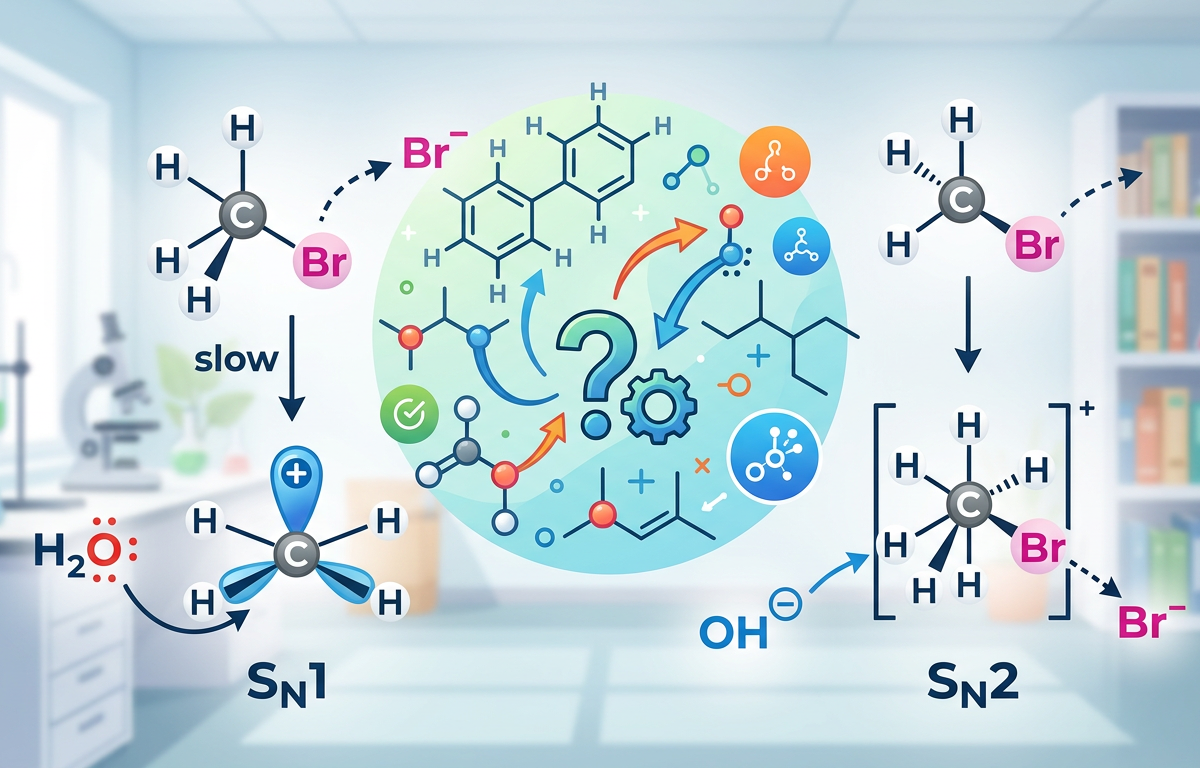
Mastering organic chemistry requires a deep understanding of how molecules interact, and few topics are as fundamental as the competition between substitution mechanisms. This guide provides Easy SN1 vs SN2 Reaction Practice Questions to help you distinguish between these two pathways by looking at substrate structure, nucleophile strength, and solvent effects. Whether you are preparing for a midterm or just refreshing your basics, practicing these concepts is the most effective way to gain confidence in predicting reaction outcomes.
Concept Explanation
An SN1 or SN2 reaction is a nucleophilic substitution where a leaving group is replaced by a nucleophile, differing primarily in whether the process occurs in one concerted step or two sequential steps. Understanding the reaction mechanism is vital for predicting the products and stereochemistry of these transformations.
SN2 (Substitution Nucleophilic Bimolecular) occurs in a single step. The nucleophile attacks the electrophilic carbon from the backside at the same time the leaving group departs. This mechanism is highly sensitive to steric hindrance, meaning it works best on primary (1°) and methyl substrates. Because the attack happens from the back, it results in a complete inversion of configuration at the chiral center.
SN1 (Substitution Nucleophilic Unimolecular) occurs in two distinct steps. First, the leaving group departs to form a carbocation intermediate. Second, the nucleophile attacks the carbocation. This pathway is preferred by tertiary (3°) substrates because they form the most stable carbocations. Since the intermediate is a flat, planar carbocation, the nucleophile can attack from either side, leading to a mixture of enantiomers (racemization).
Feature SN1 Reaction SN2 Reaction Substrate Preference 3° > 2° (1° and methyl rarely) Methyl > 1° > 2° (3° never) Nucleophile Weak (neutral molecules like H2O) Strong (charged ions like OH-) Solvent Polar Protic (e.g., Ethanol, Water) Polar Aprotic (e.g., DMSO, Acetone) Stereochemistry Racemization (Retention + Inversion) Complete Inversion
Solved Examples
Below are three solved examples that demonstrate how to analyze a substitution reaction step-by-step.
Reaction: 2-bromo-2-methylpropane + Methanol (CH3OH)
Identify the substrate: This is a tertiary (3°) alkyl halide. Tertiary carbons are too bulky for SN2.
Identify the nucleophile: Methanol is a weak, neutral nucleophile.
Mechanism: The combination of a 3° substrate and a weak nucleophile favors SN1.
Result: The bromine leaves to form a stable tertiary carbocation, followed by methanol attack.
Reaction: 1-chlorobutane + Sodium Hydroxide (NaOH) in DMSO
Identify the substrate: This is a primary (1°) alkyl halide.
Identify the nucleophile: Hydroxide (OH-) is a strong, negatively charged nucleophile.
Identify the solvent: DMSO is a polar aprotic solvent, which accelerates SN2 by not solvating the nucleophile too strongly.
Mechanism: SN2. The nucleophile attacks while the chloride leaves.
Reaction: (S)-2-iodobutane + Sodium Cyanide (NaCN)
Identify the substrate: This is a secondary (2°) alkyl halide. Secondary substrates can go either way.
Identify the nucleophile: Cyanide (CN-) is a strong nucleophile.
Mechanism: A strong nucleophile favors SN2 over SN1 for secondary substrates.
Stereochemistry: Since it is SN2, the (S) configuration will invert to (R).
Practice Questions
Test your knowledge with these Easy SN1 vs SN2 Reaction Practice Questions. Focus on identifying the substrate type and the strength of the nucleophile.
Which mechanism is favored when methyl iodide reacts with sodium ethoxide (NaOCH2CH3)?
A tertiary alkyl halide is dissolved in water. Which mechanism will dominate?
True or False: A polar aprotic solvent like acetone generally favors the SN1 mechanism.
Want unlimited practice questions like these?
Generate AI-powered questions with step-by-step solutions on any topic.
Try Question Generator Free →Which mechanism involves the formation of a carbocation intermediate?
If a reaction follows an SN2 pathway and starts with a pure (R)-enantiomer, what is the stereochemistry of the product?
Rank the following in order of increasing SN2 reactivity: 2-bromo-2-methylpropane, 1-bromopropane, 2-bromopropane.
Why are primary alkyl halides poor candidates for the SN1 mechanism?
A secondary alkyl halide is reacted with a very weak nucleophile in a polar protic solvent. Which mechanism is most likely?
Does increasing the concentration of the nucleophile speed up an SN1 reaction?
Which leaving group is better for both SN1 and SN2: Fluoride (F-) or Iodide (I-)?
Answers & Explanations
SN2. Methyl iodide is the least hindered substrate possible, and ethoxide is a strong nucleophile. This is a classic SN2 setup.
SN1. Tertiary substrates cannot undergo SN2 due to steric hindrance. Water is a weak nucleophile and a polar protic solvent, both of which support the SN1 pathway.
False. Polar aprotic solvents favor SN2 because they do not hydrogen bond with the nucleophile, leaving it "naked" and more reactive. SN1 is favored by polar protic solvents.
SN1. The rate-determining step in SN1 is the loss of the leaving group to form a carbocation.
(S)-enantiomer. SN2 reactions proceed with complete inversion of configuration.
2-bromo-2-methylpropane (3°) < 2-bromopropane (2°) < 1-bromopropane (1°). SN2 reactivity increases as steric hindrance decreases.
Carbocation stability. SN1 requires the formation of a carbocation. Primary carbocations are extremely unstable and high in energy, making the SN1 pathway unfavorable compared to the concerted SN2 pathway. You can learn more about molecular structures by checking out isomer identification practice questions.
SN1. While secondary substrates are borderline, the use of a weak nucleophile and a polar protic solvent tips the balance toward the unimolecular SN1 pathway.
No. The rate law for SN1 is Rate = k[Substrate]. The nucleophile is not involved in the rate-determining step, so its concentration does not affect the speed.
Iodide (I-). A good leaving group is a weak base. Iodide is much larger and more stable as an ion than fluoride, making it an excellent leaving group for both mechanisms. For more on how atoms and ions behave, see easy periodic trends practice questions.
For more detailed chemical analysis techniques, you might explore resources from LibreTexts Chemistry or the Khan Academy Organic Chemistry modules.
1. Which of the following is the best solvent for an SN2 reaction?
Frequently Asked Questions
What is the main difference between SN1 and SN2?
The main difference is the timing of the mechanism; SN1 is a two-step process involving a carbocation intermediate, while SN2 is a single-step concerted process. This leads to different kinetic profiles and stereochemical outcomes for the two reactions.
Why does a tertiary substrate favor SN1?
Tertiary substrates are too sterically hindered for a nucleophile to attack from the backside in an SN2 mechanism. However, they form highly stable tertiary carbocations, which lowers the energy barrier for the SN1 pathway.
How does solvent affect SN1 vs SN2?
Polar protic solvents favor SN1 by stabilizing the carbocation and leaving group through hydrogen bonding. Polar aprotic solvents favor SN2 by increasing the reactivity of the nucleophile, as they do not surround it with a solvent shell.
Can a secondary alkyl halide undergo both mechanisms?
Yes, secondary alkyl halides are considered "borderline" and can follow either pathway depending on the conditions. Strong nucleophiles and aprotic solvents push them toward SN2, while weak nucleophiles and protic solvents favor SN1.
What makes a good leaving group?
A good leaving group is typically a weak base that can stable the negative charge it carries away. Large ions like iodide or resonance-stabilized ions like tosylate are excellent leaving groups for both SN1 and SN2 reactions.
Want unlimited practice questions like these?
Generate AI-powered questions with step-by-step solutions on any topic.
Try Question Generator Free →
Want unlimited practice questions like these?
Generate AI-powered questions with step-by-step solutions on any topic.
Try Question Generator Free →Enjoyed this article?
Share it with others who might find it helpful.
Related Articles
Hard Le Chatelier’s Principle Practice Questions
Master Hard Le Chatelier’s Principle Practice Questions with our comprehensive guide featuring solved examples, practice problems, and detailed explanations.
Mar 30, 2026
Hard Reaction Quotient (Q) Practice Questions
Hard Reaction Quotient (Q) Practice Questions
Mar 30, 2026
Grams to Moles Practice Questions with Answers
Master grams to moles conversions with our comprehensive guide. Includes step-by-step examples, practice questions, and detailed answers for chemistry students.
Mar 26, 2026
Avogadro’s Number Practice Questions with Answers
Master the mole concept with our Avogadro’s Number practice questions. Includes step-by-step solved examples, a quick quiz, and detailed explanations.
Mar 26, 2026
Empirical Formulas: Solving Ratios from Mass and Percent Data
Master empirical formula calculations with 10 practice questions, worked answers, and a free step-by-step calculator for mass, percentage, and combustion problems.
Mar 26, 2026