Easy Rate Law Practice Questions

Concept Explanation
A rate law is a mathematical expression that describes the relationship between the rate of a chemical reaction and the molar concentration of its reactants. In its simplest form, for a reaction where reactants A and B form products, the rate law is written as Rate = k[A]x[B]y, where k is the rate constant, and x and y are the reaction orders with respect to each reactant. These orders are determined experimentally and indicate how sensitive the reaction rate is to changes in concentration. Understanding these basics is essential for mastering chemical kinetics, much like how reaction order practice questions help solidify your grasp of the fundamental exponents in these equations. According to Wikipedia's entry on rate equations, the rate constant k is temperature-dependent, a concept further explored in the Arrhenius equation practice questions.
Key Components of the Rate Law
- Rate Constant (k): A proportionality constant unique to a specific reaction at a specific temperature.
- Reaction Order: The power to which a concentration term is raised. The overall reaction order is the sum of all individual orders (x + y).
- Concentration: Usually expressed in Molarity (M or mol/L).
When you double the concentration of a reactant in a first-order reaction, the rate doubles. In a second-order reaction, doubling the concentration quadruples the rate. These predictable patterns make easy rate law practice questions an excellent starting point for students learning to predict chemical behavior. Educational resources like Khan Academy's Chemistry Kinetics provide excellent visualizations of these molecular collisions and energy barriers.
Solved Examples
Reviewing solved examples helps you understand the step-by-step logic required to solve kinetics problems effectively.
Example 1: Determining the Overall Order
A reaction has the rate law: Rate = k[A][B]2. What is the overall reaction order?
- Identify the exponents for each reactant. The exponent for [A] is 1 (implied), and the exponent for [B] is 2.
- Add the exponents together: 1 + 2 = 3.
- The overall reaction order is 3 (third-order).
Example 2: Calculating the Rate Constant
For the reaction A → B, the rate law is Rate = k[A]. If the rate is 0.050 M/s when [A] = 0.20 M, what is the value of k?
- Write the rate law: Rate = k[A].
- Rearrange to solve for k: k = Rate / [A].
- Substitute the values: k = 0.050 M/s / 0.20 M.
- Calculate: k = 0.25 s-1.
Example 3: Predicting Rate Changes
The rate law for a reaction is Rate = k[X]2. If the concentration of X is tripled, by what factor does the rate increase?
- Identify the relationship: Rate ∝ [X]2.
- Substitute the change (3) into the concentration term: (3)2.
- Calculate the result: 3 × 3 = 9.
- The rate increases by a factor of 9.
Practice Questions
Test your knowledge with these easy rate law practice questions designed to build your confidence in chemical kinetics.
- A reaction follows the rate law: Rate = k[NO]2[O2]. What is the order of the reaction with respect to O2?
- If a reaction is zero-order with respect to reactant [C], how does doubling the concentration of [C] affect the reaction rate?
- Calculate the overall reaction order for the rate law: Rate = k[H2][I2].
Want unlimited practice questions like these?
Generate AI-powered questions with step-by-step solutions on any topic.
Try Question Generator Free →- A reaction has a rate law of Rate = k[A]2. If the rate constant k is 0.10 M-1s-1 and [A] = 0.50 M, what is the reaction rate?
- Identify the units of the rate constant (k) for a first-order reaction.
- For the rate law Rate = k[P][Q], what happens to the rate if the concentration of P is doubled and the concentration of Q is halved?
- A reaction is found to be second-order overall. If it only involves one reactant, A, write the rate law.
- If the rate of a reaction is 1.2 × 10⁻³ M/s and k = 4.0 × 10⁻² s-1, find the concentration of the single reactant in this first-order reaction.
- Which factor does NOT affect the rate constant k: temperature, catalyst, or reactant concentration?
- If a reaction rate quadruples when a reactant's concentration is doubled, what is the order with respect to that reactant?
Answers & Explanations
- Answer: 1 (First-order). In the rate law Rate = k[NO]2[O2], the exponent for O2 is not written, which mathematically implies an exponent of 1.
- Answer: No effect. In a zero-order reaction, the rate is independent of the concentration (Rate = k[C]0, which is Rate = k). Changing the concentration does not change the rate.
- Answer: 2 (Second-order). The exponents for H2 and I2 are both 1. The overall order is the sum: 1 + 1 = 2.
- Answer: 0.025 M/s. Using Rate = k[A]2, substitute the values: Rate = (0.10)(0.50)2 = 0.10 × 0.25 = 0.025 M/s.
- Answer: s-1 (or 1/s). For a first-order reaction, Rate (M/s) = k [M]. Rearranging gives k = (M/s) / M = 1/s.
- Answer: The rate remains the same. Doubling P (factor of 2) and halving Q (factor of 0.5) results in 2 × 0.5 = 1. The rate is unchanged.
- Answer: Rate = k[A]2. Since it is second-order overall and has only one reactant, the exponent for that reactant must be 2.
- Answer: 0.03 M. Use Rate = k[A]. Rearrange to [A] = Rate / k. [A] = (1.2 × 10⁻³) / (4.0 × 10⁻²) = 0.03 M.
- Answer: Reactant concentration. The rate constant k changes with temperature and the presence of a catalyst, but it does not change when the concentration of reactants changes.
- Answer: Second-order. If 2x = 4, then x = 2. Therefore, the reaction is second-order with respect to that reactant.
1. What is the overall order of a reaction with the rate law Rate = k[A]0[B]1?
Frequently Asked Questions
What is the difference between a rate law and a reaction rate?
The reaction rate is the speed at which reactants turn into products at a specific moment, while the rate law is the general mathematical formula that shows how that speed depends on concentrations. The rate law remains constant for a reaction at a given temperature, but the rate itself changes as reactants are consumed.
Can reaction orders be fractions?
Yes, reaction orders can be fractions or even negative numbers, although they are most commonly 0, 1, or 2 in introductory chemistry. Fractional orders often indicate complex reaction mechanisms involving multiple steps or chain reactions.
How do you find the units for the rate constant k?
You can find the units of k by using the formula M1-n · t-1, where n is the overall reaction order and t is time. For example, in a second-order reaction (n=2), the units are M-1s-1.
Does the balanced chemical equation determine the rate law?
No, the rate law cannot be determined solely from the balanced chemical equation; it must be determined experimentally. The coefficients in the balanced equation do not necessarily match the exponents in the rate law unless the reaction is an elementary step.
Why is the rate constant k temperature-dependent?
The rate constant k depends on temperature because higher temperatures increase the kinetic energy of molecules, leading to more frequent and energetic collisions. This relationship is quantitatively described by the Arrhenius equation, which links k to the activation energy and temperature.
Enjoyed this article?
Share it with others who might find it helpful.
Related Articles
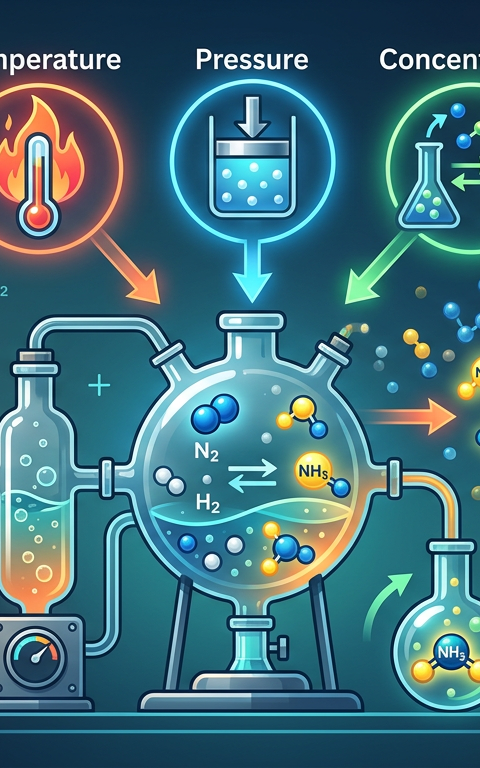
Hard Le Chatelier’s Principle Practice Questions
Master Hard Le Chatelier’s Principle Practice Questions with our comprehensive guide featuring solved examples, practice problems, and detailed explanations.
Mar 30, 2026
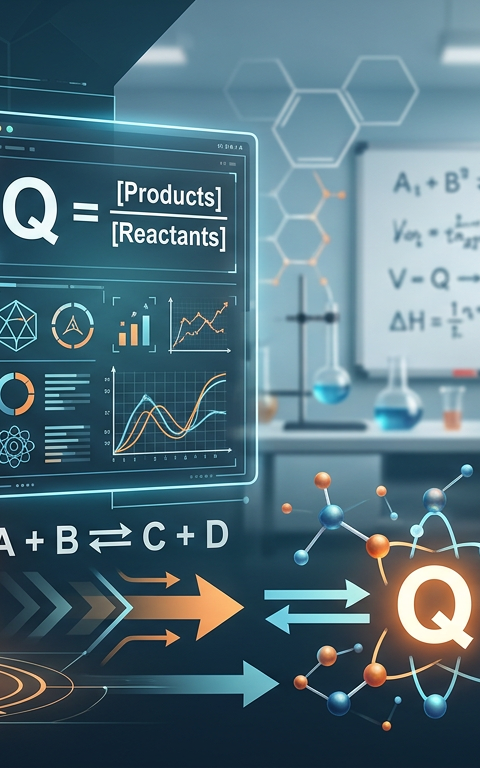
Hard Reaction Quotient (Q) Practice Questions
Hard Reaction Quotient (Q) Practice Questions
Mar 30, 2026
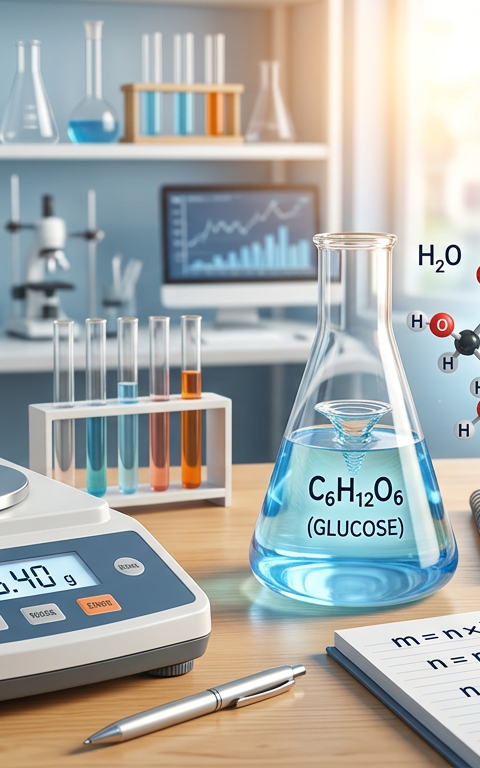
Grams to Moles Practice Questions with Answers
Master grams to moles conversions with our comprehensive guide. Includes step-by-step examples, practice questions, and detailed answers for chemistry students.
Mar 26, 2026
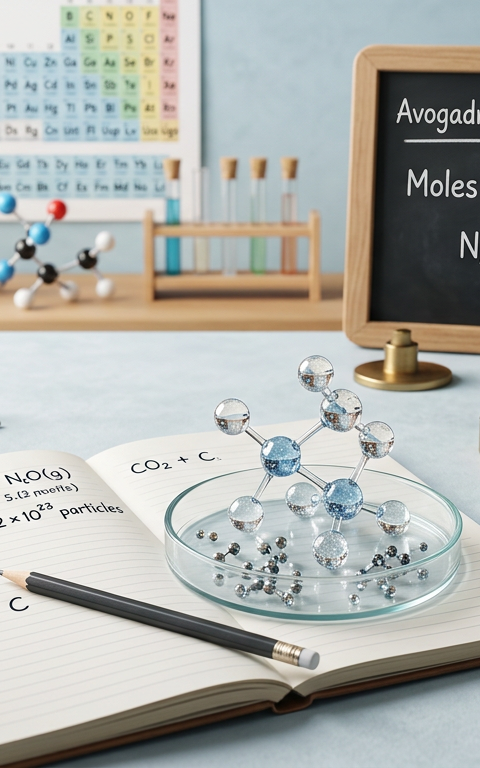
Avogadro’s Number Practice Questions with Answers
Master the mole concept with our Avogadro’s Number practice questions. Includes step-by-step solved examples, a quick quiz, and detailed explanations.
Mar 26, 2026

Empirical Formulas: Solving Ratios from Mass and Percent Data
Master empirical formula calculations with 10 practice questions, worked answers, and a free step-by-step calculator for mass, percentage, and combustion problems.
Mar 26, 2026