Easy Organelles Questions Practice Questions
Easy Organelles Questions Practice Questions
Understanding the building blocks of life is fundamental to biology, and at the heart of most cells are organelles. These tiny structures perform the essential functions that keep cells—and therefore entire organisms—alive. Whether you're just starting your journey into cell biology or need a quick refresher, tackling some easy organelles questions is a great way to solidify your knowledge. This guide provides clear explanations, solved examples, and practice problems to help you master the functions of cellular components.
Concept Explanation
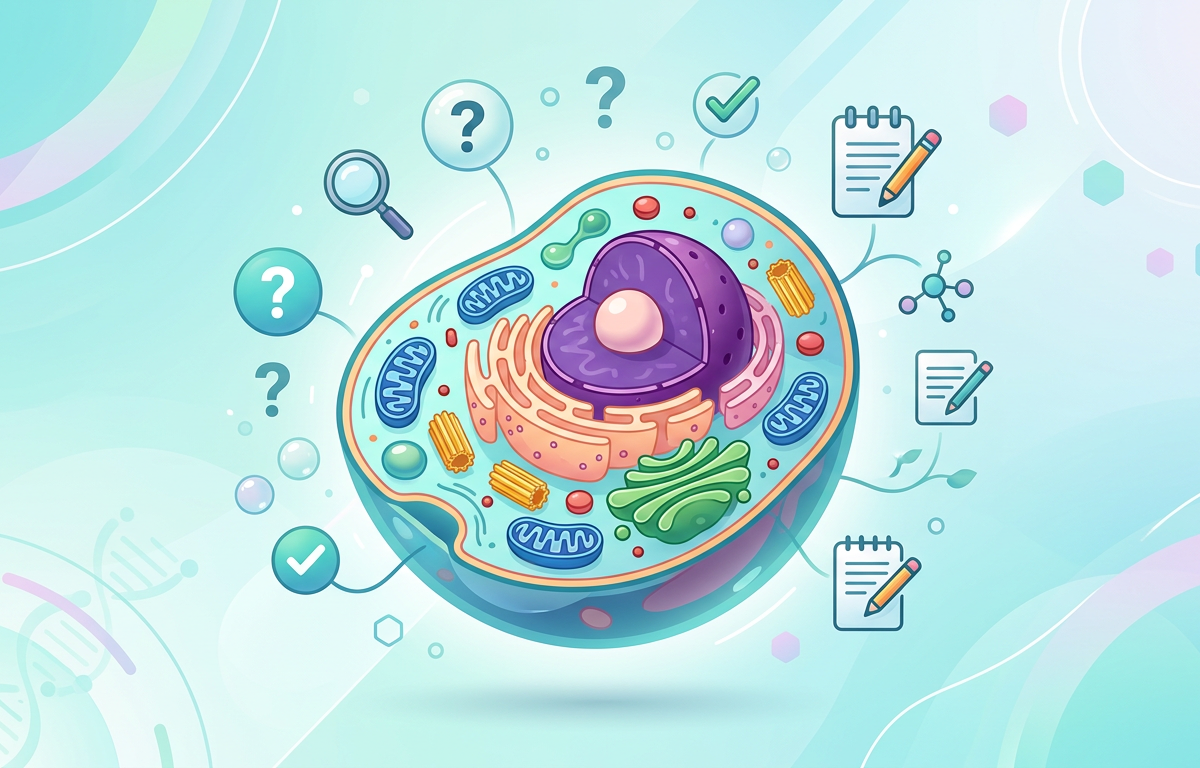
Organelles are specialized structures within a living cell that perform specific jobs, much like organs do in a body. These membrane-bound compartments allow for different chemical reactions to occur simultaneously in different parts of the cell, a process known as compartmentalization. Eukaryotic cells, which include plant and animal cells, are defined by the presence of these complex organelles, such as the nucleus and mitochondria. Prokaryotic cells, like bacteria, are simpler and lack most of these membrane-bound structures. Key organelles in eukaryotic cells include the nucleus, which houses the genetic material; mitochondria, which generate energy; and ribosomes, which synthesize proteins. A deep dive into the diversity and evolution of these structures can be found in resources from Nature Education.
Solved Organelles Questions Examples
The best way to learn is by doing. These solved examples walk you through the process of answering common organelles questions by breaking down the logic step-by-step.
Example 1: The Energy Producer
Question: A cell is using a large amount of energy to perform its functions. Which organelle would be most abundant in this cell to meet its energy demands?
Solution:
- Analyze the question: The question links high energy usage to a specific organelle. The key concept is energy production at the cellular level.
- Recall organelle functions: Think about the primary roles of major organelles. The nucleus stores DNA, ribosomes make protein, and the Golgi apparatus packages materials. The mitochondrion is known for cellular respiration.
- Connect function to the question: Cellular respiration is the process that generates most of the cell's supply of adenosine triphosphate (ATP), which is the main energy currency. This process is analogous to the concepts of work and energy in physics, where energy is converted from one form to another to power activities.
- Conclusion: The mitochondrion is the "powerhouse" of the cell. Therefore, a cell with high energy needs would have a large number of mitochondria.
Example 2: Protein Synthesis Failure
Question: If a cell suddenly lost its ability to create proteins, which tiny, non-membrane-bound organelle is most likely malfunctioning?
Solution:
- Identify the core problem: The cell cannot perform protein synthesis.
- Scan for the relevant organelle: The process of translating genetic information from RNA into a chain of amino acids to form a protein is the definition of protein synthesis.
- Pinpoint the location: This critical process is carried out by ribosomes. Ribosomes can be found floating freely in the cytoplasm or attached to the endoplasmic reticulum.
- Conclusion: A malfunction in the ribosomes would halt protein synthesis.
Example 3: Plant Cell Identification
Question: You are looking at a cell under a microscope and observe a large central vacuole, a cell wall, and chloroplasts. What type of cell are you observing?
Solution:
- List the observed features: The cell has a cell wall, a large central vacuole, and chloroplasts.
- Compare these features to cell types: Animal cells lack a cell wall, chloroplasts, and a large central vacuole. Plant cells possess all three of these structures.
- Determine the function of the unique organelles: The cell wall provides structural support, chloroplasts are for photosynthesis, and the large central vacuole stores water and maintains turgor pressure. These are all hallmarks of a plant cell.
- Conclusion: The presence of a cell wall, chloroplasts, and a large central vacuole definitively identifies the cell as a plant cell.
Practice Questions
Test your knowledge with these practice organelles questions. The answers and detailed explanations are provided below.
1. What is the main function of the cell membrane (plasma membrane)?
2. Which organelle is known as the "control center" of the cell because it contains the genetic material (DNA)?
3. In a plant cell, what is the name of the large organelle that primarily stores water, nutrients, and waste products, while also providing structural support?
4. Which organelle is often called the "powerhouse" of the cell because it is the primary site of ATP synthesis?
5. Ribosomes are cellular structures responsible for synthesizing what type of essential macromolecule?
6. What is the primary role of the Golgi apparatus (also known as the Golgi complex or Golgi body)?
7. Which of the following organelles is found in plant cells but is absent in animal cells? a) Mitochondrion b) Nucleus c) Chloroplast d) Ribosome
8. What is the name of the jelly-like substance that fills the cell, surrounds the organelles, and is the site of many metabolic reactions?
9. Which organelle acts as the cell's "recycling center" by breaking down waste materials, foreign invaders, and old cell parts with digestive enzymes?
10. What is the main structural and functional difference between the rough endoplasmic reticulum (RER) and the smooth endoplasmic reticulum (SER)?
Answers & Explanations
Check your work and deepen your understanding with these complete answers and explanations for our practice organelles questions.
1. Answer: The main function of the cell membrane is to regulate the passage of substances into and out of the cell. It is a semi-permeable barrier that protects the cell's internal environment.
2. Answer: The nucleus is the "control center" of the cell. It contains the cell's chromosomes, which are made of DNA and hold the genetic instructions for cell growth, development, and reproduction.
3. Answer: The large central vacuole is the organelle in plant cells that stores water, nutrients, and waste. It also plays a crucial role in maintaining turgor pressure against the cell wall, which helps support the plant.
4. Answer: The mitochondrion is the "powerhouse" of the cell. It's where cellular respiration occurs, a process that converts glucose and oxygen into ATP (adenosine triphosphate), the main energy molecule used by the cell.
5. Answer: Ribosomes are responsible for synthesizing proteins. They read instructions from messenger RNA (mRNA) and assemble amino acids into polypeptide chains, which then fold into functional proteins.
6. Answer: The Golgi apparatus modifies, sorts, and packages proteins and lipids for secretion or delivery to other organelles. It acts like a cellular post office, receiving products from the endoplasmic reticulum and shipping them to their final destinations.
7. Answer: c) Chloroplast. Chloroplasts are the site of photosynthesis, the process plant cells use to convert light energy into chemical energy (glucose). Animal cells do not perform photosynthesis and therefore do not have chloroplasts.
8. Answer: The cytoplasm (or more specifically, the cytosol) is the jelly-like substance that fills the cell. It provides a medium for the organelles to be suspended in and is where many of the cell's metabolic processes take place.
9. Answer: The lysosome is the cell's recycling center. It contains powerful digestive enzymes that break down cellular waste, debris, and ingested particles like bacteria. This process is called autophagy or phagocytosis.
10. Answer: The main structural difference is that the rough endoplasmic reticulum (RER) is studded with ribosomes, while the smooth endoplasmic reticulum (SER) is not. This structural difference leads to their different functions: the RER is primarily involved in synthesizing and modifying proteins (due to the attached ribosomes), while the SER is involved in lipid synthesis, detoxification of harmful substances, and calcium storage. For a more detailed breakdown, you can consult the Wikipedia page on the Endoplasmic Reticulum.
1. This quick quiz will test your ability to recall key facts about organelles based on the information covered in this article. 1. The nucleus is primarily responsible for which of the following tasks?
Frequently Asked Questions
What is the most important organelle in a cell?
The nucleus is often considered the most important organelle because it contains the cell's DNA, which directs all cellular activities. However, a cell cannot survive without the functions of other organelles like mitochondria for energy or ribosomes for protein production, so all are vital.
Do all cells have organelles?
No, not all cells have membrane-bound organelles. Eukaryotic cells (plants, animals, fungi) have many organelles, but prokaryotic cells (bacteria) lack a nucleus and other membrane-bound structures. All cells, however, have ribosomes, a cell membrane, cytoplasm, and genetic material.
What is the difference between a cell wall and a cell membrane?
The cell membrane is a flexible barrier found in all cells that controls what enters and leaves. A cell wall is a rigid outer layer found outside the cell membrane in plants, fungi, and bacteria, providing structural support and protection. Animal cells do not have a cell wall.
Why are mitochondria called the powerhouse of the cell?
Mitochondria are called the "powerhouse" because they are the primary site of cellular respiration. This metabolic process generates large quantities of adenosine triphosphate (ATP), the main energy-carrying molecule that powers nearly all cellular functions.
How do organelles work together?
Organelles work together as an integrated system. For example, the nucleus provides the DNA instructions for a protein, ribosomes on the RER build the protein, the Golgi apparatus packages it, and vesicles transport it to the cell membrane for export. This collaboration is essential for the cell's survival and function. Analyzing data about these interactions might involve calculating averages, which you can practice with our mean, median, and mode problems.
Enjoyed this article?
Share it with others who might find it helpful.
Related Articles
Hard Le Chatelier’s Principle Practice Questions
Master Hard Le Chatelier’s Principle Practice Questions with our comprehensive guide featuring solved examples, practice problems, and detailed explanations.
Mar 30, 2026
Hard Reaction Quotient (Q) Practice Questions
Hard Reaction Quotient (Q) Practice Questions
Mar 30, 2026
Grams to Moles Practice Questions with Answers
Master grams to moles conversions with our comprehensive guide. Includes step-by-step examples, practice questions, and detailed answers for chemistry students.
Mar 26, 2026
Avogadro’s Number Practice Questions with Answers
Master the mole concept with our Avogadro’s Number practice questions. Includes step-by-step solved examples, a quick quiz, and detailed explanations.
Mar 26, 2026
Empirical Formulas: Solving Ratios from Mass and Percent Data
Master empirical formula calculations with 10 practice questions, worked answers, and a free step-by-step calculator for mass, percentage, and combustion problems.
Mar 26, 2026