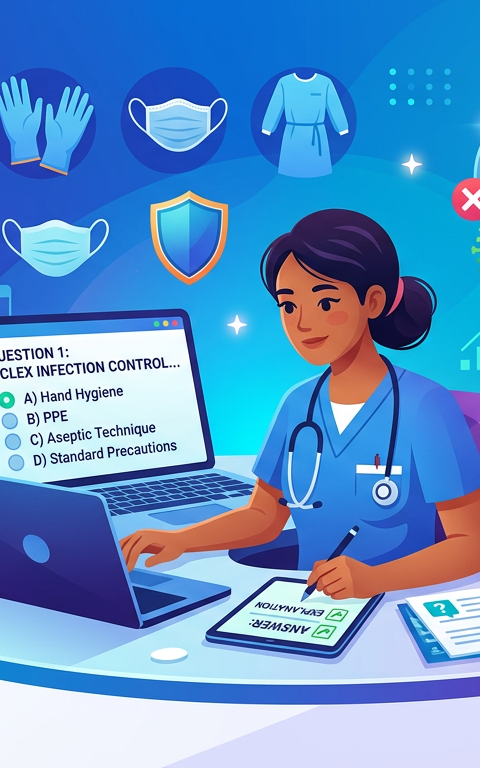
Easy NCLEX Infection Control Practice Questions

Concept Explanation
Easy NCLEX Infection Control Practice Questions focus on the fundamental principles used to prevent the spread of microorganisms in healthcare settings, primarily through standard and transmission-based precautions. Infection control is a cornerstone of nursing practice, ensuring that patients, staff, and visitors remain safe from healthcare-associated infections (HAIs). According to the Centers for Disease Control and Prevention (CDC), the primary tiers of precaution include Standard Precautions, which apply to all patients, and Transmission-Based Precautions (Contact, Droplet, and Airborne), which are used for patients with known or suspected infections.
To master this topic for the NCLEX, you must understand the "Chain of Infection" and how to break it. This involves knowing when to use specific Personal Protective Equipment (PPE), such as gloves, gowns, masks, and eye protection. For instance, while standard precautions require hand hygiene and gloves when touching body fluids, droplet precautions require a surgical mask when within 3 to 6 feet of the patient. Understanding these basics is essential before moving on to more complex topics like NCLEX Patient Safety Practice Questions.
Key categories of precautions include:
- Standard Precautions: Hand hygiene and PPE use based on anticipated exposure for all patient interactions.
- Contact Precautions: Used for organisms spread by direct or indirect contact (e.g., MRSA, VRE, C. diff). Requires gown and gloves.
- Droplet Precautions: Used for pathogens spread through large respiratory droplets (e.g., Influenza, Pertussis). Requires a surgical mask.
- Airborne Precautions: Used for small particles that remain suspended in the air (e.g., Tuberculosis, Measles). Requires an N95 respirator and a negative-pressure room.
Solved Examples
Reviewing worked examples helps clarify how to apply theoretical knowledge to clinical scenarios. These examples demonstrate the critical thinking required for Easy NCLEX Infection Control Practice Questions.
- Scenario: A nurse is preparing to enter the room of a patient diagnosed with Clostridioides difficile (C. diff). What is the most appropriate action for infection control?
- Step 1: Identify the pathogen and its mode of transmission. C. diff is spread via contact.
- Step 2: Determine the required PPE. Contact precautions require a gown and gloves.
- Step 3: Identify specific hand hygiene requirements. C. diff spores are resistant to alcohol-based rubs, so soap and water must be used.
- Solution: Don gown and gloves before entry and perform hand hygiene with soap and water upon exit.
- Scenario: A patient is admitted with a suspected case of bacterial meningitis. Which precaution should the nurse initiate?
- Step 1: Recognize the pathogen. Bacterial meningitis is transmitted via large respiratory droplets.
- Step 2: Select the precaution tier. Droplet precautions are required.
- Step 3: Identify the necessary PPE. A surgical mask is the primary requirement.
- Solution: Place the patient on Droplet Precautions and wear a surgical mask during care.
- Scenario: A nurse is removing PPE after caring for a patient on contact precautions. What is the correct sequence?
- Step 1: Remove the most contaminated items first. Usually, this starts with gloves.
- Step 2: Remove the gown (often combined with gloves depending on the technique).
- Step 3: Perform hand hygiene immediately after removal.
- Solution: Remove gloves, then gown, then perform hand hygiene.
Practice Questions
Test your knowledge with these Easy NCLEX Infection Control Practice Questions. These are designed to mimic the NCLEX Fundamentals Practice Questions found on the actual exam.
1. A nurse is caring for a patient with a large, draining wound infected with Methicillin-resistant Staphylococcus aureus (MRSA). Which precaution is most appropriate?
2. Which of the following patients requires the nurse to wear an N95 respirator mask?
3. A nurse is performing hand hygiene. Under which circumstance is using an alcohol-based hand rub contraindicated?
Train under NCLEX-style pressure.
Use timed NCLEX practice questions and adaptive quizzes to improve speed, accuracy, and confidence.
Start Timed Practice4. When transporting a patient on Droplet Precautions to the radiology department, what action should the nurse take?
5. A nurse is assigned to a patient with Pulmonary Tuberculosis. Which room assignment is most appropriate?
6. The nurse is preparing to perform a sterile dressing change. Which action would break the sterile field?
7. A nurse accidentally sticks themselves with a needle after administering an injection. What is the priority action?
8. Which PPE item should the nurse remove first when exiting a room?
9. A nurse is caring for a patient with shingles (Herpes Zoster) that is disseminated. What precautions are required?
10. What is the minimum duration a nurse should lather their hands with soap during handwashing?
Answers & Explanations
- Answer: Contact Precautions. MRSA in a draining wound is spread through direct or indirect contact. Gown and gloves are required to prevent the spread of the bacteria to other patients or the environment.
- Answer: A patient with suspected Tuberculosis (TB). TB is an airborne pathogen. N95 respirators are required for Airborne Precautions to filter out small particles.
- Answer: When hands are visibly soiled or when caring for a patient with C. diff. Alcohol does not kill C. diff spores; physical friction and rinsing with soap and water are necessary.
- Answer: Place a surgical mask on the patient. To prevent the spread of droplets during transport, the patient must wear a mask. The nurse does not need to wear a mask during transport if they maintain distance, but the patient must be masked.
- Answer: A private room with negative airflow. Airborne precautions require a specialized room that exhausts air directly outside or through a HEPA filter to prevent particles from entering the hallway.
- Answer: Reaching over the sterile field. Reaching over a sterile field introduces microorganisms from the nurse's clothing or skin into the sterile area. One should always move around the field.
- Answer: Wash the area thoroughly with soap and water. Immediate decontamination of the site is the first step, followed by reporting the incident to the supervisor.
- Answer: Gloves. Gloves are considered the most contaminated piece of PPE and should be removed first to avoid contaminating the skin or other PPE during the removal process.
- Answer: Airborne and Contact Precautions. While localized shingles only require contact precautions, disseminated (widespread) shingles require both airborne and contact precautions until the lesions are crusted.
- Answer: 15 to 20 seconds. The World Health Organization (WHO) and CDC recommend at least 15-20 seconds of vigorous scrubbing to effectively remove transient flora.
For more practice on similar foundational nursing skills, you might find NCLEX Hygiene Practice Questions or NCLEX Vital Signs Practice Questions helpful in your studies. You can also use the AI Question Generator to create custom quizzes on these topics.
1. Which transmission-based precaution requires a private room with monitored negative air pressure?
Frequently Asked Questions
What is the difference between medical and surgical asepsis?
Medical asepsis, or "clean technique," focuses on reducing the number of microorganisms and preventing their spread, while surgical asepsis, or "sterile technique," involves the total elimination of all microorganisms from an object or area.
When should I use soap and water instead of hand sanitizer?
You must use soap and water whenever your hands are visibly soiled, after using the restroom, before eating, and specifically when caring for patients with spore-forming organisms like C. difficile.
What are the three main types of transmission-based precautions?
The three main types are Airborne (for small particles like TB), Droplet (for larger respiratory particles like the flu), and Contact (for direct or indirect skin-to-skin spread like MRSA).
How do I know which PPE to wear for standard precautions?
Under standard precautions, you select PPE based on the risk of exposure to blood, body fluids, or non-intact skin; if splashing is likely, you wear a gown, mask, and eye protection in addition to gloves.
Can two patients with the same infection share a room?
Yes, this is known as cohorting, where patients infected with the same organism (and no other infections) are placed in the same room if private rooms are unavailable.
Train under NCLEX-style pressure.
Use timed NCLEX practice questions and adaptive quizzes to improve speed, accuracy, and confidence.
Start Timed PracticeEnjoyed this article?
Share it with others who might find it helpful.
Related Articles

Hard NCLEX Infection Control Practice Questions
Challenge yourself with these hard NCLEX infection control practice questions. Master isolation precautions, PPE sequencing, and sterile technique protocols.
May 21, 2026

Medium NCLEX Infection Control Practice Questions
Master Medium NCLEX Infection Control Practice Questions with our guide on isolation precautions, PPE donning/doffing, and sterile technique for nursing students.
May 21, 2026
NCLEX Infection Control Practice Questions with Answers
Master NCLEX Infection Control with our comprehensive guide featuring solved examples, practice questions, and detailed explanations on isolation precautions.
May 20, 2026

Hard NCLEX Prenatal Care Practice Questions
Hard NCLEX Prenatal Care Practice Questions
May 21, 2026

Medium NCLEX Prioritization Practice Questions
Medium NCLEX Prioritization Practice Questions
May 21, 2026

Medium NCLEX Pediatric Practice Questions
Medium NCLEX Pediatric Practice Questions
May 21, 2026

Hard NCLEX Mixed Medication Practice Questions
Master high-difficulty NCLEX mixed medication questions with our comprehensive guide featuring solved examples, practice questions, and expert explanations.
May 21, 2026

Hard NCLEX Mixed SATA Practice Questions
Hard NCLEX Mixed SATA Practice Questions
May 21, 2026