Easy NCLEX Dosage Calculation Practice Questions
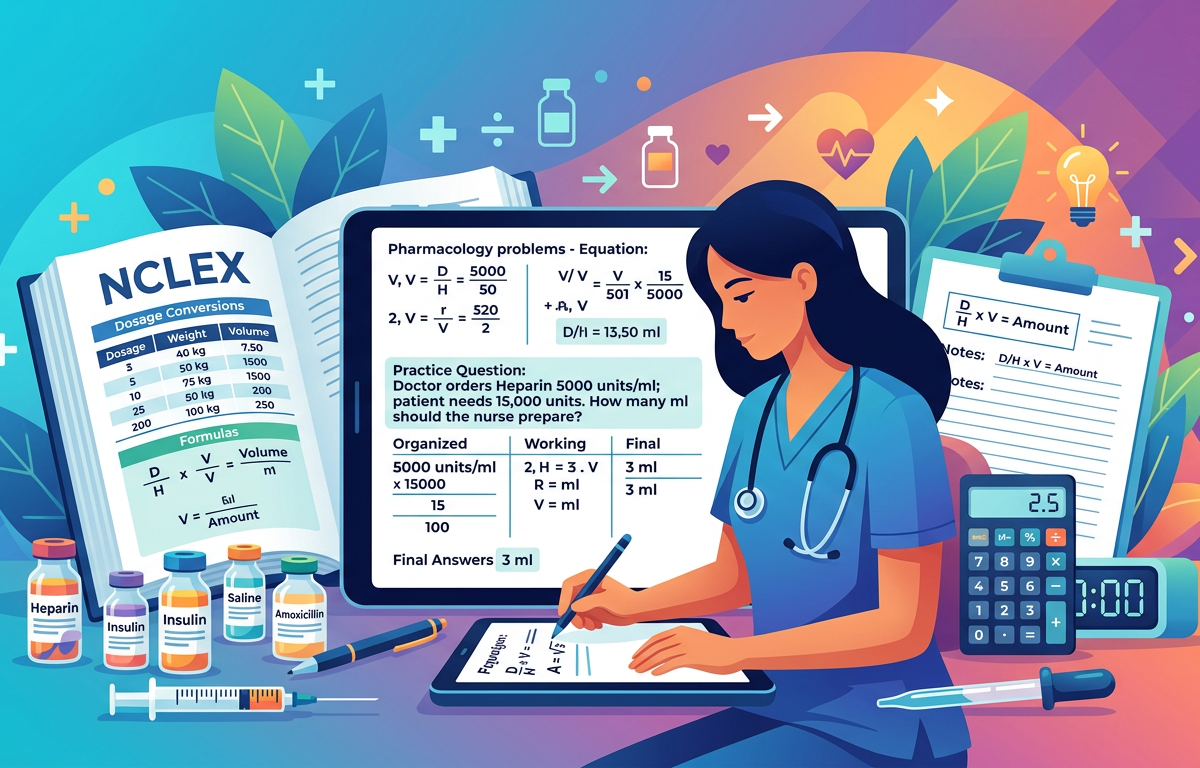
Concept Explanation
Easy NCLEX dosage calculation practice questions are foundational math assessments designed to test a nurse's ability to safely calculate medication amounts using basic arithmetic and conversion factors. Mastery of these skills is crucial for patient safety, as medication errors remain a significant concern in clinical settings. To succeed, students must be proficient in converting between metric units (such as milligrams to grams) and applying the standard formula for dosage: .
Understanding these calculations requires familiarity with common measurement systems used in healthcare. Most NCLEX questions focus on the metric system, including liters (L), milliliters (mL), grams (g), and milligrams (mg). According to the U.S. Food and Drug Administration (FDA), clear communication of dosages is vital to preventing adverse events. For more comprehensive preparation, you may find the NCLEX Dosage Calculation Practice Questions with Answers hub page helpful for advanced topics.
When approaching Easy NCLEX dosage calculation practice questions, follow these steps:
- Identify the Order: Determine the dose the physician has prescribed (the "Desired").
- Check the Supply: Identify the concentration available on the medication label (the "Have" and "Quantity").
- Convert Units: Ensure both the order and the supply are in the same units (e.g., both in mg or both in mcg).
- Calculate: Plug the numbers into the formula or use dimensional analysis.
Solved Examples
Review these step-by-step solutions to understand how to apply the basic dosage formula in real-world scenarios.
- Example 1: Oral Tablet Calculation
The provider orders 500 mg of Metformin PO. The pharmacy provides 250 mg tablets. How many tablets should the nurse administer?- Identify the Desired (D): 500 mg
- Identify the Have (H): 250 mg
- Identify the Quantity (Q): 1 tablet
- Apply formula:
- Answer: 2 tablets
- Example 2: Liquid Medication Calculation
A patient is prescribed 125 mg of an antibiotic suspension. The bottle reads 250 mg per 5 mL. How many mL will the nurse administer?- Identify the Desired (D): 125 mg
- Identify the Have (H): 250 mg
- Identify the Quantity (Q): 5 mL
- Apply formula:
- Answer: 2.5 mL
- Example 3: Unit Conversion (mg to g)
The nurse needs to administer 1 g of a medication. The available dose is 500 mg tablets. How many tablets are needed?- Convert 1 g to mg:
- Identify the Desired (D): 1,000 mg
- Identify the Have (H): 500 mg
- Apply formula:
- Answer: 2 tablets
Practice Questions
1. The healthcare provider orders Furosemide 40 mg PO daily. The pharmacy provides 20 mg tablets. How many tablets will the nurse administer?
2. A patient is to receive 0.5 g of Cephalexin PO every 6 hours. The medication is available in 250 mg capsules. How many capsules should the nurse give per dose?
3. The order is for Digoxin 0.125 mg PO. The label on the bottle reads 0.25 mg per tablet. How many tablets will the nurse administer?
Struggling with dosage calculations?
Practice IV flow rates, dimensional analysis, drip rates, and dosage calculations instantly with Bevinzey.
Practice Dosage Questions4. A physician prescribes 650 mg of Acetaminophen. The available liquid concentration is 160 mg/5 mL. How many mL should the nurse prepare? (Round to the nearest tenth).
5. The nurse is preparing to give Phenobarbital 30 mg. The medication is available as an elixir with a concentration of 15 mg/5 mL. How many mL are required?
6. An order reads 1,000 mcg of Vitamin B12 IM. The vial is labeled 1 mg/mL. How many mL will the nurse inject?
7. The provider orders 0.2 mg of a medication PO. The available tablets are 100 mcg. How many tablets should be administered?
8. A patient is prescribed 75 mg of Meperidine IM. The vial is labeled 50 mg/mL. How many mL should the nurse draw up?
9. The nurse needs to administer 60 mg of Prednisone. The available tablets are 20 mg each. How many tablets will the nurse give?
10. The order is for Potassium Chloride 40 mEq PO. The liquid available is 20 mEq/15 mL. How many mL will the nurse administer?
Answers & Explanations
- 2 tablets. Logic: .
- 2 capsules. Logic: First, convert 0.5 g to 500 mg. Then, . For more practice with pills, see Oral Dosage Practice Questions with Answers.
- 0.5 tablets. Logic: .
- 20.3 mL. Logic: . Rounded to the nearest tenth is 20.3.
- 10 mL. Logic: .
- 1 mL. Logic: First, convert 1,000 mcg to 1 mg. Since the supply is 1 mg/mL, the dose is 1 mL. If you find injections tricky, try Injectable Dosage Practice Questions with Answers.
- 2 tablets. Logic: Convert 0.2 mg to 200 mcg. .
- 1.5 mL. Logic: .
- 3 tablets. Logic: .
- 30 mL. Logic: .
1. A nurse is preparing to administer 0.25 g of a medication. The supply is 125 mg tablets. How many tablets should the nurse give?
Frequently Asked Questions
What is the basic formula for dosage calculations?
The standard formula is , where Desired is the ordered dose, Have is the stock concentration, and Quantity is the unit of measure (like 1 tablet or 5 mL). This formula works for most Easy NCLEX dosage calculation practice questions involving oral and simple injectable medications.
How do I convert grams to milligrams?
To convert grams to milligrams, multiply the number of grams by 1,000 because there are 1,000 milligrams in every gram. For example, 0.5 g multiplied by 1,000 equals 500 mg.
Why is rounding important in NCLEX dosage questions?
Rounding is critical because clinical errors can occur if a dose is rounded incorrectly, especially in pediatrics. Generally, on the NCLEX, you should round to the nearest tenth for amounts greater than 1 and the nearest hundredth for amounts less than 1, unless the question specifies otherwise. You can practice more precise calculations using the AI Question Generator.
What is the difference between mcg and mg?
A microgram (mcg) is 1,000 times smaller than a milligram (mg). When converting from mg to mcg, you move the decimal point three places to the right; when converting from mcg to mg, move it three places to the left.
How do I handle weight-based calculations?
Weight-based calculations require converting the patient's weight from pounds to kilograms (divide by 2.2) before multiplying by the ordered dose per kilogram. For specific practice in this area, check out Weight-Based Dosage Calculations Practice Questions with Answers.
Struggling with dosage calculations?
Practice IV flow rates, dimensional analysis, drip rates, and dosage calculations instantly with Bevinzey.
Practice Dosage QuestionsReviewed by
Michael Danquah, MS, PhD
Dr. Michael Danquah is a professor of pharmaceutical sciences and founder of several educational technology platforms focused on improving student learning and performance.
Enjoyed this article?
Share it with others who might find it helpful.
Related Articles

Hard NCLEX Dosage Calculation Practice Questions
Hard NCLEX Dosage Calculation Practice Questions
May 17, 2026
Medium NCLEX Dosage Calculation Practice Questions
Master medium-level NCLEX dosage calculations with our comprehensive guide featuring solved examples, practice questions, and detailed explanations for nursing students.
May 17, 2026

NCLEX Dosage Calculation Practice Questions with Answers
Master NCLEX dosage calculations with this comprehensive guide featuring step-by-step examples, formulas, and practice questions with detailed answers.
May 17, 2026

Hard NCLEX Prenatal Care Practice Questions
Hard NCLEX Prenatal Care Practice Questions
May 21, 2026

Medium NCLEX Prioritization Practice Questions
Medium NCLEX Prioritization Practice Questions
May 21, 2026

Medium NCLEX Pediatric Practice Questions
Medium NCLEX Pediatric Practice Questions
May 21, 2026

Hard NCLEX Mixed Medication Practice Questions
Master high-difficulty NCLEX mixed medication questions with our comprehensive guide featuring solved examples, practice questions, and expert explanations.
May 21, 2026

Hard NCLEX Mixed SATA Practice Questions
Hard NCLEX Mixed SATA Practice Questions
May 21, 2026