Easy MCAT Reproduction Practice Questions
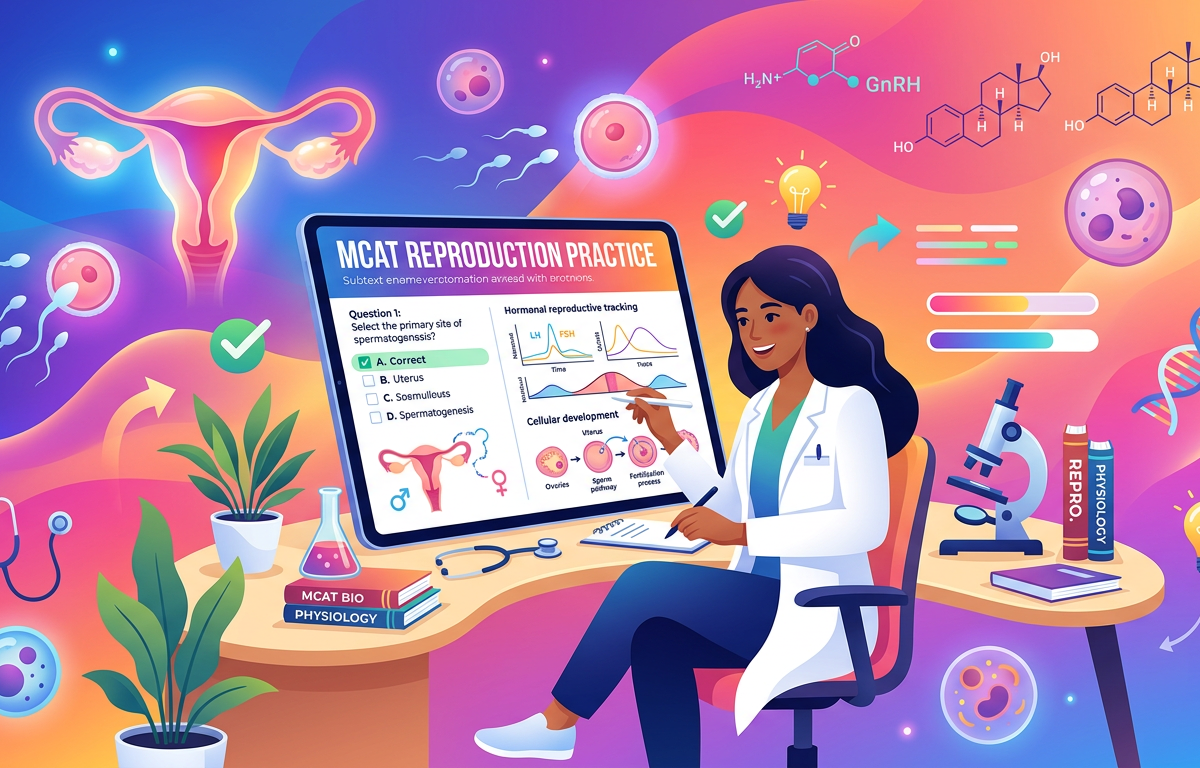
Easy MCAT Reproduction Practice Questions
Mastering the fundamentals of human biology is a cornerstone of success on the Medical College Admission Test, and tackling Easy MCAT Reproduction Practice Questions is the most effective way to build a solid foundation. Understanding the intricate dance of hormones, the stages of gametogenesis, and the physiological changes during pregnancy is essential for any aspiring physician. This guide provides a focused review of reproductive biology, designed to help you transition from passive reading to active mastery through targeted retrieval practice.
Concept Explanation
Reproduction in humans is the biological process by which offspring are produced through the fusion of specialized haploid cells called gametes. This process is regulated by the hypothalamic-pituitary-gonadal axis, involving hormones such as Gonadotropin-Releasing Hormone (GnRH), Follicle-Stimulating Hormone (FSH), and Luteinizing Hormone (LH). In males, spermatogenesis occurs in the seminiferous tubules of the testes, producing four functional sperm cells from one primary spermatocyte. In females, oogenesis is a more complex, discontinuous process that begins before birth, pauses in prophase I of meiosis, and resumes at puberty, typically producing one viable egg and polar bodies.
The female reproductive cycle is divided into the ovarian cycle (follicular phase, ovulation, and luteal phase) and the uterine cycle (menstruation, proliferative phase, and secretory phase). A key milestone is ovulation, triggered by a sharp surge in LH. If fertilization occurs, it typically happens in the fallopian tubes, leading to the formation of a zygote that undergoes cleavage as it travels to the uterus for implantation. For more foundational biology review, you can explore our MCAT Biology Practice Questions.
Solved Examples
Review these step-by-step solutions to common reproductive biology problems frequently seen on the MCAT.
- Question: Which hormone is primarily responsible for the regeneration of the endometrial lining after menstruation?
Solution:- Identify the phase of the uterine cycle: After menstruation, the uterus enters the proliferative phase.
- Recall the dominant hormone in the proliferative phase: Estrogen is secreted by the developing follicles in the ovary.
- Connect hormone to function: Estrogen stimulates the growth of the endometrium.
- Conclusion: Estrogen is the correct answer.
- Question: At which stage of meiosis is the secondary oocyte arrested until fertilization occurs?
Solution:- Recall the stages of oogenesis: Primary oocytes are arrested in Prophase I until puberty.
- Identify the stage after ovulation: Following the LH surge, the primary oocyte completes meiosis I and becomes a secondary oocyte.
- Determine the second arrest point: The secondary oocyte begins meiosis II but stops at Metaphase II.
- Final Answer: Metaphase II.
- Question: What is the correct path of sperm from production to ejaculation?
Solution:- Start at the site of production: Seminiferous tubules.
- Follow the storage path: Sperm move to the Epididymis for maturation.
- Trace the exit route: Vas deferens, then the Ejaculatory duct.
- Final exit: Urethra. (Mnemonic: SEVE(N) UP).
Practice Questions
- Which cell type in the testes is responsible for nourishing developing sperm cells and is stimulated by FSH?
- During the menstrual cycle, what specific event is triggered by a sudden surge in Luteinizing Hormone (LH)?
- In the male reproductive system, which gland produces a clear, alkaline fluid that neutralizes acidic urine in the urethra before ejaculation?
Need more MCAT practice questions?
Generate unlimited MCAT-style questions with instant explanations and adaptive practice powered by Bevinzey AI.
Generate Questions Free- Which embryonic layer is responsible for the development of the gonads?
- What is the ploidy of a secondary spermatocyte?
- Following ovulation, the remaining follicular cells transform into the corpus luteum. Which hormone does the corpus luteum primarily secrete to maintain the endometrium?
- Which structure is the site of fertilization in the human female reproductive tract?
- What is the function of the acrosome found at the tip of a sperm cell?
- In the context of embryogenesis, what is the term for the solid ball of cells formed after several rounds of cleavage?
- Which hormone, produced by the embryo, prevents the degradation of the corpus luteum during early pregnancy?
Answers & Explanations
- Sertoli Cells: Located in the seminiferous tubules, Sertoli cells provide nutrients and support to spermatids. They are activated by FSH, whereas Leydig cells produce testosterone in response to LH.
- Ovulation: The LH surge, occurring around day 14 of the cycle, triggers the release of the secondary oocyte from the Graafian follicle into the fallopian tube.
- Bulbourethral (Cowper's) Glands: These glands secrete a pre-ejaculate that cleanses and lubricates the urethra, protecting sperm from the acidic environment of leftover urine.
- Mesoderm: The mesoderm gives rise to the circulatory system, muscular system, skeletal system, and the genitourinary system (including gonads). You can review more on germ layers in our MCAT Reproduction Practice Questions.
- Haploid (): Primary spermatocytes are diploid (). After completing Meiosis I, they divide into two secondary spermatocytes, which are haploid but still contain sister chromatids.
- Progesterone: While it secretes some estrogen, the corpus luteum is the primary source of progesterone during the luteal phase, which stabilizes the uterine lining for potential implantation.
- Fallopian Tube (Ampulla): Fertilization typically occurs in the widest part of the fallopian tube, known as the ampulla.
- Penetrating the Zona Pellucida: The acrosome contains digestive enzymes that break down the protective layers of the egg (corona radiata and zona pellucida) to allow the sperm nucleus to enter.
- Morula: After the zygote undergoes several divisions (cleavage), it forms a solid ball of 16-32 cells called a morula, which later becomes a hollow blastula.
- Human Chorionic Gonadotropin (hCG): Secreted by the trophoblast cells of the blastocyst, hCG mimics LH to keep the corpus luteum alive, ensuring continued progesterone production until the placenta takes over.
1. Which of the following correctly describes the state of an oocyte at the time of birth in a human female?
Frequently Asked Questions
What is the difference between spermatogenesis and oogenesis?
Spermatogenesis is a continuous process in males that produces four equal haploid sperm cells, while oogenesis is a discontinuous process in females that produces one large egg and smaller polar bodies. Oogenesis begins before birth and only completes if fertilization occurs.
How does the LH surge trigger ovulation?
The LH surge is caused by a positive feedback loop of estrogen from the mature follicle, which then triggers the weakening of the follicular wall and the release of the secondary oocyte. This event typically occurs on day 14 of a standard 28-day menstrual cycle.
What role does the placenta play in hormone production?
By the end of the first trimester, the placenta takes over the production of estrogen and progesterone from the corpus luteum to maintain the pregnancy. It also facilitates nutrient and gas exchange between the mother and the fetus through the umbilical cord.
What are the three germ layers formed during gastrulation?
Gastrulation results in the ectoderm (nervous system and skin), mesoderm (muscles, skeleton, and circulatory system), and endoderm (inner linings of digestive and respiratory tracts). These layers are the foundation for all specialized tissues in the body.
Where is GnRH produced and what is its target?
Gonadotropin-Releasing Hormone (GnRH) is produced by the hypothalamus and targets the anterior pituitary gland. It stimulates the release of FSH and LH, which then act on the gonads to regulate reproductive functions.
Need more MCAT practice questions?
Generate unlimited MCAT-style questions with instant explanations and adaptive practice powered by Bevinzey AI.
Generate Questions FreeWritten by
Michael Danquah, MS, PhD
Dr. Michael Danquah is a professor of pharmaceutical sciences and founder of several educational technology platforms focused on improving student learning and performance.
Enjoyed this article?
Share it with others who might find it helpful.
Related Articles
Hard MCAT Reproduction Practice Questions
Hard MCAT Reproduction Practice Questions
May 9, 2026

Hard MCAT Philosophy Passage Practice Questions
Master Hard MCAT Philosophy Passage Practice Questions with our comprehensive guide featuring solved examples, practice questions, and expert explanations.
May 17, 2026

Hard MCAT Humanities Passage Practice Questions
Master Hard MCAT Humanities Passage Practice Questions with our comprehensive guide featuring solved examples, practice questions, and expert strategies.
May 17, 2026

Hard MCAT Critical Analysis Practice Questions
Hard MCAT Critical Analysis Practice Questions
May 17, 2026

Hard MCAT Reading Comprehension Practice Questions
Hard MCAT Reading Comprehension Practice Questions
May 17, 2026

Hard MCAT CARS Passage Practice Questions
Master high-difficulty MCAT CARS passages with our expert guide featuring solved examples, practice questions, and detailed logical analysis.
May 17, 2026

Hard MCAT CARS Practice Questions
Master Hard MCAT CARS Practice Questions with our comprehensive guide featuring solved examples, practice passages, and expert reasoning strategies.
May 17, 2026

Hard MCAT Sensation and Perception Practice Questions
Master advanced MCAT Sensation and Perception concepts with hard practice questions, Weber's Law calculations, and detailed explanations of sensory pathways.
May 17, 2026