Medium MCAT Functional Group Practice Questions
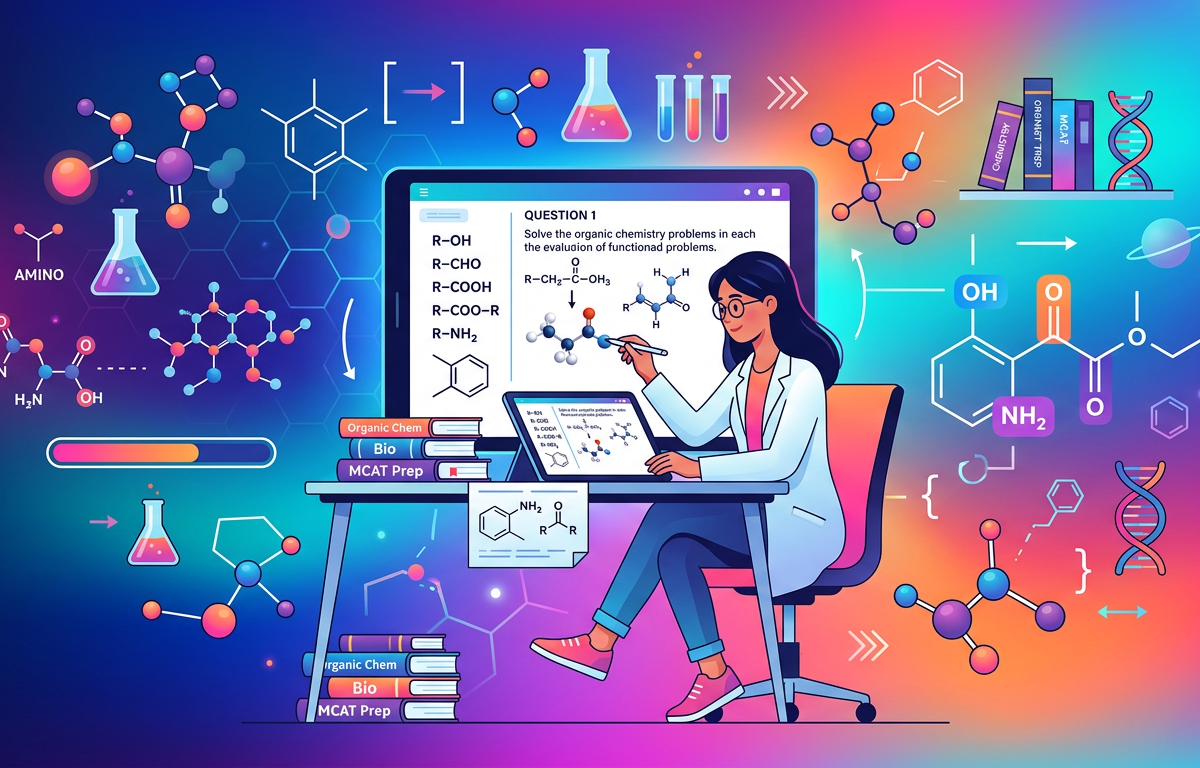
Medium MCAT Functional Group Practice Questions
Mastering functional groups is a non-negotiable step for any student aiming for a high score on the Chemical and Physical Foundations of Biological Systems section of the MCAT. These structural motifs determine the reactivity, polarity, and biological role of organic molecules. To help you move beyond basic identification, these Medium MCAT Functional Group Practice Questions focus on the nuances of reactivity, IUPAC naming, and physical properties that frequently appear on the actual exam.
Concept Explanation
A functional group is a specific arrangement of atoms within a molecule that is responsible for the characteristic chemical reactions of that molecule. On the MCAT, these groups are categorized by their oxidation states and the types of heteroatoms (atoms other than carbon and hydrogen) they contain. Understanding these groups is essential for predicting how molecules will behave in biological systems, such as how an ester linkage in a triglyceride is hydrolyzed or how an amine acts as a nucleophile in peptide bond formation.
Key functional groups you must master include:
- Hydrocarbons: Alkanes, alkenes, alkynes, and aromatics (arenes).
- Oxygen-Containing: Alcohols, ethers, aldehydes, ketones, carboxylic acids, esters, and acid anhydrides.
- Nitrogen-Containing: Amines, amides, nitriles, and imines.
- Sulfur-Containing: Thiols and thioesters.
Beyond simple identification, the MCAT requires you to understand the electronic effects of these groups. For instance, the carbonyl group () is highly polar, making the carbon electrophilic. This fundamental concept explains why aldehydes and ketones are susceptible to nucleophilic attack. Using retrieval practice to regularly test your knowledge of these properties is far more effective than passive reading. By actively recalling the priority of functional groups in IUPAC naming or their relative acidities, you build the mental pathways necessary for the fast-paced testing environment.
Solved Examples
Review these solved examples to understand the logic required for medium-difficulty functional group questions.
- Example: Identifying Priority. Name the following compound according to IUPAC rules: .
- Identify the functional groups present: an alcohol () and a ketone ().
- Determine priority: According to IUPAC rules, the carbonyl group in a ketone has higher priority than an alcohol group.
- Number the chain: Start from the end closer to the ketone. The ketone is at carbon 2, and the alcohol is at carbon 4.
- Combine: The parent chain is pentane. The suffix is "-one" for the ketone and the prefix is "hydroxy-" for the alcohol.
- Final Answer: 4-hydroxypentan-2-one.
- Example: Solubility Trends. Which of the following molecules has the highest boiling point: Propan-1-ol, Butane, or Propanone?
- Analyze intermolecular forces: Butane is nonpolar (London dispersion forces only). Propanone is polar (dipole-dipole). Propan-1-ol has a hydroxyl group capable of hydrogen bonding.
- Rank strength: Hydrogen bonding > Dipole-dipole > London dispersion forces.
- Final Answer: Propan-1-ol has the highest boiling point due to its ability to form intermolecular hydrogen bonds.
- Example: Reactivity. Rank the following in order of decreasing electrophilicity of the carbonyl carbon: Acyl chloride, Amide, Ester.
- Evaluate the leaving group/substituent: Electrophilicity increases with the electron-withdrawing power of the attached group.
- Chlorine is highly electronegative and a weak base, making the acyl chloride the most reactive.
- The nitrogen in an amide is less electronegative than the oxygen in an ester and provides significant resonance stabilization of the carbonyl, making it the least reactive.
- Final Answer: Acyl chloride > Ester > Amide.
Practice Questions
Test your knowledge with these medium-difficulty questions. Use retrieval practice strategies to answer these without looking at your notes first.
- Which functional group is characterized by a nitrogen atom bonded to a carbonyl carbon?
- Rank the following functional groups in order of increasing IUPAC priority: Carboxylic acid, Alcohol, Aldehyde, Alkane.
- A molecule with the formula could belong to which two functional group classes?
Study smarter for the MCAT.
Turn practice into performance with AI-powered MCAT tools designed to help students retain more and score higher.
Start Learning Free- Explain why a carboxylic acid has a significantly higher boiling point than an alcohol of similar molecular weight.
- Identify the functional group that results from the reaction between a primary amine and an aldehyde.
- Which functional group is found in cysteine that allows it to form disulfide bridges?
- Draw the structure of an acid anhydride and identify the two parent molecules required for its synthesis.
- In an aqueous environment at pH 7, what is the predominant charge of a primary amine group ()?
- What is the hybridization of the carbon atom in a nitrile group ()?
- Compare the acidity of phenol and ethanol. Which is more acidic and why?
Answers & Explanations
- Amide. An amide consists of a carbonyl group () directly bonded to a nitrogen atom. This is distinct from an amine, which lacks the carbonyl.
- Alkane < Alcohol < Aldehyde < Carboxylic acid. In IUPAC nomenclature, the more oxidized the carbon, the higher the priority. Carboxylic acids are at the top of the priority list for the MCAT.
- Aldehyde or Ketone. Both have the general formula for aliphatic chains (e.g., Propanal and Propanone).
- Dimerization. Carboxylic acids can form two hydrogen bonds per pair of molecules, creating stable dimers. This increases the effective molecular weight and the energy required to break the intermolecular forces compared to alcohols, which only form single hydrogen bonds between molecules.
- Imine. The reaction of a primary amine with an aldehyde or ketone results in the formation of an imine () with the loss of a water molecule.
- Thiol (Sulfhydryl). The group in cysteine is highly reactive and can undergo oxidation with another thiol group to form a covalent disulfide bond, which is critical for protein tertiary structure.
- Structure: . It is synthesized via the dehydration of two carboxylic acid molecules.
- Positive (+1). Since the pH (7) is lower than the (9-10), the environment is acidic enough to keep the nitrogen protonated ().
- sp hybridization. The carbon in a nitrile is triple-bonded to nitrogen and single-bonded to another carbon, resulting in a linear geometry and hybridization.
- Phenol is more acidic. The conjugate base of phenol (phenoxide) is resonance-stabilized by the aromatic ring, whereas the conjugate base of ethanol (ethoxide) has no resonance stabilization.
1. Which of the following functional groups contains a carbonyl group?
Frequently Asked Questions
What is the priority of functional groups for MCAT naming?
The priority generally follows the oxidation state of the carbon atom: Carboxylic acid > Anhydride > Ester > Amide > Aldehyde > Ketone > Alcohol > Amine > Alkane.
How do functional groups affect boiling point?
Groups capable of hydrogen bonding, like carboxylic acids and alcohols, significantly increase boiling points compared to polar groups like ketones or nonpolar groups like alkanes. More hydrogen bond donors and acceptors result in higher boiling points.
What is the difference between an amine and an amide?
An amine is a nitrogen atom bonded to alkyl or aryl groups, while an amide is a nitrogen atom bonded directly to a carbonyl carbon. This difference significantly changes their basicity and resonance properties.
Why are aldehydes more reactive than ketones?
Aldehydes are more reactive toward nucleophiles because they are less sterically hindered and the carbonyl carbon is more electrophilic due to fewer electron-donating alkyl groups. For further reading on molecular geometry, see the IUPAC Gold Book.
Are ethers polar or nonpolar?
Ethers are slightly polar due to the bent geometry of the bond, but they cannot act as hydrogen bond donors, making them much less polar than alcohols. They are often used as aprotic solvents in organic chemistry.
Study smarter for the MCAT.
Turn practice into performance with AI-powered MCAT tools designed to help students retain more and score higher.
Start Learning FreeReviewed by
Michael Danquah, MS, PhD
Dr. Michael Danquah is a professor of pharmaceutical sciences and founder of several educational technology platforms focused on improving student learning and performance.
Enjoyed this article?
Share it with others who might find it helpful.
Related Articles

Hard MCAT Functional Group Practice Questions
Hard MCAT Functional Group Practice Questions
May 11, 2026
Easy MCAT Functional Group Practice Questions
Easy MCAT Functional Group Practice Questions
May 11, 2026

MCAT Functional Group Practice Questions with Answers
MCAT Functional Group Practice Questions with Answers
May 10, 2026

Hard MCAT Philosophy Passage Practice Questions
Master Hard MCAT Philosophy Passage Practice Questions with our comprehensive guide featuring solved examples, practice questions, and expert explanations.
May 17, 2026

Hard MCAT Humanities Passage Practice Questions
Master Hard MCAT Humanities Passage Practice Questions with our comprehensive guide featuring solved examples, practice questions, and expert strategies.
May 17, 2026

Hard MCAT Critical Analysis Practice Questions
Hard MCAT Critical Analysis Practice Questions
May 17, 2026

Hard MCAT Reading Comprehension Practice Questions
Hard MCAT Reading Comprehension Practice Questions
May 17, 2026

Hard MCAT CARS Passage Practice Questions
Master high-difficulty MCAT CARS passages with our expert guide featuring solved examples, practice questions, and detailed logical analysis.
May 17, 2026