Easy MCAT Force Practice Questions
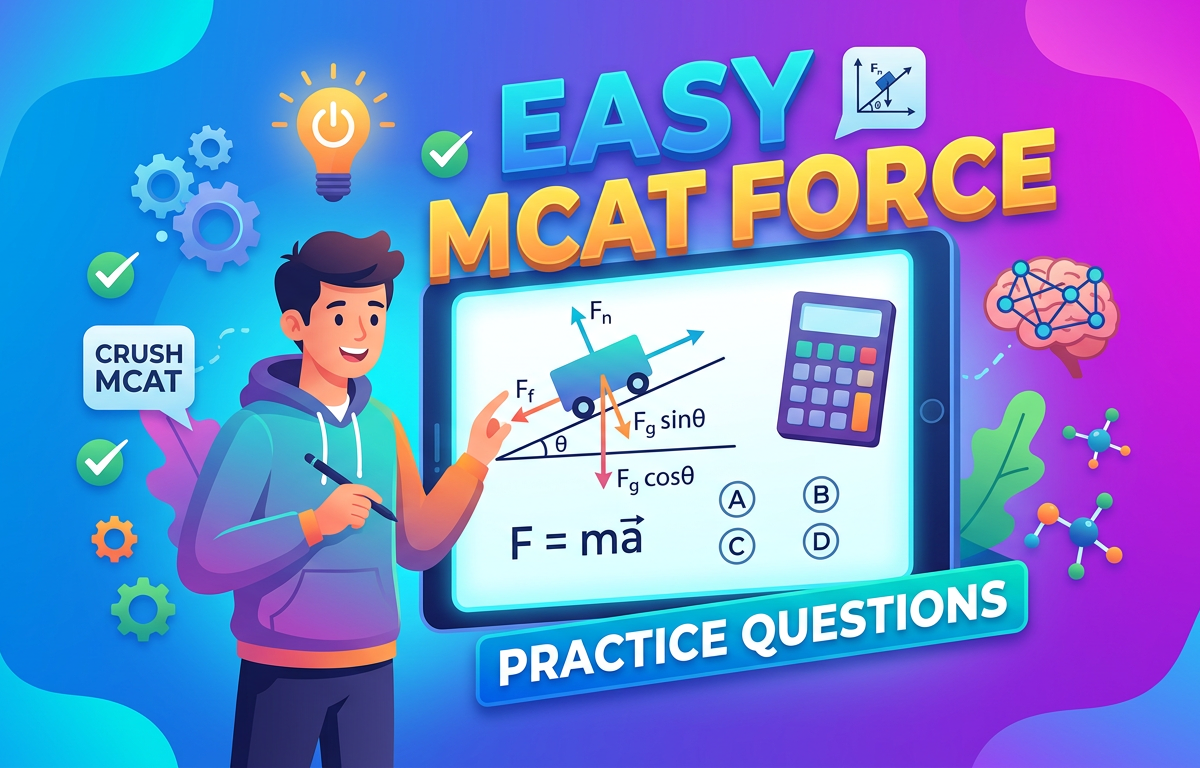
Easy MCAT Force Practice Questions
Mastering the fundamentals of Newton’s Laws and translational dynamics is a critical step for any pre-medical student aiming for a high score on the Chemical and Physical Foundations of Biological Systems section. This guide provides Easy MCAT Force Practice Questions designed to solidify your understanding of how objects interact and move. Understanding these concepts is just as essential as mastering easy MCAT kinetics practice questions when building a strong physics foundation.
Concept Explanation
Force is a vector quantity that represents an interaction which, when unopposed, will change the motion of an object. In the context of the MCAT, forces are primarily governed by Newton's Three Laws of Motion. The most frequently applied principle is Newton’s Second Law, which states that the net force acting on an object is equal to the product of its mass and its acceleration, expressed by the formula .
To succeed with Easy MCAT Force Practice Questions, you must distinguish between various types of forces:
- Weight (Gravitational Force): The force exerted by gravity on an object, calculated as , where for the MCAT.
- Normal Force (): The perpendicular contact force exerted by a surface on an object.
- Friction (): A force that opposes sliding motion, divided into static friction (preventing motion) and kinetic friction (opposing active motion).
- Tension (): The pulling force transmitted through a string, rope, or cable.
When solving force problems, always begin by drawing a Free Body Diagram (FBD). This allows you to visualize all vector components and set up your coordinate system. Much like how you would approach easy MCAT gas laws practice questions by identifying variables, force problems require identifying all acting vectors before applying .
Solved Examples
Example 1: Calculating Net Force
A 5 kg block is pushed across a frictionless floor with a horizontal force of 20 N. What is the acceleration of the block?
- Identify the known values: , .
- Apply Newton's Second Law:
- Substitute the values:
- The block accelerates at .
Example 2: Weight on Earth vs. Moon
An astronaut has a mass of 70 kg. If the acceleration due to gravity on the Moon is , what is the astronaut's weight on the Moon?
- Recall the weight formula: .
- Identify the local gravity: .
- Calculate:
- Note: The mass remains 70 kg, but the weight changes.
Example 3: Normal Force on a Flat Surface
A 10 kg crate rests on a horizontal table. A person pushes down on the crate with an additional vertical force of 30 N. What is the normal force exerted by the table?
- Identify all vertical forces. Downward forces: Weight () and the applied push (). Upward force: Normal force ().
- Since the crate is at rest, , so .
- Set up the equation:
- Solve for :
Practice Questions
1. A 2 kg object is subjected to two forces: 10 N acting to the right and 4 N acting to the left. What is the magnitude of the acceleration of the object?
2. Which of the following describes an object in translational equilibrium?
3. A book weighing 15 N sits at rest on a table. What is the magnitude of the normal force acting on the book?
Track your MCAT progress intelligently.
Use Bevinzey’s analytics and AI-powered feedback to identify weaknesses and improve faster.
See My Progress4. A 50 kg crate is being pulled by a rope with a tension of 100 N at a constant velocity. What is the magnitude of the kinetic friction force acting on the crate?
5. If the net force acting on an object is doubled while the mass is kept constant, what happens to the acceleration?
6. An object of mass is falling through the air at terminal velocity. What is the magnitude of the air resistance force acting on the object?
7. A 12 kg medicine ball is thrown with an acceleration of . What is the force required to achieve this acceleration?
8. According to Newton's Third Law, if a hammer hits a nail with a force of 50 N, what is the force the nail exerts on the hammer?
9. A box is placed on a frictionless incline. Which component of gravity is responsible for pulling the box down the slope?
10. An elevator is moving upward at a constant speed. How does the tension in the cable compare to the weight of the elevator?
Answers & Explanations
1. Answer: . The net force is the sum of the vectors: to the right. Using , we get .
2. Answer: An object with a net force of zero. Translational equilibrium occurs when the sum of all forces acting on an object is zero, meaning the object is either at rest or moving at a constant velocity.
3. Answer: 15 N. For an object at rest on a horizontal surface with no other vertical forces, the normal force must exactly balance the weight to result in a net vertical force of zero.
4. Answer: 100 N. Constant velocity implies zero acceleration (). According to Newton's Second Law, the net force must be zero. Therefore, the force of friction must equal the tension force in magnitude: .
5. Answer: The acceleration doubles. Since , acceleration is directly proportional to force. If force is multiplied by 2, acceleration is also multiplied by 2.
6. Answer: . Terminal velocity is achieved when the force of air resistance (upward) equals the force of gravity (downward), resulting in zero net force and zero acceleration.
7. Answer: 60 N. Applying : .
8. Answer: 50 N. Newton's Third Law states that for every action, there is an equal and opposite reaction. The nail exerts exactly 50 N back on the hammer.
9. Answer: . Gravity acts straight down, but on an incline, the component parallel to the surface is , while the component perpendicular to the surface is .
10. Answer: The tension is equal to the weight. At constant speed, acceleration is zero. Thus, the upward force (tension) must perfectly balance the downward force (weight).
1. A 10 kg object is accelerating at \( 2 \, \text{m/s}^2 \). What is the net force?
Frequently Asked Questions
What is the difference between mass and weight?
Mass is an intrinsic property representing the amount of matter in an object and is measured in kilograms. Weight is the force of gravity acting on that mass and varies depending on the local gravitational field strength.
Does a normal force always equal the weight of an object?
No, the normal force only equals the weight when an object is on a horizontal surface and no other vertical forces are present. If the surface is inclined or if there are additional vertical pushes or pulls, the normal force will change.
What happens to friction when an object starts moving?
Generally, the coefficient of kinetic friction is lower than the coefficient of static friction. This means that once an object overcomes static friction and begins to slide, the force required to keep it moving is typically less than the force required to start the motion.
How do you calculate net force with multiple vectors?
Net force is calculated by performing vector addition of all individual forces acting on an object. This involves breaking forces into their x and y components using trigonometry and summing them independently.
Why is Newton's Third Law important for the MCAT?
Newton's Third Law is vital because it reminds students that forces always exist in pairs. It helps in identifying internal forces within a system and understanding contact forces between two interacting bodies.
Is acceleration possible if the net force is zero?
No, according to Newton's Second Law (), if the net force is zero, the acceleration must also be zero. The object will either remain at rest or continue moving at a constant velocity in a straight line.
Track your MCAT progress intelligently.
Use Bevinzey’s analytics and AI-powered feedback to identify weaknesses and improve faster.
See My ProgressEnjoyed this article?
Share it with others who might find it helpful.
Related Articles

Hard MCAT Force Practice Questions
Hard MCAT Force Practice Questions
May 17, 2026

Solving MCAT Force Problems: From Inclined Planes to Blood Flow
MCAT Force Practice Questions with Answers
May 17, 2026

Hard MCAT Philosophy Passage Practice Questions
Master Hard MCAT Philosophy Passage Practice Questions with our comprehensive guide featuring solved examples, practice questions, and expert explanations.
May 17, 2026

Hard MCAT Humanities Passage Practice Questions
Master Hard MCAT Humanities Passage Practice Questions with our comprehensive guide featuring solved examples, practice questions, and expert strategies.
May 17, 2026

Hard MCAT Critical Analysis Practice Questions
Hard MCAT Critical Analysis Practice Questions
May 17, 2026

Hard MCAT Reading Comprehension Practice Questions
Hard MCAT Reading Comprehension Practice Questions
May 17, 2026

Hard MCAT CARS Passage Practice Questions
Master high-difficulty MCAT CARS passages with our expert guide featuring solved examples, practice questions, and detailed logical analysis.
May 17, 2026

Hard MCAT CARS Practice Questions
Master Hard MCAT CARS Practice Questions with our comprehensive guide featuring solved examples, practice passages, and expert reasoning strategies.
May 17, 2026