Easy Isomer Identification Practice Questions
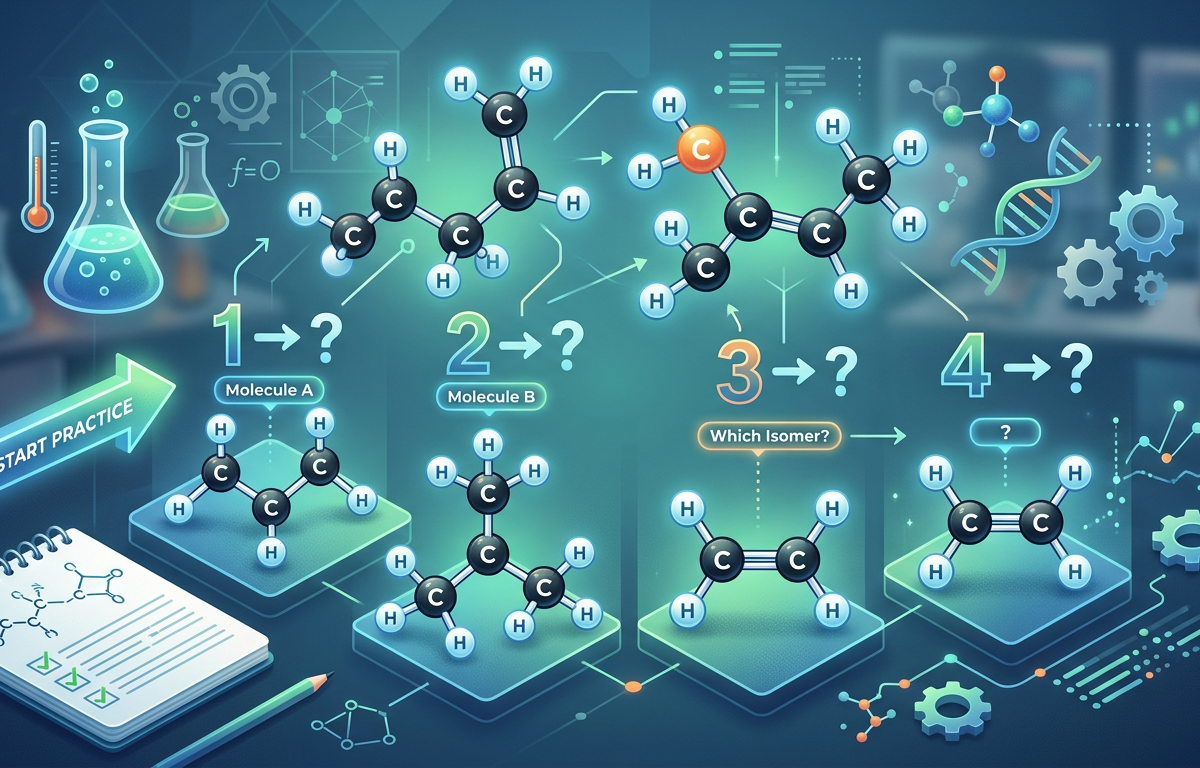
Mastering Easy Isomer Identification Practice Questions is a fundamental step for any student beginning their journey into organic chemistry, as it builds the foundation for understanding how molecular structure dictates physical and chemical properties. Isomers are unique compounds that share the same molecular formula but possess different arrangements of atoms in space. By learning to distinguish between structural isomers and stereoisomers, you can better predict how molecules will react in biological systems or industrial processes.
Concept Explanation
Isomer identification is the process of determining the relationship between two or more molecules that share the same molecular formula but differ in their atomic connectivity or spatial orientation. To successfully identify isomers, you must first verify that the molecular formulas are identical by counting the number of each type of atom (carbon, hydrogen, oxygen, etc.). If the formulas differ, the molecules are simply different compounds, not isomers. Once a match is confirmed, isomers are generally classified into two main categories: constitutional (structural) isomers and stereoisomers.
Constitutional isomers differ in the order in which their atoms are bonded. For example, butane and isobutane both have the formula C4H10, but while butane is a straight chain, isobutane features a branched structure. Stereoisomers, on the other hand, have the same bond connectivity but differ in the 3D orientation of those atoms. This category includes enantiomers (mirror images) and diastereomers (non-mirror image stereoisomers, such as cis/trans isomers in alkenes). Understanding these differences is vital for topics like Naming Organic Compounds (IUPAC), where specific prefixes are used to denote these arrangements. You can find detailed structural hierarchies on resources like Wikipedia's Isomer Page or the Khan Academy Isomer Introduction.
Solved Examples
Review these step-by-step solutions to understand the logic behind identifying different types of isomers.
Example 1: Ethanol vs. Dimethyl Ether
Determine the relationship between CH3CH2OH and CH3OCH3.Count the atoms: Both molecules contain 2 Carbons, 6 Hydrogens, and 1 Oxygen (C2H6O).
Check connectivity: Ethanol has a C-C-O bond sequence, while Dimethyl Ether has a C-O-C sequence.
Conclusion: Since the connectivity is different but the formula is the same, they are constitutional isomers.
Example 2: Pentane vs. 2-Methylbutane
Identify the relationship between a five-carbon straight chain and a four-carbon chain with a methyl branch on the second carbon.Count the atoms: Both have the formula C5H12.
Check connectivity: Pentane is unbranched; 2-methylbutane is branched.
Conclusion: They are constitutional isomers (specifically skeletal isomers).
Example 3: Cis-2-butene vs. Trans-2-butene
Analyze two molecules of CH3CH=CHCH3 where one has methyl groups on the same side and the other has them on opposite sides.Count the atoms: Both are C4H8.
Check connectivity: Both have the same bond sequence (C-C=C-C).
Check spatial arrangement: The groups are oriented differently around the rigid double bond.
Conclusion: These are stereoisomers (specifically diastereomers/geometric isomers).
Practice Questions
Test your skills with these Easy Isomer Identification Practice Questions. Use the molecular formulas and connectivity patterns to find the answers.
Are 1-propanol and 2-propanol isomers? If so, what type?
Compare CH3CH2CH2CH3 and (CH3)3CH. Are these isomers?
True or False: Molecules with the formulas C3H8 and C3H6 are isomers.
Want unlimited practice questions like these?
Generate AI-powered questions with step-by-step solutions on any topic.
Try Question Generator Free →Identify the relationship between Cyclohexane (C6H12) and 1-Hexene (C6H12).
Does CH3CH2OH have a functional group isomer? If so, name it.
Are (R)-2-chlorobutane and (S)-2-chlorobutane constitutional isomers or stereoisomers?
Which of the following is a structural isomer of Butane: Cyclobutane, 2-Methylpropane, or 1-Butene?
What is the minimum number of carbon atoms required to have skeletal isomers in alkanes?
Identify the relationship between Propanal and Propanone.
If two molecules have the same connectivity but different spatial arrangements that are non-superimposable mirror images, what are they called?
Answers & Explanations
Check your work against the detailed explanations below to refine your understanding of isomer identification.
1-propanol and 2-propanol: Yes, they are constitutional isomers (specifically positional isomers). Both have the formula C3H8O, but the hydroxyl (-OH) group is on carbon 1 in the first and carbon 2 in the second.
CH3CH2CH2CH3 and (CH3)3CH: Yes, these are constitutional isomers. Both are C4H10. The first is n-butane (straight chain) and the second is isobutane (branched).
False: Isomers must have the exact same molecular formula. C3H8 has two more hydrogens than C3H6, so they cannot be isomers.
Cyclohexane and 1-Hexene: These are constitutional isomers. Despite one being a ring and the other an alkene, they both share the formula C6H12. This is an example of functional group/ring-chain isomerism.
Yes, Dimethyl Ether: Ethanol (CH3CH2OH) and Dimethyl Ether (CH3OCH3) both have the formula C2H6O but contain different functional groups (alcohol vs. ether).
Stereoisomers: Specifically, they are enantiomers. They have the same connectivity but differ in the 3D arrangement of atoms around the chiral center.
2-Methylpropane: Butane is C4H10. 2-Methylpropane is also C4H10. Cyclobutane and 1-Butene are C4H8, so they are not isomers of butane.
Four: Methane (1), Ethane (2), and Propane (3) only have one possible arrangement. Butane (4) is the first alkane that can exist as either a straight chain or a branched chain.
Constitutional Isomers: Both have the formula C3H6O. Propanal is an aldehyde, while Propanone (acetone) is a ketone. Identifying these is easier if you are familiar with Functional Group Identification.
Enantiomers: This is the specific definition for stereoisomers that are mirror images of each other but cannot be perfectly overlapped.
1. Which condition must be met for two molecules to be considered isomers?
Frequently Asked Questions
What is the easiest way to identify an isomer?
The easiest way is to first count all atoms to ensure the molecular formulas are identical, then check if the atoms are connected in the same order. If the formula is the same but the connections differ, you have found a constitutional isomer.
Can two isomers have different functional groups?
Yes, these are known as functional isomers, a type of constitutional isomerism where the same atoms are arranged into different functional groups, such as an alcohol and an ether. Identifying these often requires knowledge from functional group practice.
What is the difference between a structural isomer and a stereoisomer?
Structural isomers have different bonding sequences (connectivity), whereas stereoisomers have the same bonding sequence but differ in how their atoms are oriented in three-dimensional space. Structural isomers are generally easier to identify on a 2D plane than stereoisomers.
Do isomers have the same chemical properties?
No, isomers usually have different chemical and physical properties, such as boiling points, melting points, and reactivity levels. Even stereoisomers like enantiomers can behave differently when interacting with other chiral molecules, which is critical in pharmacology.
How do I know if a molecule has no isomers?
Small molecules like methane (CH4), ethane (C2H6), and propane (C3H8) have no constitutional isomers because there is only one mathematically possible way to connect those atoms while following valency rules. As the number of carbon atoms increases, the number of possible isomers grows exponentially.
Want unlimited practice questions like these?
Generate AI-powered questions with step-by-step solutions on any topic.
Try Question Generator Free →
Want unlimited practice questions like these?
Generate AI-powered questions with step-by-step solutions on any topic.
Try Question Generator Free →Enjoyed this article?
Share it with others who might find it helpful.
Related Articles
Hard Le Chatelier’s Principle Practice Questions
Master Hard Le Chatelier’s Principle Practice Questions with our comprehensive guide featuring solved examples, practice problems, and detailed explanations.
Mar 30, 2026
Hard Reaction Quotient (Q) Practice Questions
Hard Reaction Quotient (Q) Practice Questions
Mar 30, 2026
Grams to Moles Practice Questions with Answers
Master grams to moles conversions with our comprehensive guide. Includes step-by-step examples, practice questions, and detailed answers for chemistry students.
Mar 26, 2026
Avogadro’s Number Practice Questions with Answers
Master the mole concept with our Avogadro’s Number practice questions. Includes step-by-step solved examples, a quick quiz, and detailed explanations.
Mar 26, 2026
Empirical Formulas: Solving Ratios from Mass and Percent Data
Master empirical formula calculations with 10 practice questions, worked answers, and a free step-by-step calculator for mass, percentage, and combustion problems.
Mar 26, 2026