Easy IR Spectroscopy Practice Questions
Concept Explanation
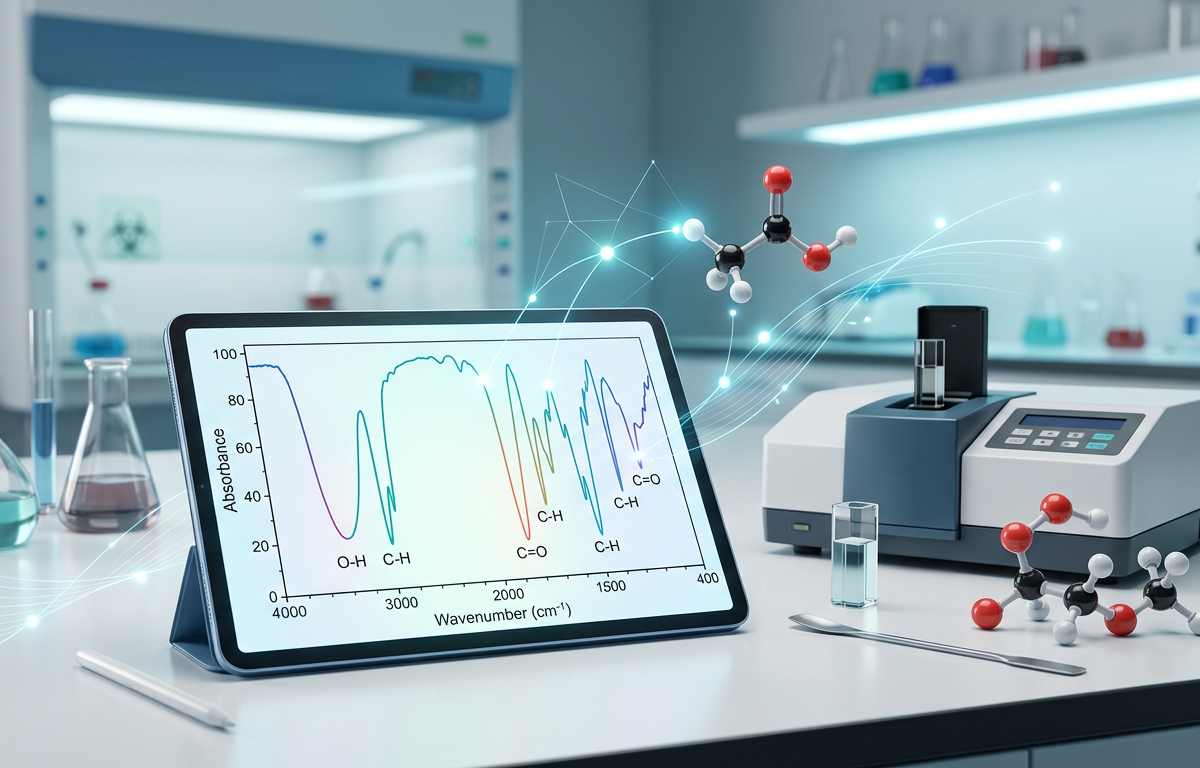
Infrared (IR) spectroscopy is an analytical technique used to identify functional groups within a molecule by measuring the absorption of infrared radiation, which causes chemical bonds to vibrate at specific frequencies. When a molecule absorbs IR light, the energy promotes transitions between vibrational energy levels. For a bond to be "IR active," the vibration must result in a change in the molecule's dipole moment. This makes IR spectroscopy an essential tool in organic chemistry for distinguishing between compounds like alcohols, ketones, and carboxylic acids. By examining the functional group identification patterns in a spectrum, chemists can determine the structural framework of an unknown substance. The spectrum is typically plotted as transmittance versus wavenumber (cm⁻¹), where the region from 4000 to 1500 cm⁻¹ is used for diagnostic purposes and the region below 1500 cm⁻¹ is known as the fingerprint region, unique to every molecule.
Different types of bonds vibrate at different frequencies based on bond strength and the mass of the atoms involved. According to Hooke's Law, stronger bonds and lighter atoms vibrate at higher frequencies (higher wavenumbers). For instance, an O-H bond vibrates at a higher frequency than a C-H bond because oxygen is more electronegative and the bond is generally stronger. IR spectroscopy is often used alongside other techniques like mass spectrometry to provide a complete picture of a molecule's identity. You can find more detailed discussions on molecular physics at LibreTexts Chemistry or the Royal Society of Chemistry.
Solved Examples
The following examples demonstrate how to interpret basic IR spectra by identifying key peaks associated with common functional groups.
Example 1: Identifying an Alcohol
A spectrum shows a very broad, strong peak centered around 3350 cm⁻¹ and no peak near 1700 cm⁻¹. What is the likely functional group?Identify the region: 3200–3600 cm⁻¹ is the characteristic region for O-H stretching.
Observe the shape: A broad, "tongue-shaped" peak indicates hydrogen bonding, typical of alcohols.
Check for carbonyls: The absence of a peak at 1700 cm⁻¹ rules out ketones or acids.
Conclusion: The molecule contains an alcohol (-OH) group.
Example 2: Distinguishing a Ketone from an Alkane
An unknown liquid produces a sharp, intense peak at 1715 cm⁻¹ and several peaks just below 3000 cm⁻¹. Interpret these findings.Identify the 1715 cm⁻¹ peak: This is the classic signature of a Carbonyl (C=O) group.
Identify the peaks below 3000 cm⁻¹: These correspond to C-H stretches from sp³ hybridized carbons (alkane backbone).
Synthesize: The molecule is likely a ketone or an aldehyde.
Final Answer: The substance contains a carbonyl group.
Example 3: Recognizing a Carboxylic Acid
A spectrum displays a very broad, messy absorption from 2500 to 3300 cm⁻¹ that overlaps with the C-H stretches, plus a sharp peak at 1710 cm⁻¹. What does this suggest?Evaluate the 2500-3300 cm⁻¹ region: This extremely broad "hairy beard" peak is specific to the O-H stretch of a carboxylic acid.
Evaluate the 1710 cm⁻¹ peak: This confirms the presence of a C=O group.
Combine findings: A C=O and an O-H on the same carbon define a carboxylic acid.
Final Answer: Carboxylic acid.
Practice Questions
Test your knowledge with these easy IR spectroscopy practice questions. Focus on identifying the primary functional groups based on their characteristic wavenumbers.
A compound shows a sharp peak at 3300 cm⁻¹ and a peak at 2150 cm⁻¹. Which functional group is present?
Where would you expect to find the C=O stretch for a typical saturated ketone?
Which bond vibration generally appears at the highest wavenumber: C-H, C=C, or C-O?
Want unlimited practice questions like these?
Generate AI-powered questions with step-by-step solutions on any topic.
Try Question Generator Free →An IR spectrum shows a strong, sharp peak at 1650 cm⁻¹ and two peaks at 3400 cm⁻¹ and 3500 cm⁻¹. What group is likely present?
True or False: A C-C single bond stretch is typically found in the diagnostic region (above 1500 cm⁻¹).
Which functional group is characterized by a "doublet" (two peaks) near 2720 and 2820 cm⁻¹?
If a molecule has the formula C₆H₁₂ and shows no peaks above 3000 cm⁻¹ (except for C-H) and no peaks in the 1600-1800 cm⁻¹ range, is it likely an alkene?
A peak at 2250 cm⁻¹ is indicative of which functional group?
Why do O-H stretches in alcohols appear as broad signals rather than sharp peaks?
Compare the C-H stretch of an alkene (sp²) vs. an alkane (sp³). Which occurs at a higher wavenumber?
Answers & Explanations
Terminal Alkyne: The peak at 3300 cm⁻¹ is the C-H stretch of a terminal alkyne (sp hybridized carbon), and 2150 cm⁻¹ is the C≡C triple bond stretch.
1710–1720 cm⁻¹: This is the standard range for a non-conjugated ketone carbonyl.
C-H: Because hydrogen has a much smaller mass than oxygen or carbon, the reduced mass in the vibration equation is smaller, leading to a higher frequency/wavenumber (usually 2850–3300 cm⁻¹).
Primary Amine: The two peaks at 3400-3500 cm⁻¹ represent the symmetric and asymmetric N-H stretches of a primary amine (-NH₂). The 1650 cm⁻¹ peak is the N-H bend.
False: C-C single bonds are found in the fingerprint region (below 1500 cm⁻¹).
Aldehyde: These are the Fermi resonance peaks of the aldehydic C-H bond.
No: If it were an alkene, we would expect a C=C stretch around 1640 cm⁻¹ and a vinylic C-H stretch above 3000 cm⁻¹. Since these are missing, it is likely a cycloalkane (like cyclohexane).
Nitrile (C≡N): Triple bonds involving nitrogen typically appear in the 2200–2260 cm⁻¹ range.
Hydrogen Bonding: Intermolecular hydrogen bonding weakens the O-H bond to varying degrees in a sample, resulting in a distribution of vibrational frequencies that manifests as a broad peak.
Alkene C-H (sp²): Bonds with more s-character are shorter and stronger. An sp² C-H bond stretches above 3000 cm⁻¹, while an sp³ C-H bond stretches below 3000 cm⁻¹.
1. Which region of the IR spectrum is most useful for identifying specific functional groups?
Frequently Asked Questions
What is the fingerprint region in IR spectroscopy?
The fingerprint region is the area of the IR spectrum below 1500 cm⁻¹ that contains complex absorption patterns unique to a specific molecule. While hard to interpret for specific groups, it allows for the definitive identification of a compound by comparing it to a known reference standard.
Why are some vibrations IR inactive?
A vibration is IR inactive if it does not result in a change in the net dipole moment of the molecule. For example, the stretching of a symmetrical diatomic molecule like O₂ or N₂ produces no change in dipole, so no IR light is absorbed.
How do bond strength and atom mass affect wavenumber?
Wavenumber is directly proportional to bond strength and inversely proportional to the mass of the atoms. Stronger bonds (like C≡C) and lighter atoms (like Hydrogen) vibrate at higher wavenumbers, as described by the principles of spectroscopic analysis.
What is the difference between an alcohol and a carboxylic acid O-H peak?
An alcohol O-H peak is typically broad and smooth, centered around 3300 cm⁻¹. A carboxylic acid O-H peak is much broader, often spanning from 2500 to 3300 cm⁻¹, and has a jagged appearance because it overlaps with C-H stretching peaks.
Can IR spectroscopy determine the exact molecular weight of a compound?
No, IR spectroscopy only identifies functional groups and bond types. To determine molecular weight, you must use mass spectrometry, which measures the mass-to-charge ratio of ions.
Want unlimited practice questions like these?
Generate AI-powered questions with step-by-step solutions on any topic.
Try Question Generator Free →
Want unlimited practice questions like these?
Generate AI-powered questions with step-by-step solutions on any topic.
Try Question Generator Free →Enjoyed this article?
Share it with others who might find it helpful.
Related Articles
Hard Le Chatelier’s Principle Practice Questions
Master Hard Le Chatelier’s Principle Practice Questions with our comprehensive guide featuring solved examples, practice problems, and detailed explanations.
Mar 30, 2026

Hard Reaction Quotient (Q) Practice Questions
Hard Reaction Quotient (Q) Practice Questions
Mar 30, 2026
Grams to Moles Practice Questions with Answers
Master grams to moles conversions with our comprehensive guide. Includes step-by-step examples, practice questions, and detailed answers for chemistry students.
Mar 26, 2026
Avogadro’s Number Practice Questions with Answers
Master the mole concept with our Avogadro’s Number practice questions. Includes step-by-step solved examples, a quick quiz, and detailed explanations.
Mar 26, 2026

Empirical Formulas: Solving Ratios from Mass and Percent Data
Master empirical formula calculations with 10 practice questions, worked answers, and a free step-by-step calculator for mass, percentage, and combustion problems.
Mar 26, 2026